
Key Takeaways
-
Scalable content solutions enable agencies to double article output without doubling team size by automating keyword research, planning, writing, optimization, and publishing—eliminating the need for proportional headcount growth.
-
A truly scalable system requires five core components: automated keyword research, content calendar automation, AI-assisted long-form generation, SEO optimization with quality control, and direct CMS publishing to eliminate manual bottlenecks.
-
Automated systems reduce per-article costs from $100-$500 to ~$3 while increasing monthly output from 10-30 articles to 300+, making smaller agencies competitive against traditional $3,000-$5,000/month SEO agencies.
-
Look for agency-specific platform features including multi-client workspaces, role-based access controls, approval workflows, real-time SEO scoring, and CMS integrations with WordPress, Shopify, and Webflow to avoid creating new manual bottlenecks.
-
Daily consistent publishing of optimized content builds topical authority and rankings over time, creating compounding SEO growth that sporadic manual content production cannot match, especially important for AI search engines.
-
Common scaling mistakes to avoid include skipping quality reviews, using identical strategies for different clients, ignoring performance data, publishing without optimization checks, and choosing tools that don’t integrate with client CMS platforms.
If you run an agency, you know the feeling. A new client signs on, and suddenly your content team is scrambling. More clients mean more articles, more keyword research, more publishing schedules to manage. It feels like the only way to grow is to hire more people. But what if that wasn’t true?
A scalable content solution for agencies changes everything. Instead of adding headcount every time your client roster grows, you build a system that handles the heavy lifting automatically. You produce more content, serve more clients, and keep quality high — all without burning out your team.
In this guide, you’ll learn exactly how to build that system. We’ll cover what true scalability looks like in SEO content automation, which features matter most, and how to put it all together in a workflow that runs like clockwork. Let’s dig in.

What Does a Scalable Content Solution Actually Mean for Agencies?
Scalability in SEO content means something specific. It means your content output can grow without your costs and effort growing at the same rate. If doubling your article output requires doubling your team size, that’s not scalable. True scalability lets you produce twice the content with the same team — or even a smaller one.
For agencies managing multiple clients, this matters enormously. Each client needs its own keyword strategy, content calendar, and publishing schedule. Managing all of that manually is exhausting and error-prone. A scalable system automates those repetitive steps so your team focuses on strategy and client relationships instead.
According to Sight AI’s guide on scalable content marketing automation, true scalability means maintaining quality while increasing volume — specifically avoiding the need to double team size when output doubles. That’s the gold standard agencies should aim for.
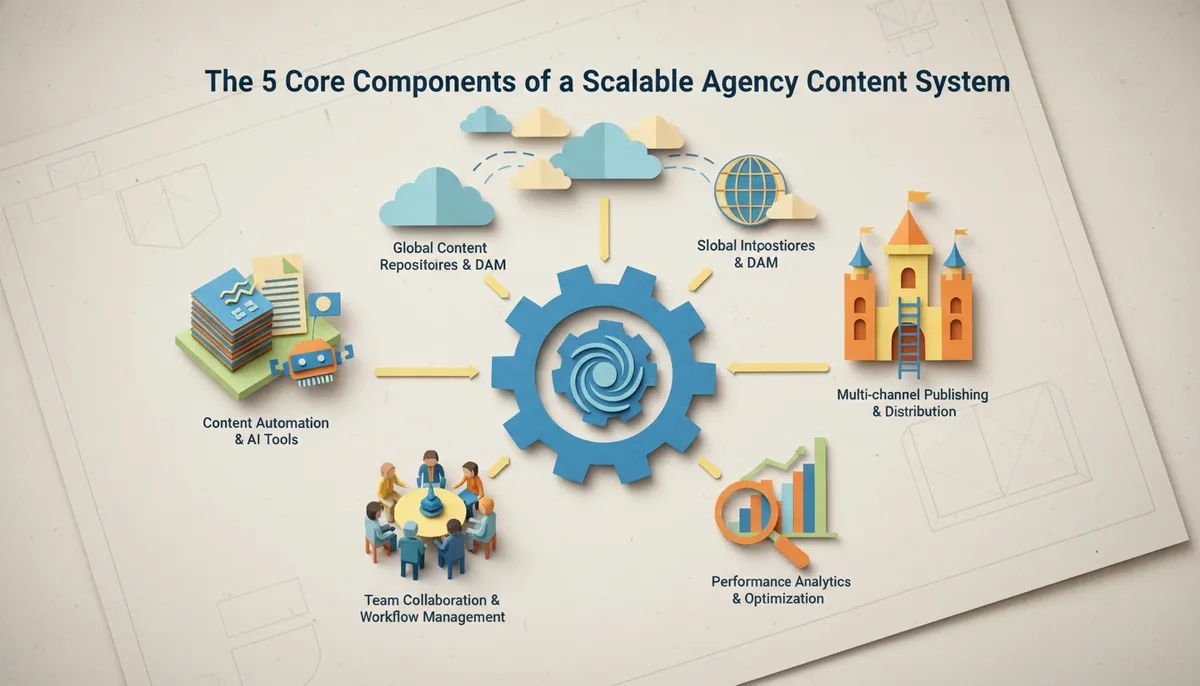
The 5 Core Components of a Scalable Agency Content System
Not all content tools are built for scale. A genuinely scalable system connects several key components into one smooth workflow. Here’s what you need:
1. Automated Keyword Research
Manual keyword research is a time drain. For agencies managing five, ten, or twenty clients, doing it by hand for each account is simply not viable. A scalable solution includes built-in keyword research that surfaces real opportunities automatically — showing search volume, competition level, and search intent all in one place.
This lets your team skip the spreadsheet juggling and move straight to strategy. You can read more about this in our guide on what a keyword discovery tool is and why you need one.
2. Automated Content Planning and Calendars
Once you have keywords, you need a plan. A scalable content solution replaces manual editorial spreadsheets with an automated content calendar. Keywords get scheduled, articles get assigned to publication dates, and the system keeps everything organized without your team lifting a finger.
This is especially powerful for agencies because each client workspace can have its own calendar running simultaneously. Check out our post on AI content calendar benefits that save time in 2026 for more on this.
3. AI-Assisted Long-Form Content Generation
Writing first drafts takes the most time. AI-powered content generation can handle dozens or even hundreds of articles without compromising quality. The key is that AI handles the drafting so your team spends time editing and refining — not staring at a blank page.
The best systems generate long-form content (3,000+ words) that covers topics in depth, which is exactly what Google and modern AI search engines reward. For a deeper look, see our overview of writing AI for SEO and how to automate content that ranks.
4. SEO Optimization and Quality Control
Generating content is only half the battle. Every article needs proper optimization — metadata, internal links, keyword density, readability scores, and more. A scalable system handles this automatically and flags issues before publishing. Quality control at scale is non-negotiable.
You can explore this further in our article on what content optimization software is and whether you need it.
5. Direct Publishing to CMS Platforms
Copy-pasting articles into WordPress or another CMS manually is a huge bottleneck. A truly scalable solution publishes directly to your client’s website. No copy-pasting. No formatting headaches. The article goes live automatically after passing quality checks.
See how this works in practice in our guide on how to use CMS integration to automate your SEO content.

Key Features to Look for in an Agency Content Platform
Not every SEO content tool is built with agencies in mind. When evaluating a scalable content solution for agencies, look for these must-have features:
- Multi-client workspace management — Each client needs its own separate environment for keywords, content, and calendars
- Role-based collaboration — Different team members need different access levels (editors, strategists, account managers)
- Approval workflows — Content should go through review before publishing, especially for sensitive client niches
- Automated internal and external linking — Links should be added automatically to boost SEO without manual effort
- Real-time SEO scoring — Every article should be scored and optimized before it goes live
- Performance tracking and reporting — Agencies need to show clients results, so reporting dashboards are essential
- Platform integrations — The tool should connect with WordPress, Shopify, Webflow, Wix, and other CMS platforms your clients use
If a tool is missing several of these features, it will create bottlenecks as you grow. You’ll end up patching gaps with other tools, which defeats the purpose of having a scalable system in the first place.
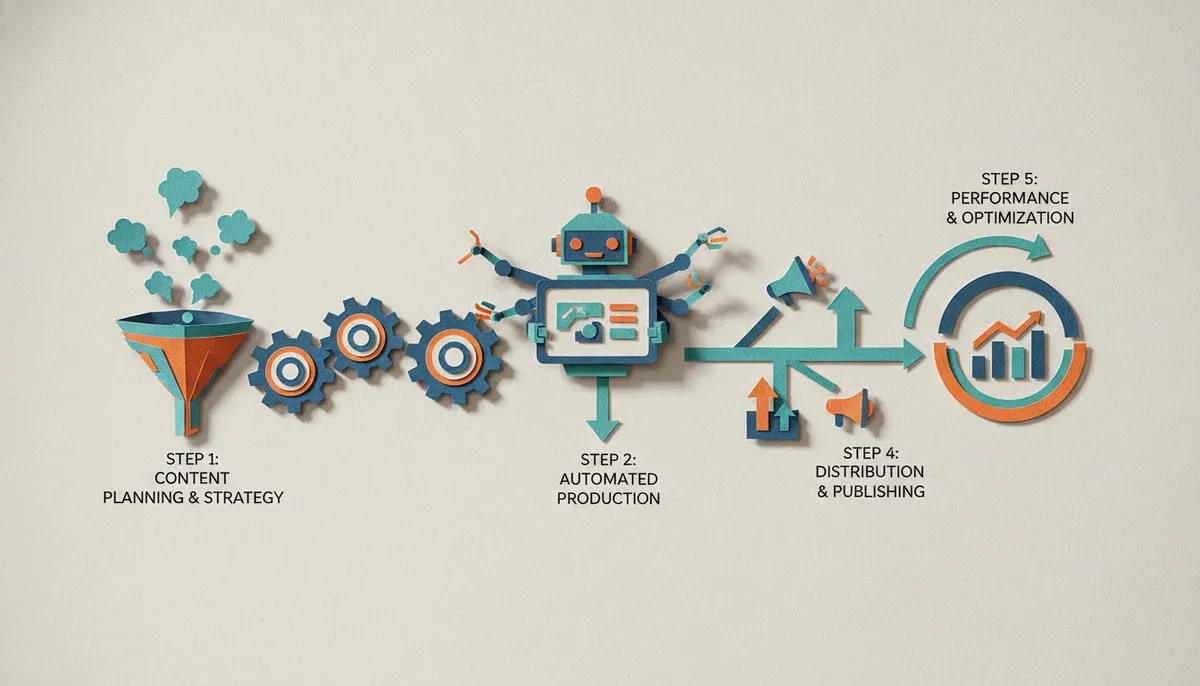
How to Set Up a Scalable Content Workflow in 5 Steps
Ready to build your scalable content system? Here’s a simple step-by-step process to get started:
- Choose the right platform — Select an all-in-one SEO content automation tool designed specifically for agencies, not just solo bloggers or small sites
- Set up client workspaces — Create a separate workspace for each client with their own keyword list, brand voice settings, and CMS connection
- Run automated keyword research — Let the platform discover the best keyword opportunities for each client based on real search data
- Populate the content calendar — Add approved keywords to the calendar and let the system schedule and generate articles automatically
- Review, approve, and publish — Set up your approval workflow so team members review AI-generated drafts before they go live, then let the system publish directly to the CMS
This workflow replaces hours of manual work each week. Once it’s running, your team’s job shifts from doing the work to overseeing the system. That’s a huge win for agency efficiency.
For a broader look at automating your overall SEO strategy, check out our guide on content automation SEO and how to scale organic traffic in 2026.
Agency Content Automation: Manual vs. Automated Comparison
To understand why a scalable content solution matters, it helps to compare the two approaches side by side. Here’s how manual content production stacks up against a fully automated system:
| Factor | Manual Content Production | Automated Content System |
|---|---|---|
| Time per article | 4–8 hours | Minutes (automated) |
| Cost per article | $100–$500+ | ~$3 per article |
| Articles per month (small team) | 10–30 | 30–300+ |
| Consistency | Variable (depends on team) | Daily publishing guaranteed |
| SEO optimization | Manual, time-consuming | Automated and real-time |
| Scalability | Requires more hires | Scales without headcount growth |
| Multi-client management | Complex spreadsheets | Separate client workspaces |
The difference is stark. Manual production simply can’t compete at scale. And when traditional SEO agencies charge $3,000–$5,000 per month for content services, an automated platform at a fraction of the cost is a game-changer for smaller agencies looking to compete.
Want to go deeper on this comparison? Read our full breakdown: manual SEO content vs. full automation — which one wins?
Maintaining Content Quality at Scale
One of the most common concerns agencies have about automation is quality. “Will the content actually be good?” This is a fair question. The answer depends entirely on the system you use.
The best scalable content solutions don’t just generate content — they optimize it. Every article should be scored against real SEO criteria before publishing. The system should flag thin content, missing metadata, poor keyword usage, and weak internal linking automatically.
Here are the key quality control checkpoints a good system should include:
- Real-time SEO scoring with a clear pass/fail threshold
- Automatic suggestions for fixing SEO issues before publishing
- Brand voice settings per client so content matches their tone
- Human review step in the approval workflow for sensitive content
- Unlimited rewrites so you can regenerate any article that misses the mark
Quality doesn’t have to drop when volume increases. With the right system, quality actually improves over time as the platform learns your preferences and your clients’ brand voices.
For more on this topic, see our article on automated content for agency clients vs. manual — which wins?
Agency Pricing Models for Content Automation Tools
Agency-focused SEO content platforms typically use tiered pricing to support growth. Here’s what you can generally expect:
| Plan Type | Best For | Typical Features |
|---|---|---|
| Business / Starter | Individual businesses or small agencies | 1 client site, 30 articles/month, core automation |
| Agency / Growth | Agencies managing multiple clients | Multiple client workspaces, 300 articles/month, team collaboration |
| Lifetime / One-time | Agencies wanting to eliminate recurring costs | Permanent access, all features, no monthly fees |
SEO Rocket, for example, offers a Business plan at $99/month (30 articles, 1 site) and an Agency plan at $799/month (300 articles across 10 client workspaces). There’s also a $1,499 lifetime plan for agencies that want to eliminate recurring subscription costs entirely. You can explore SEO Rocket’s pricing plans to find the right fit for your agency’s needs.
Want to understand what agency blog automation should really cost? Read our breakdown of agency blog automation pricing in 2026.
Why SEO Rocket Is Built for Agency Scale
SEO Rocket is an all-in-one SEO content automation platform designed from the ground up to serve agencies. It handles everything from keyword research to daily publishing — completely automatically. Setup takes under 10 minutes, and once running, it generates and publishes one SEO-optimized, 3,000+ word article per day per client on the Business plan, or up to 10 per day on the Agency plan.
Here’s what makes it stand out as a scalable content solution for agencies:
- Built-in keyword research engine with live SEO data and competitor analysis
- Visual content calendar that auto-fills with keyword opportunities
- AI-generated 3,000+ word articles optimized for Google and AI search engines
- Direct publishing to WordPress, Shopify, Webflow, and Wix
- Agency plan supports 10 client workspaces and 300 articles per month
- Unlimited team members and unlimited AI rewrites
- Auto-generated metadata, images, internal links, and business mentions
- Real-time SEO scoring with automated fix suggestions
- Articles structured for visibility in ChatGPT, Perplexity, Gemini, and other AI engines
The platform replaces the need for separate keyword tools, writing tools, optimization tools, and scheduling tools — all in one system. You can learn more about how SEO Rocket works or check out real writing examples from the platform.
For agencies that want to see how it compares to managing SEO manually or through traditional agencies, our post on which agency-level SEO automation tools actually scale is a great place to start. You can also read about why marketing agencies should use content automation for more context.
Google’s Search Quality Rater Guidelines make clear that helpful, authoritative content wins in search. SEO Rocket is built to produce exactly that — at agency scale.
Common Mistakes Agencies Make When Scaling Content
Even with the right tools, agencies can stumble when scaling content. Here are the most common mistakes to avoid:
- Skipping the quality review step — Automation speeds things up, but human review for brand-sensitive clients is still important
- Using the same keyword strategy for every client — Each client has unique competitors, audiences, and goals; tailor keyword research accordingly
- Ignoring content performance data — Track which articles drive traffic and rankings; use that data to refine your content strategy
- Publishing too fast without an optimization check — Speed matters, but unoptimized content won’t rank; always run SEO scoring before publishing
- Choosing tools that don’t integrate with client CMS platforms — If your tool can’t publish directly to a client’s WordPress or Shopify site, you’ve created a new manual bottleneck
Avoiding these pitfalls will save you time and protect client relationships. For more guidance, check out our post on automated content delivery mistakes agencies must avoid.
Building Long-Term SEO Results for Clients
The real power of a scalable content solution isn’t just speed — it’s compounding growth. When you publish daily, high-quality SEO content consistently, rankings build over time. Each article adds to a client’s topical authority. Each internal link strengthens the site’s overall structure. Each new piece increases the chances of appearing in AI-generated search answers.
This compounding effect is what separates agencies that use automation from those that don’t. Manual content production is sporadic. Automated daily publishing is consistent. And consistency is what Google and AI search engines reward.
To understand how topical authority builds over time, read our guide on 7 ways to build topical authority that Google rewards in 2026. And for a look at how to manage multiple client blogs at scale, our article on how to manage multiple client blogs automatically is a must-read.
You can also read our blog for more strategies on scaling SEO content production for agencies in 2026 and beyond.
Start Building Your Scalable Content System Today
Scaling your agency’s content production doesn’t have to mean scaling your headcount. With the right SEO content automation platform, you can serve more clients, publish more content, and deliver better results — all without burning out your team.
The key is choosing a system that connects every step of the content workflow. From keyword research to publishing to performance tracking, everything should work together automatically. That’s what a true scalable content solution for agencies looks like in 2026.
SEO Rocket is purpose-built for exactly this. It takes under 10 minutes to set up, costs about $3 per article, and handles everything your team currently does manually. If you’re ready to stop trading time for output and start building a system that grows with you, start your free 3-day trial of SEO Rocket today and see what agency-scale content automation can do for your clients.
FAQs
Q: What is a scalable content solution for agencies?
A: A scalable content solution for agencies is a system that lets you produce more SEO content for more clients without needing to hire more people at the same rate. It uses automation to handle keyword research, content creation, optimization, and publishing — so your team can focus on strategy instead of manual tasks.
Q: How does SEO content automation help agencies manage multiple clients?
A: SEO content automation platforms typically include multi-client workspace management, so each client has their own keyword list, content calendar, and publishing schedule running separately. This makes it easy to scale from five clients to twenty without things falling through the cracks.
Q: How do agencies maintain content quality when using AI at scale?
A: The best platforms include real-time SEO scoring, automated fix suggestions, and approval workflows so a human can review content before it publishes. Unlimited rewrite features also mean you can regenerate any article that doesn’t meet your quality standards — quality and volume can absolutely coexist!
Q: What features should an agency content automation platform include?
A: Look for multi-client workspace management, automated keyword research, AI-powered content generation, real-time SEO optimization, direct CMS publishing, and performance reporting. These features together create a truly end-to-end scalable content workflow for agencies.
Q: How much can agencies save by automating SEO content workflows?
A: Traditional SEO agencies and freelancers typically charge $100–$500 per article, with full agency retainers running $3,000–$5,000 per month. Automated platforms like SEO Rocket bring that cost down to roughly $3 per long-form article — a savings that adds up fast when you’re producing content for multiple clients every day!