
Key Takeaways
-
SEO-specific writing AI automates the entire content pipeline—keyword research, long-form article generation, on-page optimization, and publishing—enabling consistent daily publishing that significantly improves search rankings.
-
Consistency beats perfection in SEO; automated writing AI platforms have driven 1.2+ billion impressions and 30 million clicks by enabling high-volume, regular content publishing that manual efforts cannot match.
-
SEO writing AI differs fundamentally from general AI tools by including built-in keyword research, SERP analysis, automated on-page optimization, and direct CMS publishing specifically designed for search engine ranking.
-
Writing AI enables small businesses to eliminate $3,000-$5,000/month agency costs and agencies to scale output across multiple clients without hiring additional writers, with setup taking under 10 minutes.
-
Modern search optimization requires content structured for both traditional Google rankings and AI-powered search engines like ChatGPT and Perplexity, making SEO-specific writing AI essential for multi-engine visibility.
-
Key features to prioritize when selecting writing AI tools include long-form generation (2,000-4,000+ words), built-in keyword research, on-page SEO automation, content grading, and direct CMS integration.
If you’ve ever stared at a blank screen wondering what to write next, you’re not alone. Content creation is one of the biggest bottlenecks for businesses trying to grow organic traffic. The good news? Writing AI has completely changed the game in 2026. Today, AI-powered tools can plan, write, optimize, and publish SEO content — automatically. Whether you run a small business, manage a marketing team, or handle SEO for multiple clients, writing AI can save you hours every week while helping your content rank higher in search results.
In this guide, we’ll walk you through exactly how writing AI works for SEO, what features to look for, and how to use it to build a consistent content engine for your website. Let’s dive in!

What Is Writing AI for SEO Content Automation?
Writing AI for SEO is not just a tool that writes words. It’s a smart system that combines content generation with search engine intelligence. It understands what topics rank, what keywords to target, and how to structure articles that Google loves. Think of it as having a full content team — researcher, writer, editor, and publisher — all in one platform.
Modern writing AI tools handle three core functions that power an effective SEO strategy:
- Content Creation — Generates full-length, keyword-optimized articles based on top-ranking content in your niche.
- Keyword Research and Clustering — Groups keywords by search intent and difficulty so you always write about the right topics.
- Performance Analysis — Tracks rankings, monitors competitor strategies, and suggests improvements over time.
This combination means you’re not just producing content — you’re producing content that has a real shot at ranking. For a deeper look at the basics, check out this SEO content writing beginner’s guide for 2026.
Key Features to Look for in Writing AI Tools
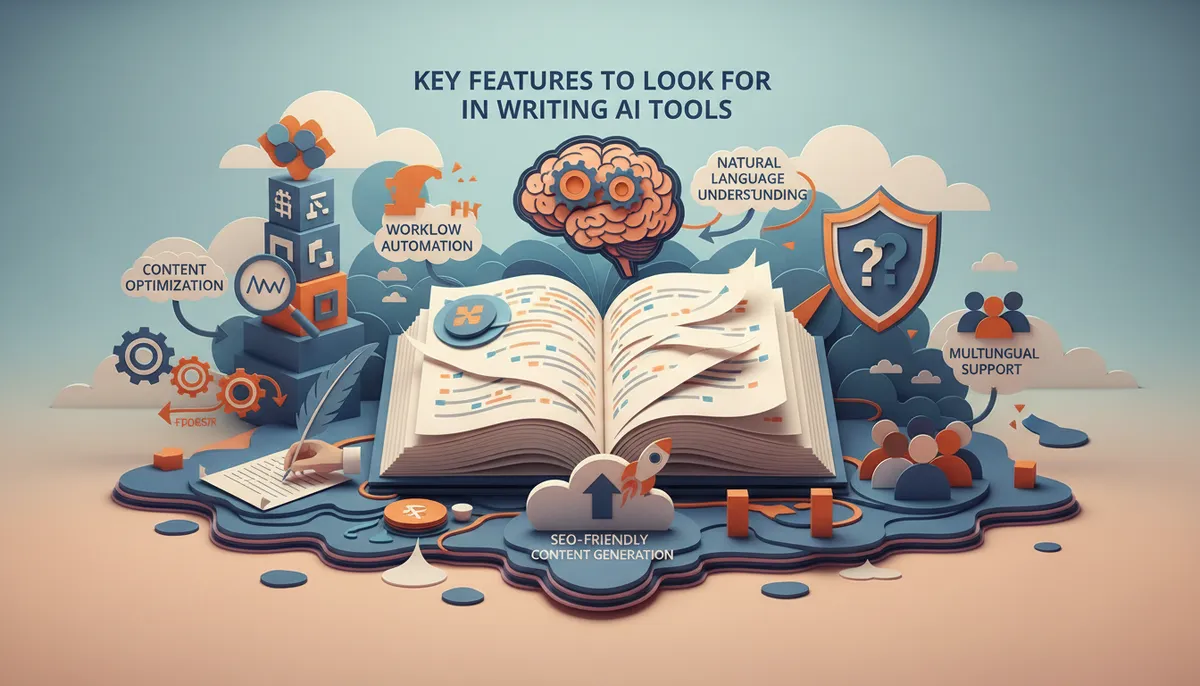
Not all writing AI tools are created equal. When you’re evaluating platforms for SEO content automation, here are the features that actually move the needle:
- Long-form content generation — Articles of 2,000–4,000+ words tend to rank better. Look for tools that go beyond short snippets.
- Built-in keyword research — The best tools don’t just write; they tell you what to write about first.
- On-page SEO automation — Auto-generated titles, meta descriptions, headings, and internal links save massive amounts of time.
- Content grading — Compare your article against top-ranking pages to see where you can improve.
- CMS integration — Direct publishing to WordPress, Webflow, Shopify, or Wix eliminates the copy-paste workflow.
- Brand voice training — Maintains consistent tone across all content so everything sounds like you.
- AI humanizer — Makes generated content sound natural and authentic, not robotic.
Advanced platforms also include FAQ optimization for featured snippets and semantic analysis to improve content relevance across the board. If you’re curious about the top tools available today, this guide on the best AI writing tools for content creation in 2026 is a great resource.

How Writing AI Improves SEO Rankings
Here’s a truth most marketers learn the hard way: consistency beats perfection in SEO. Publishing one great article per month will almost never outperform publishing solid, optimized content every single day. Writing AI makes that daily consistency possible without burning out your team.
Here’s how writing AI directly improves your search rankings:
- Consistent publishing signals freshness — Search engines reward websites that publish regularly. AI tools keep your content calendar full automatically.
- Keyword coverage grows over time — With automated keyword clustering, your site gradually covers more search queries, compounding your traffic.
- On-page optimization is baked in — AI handles title tags, meta descriptions, and headings in every article — no manual checklist needed.
- Internal linking improves authority — Writing AI can automatically link between related articles, spreading link equity across your site.
- Content matches search intent — By analyzing SERP data, writing AI produces content that mirrors what searchers actually want to find.
The results can be significant. Autonomous writing AI platforms have driven over 1.2 billion impressions and 30 million clicks across just 11 SaaS projects and 20 directories. That kind of reach is only possible through consistent, high-volume automated publishing. You can also learn how to improve your AI search visibility in 2026 to take things even further.

General Writing AI vs SEO-Specific Writing AI
There’s an important distinction worth understanding. General AI writing tools are great for brainstorming emails, social posts, or one-off copy. But they weren’t designed with search engines in mind. SEO-specific writing AI is a different beast entirely.
| Feature | General Writing AI | SEO Writing AI |
|---|---|---|
| Keyword Research | Not included | Built-in with live data |
| Content Length | Short-form (500–1,000 words) | Long-form (2,000–4,000+ words) |
| On-Page SEO | Manual | Automated (titles, metas, headings) |
| SERP Analysis | None | Analyzes top-ranking pages |
| CMS Publishing | Copy-paste required | Direct auto-publishing |
| Content Calendar | Not included | Built-in and automated |
| AI Search Optimization | Not designed for it | Optimized for Google + AI engines |
As you can see, SEO-specific writing AI is purpose-built for the job. It’s not just faster — it’s fundamentally smarter about what gets articles to rank. For more on how AI blog writing works in practice, explore this complete guide to blog writing with AI for 2026.
Writing AI for Different Business Types
One of the best things about modern writing AI is how well it scales across different use cases. Here’s how different teams and businesses benefit:
Small Businesses
For small business owners with lean teams, writing AI removes the need to hire an SEO agency or freelance writers. You get consistent content without the $3,000–$5,000/month agency price tag. Setup can take less than 10 minutes, and the platform handles everything from there.
Marketing Teams
In-house marketing teams can redirect time from content production toward strategy and promotion. Instead of spending days writing and editing, they review a fully automated content pipeline. That’s a major productivity win for teams with tight deadlines and limited headcount.
SEO Agencies
Small SEO agencies can scale their output dramatically without hiring more writers. Serving 10 clients with consistent daily content — each with their own content workspace — becomes fully manageable with the right writing AI platform. That’s a scalability advantage that changes what agencies can offer.
E-commerce SEO Specialists
Product pages and category descriptions are a perfect use case for writing AI. With bulk optimization capabilities, specialists can update hundreds of pages with optimized titles, meta descriptions, and headings simultaneously — a task that would otherwise take weeks manually.
If you want to dig into daily publishing strategies that consistently deliver results, this article on 4 daily blog posting strategies that actually drive results is worth your time.
How SEO Rocket Makes Writing AI Work for You
If you’re looking for an all-in-one writing AI platform built specifically for SEO content automation, SEO Rocket is designed exactly for this. It’s not just a writing tool — it’s a complete SEO content system.
Here’s what SEO Rocket handles automatically:
- Keyword discovery and competitor analysis
- Content calendar planning with one article published per day
- Long-form, 3,000+ word SEO-optimized articles generated daily
- AI-generated metadata, images, internal links, and business mentions
- Real-time SEO scoring with automated fix suggestions
- Direct publishing to WordPress, Webflow, Shopify, and Wix
- Optimization for Google AND AI search engines like ChatGPT, Perplexity, Claude, Gemini, Copilot, and Grok
Setup takes under 10 minutes. After that, you simply review your keyword opportunities, approve your content calendar, and SEO Rocket does the rest. No ongoing maintenance. No manual writing. Just consistent, compounding SEO growth. See how it works or browse writing examples to get a feel for the quality of content it produces.
Pricing starts at just $99/month for the Business plan — that’s roughly $3 per long-form article, which is extraordinary value compared to traditional content production costs. You can check the full pricing breakdown here. Agencies can access the Agency plan at $799/month, which supports 10 client workspaces and 300 articles per month. There’s even a lifetime plan if you prefer to skip the subscription entirely.
Want to know what other users think? Check out SEO Rocket reviews from businesses already using it to grow their organic traffic.
Writing AI and the Future of SEO in 2026
Search in 2026 is no longer just about Google. AI-powered search engines like ChatGPT, Perplexity, and Google AI Overviews are changing how people find information. Content that once ranked well on Google now also needs to be structured so that AI models can reference it as a trusted source.
This is where SEO-specific writing AI has a clear edge. The best platforms are built with this multi-engine reality in mind. They don’t just optimize for traditional blue-link rankings — they structure content so AI models pull it into answers and overviews. You can explore this topic further with this guide on how to get featured in AI Overviews.
To produce trustworthy, AI-readable content, it’s also worth understanding what search quality means to Google. The Google Search Quality Rater Guidelines are a valuable reference for understanding the E-E-A-T principles (Experience, Expertise, Authoritativeness, Trustworthiness) that both human raters and AI systems use to evaluate content.
The bottom line? Writing AI isn’t a shortcut — it’s a smarter, faster way to build the kind of content authority that drives long-term organic growth. The businesses that embrace it now will have a significant compounding advantage over those that don’t.
How to Get Started with Writing AI for SEO
Getting started with writing AI for SEO doesn’t have to be complicated. Here’s a simple three-step approach:
- Choose a platform built for SEO — Make sure it includes keyword research, long-form generation, and CMS publishing. General writing tools won’t cut it for SEO goals.
- Set up your content calendar — Use the platform’s keyword discovery tools to identify your best opportunities, then fill your calendar weeks or months in advance.
- Let automation do the work — Once your calendar is set, the system should handle generation, optimization, and publishing automatically every day.
If you want to explore your options further, this comparison of the best AI blog writers and top tools compared for 2026 is a helpful starting point. You can also read our blog for the latest insights on SEO content automation.
Conclusion: Writing AI Is Your SEO Superpower
Writing AI has moved from a novelty to a necessity for anyone serious about SEO in 2026. It solves the biggest problem in content marketing — consistency — while also improving quality, coverage, and optimization across every article you publish. From small business owners to large agencies, writing AI levels the playing field and makes sustained organic growth achievable for everyone.
The key is choosing a platform that combines writing AI with full SEO automation. When keyword research, content generation, optimization, and publishing are all connected in one system, the results compound over time in ways that manual efforts simply can’t match.
Ready to put writing AI to work for your website? Start your free 3-day trial with SEO Rocket and see what daily automated SEO content can do for your organic traffic. For any questions along the way, the SEO Rocket support team is always ready to help, and you can also check the product roadmap to see what exciting features are coming next.
FAQs
Q: What is writing AI and how does it help with SEO?
A: Writing AI is a type of artificial intelligence that automatically creates, optimizes, and publishes SEO-friendly content. It combines language generation with keyword research and SERP analysis, so every article it produces has a strong chance of ranking in search engines. It’s like having a full content team working around the clock without the overhead!
Q: Can writing AI produce content that ranks without human editing?
A: Yes! Advanced SEO writing AI platforms are built to generate publish-ready content that follows on-page SEO best practices from the start. They include real-time SEO scoring, automated optimization suggestions, and SERP-based content structuring — so minimal or no human editing is often needed. Of course, adding a personal touch is always an option if you want it.
Q: How does writing AI handle keyword research?
A: Great SEO writing AI tools include a built-in keyword research engine that pulls live search data. They identify keyword opportunities, group them by search intent, and map them to specific articles on your content calendar. This means you never have to guess what to write about — the AI figures it out for you based on real search volume and competition data.
Q: Is writing AI suitable for small businesses with no SEO experience?
A: Absolutely — and it’s one of the best tools small business owners can use! Platforms like SEO Rocket are designed to be set up in under 10 minutes with no SEO experience required. The system handles keyword discovery, writing, optimization, and publishing automatically, so you can focus on running your business while your content works in the background.
Q: What is the difference between writing AI for SEO and general AI writing tools?
A: General AI writing tools are designed for versatile content tasks like emails or social posts, but they don’t include SEO-specific features. SEO writing AI adds built-in keyword research, SERP analysis, long-form article generation, on-page optimization, and direct CMS publishing — everything you need to rank in search engines, all in one place.