Key Takeaways
- Understand search intent before writing – match content to what users actually want when searching specific keywords.
- Create comprehensive, original content that provides unique insights beyond existing articles, aiming for 2,000-3,000 word depth.
- Incorporate primary keywords strategically in title, first paragraph, headings, URL, and meta description with natural 1-5% density.
- Structure content with clear, hierarchical headings (H2, H3) that help both readers and search engine crawlers understand the information.
- Demonstrate E-E-A-T by showing first-hand experience, expertise through accurate information, and including authoritative sources and author credentials.
- Use internal and external links strategically to improve user experience, distribute page authority, and establish content credibility.
- Balance keyword optimization with readability – use short paragraphs, varied sentence lengths, and natural language that serves reader needs.
SEO content writing is the foundation of online visibility in 2026. As search engines evolve and AI-powered platforms like ChatGPT, Perplexity, Claude, Gemini, Copilot, and Grok become mainstream information sources, understanding how to create content that ranks has never been more critical. Whether you’re a small business owner trying to attract customers, a content manager building authority, or a marketing professional looking to drive organic traffic, mastering SEO content writing opens doors to sustainable growth without expensive advertising.
This comprehensive guide breaks down SEO content writing into manageable steps, starting from the absolute basics and building toward practical application. You’ll learn what SEO content writing truly means, why it matters for your business, and how to create articles that satisfy both search engines and human readers. By the end, you’ll understand the entire process from keyword research to publication, with actionable techniques you can implement immediately. For those seeking to streamline this process, platforms like SEO Rocket automate the entire workflow, handling everything from keyword discovery to daily publishing.

What Is SEO Content Writing?
SEO content writing is the practice of creating high-quality, original content specifically designed to rank well in search engines while providing genuine value to readers. Unlike traditional writing that focuses solely on storytelling or information delivery, SEO content writing strategically incorporates relevant keywords, follows search engine guidelines, and addresses the specific questions users are searching for online.
The goal is twofold: satisfy search engine algorithms that determine rankings and meet the needs of actual people seeking information. This balance distinguishes effective SEO content from keyword-stuffed articles that search engines now penalize. Modern SEO content writing emphasizes user experience, readability, and comprehensive topic coverage rather than simply repeating keywords.
In 2026, SEO content writing has expanded beyond traditional Google search optimization. Your content must now perform across AI search platforms where users ask conversational questions and expect direct, authoritative answers. This shift means writing must be more structured, fact-based, and clearly organized so AI models can confidently reference your content as a trusted source.

Why SEO Content Writing Matters for Your Business
SEO content writing directly impacts your business’s online visibility and revenue potential. When your content ranks on the first page of search results, you gain consistent, free traffic from people actively searching for solutions you provide. Studies consistently show that websites appearing in top search positions receive the overwhelming majority of clicks, while second-page results receive minimal attention.
For small businesses and startups, SEO content writing offers a cost-effective alternative to paid advertising. While pay-per-click campaigns require continuous budget allocation, well-optimized content continues generating traffic months and years after publication. This compounding effect means each article becomes a long-term asset rather than a temporary marketing expense.
The rise of AI search engines has multiplied the importance of SEO content writing. Your articles can now appear as sources within ChatGPT responses, Perplexity citations, and Gemini answers, dramatically expanding your reach beyond traditional search results. Businesses that master SEO content writing position themselves as authorities in AI-powered discovery, gaining visibility where competitors remain invisible.

Understanding Search Intent: The Foundation of SEO Content
Search intent represents the underlying goal behind a user’s search query. Before writing a single word, you must understand what searchers actually want when they type specific keywords. Search intent generally falls into four categories: informational (seeking knowledge), navigational (finding a specific website), transactional (ready to purchase), and commercial investigation (researching before buying).
Matching your content to search intent determines whether it ranks well and satisfies readers. If someone searches “what is SEO content writing,” they want educational information, not a sales pitch. Creating a product page for this informational query will fail because it mismatches intent. Conversely, targeting “hire SEO content writer” with a general blog post wastes opportunity when users clearly want service providers.
To identify search intent, examine the current top-ranking results for your target keyword. Google’s algorithm has already determined what satisfies users for that query. If top results are comprehensive guides, users expect detailed explanations. If they’re product comparisons, searchers are evaluating options. Understanding this pattern allows you to create content that aligns with proven user expectations.
How to Analyze Search Intent Effectively
Start by searching your target keyword and carefully reviewing the first ten results. Note the content format (blog post, product page, video, list article), depth of coverage, and angle each takes. Look for commonalities—if eight of ten results are beginner guides, your content should also target beginners rather than advanced practitioners.
Pay attention to featured snippets and “People Also Ask” boxes, which reveal specific questions users have about your topic. These elements provide direct insight into information gaps your content should address. Additionally, review related searches at the bottom of search results pages to understand the broader context of what users explore alongside your primary keyword.

Keyword Research: Finding Topics That Actually Rank
Keyword research identifies the specific terms and phrases your target audience uses when searching for information related to your business. Effective keyword research balances three factors: search volume (how many people search this term), keyword difficulty (how competitive it is to rank), and relevance (how closely it aligns with your business goals).
Begin with seed keywords—broad terms describing your industry or topic. For SEO content writing, seed keywords might include “content marketing,” “blog writing,” or “SEO strategies.” Use keyword research tools to expand these seeds into longer, more specific phrases called long-tail keywords. These typically have lower competition and higher conversion rates because they capture more specific search intent.
Focus on keywords where you can realistically compete. New websites struggle to rank for highly competitive terms like “SEO” or “digital marketing” but can succeed with specific phrases like “SEO content writing for small businesses” or “how to write SEO articles for beginners.” This approach builds authority gradually rather than fighting impossible battles against established competitors.
Primary vs. Secondary Keywords
Your primary keyword is the main search term you’re targeting with a specific article. Each piece of content should focus on one primary keyword to maintain clear topical focus and avoid diluting SEO signals. Secondary keywords are related terms and variations you naturally incorporate throughout the content to capture additional search traffic and demonstrate comprehensive topic coverage.
For an article targeting “SEO content writing” as the primary keyword, secondary keywords might include “SEO copywriting,” “search engine optimization writing,” “content optimization,” and “writing for SEO.” These variations appear naturally when discussing the topic thoroughly and help your content rank for multiple related queries without keyword stuffing.
Creating SEO-Optimized Article Structure
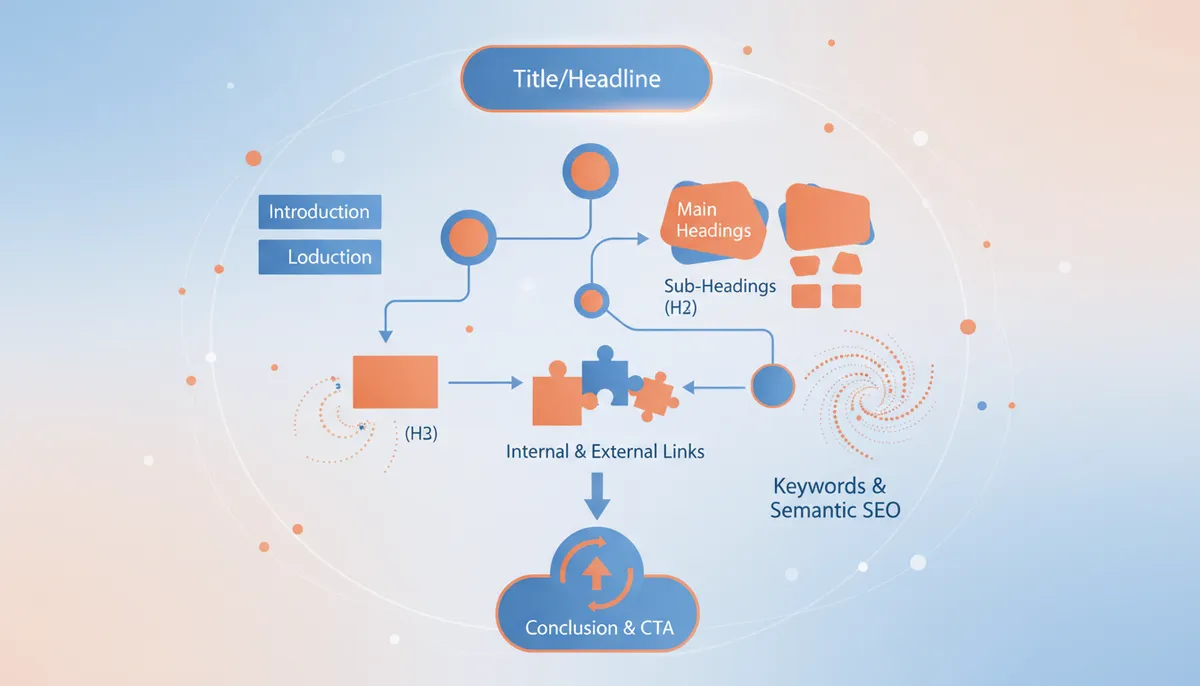
Proper structure makes your content accessible to both readers and search engine crawlers. Well-structured articles use hierarchical headings (H2, H3, H4) to organize information logically, making it easy for readers to scan and find specific sections. Search engines use this structure to understand your content’s organization and identify key topics covered within the article.
Start with a compelling introduction that clearly states what readers will learn and why it matters to them. Your introduction should incorporate the primary keyword naturally while establishing credibility and encouraging continued reading. According to Google’s Search Quality Rater Guidelines, content should demonstrate Experience, Expertise, Authoritativeness, and Trustworthiness from the very first paragraph.
Break your content into logical sections using descriptive H2 headings that tell readers exactly what each section covers. Within major sections, use H3 subheadings to further organize information. This hierarchy creates a clear outline that improves readability and helps search engines understand the relationship between different content sections. Never skip heading levels—always follow H2 with H3, not H4.
Optimal Paragraph and Sentence Length
Keep paragraphs short and focused, ideally between two and four sentences. Online readers scan content rather than reading every word, and dense paragraphs discourage engagement. Short paragraphs with clear topic sentences make content more accessible and improve time-on-page metrics that influence SEO rankings.
Similarly, favor shorter sentences over complex, multi-clause constructions. Aim for an average sentence length of 15-20 words, varying between shorter and longer sentences to maintain natural rhythm. This approach improves readability scores—a factor that correlates with higher search rankings and better user engagement.

Writing High-Quality, Original Content
Content quality determines long-term SEO success more than any technical optimization. High-quality content provides unique insights, thoroughly addresses topics, and offers practical value readers cannot easily find elsewhere. Search engines have become remarkably sophisticated at identifying thin, recycled content that merely rephrases existing information without adding new value.
Original content doesn’t mean covering entirely new topics—it means bringing fresh perspective, updated information, personal experience, or deeper analysis to existing subjects. Share specific examples, case studies, original research, or unique methodologies that distinguish your content from the dozens of similar articles already ranking. This originality creates natural backlink opportunities as other content creators reference your unique contributions.
Depth matters significantly in 2026. Studies consistently show longer, comprehensive articles (typically 2,000-3,000+ words) outrank shorter content for competitive keywords. However, length alone doesn’t guarantee quality—every paragraph must serve a purpose, advancing reader understanding rather than adding filler to inflate word count. Platforms like SEO Rocket automatically generate 3,000+ word articles optimized for both depth and relevance, ensuring comprehensive coverage without unnecessary padding.
Demonstrating E-E-A-T in Your Content
Google’s E-E-A-T principle (Experience, Expertise, Authoritativeness, Trustworthiness) has become central to content evaluation. Experience means showing first-hand knowledge of your topic through specific examples and practical application. Expertise involves demonstrating deep understanding through accurate information and comprehensive topic coverage.
Authoritativeness comes from recognition within your industry—citations from other websites, author credentials, and consistent publishing on related topics. Trustworthiness includes transparent sourcing, accurate information, secure website infrastructure, and clear author attribution. Incorporate these elements by citing authoritative sources, including author bios, updating content regularly, and maintaining factual accuracy throughout your articles.

Strategic Keyword Placement and Optimization
Keyword placement signals to search engines what your content is about, but modern optimization requires natural integration rather than forced repetition. Your primary keyword should appear in strategic locations: the article title, first paragraph, at least one H2 heading, URL slug, and meta description. Beyond these critical placements, incorporate the keyword naturally throughout the content at approximately 1-5% density.
Title tags remain one of the most influential on-page SEO elements. Keep titles within 60 characters so they display fully in search results, and place your primary keyword near the beginning. For example, “SEO Content Writing: A Beginner’s Guide for 2026” clearly indicates the topic while remaining under the character limit and beginning with the target keyword.
Meta descriptions don’t directly impact rankings but significantly influence click-through rates. Write compelling meta descriptions between 150-160 characters that include your primary keyword and clearly communicate the content’s value. Think of the meta description as advertising copy that convinces searchers to choose your result over competitors appearing alongside you in search results.
Optimizing URLs for SEO
URL structure affects both user experience and search engine understanding. Create short, descriptive URLs that include your primary keyword and clearly indicate page content. Use hyphens to separate words, avoid special characters, and keep URLs as concise as possible while remaining descriptive. For example, “yoursite.com/seo-content-writing-guide” is ideal, while “yoursite.com/p=12345?cat=blog” provides no SEO or user benefit.
Using Internal and External Links Effectively
Strategic linking improves both SEO and user experience by connecting related content and establishing credibility through authoritative references. Internal links connect your content to other pages on your website, distributing page authority, keeping visitors engaged longer, and helping search engines understand your site structure and topic relationships.
Include 3-5 relevant internal links in each article, using descriptive anchor text that clearly indicates what the linked page covers. Instead of generic phrases like “click here,” use specific descriptions such as “learn more about keyword research strategies” or “see our complete SEO pricing options.” This approach helps both users and search engines understand the link destination’s content before clicking.
External links to authoritative sources demonstrate that your content is well-researched and not operating in isolation. Link to reputable sources such as industry research, government data, established publications, or recognized experts when citing statistics, referencing studies, or supporting claims. These outbound links actually help your SEO by signaling to search engines that your content connects to the broader web of information and provides readers with additional valuable resources. According to recent platform updates, proper linking strategies have become increasingly important for AI search visibility.
Anchor Text Best Practices
Anchor text—the clickable words in a hyperlink—should describe the linked page’s content while incorporating relevant keywords naturally. Avoid over-optimization by varying anchor text rather than always using exact-match keywords. Mix branded anchors (company names), generic anchors (“learn more”), and descriptive anchors (“comprehensive keyword research guide”) to create a natural link profile that doesn’t trigger spam filters.
Formatting Content for Readability and Engagement
Visual formatting dramatically impacts how readers engage with your content and how long they stay on your page—both user experience signals that influence SEO rankings. Well-formatted content uses visual hierarchy, whitespace, and varied elements to maintain reader attention and facilitate information absorption.
Incorporate bullet points and numbered lists to break down complex information into digestible chunks. Lists provide visual relief from paragraph text, make key points easy to scan, and often appear in featured snippets. Use numbered lists for sequential steps or ranked items, and bullet points for features, benefits, or non-sequential information.
| Formatting Element | SEO Benefit | User Benefit |
|---|---|---|
| Short paragraphs (2-4 sentences) | Improved readability scores | Easier scanning and comprehension |
| H2/H3 headings every 300-400 words | Clear content structure for crawlers | Quick navigation to relevant sections |
| Bullet points and numbered lists | Featured snippet opportunities | Quick information absorption |
| Bold text for key terms | Keyword emphasis signals | Important points stand out |
| Images with alt text | Image search rankings | Visual interest and explanation |
Use bold text sparingly to emphasize critical concepts, statistics, or key takeaways. Overusing bold dilutes its impact, but strategic highlighting helps scanners identify essential information quickly. Similarly, italics can emphasize subtle points or introduce new terminology without the visual weight of bold text.
The Power of Visual Elements
Incorporate images, screenshots, charts, and diagrams to explain complex concepts, break up text, and maintain visual interest. Every image should include descriptive alt text that explains the image content for accessibility and SEO purposes. Alt text helps search engines understand image content while ensuring visually impaired users can access your content through screen readers.
Optimizing Content for AI Search Engines
AI-powered search platforms like ChatGPT, Perplexity, Claude, Gemini, Copilot, and Grok have transformed how users discover information in 2026. These platforms synthesize information from multiple sources to answer conversational queries, often citing specific articles as references. Optimizing for AI search requires structuring content so AI models can easily extract and reference your information confidently.
Create content that directly answers specific questions with clear, factual statements supported by evidence. AI models prioritize content that demonstrates expertise through detailed explanations, accurate data, and proper attribution of claims. Structure information hierarchically so key points appear in logical order, making it easy for AI to identify and extract relevant passages.
Include specific data points, statistics, and concrete examples rather than vague generalities. AI search engines favor precision and verifiable information they can confidently reference. When stating facts or statistics, provide context and sources to establish credibility. This approach not only helps AI platforms but also strengthens your content’s authority with human readers and traditional search engines.
Structured Data and Schema Markup
Implement structured data (schema markup) to explicitly tell search engines and AI platforms what your content contains. Schema markup for articles, FAQs, how-to guides, and other content types helps AI models understand your content structure and extract relevant information accurately. While technical implementation varies by platform, most content management systems offer plugins or built-in tools for adding schema without coding knowledge.
Content Updating and Maintenance
SEO content writing doesn’t end at publication. Search engines favor fresh, current content, and regularly updating articles signals that your site actively maintains information accuracy. Studies show that updating existing content can significantly boost rankings, often more effectively than publishing entirely new articles.
Review your published content quarterly to identify update opportunities. Add new information, update statistics with recent data, refresh examples to reflect current trends, and ensure all links remain functional. Significant updates should include changing the publication date to signal freshness to both search engines and readers. According to industry best practices, websites publishing or updating content at least twice weekly tend to perform better in search results, particularly for time-sensitive topics.
Monitor your content’s performance using analytics tools to identify which articles drive traffic, generate engagement, and convert visitors. Double down on successful content by expanding it, updating it regularly, and creating related articles that build topical authority. Conversely, identify underperforming content and determine whether it needs updating, merging with similar articles, or removal to improve your site’s overall quality signals.
Measuring SEO Content Success
Track specific metrics to evaluate your SEO content writing effectiveness and identify improvement opportunities. Organic traffic measures how many visitors arrive through search engines—the primary indicator of SEO success. Monitor traffic trends over time rather than day-to-day fluctuations, as SEO results typically take weeks or months to materialize fully.
Keyword rankings show where your content appears in search results for target keywords. Track positions for your primary keywords and important secondary keywords, noting movement over time. Remember that rankings fluctuate naturally, so focus on long-term trends rather than daily changes. Significant ranking improvements typically correlate with traffic increases, though top positions for low-volume keywords may not drive substantial traffic.
Engagement metrics reveal how users interact with your content once they arrive. Time on page, bounce rate, and pages per session indicate whether your content satisfies user intent and encourages further exploration. High bounce rates may suggest mismatched search intent or poor content quality, while strong engagement metrics signal that your content resonates with your audience. The latest development roadmap indicates that advanced engagement tracking will become increasingly important for comprehensive SEO analysis.
Conversion Tracking
Ultimately, SEO content should drive business results beyond traffic. Set up conversion tracking to measure how content contributes to business goals such as email signups, product purchases, demo requests, or contact form submissions. Understanding which articles drive conversions helps you identify effective content approaches and optimize future topics and formats accordingly.
Common SEO Content Writing Mistakes to Avoid
Keyword stuffing—unnaturally repeating keywords throughout content—remains a common mistake despite search engines penalizing this practice for years. Modern algorithms easily identify forced keyword insertion, and excessive density harms readability and user experience. Instead, focus on natural language that serves readers first while incorporating keywords where they fit contextually.
Thin content that barely scratches the surface of topics fails to satisfy user intent or compete with comprehensive alternatives. Articles under 500 words rarely rank for competitive keywords because they cannot adequately address topics. Commit to thorough coverage that answers related questions and provides actionable information rather than publishing multiple shallow articles.
Ignoring mobile optimization is catastrophic in 2026, when mobile devices generate the majority of web traffic. Ensure your content displays properly on all screen sizes, with readable font sizes, appropriately sized interactive elements, and fast loading times. Mobile-first indexing means search engines primarily use your mobile site version for ranking, making mobile optimization essential rather than optional.
How SEO Rocket Simplifies Content Writing for Beginners
Learning SEO content writing takes time, practice, and ongoing education as search algorithms evolve. For beginners and busy professionals, automation platforms offer a practical solution that delivers professional results without requiring years of expertise. SEO Rocket specifically addresses the challenges beginners face by automating the entire content creation workflow from keyword research through publication.
The platform requires under 10 minutes to set up—simply connect your website (supporting WordPress, Webflow, Shopify, and Wix), and SEO Rocket automatically discovers keyword opportunities relevant to your business. It analyzes competitor content, identifies ranking gaps, and builds a content calendar filled with topics that have genuine search demand and ranking potential. This eliminates the guesswork and research time that typically overwhelms beginners.
SEO Rocket generates complete 3,000+ word articles optimized for both traditional search engines and AI platforms like ChatGPT, Perplexity, and Gemini. Each article includes proper heading structure, natural keyword integration, internal and external linking, optimized metadata, AI-generated images, and embedded videos—all elements that beginners struggle to implement correctly. The platform’s real-time SEO scoring provides instant feedback with automated fix suggestions, teaching best practices while ensuring every article meets quality standards.
The system publishes one article daily for business users or up to ten daily for agency clients, creating the consistent publishing schedule that drives compounding SEO growth. This automation eliminates the time barrier that prevents most beginners from publishing frequently enough to build meaningful search visibility. At approximately $3 per article, SEO Rocket delivers professional-quality content at a fraction of traditional agency costs or the time investment required for manual creation.
Conclusion
SEO content writing combines strategic thinking, audience understanding, and technical optimization to create content that ranks well and genuinely serves readers. As a beginner, focus on mastering the fundamentals: thorough keyword research, clear content structure, natural optimization, and consistent publishing. Remember that SEO success compounds over time—each well-optimized article builds your site’s authority and improves your overall visibility.
The evolution toward AI-powered search platforms adds new dimensions to SEO content writing but doesn’t change the core principle: create genuinely valuable content that thoroughly addresses user needs with accuracy and expertise. Whether you manually craft every article or leverage automation to scale your content production, maintaining quality and relevance remains paramount.
For beginners overwhelmed by the complexity or time requirements of SEO content writing, automation platforms like SEO Rocket remove barriers to entry while delivering professional results. The platform’s comprehensive approach handles every aspect of content creation and publishing, allowing you to focus on your business while building the search visibility that drives sustainable growth. Start your SEO content journey for just $99 per month and experience the compounding benefits of consistent, optimized publishing designed for 2026’s search landscape.
FAQs
Q: What is SEO content writing and why does it matter?
A: SEO content writing is the practice of creating high-quality, original content optimized to rank well in search engines while providing genuine value to readers. It matters because it drives consistent, free organic traffic to your website, establishes your authority in your industry, and creates long-term assets that continue generating visibility and leads months or years after publication.
Q: How do I find the right keywords for my SEO content?
A: Start with seed keywords related to your business, then use keyword research tools to find longer, more specific phrases (long-tail keywords) with manageable competition. Focus on keywords that balance search volume, ranking difficulty, and relevance to your business goals. Analyze top-ranking results to understand search intent and ensure your content matches what users actually want when searching those terms.
Q: How long should my SEO content be to rank well?
A: Comprehensive articles typically perform best, with studies showing that content in the 2,000-3,000+ word range tends to outrank shorter articles for competitive keywords. However, length alone doesn’t guarantee success—every paragraph must provide value and advance reader understanding. Quality and thorough topic coverage matter more than hitting arbitrary word counts.
Q: How often should I publish new SEO content?
A: Consistency matters more than frequency. Publishing at least twice weekly shows strong commitment and can improve SEO performance, particularly for time-sensitive topics. However, quality should never be sacrificed for quantity. For beginners, start with one high-quality article weekly and increase frequency as you develop systems and efficiency. Automated platforms like SEO Rocket enable daily publishing by handling the entire creation process.
Q: What’s the difference between writing for Google and writing for AI search engines?
A: Writing for traditional Google search emphasizes keyword optimization, backlinks, and technical SEO factors. Writing for AI search engines like ChatGPT, Perplexity, and Gemini requires clear, factual statements with proper attribution, structured information that’s easy to extract, and comprehensive answers to specific questions. The good news is that content optimized for AI search typically also performs well in traditional search engines, as both prioritize expertise, accuracy, and thorough topic coverage.