Key Takeaways
-
Daily blog posting in 2026 requires balancing quality with quantity, leveraging AI tools without sacrificing authenticity.
-
Implement a pillar-and-cluster content strategy to systematically build topical authority and maintain consistent, strategic publishing.
-
Batch content creation and strategic scheduling allow for efficient daily posting without daily manual writing efforts.
-
Regularly update and repurpose existing content to maintain SEO performance and provide fresh value with less effort.
-
AI writing tools can automate content production, but human oversight is crucial to maintain brand voice and accuracy.
Daily blog posting has become a hot topic among content creators and marketers in 2026, with many wondering whether publishing content every single day is the secret to SEO success and audience growth. The reality is more nuanced than simply hitting publish 365 days a year. While consistent content creation remains a cornerstone of effective digital marketing, the approach to daily posting has evolved significantly with the rise of AI-powered tools and changing search engine algorithms.
The modern landscape of daily blog posting balances quality with quantity, leveraging automation without sacrificing authenticity. Businesses that master this balance see compound growth in organic traffic, audience engagement, and brand authority. Whether you’re a small SEO agency managing multiple clients, an in-house marketing team working with limited resources, or a digital marketing consultant looking to differentiate your services, understanding the strategic approach to daily posting is essential for competitive advantage in 2026.
This article explores four proven strategies that make daily blog posting sustainable, effective, and genuinely beneficial for your SEO performance. These approaches have been tested across diverse industries and consistently deliver measurable results without leading to content creator burnout or quality degradation.

Understanding the Reality of Daily Blog Posting in 2026
The conversation around daily blog posting has shifted dramatically over the past few years. While some content creators successfully publish new articles every day, research and expert consensus reveal that consistency matters more than raw volume. According to current SEO best practices, posting once per week (approximately 39 posts in 2026 when accounting for holidays) represents a more sustainable and effective target for most businesses than attempting daily publication.
The key distinction lies between different types of daily posting. Some businesses maintain daily activity through social media updates, newsletter content, or micro-blog posts, while reserving their comprehensive, SEO-optimized long-form articles for weekly publication. This hybrid approach allows brands to maintain daily visibility while ensuring each major blog post receives adequate research, optimization, and promotion.
Morning posts around 9 a.m. consistently generate higher click-through rates, while Mondays yield more page views and overall traffic. Interestingly, Sundays prove optimal for social media blog shares, leading to higher views and shares throughout the following week. These timing insights help maximize the impact of whatever posting frequency you choose.
The SEO Impact of Posting Frequency
Search engines reward websites that publish high-quality content consistently, but the relationship between posting frequency and rankings is not linear. More frequent high-quality posts increase visibility in oversaturated markets and drive engagement, but only when each piece maintains rigorous standards for depth, accuracy, and optimization.
According to Search Quality Rater Guidelines, Google prioritizes content that demonstrates Experience, Expertise, Authoritativeness, and Trustworthiness (E-E-A-T). A single well-researched, comprehensive article published weekly often outperforms seven rushed, thin content pieces published daily. This principle has become even more critical as AI-powered search engines like ChatGPT, Perplexity, Claude, and Gemini evaluate content for use in their response systems.
For businesses serious about maximizing their SEO performance through consistent content creation, platforms like SEO Rocket have emerged as game-changers. These systems automate the entire process from keyword research through optimization and publishing, making it possible to maintain daily content production without manual effort or quality compromise.

Strategy 1: Build a Pillar-and-Cluster Content System
The most effective approach to sustainable daily blog posting involves creating a pillar-and-cluster content architecture. This strategy organizes your content around 3-5 core topics (pillars) that represent your primary business offerings or expertise areas, with supporting cluster content that explores related subtopics in depth.
Your pillar content consists of comprehensive, evergreen articles that thoroughly address broad topics within your niche. These pieces typically exceed 3,000 words and serve as authoritative resources that attract links and establish topical authority. Cluster content then connects back to these pillars through strategic internal linking, creating a semantic web that search engines recognize as authoritative.
Implementing the Pillar-Cluster Model Daily
To make this system work with daily posting, establish a rotation schedule:
- Identify your 3-5 core topics based on business priorities and keyword research
- Create or update one pillar article per topic quarterly (comprehensive updates)
- Develop 10-15 cluster articles per pillar, each targeting specific long-tail keywords
- Schedule cluster content publication throughout the week, ensuring each pillar receives regular support
- Link cluster articles back to their pillar and to related cluster content within the same topic family
This structure allows you to maintain posting consistency while ensuring every article serves a strategic purpose within your broader content ecosystem. Rather than scrambling for random topics daily, you follow a predetermined roadmap that systematically builds authority.
The beauty of this approach is its scalability. Small business owners can focus on one pillar per month with weekly cluster posts, while agencies managing multiple clients can run parallel pillar-cluster systems across different accounts. Tools that offer automated content calendar management make implementing this strategy significantly easier by identifying keyword opportunities and scheduling content automatically.
Measuring Pillar-Cluster Performance
Track these metrics to evaluate your pillar-cluster system effectiveness:
| Metric | Target | Measurement Frequency |
|---|---|---|
| Pillar Page Rankings | Top 10 for primary keywords within 6 months | Monthly |
| Cluster Content Rankings | Top 20 for long-tail keywords within 3 months | Monthly |
| Internal Link Network Strength | Minimum 5 internal links per article | Quarterly audit |
| Topic Authority Score | Increasing trend across pillar topics | Quarterly |
| Organic Traffic to Pillar Pages | 30% increase quarter-over-quarter | Monthly |
Regular monitoring ensures your content architecture delivers measurable SEO improvements rather than simply filling your blog with disconnected articles.

Strategy 2: Implement Batch Creation and Strategic Scheduling
Daily blog posting does not require daily content creation. The most successful content teams separate creation from publication through batch production and strategic scheduling. This approach prevents burnout, maintains consistent quality, and allows for better resource allocation.
Batch creation involves dedicating specific blocks of time to producing multiple articles simultaneously. This method leverages the psychological benefits of focused work, reduces context-switching overhead, and enables more efficient research processes. Many successful bloggers dedicate one or two full days monthly to producing their entire month’s content, then schedule publication throughout the period.
Establishing an Efficient Batch Workflow
Create a repeatable workflow that transforms raw ideas into published content systematically:
- Research Day (Monday): Conduct comprehensive keyword research, competitor analysis, and topic validation for 10-15 articles simultaneously
- Outline Day (Tuesday): Create detailed outlines with headers, key points, and research notes for each article
- Drafting Days (Wednesday-Thursday): Write first drafts using your outlines, focusing on content flow rather than perfection
- Editing and Optimization Day (Friday): Review drafts for clarity, optimize for SEO, add internal/external links, and finalize meta descriptions
- Scheduling and Asset Creation (Following Monday): Schedule publication dates, create or assign images, and set up promotional materials
This workflow transforms chaotic daily scrambling into predictable, manageable work blocks. Teams can divide responsibilities based on strengths—one person handles research and optimization while another focuses on drafting and editing.
Modern AI-powered platforms have revolutionized batch creation efficiency. Systems like SEO Rocket automate the entire process from keyword discovery through optimization and publishing, enabling businesses to maintain daily publication schedules without dedicating days to manual content creation. This automation particularly benefits agencies managing multiple client accounts simultaneously.
Strategic Publication Timing
Once you have batched content ready, strategic scheduling maximizes impact:
- Schedule cornerstone content for Monday mornings around 9 a.m. to capture peak weekly traffic
- Position time-sensitive or news-related content for Tuesday-Wednesday publication when engagement remains high
- Reserve Thursday-Friday slots for evergreen how-to guides and resource articles
- Use weekend slots for lighter, community-focused content or content recaps
Testing and adjusting publication times based on your specific audience behavior data ensures optimal visibility. Most analytics platforms provide insights into when your readers are most active, allowing you to refine your schedule continuously.

Strategy 3: Leverage Content Repurposing and Updates
Sustainable daily blog posting does not always mean creating entirely new content from scratch. Strategic repurposing and systematic updates of existing content provide substantial value while requiring significantly less effort than original creation. This approach also sends positive signals to search engines that your site remains actively maintained and current.
Google increasingly favors fresh, updated content over stale articles, even when those older pieces once ranked well. Regular content audits and updates help maintain rankings while providing opportunities to add new keywords, improve internal linking, and enhance user experience based on actual reader behavior data.
Effective Content Repurposing Methods
Transform existing content into new formats and angles:
| Original Format | Repurposed Format | Effort Level |
|---|---|---|
| Comprehensive Guide (3,000+ words) | 5-7 Individual Deep-Dive Posts | Medium |
| Research-Heavy Article | Infographic Summary + Social Posts | Low |
| Case Study | Before/After Comparison + Lessons Learned Post | Low |
| Interview or Expert Roundup | Individual Quote-Based Articles | Low |
| Product Review | Comparison Articles + FAQ Posts | Medium |
Each repurposed piece should add unique value rather than simply duplicating content. Expand on specific points, provide additional examples, incorporate new data, or address different audience segments to ensure each version serves a distinct purpose.
Systematic Content Update Process
Establish a quarterly review process for your existing blog content:
- Identify articles with declining traffic or rankings using analytics tools
- Review top-performing competitor content on the same topics to identify gaps
- Update statistics, examples, and references with current information
- Add new sections addressing questions or subtopics that have emerged since original publication
- Improve internal linking to connect with newer related content
- Enhance meta descriptions and headers for better click-through rates
- Update publication dates to signal freshness (when substantial changes have been made)
This systematic approach to updates can fill 1-2 days of your weekly publishing schedule while delivering SEO benefits comparable to new content creation. Articles that receive comprehensive updates often experience ranking improvements within weeks, particularly for informational queries where freshness is a ranking factor.
For businesses managing extensive content libraries across multiple domains, automation tools that track content performance and flag update opportunities become invaluable. Check out how automated systems identify content refresh opportunities and streamline the update process.

Strategy 4: Integrate AI Tools While Maintaining Human Oversight
The emergence of sophisticated AI writing tools in 2026 has fundamentally changed the economics and feasibility of daily blog posting. These systems can generate high-quality, SEO-optimized content at scale, making strategies that were previously labor-intensive now accessible to businesses of all sizes. However, success requires understanding how to integrate AI effectively while maintaining the human elements that build trust and authority.
Modern AI platforms do far more than generate text. They conduct keyword research, analyze competitor strategies, structure content for optimal SEO performance, create internal linking networks, optimize metadata, and even generate complementary visual assets. This comprehensive automation allows businesses to maintain aggressive publishing schedules without proportionally increasing their content teams.
Selecting the Right AI Content Platform
Not all AI writing tools deliver equal results for SEO-focused blog content. Evaluate platforms based on these criteria:
- SEO Optimization Depth: Does the platform only generate text, or does it handle comprehensive optimization including headers, meta descriptions, internal linking, and keyword distribution?
- Content Length and Depth: Can the system produce the 3,000+ word comprehensive articles that rank well, or does it default to shorter, less competitive content?
- Integration Capabilities: Does it publish directly to your CMS (WordPress, Webflow, Shopify, Wix), or require manual copying and pasting?
- Automation Level: How much manual intervention does each article require? Can you truly maintain daily posting with minimal effort?
- AI Search Optimization: Is content structured for visibility in AI-powered search engines (ChatGPT, Perplexity, Claude, Gemini) beyond just Google?
- Cost Per Article: What is the actual cost per published article when considering subscription fees and time investment?
Platforms like SEO Rocket represent the current state-of-the-art in automated content creation, handling everything from keyword discovery through daily publishing with minimal manual oversight. For businesses serious about scaling content production to daily levels, investigating automation-first solutions that deliver true end-to-end workflows makes strategic sense.
Maintaining Quality and Brand Voice
Even with sophisticated AI tools, human oversight remains essential for maintaining brand consistency and ensuring content resonates with your specific audience. Establish quality control processes that balance efficiency with authenticity:
- Review AI-generated content for factual accuracy, particularly for statistics and technical claims
- Inject brand-specific examples, case studies, and perspectives that only your team can provide
- Ensure content reflects current brand positioning and messaging priorities
- Add personal anecdotes or proprietary insights that differentiate your content from competitors
- Verify that tone and style match your established brand voice guidelines
The most successful implementations of AI content tools treat the technology as a highly capable first-draft creator rather than a complete replacement for human content teams. This approach combines the efficiency and consistency of AI with the strategic thinking and authentic voice that builds genuine audience connection.
Measuring AI Content Performance
Track specific metrics to ensure your AI-assisted content delivers results:
| Performance Indicator | Benchmark | Action if Below Benchmark |
|---|---|---|
| Average Time on Page | 3+ minutes for long-form content | Review content depth and readability |
| Bounce Rate | Below 60% | Improve introductions and internal linking |
| Ranking Trajectory | Steady improvement over 90 days | Enhance optimization and build backlinks |
| Social Shares | Comparable to human-written content | Add more unique insights and data |
| Conversion Rate | Within 10% of human-written content | Strengthen CTAs and value proposition |
If AI-generated content consistently underperforms human-written articles in these areas, increase human oversight and editing rather than abandoning AI tools entirely. The goal is finding the optimal balance for your specific business context.
Implementing Your Daily Blog Posting Strategy
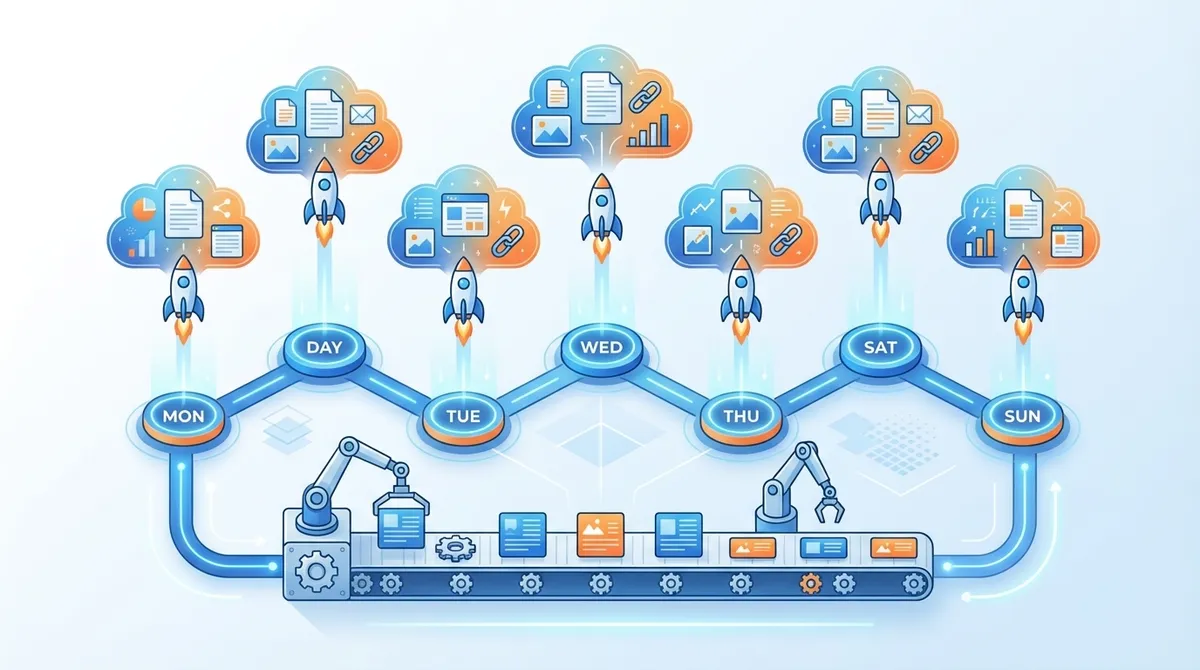
Successfully transitioning to a daily blog posting schedule requires careful planning and realistic expectations. Rather than attempting to jump immediately from sporadic posting to daily publication, most businesses benefit from a phased approach that builds systems and habits gradually.
Begin by establishing your baseline—how frequently are you currently publishing, and what resources are you dedicating to content creation? From there, increase frequency incrementally while monitoring quality metrics and team capacity. Moving from monthly to weekly posting represents a significant operational change; weekly to daily requires even more substantial infrastructure.
30-Day Implementation Roadmap
Follow this structured approach to launch your daily posting strategy:
- Week 1 – Foundation: Define your 3-5 content pillars, conduct comprehensive keyword research for each pillar, audit existing content for repurposing opportunities, and select your AI content tools or automation platform
- Week 2 – Calendar Creation: Build a 90-day content calendar mapping specific topics to publication dates, establish your batch creation workflow, and create article templates for consistency
- Week 3 – Content Production: Generate your first batch of 15-20 articles using your chosen workflow, optimize each piece for SEO, and schedule publication for the upcoming month
- Week 4 – Systems and Monitoring: Set up analytics tracking for key metrics, create promotion workflows for new content, establish team responsibilities if working collaboratively, and document your processes for repeatability
This timeline assumes you are dedicating significant resources to the launch. Smaller teams or those working with limited capacity may need to extend this to 60 or 90 days, which is perfectly acceptable. The key is maintaining forward momentum rather than achieving arbitrary speed milestones.
Resource Allocation for Daily Posting
Different approaches to daily posting require different resource investments:
| Approach | Time Investment | Cost | Best For |
|---|---|---|---|
| Manual Creation (In-house) | 40+ hours/week | Staff salary | Large teams with dedicated writers |
| Freelance Writers | 10-15 hours management | $200-500 per article | Businesses needing high touch customization |
| AI-Assisted with Heavy Editing | 20-30 hours/week | $50-200/month tools | Teams wanting control with efficiency gains |
| Fully Automated Platform | 2-5 hours/week | $99-799/month | Agencies and businesses prioritizing scale |
For small SEO agencies managing multiple clients, in-house marketing teams with limited headcount, and digital marketing consultants seeking service differentiation, fully automated platforms offer the most attractive cost-benefit ratio. At approximately $3 per long-form article, these systems deliver enterprise-level content production at accessible price points.

Conclusion: Building Sustainable Daily Posting Success
Daily blog posting in 2026 is both more achievable and more strategic than ever before. The four strategies outlined in this article—pillar-cluster architecture, batch creation workflows, systematic repurposing, and strategic AI integration—provide a comprehensive framework for sustainable, results-driven content production.
The key insight is that successful daily posting is not about scrambling to create something new every 24 hours. Instead, it is about implementing systems that ensure consistent, high-quality content publication while maintaining efficiency and preventing team burnout. Whether you choose to publish daily, weekly, or somewhere in between, consistency and strategic planning matter more than raw frequency.
For businesses serious about maximizing their organic search visibility through content, the compounding effects of consistent publishing cannot be overstated. Each additional optimized article expands your keyword footprint, strengthens your topical authority, and creates new opportunities for internal linking and audience engagement. Over months and years, this compound growth significantly outpaces sporadic, inconsistent publishing efforts.
The tools and technologies available in 2026 have removed traditional barriers to scaling content production. Platforms that handle everything from keyword research through optimization and publishing make daily posting accessible to businesses of all sizes, not just those with large content teams or substantial budgets. If you are ready to transform your content strategy and experience the growth that comes from consistent, optimized publishing, explore how automation can eliminate the manual work while delivering superior results.
Remember that sustainable success comes from building systems rather than relying on heroic individual efforts. Start with the strategy that best matches your current resources and capabilities, implement it consistently for 90 days, measure your results, and refine your approach based on data. The businesses that win in SEO are not necessarily those with the most resources—they are the ones with the most consistent, strategic approach to content creation and optimization.
FAQs
Q: How often should I post on my blog in 2026?
A: The optimal posting frequency depends on your resources and goals, but consistency matters more than raw volume. Research shows that posting once per week (approximately 39 articles annually) is more sustainable and effective than attempting daily publication for most businesses. If you have the systems and tools to maintain daily posting without sacrificing quality, it can accelerate SEO growth through compound effects. The key is choosing a frequency you can maintain consistently over months and years.
Q: What is the best time and day to publish blog posts?
A: Morning posts around 9 a.m. consistently generate higher click-through rates across most industries. Mondays yield the highest page views and overall traffic, making them ideal for cornerstone content and major announcements. Interestingly, Sundays prove optimal for sharing blog content on social media, as these posts tend to receive higher engagement throughout the following week. However, these are general trends—analyzing your specific audience behavior data will provide the most accurate guidance for your publication schedule.
Q: Is daily blogging worth it for SEO and business growth?
A: Daily blogging can significantly accelerate SEO growth when executed strategically with high-quality, optimized content. The compound effects of consistent publishing expand your keyword footprint, strengthen topical authority, and create more opportunities for internal linking and backlinks. However, daily posting only delivers value when each article maintains rigorous standards for depth, accuracy, and optimization. Seven rushed, thin articles published daily will underperform one comprehensive, well-researched piece published weekly. The key is implementing systems—whether through batching, repurposing, or automation—that enable daily publication without quality compromise.
Q: How can AI tools help with daily blog posting?
A: Modern AI content platforms have transformed daily blog posting from labor-intensive to highly efficient. Advanced systems handle keyword research, competitor analysis, long-form article generation, SEO optimization, internal linking, metadata creation, and direct publishing to your CMS. This comprehensive automation makes daily posting achievable for businesses of all sizes. The most effective approach treats AI as a sophisticated first-draft creator, with human oversight ensuring factual accuracy, brand consistency, and authentic voice. Platforms offering true end-to-end automation can reduce the time investment for daily posting from 40+ hours weekly to just 2-5 hours.
Q: What is a pillar content strategy for blogs?
A: A pillar content strategy organizes your blog around 3-5 comprehensive, authoritative articles (pillars) that thoroughly address broad topics central to your business. Each pillar typically exceeds 3,000 words and serves as the definitive resource on its subject. Supporting cluster content then explores specific subtopics related to each pillar, with strategic internal links connecting cluster articles back to their pillar and to related cluster content. This architecture helps search engines recognize your topical authority while providing a systematic framework for consistent content creation. For daily posting, you rotate through your pillars, ensuring each receives regular cluster content support that builds comprehensive coverage over time.