
Key Takeaways
-
Keyword discovery tools identify exact phrases your audience searches for, eliminating guesswork and driving measurable traffic results instead of publishing articles that get zero visibility.
-
Modern AI-powered tools use machine learning and NLP to cluster keywords semantically, predict trends, and reveal content gaps—capabilities far beyond simple volume metrics that traditional tools offer.
-
In 2026, your content must rank in both traditional search results and AI-generated answers (ChatGPT, Perplexity, Gemini), making keyword discovery essential for dual-platform visibility.
-
Automated keyword discovery connected to content platforms eliminates manual workflows: one keyword triggers research, planning, writing, optimization, and publishing automatically—reducing 3-5 hours per keyword to under 10 minutes.
-
Balance search volume with competition level and prioritize search intent matching; targeting high-volume keywords you can't rank for or mismatching intent (informational vs. transactional) wastes effort.
-
Keyword clustering and consistent publishing build topical authority; sporadic articles with unrelated keywords underperform compared to themed content clusters published on regular schedules.
Struggling to figure out what to write about next? You’re not alone. Many business owners, marketers, and content managers spend hours guessing at topics — only to publish articles that get zero traffic. A keyword discovery tool changes that completely. It takes the guesswork out of content planning and helps you find the exact phrases your audience is already searching for. Whether you’re running a small business or managing SEO for multiple clients, the right tool can save you serious time and drive real, measurable results. In this guide, we’ll break down exactly what a keyword discovery tool is, how it works, and why it’s become essential for anyone serious about SEO content automation in 2026. Let’s dive in!

What Is a Keyword Discovery Tool?
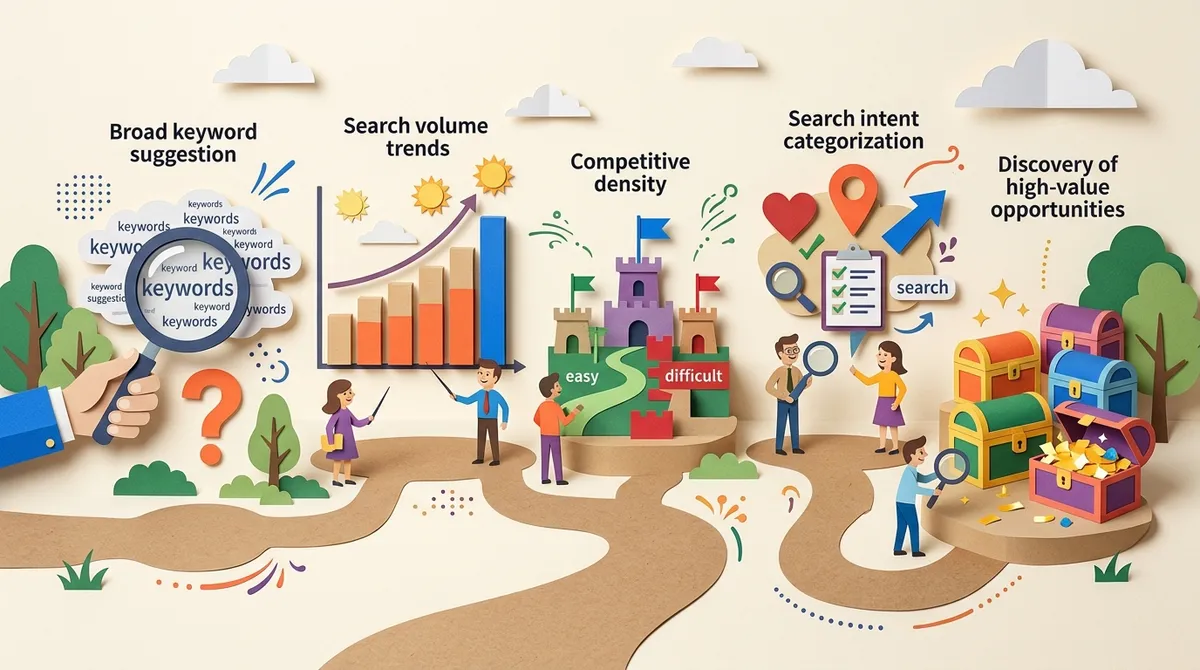
A keyword discovery tool is software that helps you find the best keywords to target in your content. It analyzes search data to show you what people are typing into search engines. You get information like search volume, competition level, and search intent. This data helps you decide which topics are worth writing about.
Modern keyword discovery tools go way beyond simple volume metrics. Today’s AI-powered tools use machine learning and natural language processing (NLP) to cluster keywords semantically, predict trending topics, and identify content gaps. For example, tools like the Semrush Keyword Magic Tool access over 25 billion keywords and provide AI-driven search intent analysis. That’s a lot of opportunity waiting to be discovered! You can learn more about how these tools fit into a broader strategy by checking out our SEO content writing beginner’s guide for 2026.

Why Keyword Discovery Matters More Than Ever in 2026
Search is not just about Google anymore. In 2026, AI-powered search engines like ChatGPT, Perplexity, and Gemini are answering more questions directly. This means your content needs to rank in two places: traditional search results AND AI-generated answers. A good keyword discovery tool helps you identify the topics that matter in both environments.
Here’s why keyword discovery has become a must-have, not a nice-to-have:
- Search behavior keeps changing. New queries emerge daily, and staying ahead requires live data.
- Competition is fierce. Without the right keywords, your content gets buried.
- AI search demands topical authority. You need clusters of related content, not just one-off posts.
- Publishing consistently requires a steady pipeline. You can’t publish daily without knowing what to write about.
- Content gaps are opportunities. A keyword discovery tool reveals what competitors are missing.
Want to understand how AI search visibility fits into this? Our guide on how to improve your AI search visibility in 2026 covers this topic in depth.
Key Features to Look For in a Keyword Discovery Tool
Not all keyword discovery tools are created equal. Some are basic and manual. Others are fully automated and AI-powered. Here’s what to look for when evaluating any tool:
Must-Have Features
- Live search data: Real-time keyword suggestions based on current search behavior, not outdated databases.
- Search intent classification: Knowing whether a query is informational, navigational, or transactional changes everything about how you write your content.
- Keyword clustering: Grouping related keywords together so you can build topical authority with a single piece of content.
- Content gap analysis: Identifying topics your competitors rank for that you don’t yet cover.
- SERP feature prediction: Understanding which keywords trigger featured snippets, People Also Ask boxes, or AI overviews.
- Integration with content creation: The best tools connect keyword research directly to article writing and publishing workflows.
Nice-to-Have Features
- Trend forecasting to predict emerging keywords before they peak
- Competitor keyword analysis to understand what’s working in your niche
- Automated content briefs generated from keyword data
- Rank tracking to measure your progress over time
- AI visibility tracking beyond traditional Google rankings

How Keyword Discovery Tools Fit Into SEO Content Automation
Here’s where things get really exciting. A keyword discovery tool is most powerful when it’s connected to your entire content workflow. In a manual setup, you’d research keywords in one tool, plan content in a spreadsheet, write articles in another app, optimize with a third tool, and then manually publish. That’s exhausting and time-consuming!
SEO content automation changes this completely. When keyword discovery is built into your content platform, one keyword can trigger an entire workflow. The system finds the keyword, plans the content, writes the article, optimizes it, and publishes it — all automatically. This is exactly what platforms like SEO Rocket are built for.
From Keyword to Published Article in One Platform
SEO Rocket includes a built-in keyword research engine with live SEO data. Instead of juggling multiple tools, you get a complete keyword list showing real opportunities based on search volume, competition, and intent. Once you approve keywords, they go straight into your content calendar. The system then generates a full SEO-optimized article for each keyword — automatically, every single day.
This approach eliminates the biggest bottleneck in SEO: the gap between knowing what to write and actually getting it published. To see this in action, explore the full feature list on the SEO Rocket platform.
Comparing Manual vs. Automated Keyword Discovery
| Feature | Manual Keyword Research | Automated Keyword Discovery |
|---|---|---|
| Time Required | 3–5 hours per keyword set | Under 10 minutes setup |
| Data Freshness | May use outdated data | Live, real-time data |
| Keyword Clustering | Manual grouping in spreadsheets | AI-powered semantic clustering |
| Content Planning | Separate editorial calendar tool | Built-in visual content calendar |
| Publishing | Manual copy-paste to CMS | Direct auto-publish to WordPress, Webflow, Shopify, Wix |
| Scalability | Limited by team size | Scales to 300+ articles per month |
| Cost | High (agency: $3,000–$5,000/month) | Low (~$3 per article) |
The difference is stark. Automated keyword discovery connected to content automation is simply more efficient for teams of any size. Check out some real writing examples from SEO Rocket to see what fully automated, keyword-driven content looks like.
How to Use a Keyword Discovery Tool Effectively
Having a great tool is just the start. Here’s a simple process to get the most out of any keyword discovery tool:
- Start with seed keywords: Enter broad terms related to your business or niche. These act as starting points for deeper research.
- Filter by intent: Focus on keywords that match your content goals. Informational keywords work for blog posts. Transactional keywords are better for landing pages.
- Look for low-competition opportunities: High volume is great, but low competition means faster rankings. Find the sweet spot.
- Group keywords into clusters: Build topical authority by grouping related keywords into content clusters. This strategy signals expertise to search engines.
- Plan your publishing schedule: Add keywords to a content calendar and commit to a consistent publishing frequency. Our post on daily blog posting strategies that drive results is a great resource here.
- Track and refine: Monitor rankings and adjust your keyword strategy based on what’s actually working.
Common Mistakes People Make With Keyword Discovery
Even with the best keyword discovery tool, it’s easy to make mistakes that cost you time and results. Here are the most common ones to avoid:
- Chasing volume only: A keyword with 50,000 monthly searches isn’t useful if you can’t rank for it. Balance volume with competition level.
- Ignoring search intent: Writing an informational blog post for a transactional keyword (or vice versa) will always underperform.
- Skipping keyword clustering: Publishing random, unrelated articles is less effective than building topical clusters around core themes.
- Publishing inconsistently: Sporadic publishing gives poor SEO results. Consistent daily or weekly publishing compounds over time.
- Not updating old content: Keywords and rankings shift. Revisit older articles to keep them fresh and competitive.
- Disconnecting research from writing: When keyword research lives in a separate tool from your content workflow, things get lost or ignored.
If you want to understand how search intent fits into broader content strategy, Google’s Search Quality Rater Guidelines are a fantastic reference point for understanding what makes content truly valuable.
Who Benefits Most From a Keyword Discovery Tool?
The short answer? Almost everyone doing SEO. But here are the audiences who get the biggest benefit:
- Small SEO agencies that need to produce keyword-driven content for multiple clients efficiently
- In-house marketing teams that need to scale content output without hiring more writers
- Content managers responsible for keeping large websites fresh and optimized
- E-commerce SEO specialists who need to rank product and category pages at scale
- Small business owners who want to compete online without a big budget
- Digital marketing consultants who want to deliver faster SEO results to clients
For agency professionals especially, a keyword discovery tool that connects to automation can be a game-changer. Producing 300 articles per month for 10 clients would be impossible manually — but with the right automated system, it becomes very doable. Explore the SEO Rocket pricing plans to see what fits your setup, or create a free account and try it out today.
What Makes SEO Rocket’s Keyword Discovery Different
Most keyword tools stop at giving you a list of suggestions. SEO Rocket takes keyword discovery several steps further. The platform uses live SEO data to surface real keyword opportunities for your specific niche. It automatically fills a visual content calendar with those opportunities. Then, without any extra effort from you, it generates and publishes a full 3,000-word, SEO-optimized article for each keyword — every single day.
Setup takes under 10 minutes. After that, the system runs on its own. There’s no manual prompting, editing, or scheduling required. It even auto-generates images, internal links, metadata, and business mentions. For anyone serious about consistent organic growth, this level of automation is a genuine competitive advantage. You can read more about AI blog post generation tools or explore the best AI writing tools for 2026 to see how SEO Rocket compares to the market. Also check out our complete guide to blog writing with AI for a deeper dive.
Conclusion
A keyword discovery tool is one of the most valuable investments you can make in your SEO strategy. It removes the guesswork, uncovers real opportunities, and gives your content a roadmap to follow. But the real magic happens when keyword discovery is connected to a fully automated content system. Instead of researching, writing, and publishing manually, you can let automation handle the heavy lifting while you focus on growing your business.
If you’re ready to stop guessing and start publishing content that actually ranks, give SEO Rocket a try. You can get started with a free 3-day trial today — no long setup, no complicated tools, just consistent, keyword-driven content working for you every single day. And if you have questions, feel free to reach out through our contact page or read our blog for more tips and strategies.
FAQs
Q: What is a keyword discovery tool used for?
A: A keyword discovery tool helps you find the best keywords to target in your SEO content. It shows you search volume, competition level, and search intent so you can create articles that actually rank and attract the right audience. Think of it as your content roadmap!
Q: How does a keyword discovery tool help with SEO content automation?
A: When a keyword discovery tool is built into an automated content platform, it can trigger an entire workflow — from identifying a keyword all the way to publishing a finished, optimized article. This eliminates the manual gap between research and writing, saving you hours of work every week.
Q: Do I need technical SEO knowledge to use a keyword discovery tool?
A: Not at all! Modern keyword discovery tools are designed to be beginner-friendly. Platforms like SEO Rocket present keyword opportunities in plain language with clear recommendations, so even if you’re new to SEO, you can quickly identify what to write about and get started.
Q: How many keywords should I target per article?
A: A best practice in 2026 is to focus on one primary keyword per article, supported by several semantically related keywords. This approach, known as keyword clustering, helps search engines understand your content’s full topic and improves your chances of ranking for multiple related queries.
Q: Can a keyword discovery tool help me rank in AI search engines like ChatGPT or Perplexity?
A: Yes! The best keyword discovery tools in 2026 now track visibility across AI search platforms, not just Google. By targeting keywords with high informational intent and building topical authority through consistent publishing, your content becomes more likely to appear in AI-generated answers and overviews.