Key Takeaways
-
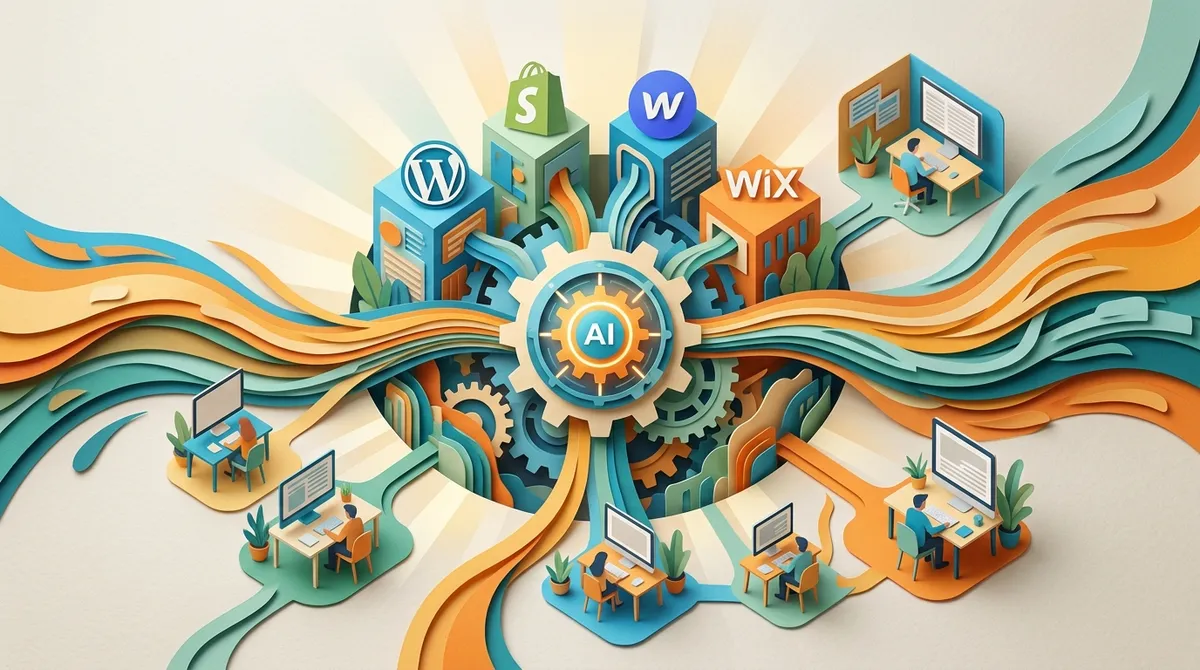
Agency blog automation platforms enable direct CMS publishing to WordPress, Shopify, Webflow, and Wix, eliminating manual copy-paste workflows that waste hours per article.
-
AI-powered platforms generating 2,000-3,000+ word optimized articles consistently outrank shorter automated content and deliver better client results without scaling team headcount.
-
Agencies must optimize content for AI search engines (ChatGPT, Perplexity, Claude, Gemini) using proper schema markup and E-E-A-T signals, not just Google rankings.
-
Multi-client workspace management with separate brand voice settings and publishing schedules makes onboarding new clients seamless and content operations scalable.
-
Built-in keyword research with live SEO data (search volume, difficulty, intent) eliminates tool-switching and enables data-driven targeting of low-competition opportunities.
-
Real-time on-page SEO scoring with one-click auto-fix suggestions for metadata, internal linking, and readability saves agencies significant optimization time across multiple clients daily.
Running an agency means wearing a lot of hats. You have client deadlines, content calendars, keyword targets, and publishing schedules — all happening at once. It can feel overwhelming, especially when you’re trying to produce quality blog content for multiple clients every single week. That’s exactly why an agency blog automation platform has become one of the most important tools in a modern agency’s toolkit.
In 2026, agencies that automate their content workflows are pulling ahead of those that still do everything manually. The right platform doesn’t just save time. It helps you publish more consistently, rank higher in search, and deliver better results to your clients — without burning out your team. Whether you manage three clients or thirty, the features you choose can make or break your content operations.
Let’s walk through the eight features that actually move the needle for agencies using blog automation today.

1. Built-In Keyword Research With Real SEO Data
Good content starts with good keywords. An agency blog automation platform should include its own keyword research engine — not just a basic suggestion tool, but one that shows real search volume, competition levels, and user intent. This saves you from jumping between tools and lets you build a data-driven content strategy in one place.
When you have live SEO data at your fingertips, you stop guessing and start targeting. You can spot low-competition opportunities for newer clients. You can plan topically relevant content that builds authority over time. To learn more about this process, check out this guide on how to master keyword research for 2026 SEO success.
Here are the key things a keyword research feature should show you:
- Monthly search volume for each keyword
- Keyword difficulty and competition score
- Search intent (informational, transactional, navigational)
- Related and long-tail keyword suggestions
- Trend data showing whether interest is growing or declining

2. Automated Content Planning and Calendar Management
Once you have your keywords, the next challenge is organizing them. Spreadsheets and manual editorial calendars are time sinks. A good agency blog automation platform replaces all of that with a visual content calendar that automatically fills itself with scheduled articles.
Instead of manually assigning topics and dates, you simply approve keyword opportunities and the platform does the rest. Articles get queued, scheduled, and prepared for publishing without you having to chase down writers or update spreadsheets. This is a huge win for agencies managing multiple client accounts. You can plan weeks or months in advance with just a few clicks.
This kind of AI content calendar approach transforms content operations from reactive to proactive. Your team always knows what’s coming next, and nothing falls through the cracks.

3. AI-Powered Long-Form Article Generation
This is where things get exciting. The best agency blog automation platforms use AI to write full, long-form articles — not just short blurbs or outlines, but complete posts optimized for search. We’re talking 2,000 to 3,000+ word articles that cover topics thoroughly and give search engines what they need to rank your content.
AI content generation has matured significantly. Modern platforms use natural language processing and machine learning to write articles that are:
- Tailored to a specific brand voice
- Optimized for target keywords and semantic variations
- Structured with proper headings, lists, and formatting
- Written to satisfy both search engines and human readers
Shorter articles used to be the norm for automated content. That’s changed. Agencies that publish longer, more comprehensive content consistently see better rankings and higher engagement. If you want to understand more, this complete guide to blog writing with AI is a great place to start.

4. Direct Publishing to CMS Platforms
Writing the content is only half the battle. Getting it live on your client’s website is where manual workflows usually break down. Copy-pasting articles from a doc into WordPress, reformatting everything, adding images, fixing metadata — it takes hours. An agency blog automation platform should eliminate all of that.
Look for direct publishing integrations with the most popular CMS platforms:
- WordPress — The most common platform for agency clients
- Shopify — Essential for e-commerce SEO clients
- Webflow — Increasingly popular with design-forward businesses
- Wix — Common for small business clients
When your platform publishes directly, you remove a major bottleneck. Articles go live automatically, on schedule, without anyone on your team having to manually upload a single post. This is how agencies scale content operations without scaling headcount. For more on this, see how CMS integration helps automate your SEO content.
5. On-Page SEO Optimization and Real-Time Scoring
Publishing content is only valuable if it’s optimized for search. Your agency blog automation platform should handle on-page SEO automatically — and give you a real-time score so you know exactly how each article performs before it goes live.
A solid SEO scoring system checks things like:
- Keyword placement in title, headings, and body
- Meta title and meta description optimization
- Image alt text and file names
- Internal and external linking
- Content readability and structure
- Schema markup for featured snippets
Platforms that offer auto-fix suggestions make this even better. Instead of manually correcting each issue, you get one-click fixes that bring your score up fast. This matters a lot when you’re producing articles daily across multiple client sites. Learn more about AI content optimization and how to rank faster in 2026.
6. Multi-Client and Multi-Site Management
This is a non-negotiable for agencies. You need to manage separate content workflows for each of your clients — different keywords, different brand voices, different publishing schedules. A good agency blog automation platform makes this seamless with dedicated client workspaces.
With multi-client management, you can:
- Keep each client’s content and data completely separate
- Set up custom brand voice settings per client
- Manage individual publishing schedules for each site
- Monitor performance across all clients from one dashboard
This structure also makes it easy to onboard new clients quickly. You don’t have to rebuild workflows from scratch each time. You just set up a new workspace, connect the CMS, and the automation kicks in. It’s the kind of scalable content solution for agencies that makes growth feel sustainable instead of stressful.
7. AI Search Visibility Optimization
Here’s something many agencies overlook: SEO in 2026 isn’t just about Google anymore. AI-powered search engines like ChatGPT, Perplexity, Claude, Gemini, and Copilot are now actively surfacing content to users. If your client’s articles aren’t structured for AI visibility, they’re missing a huge slice of potential organic traffic.
An advanced agency blog automation platform should optimize content so that AI models can reference it as a trusted source. This means:
- Structuring articles with clear, direct answers to questions
- Using proper schema markup and semantic formatting
- Writing with authority signals that AI models recognize
- Including factual, well-cited information that builds trust
- Following the Search Quality Rater Guidelines for E-E-A-T signals
Agencies that understand this shift are delivering significantly better results to their clients. If you want to future-proof your content strategy, read more about how to improve your AI search visibility in 2026.
8. Performance Tracking and Reporting
Clients want to see results. That means your agency blog automation platform needs built-in performance tracking that shows what’s working and what isn’t. The best platforms give you clear data on rankings, traffic, and content performance — all in one place.
Good performance reporting should include:
- Keyword ranking changes over time
- Organic traffic growth per client site
- Article-level performance data
- Publishing consistency metrics
- SEO score history and improvements
When you can show a client a clear graph of how their organic traffic has grown since starting blog automation, retention becomes much easier. Data builds trust. And trust keeps clients paying month after month.
Comparing Key Platform Features at a Glance
When evaluating an agency blog automation platform, it helps to see how the core features stack up. Here’s a quick comparison of what to look for versus what to avoid:
| Feature | What to Look For | What to Avoid |
|---|---|---|
| Content Generation | 3,000+ word AI articles, optimized for SEO | Short posts under 1,000 words with no structure |
| Publishing | Direct CMS publishing (WordPress, Shopify, Wix) | Manual copy-paste workflows required |
| Keyword Research | Live data with volume, difficulty, and intent | Basic suggestions with no real metrics |
| Client Management | Separate workspaces per client | One shared account with no separation |
| SEO Optimization | Real-time scoring with auto-fix suggestions | No scoring or manual optimization only |
| AI Search Optimization | Structured for ChatGPT, Perplexity, Gemini | Google-only focus, ignores AI search |
| Pricing | Flat monthly rate with clear article limits | Per-article pricing that adds up quickly |
How SEO Rocket Delivers All 8 Features in One Platform
SEO Rocket is built specifically for agencies and businesses that want a true end-to-end content automation system. It covers every feature on this list — from keyword discovery and AI article generation to direct publishing and AI search visibility — all in a single, connected platform.
Setup takes under 10 minutes. You connect your client’s site (WordPress, Webflow, Shopify, or Wix), review the keyword opportunities the system discovers automatically, approve your content calendar, and SEO Rocket handles everything else. It publishes one SEO-optimized, 3,000-word article per day on the Business plan, and up to 10 per day on the Agency plan. The Agency plan also supports 10 separate client workspaces, making multi-client management genuinely easy.
At $799/month for 300 articles across 10 clients, the math is simple. You’re getting high-quality, fully optimized, auto-published articles for about $2.66 each. Compare that to traditional agency fees of $3,000–$5,000 per month, and the value is clear. You can explore SEO Rocket’s full pricing options to see what fits your agency’s needs.
For agencies that want consistent publishing, better rankings, and happier clients — without adding more team members — SEO Rocket is worth a serious look. You can also compare the best SEO software for agencies in 2026 to see how different tools stack up. To stay up to date on new platform capabilities, check out the SEO Rocket changelog.
Agency Blog Automation Pricing: What to Expect in 2026
Pricing for agency blog automation platforms varies widely depending on features and article volume. Here’s a general breakdown of what agencies are paying in 2026:
| Plan Type | Typical Monthly Cost | Articles Per Month | Best For |
|---|---|---|---|
| Solo/Basic | $10–$70/month | 10–50 articles | Solopreneurs and small bloggers |
| Business | $99/month | 30 articles | Small businesses and in-house teams |
| Agency | $799/month | 300 articles, 10 clients | SEO agencies managing multiple clients |
| Lifetime Deal | $1,499 one-time | Permanent access | Agencies wanting no monthly fees |
If you want a deeper breakdown, this article on agency blog automation pricing in 2026 covers the topic in detail. And if you’re curious about budget-friendly options, you can also explore AI blog automation tools under $100/month.
Getting Started: How to Choose the Right Platform for Your Agency
Choosing the right agency blog automation platform comes down to a few key questions. Work through this quick checklist before committing to any tool:
- How many clients do you manage? Make sure the platform supports enough workspaces.
- Which CMS platforms do your clients use? Confirm the integrations work before signing up.
- What’s your target article volume? Match the plan to your publishing goals.
- Do you need AI search optimization? Choose a platform built for the full search landscape, not just Google.
- What’s your budget per article? Calculate the cost per article and compare it to your current spending.
Once you know your answers, the right choice becomes much clearer. You can also read this guide on choosing SEO content automation that works in 2026 for a more detailed walkthrough. The SEO Rocket product roadmap is also worth reviewing if you want to see where the platform is heading.
For more SEO tips, automation guides, and content strategy advice, feel free to read our blog — it’s packed with practical, up-to-date resources for agencies and marketers.
Wrapping Up
An agency blog automation platform isn’t a luxury anymore. It’s a core part of how modern agencies deliver consistent SEO results at scale. From keyword research and AI article generation to direct publishing and multi-client management, the right platform can transform how your agency operates.
The eight features covered in this article give you a clear framework for evaluating any tool you’re considering. Focus on platforms that automate the full workflow, publish directly to CMS, optimize for AI search, and give you the client management tools you need to grow without adding overhead.
Ready to put your agency’s blog content on autopilot? Get started with SEO Rocket today and see how effortless consistent, high-quality content production can be for your agency and your clients.
FAQs
Q: What is an agency blog automation platform?
A: An agency blog automation platform is software that handles the full content workflow for marketing agencies — from keyword research and article writing to SEO optimization and direct publishing. It’s designed to reduce manual work so agencies can produce more content across more clients without burning out their teams.
Q: Can automated blog content actually rank well on Google?
A: Absolutely — when it’s done right! High-quality automated content that’s well-structured, keyword-optimized, and covers topics in depth can rank just as well as manually written posts. The key is using a platform that generates long-form, properly formatted articles rather than thin, low-effort content.
Q: How does blog automation help SEO agencies serve more clients?
A: Blog automation removes the time-consuming manual steps — writing, formatting, optimizing, and uploading — that slow agencies down. With automation handling the heavy lifting, agencies can take on more clients, maintain consistent publishing schedules, and deliver results without needing a bigger team.
Q: Which CMS platforms do agency blog automation tools integrate with?
A: Most modern agency blog automation platforms integrate directly with popular CMS platforms like WordPress, Shopify, Webflow, and Wix. These integrations allow articles to be published automatically without any manual copy-pasting, which is a huge time saver for agencies managing multiple client sites.
Q: How much does an agency blog automation platform cost in 2026?
A: Costs vary widely depending on features and article volume. Entry-level plans start around $10–$70/month for basic use, while agency-focused plans like SEO Rocket’s Agency plan offer 300 articles across 10 client workspaces for $799/month. Some platforms also offer lifetime deals for a one-time fee, which can be great value for growing agencies.