
Key Takeaways
-
SEO content automation in 2026 requires platforms that generate comprehensive, long-form articles (3000+ words) with zero manual intervention.
-
Human-in-the-loop automation wins by combining AI drafting with human expertise, adding unique insights and brand-specific knowledge.
-
Effective automation platforms must optimize for multiple search engines including Google, ChatGPT, Perplexity, and other AI platforms.
-
Choose automation tools that offer direct CMS integration, daily publishing, and real-time SEO scoring with automated optimization suggestions.
-
Successful SEO automation balances speed and quality, producing publish-ready content that demonstrates expertise and meets modern search engine standards.
SEO content automation has changed everything about how businesses rank online. In 2026, the right automation platform can generate keyword research, write long-form articles, optimize metadata, and publish directly to your website without lifting a finger. But not all automation works. Low-quality AI content gets de-indexed, generic articles fail to rank, and clunky tools still require hours of manual editing.
If you want automation that actually drives traffic, you need a system built for modern search engines like Google AND AI platforms like ChatGPT, Perplexity, Claude, Gemini, Copilot, and Grok. The best automation platforms in 2026 combine speed, quality, and hands-free workflows to produce content that ranks consistently.
This guide explains exactly how to choose SEO content automation that delivers real results in 2026. You will learn what separates working automation from broken tools, how to evaluate platforms, and why some systems outperform traditional SEO agencies at a fraction of the cost.

What Makes SEO Content Automation Work in 2026
SEO content automation only works if it solves the core problems businesses face: lack of time, inconsistent publishing, poor keyword targeting, and content that does not rank. In 2026, automation must handle everything from keyword discovery to final publication without requiring manual intervention.
True automation means zero daily maintenance. You should not need to write prompts, manually edit drafts, or copy-paste content into your CMS. The system should discover keywords, generate optimized articles, add images and links, and publish directly to your website every single day.
Here are the key elements that make SEO content automation work:
- Automated keyword research that identifies real ranking opportunities based on search volume, competition, and intent.
- Long-form content generation (3,000+ words) that meets Google’s quality standards and satisfies search intent.
- Real-time SEO scoring with automated fix suggestions for metadata, headings, internal links, and readability.
- Direct publishing to WordPress, Webflow, Shopify, and Wix without manual uploads or formatting.
- AI search optimization so your content appears in ChatGPT answers, Perplexity citations, and Google AI Overviews.
- Daily publishing schedules that create compounding SEO growth through consistent output.
Working automation removes bottlenecks. If you still need to spend hours reviewing drafts, fixing SEO errors, or managing publishing schedules, the automation is not complete. Platforms like SEO Rocket handle the entire workflow automatically, from keyword discovery to live publication, with zero monthly maintenance after a 10-minute setup.

Why Human-in-the-Loop Automation Wins in 2026
Fully automated AI content works, but human-in-the-loop automation works better. In 2026, Google rewards content that demonstrates experience, expertise, authority, and trustworthiness (E-E-A-T). Purely AI-generated content often lacks original insights, real-world examples, and brand-specific knowledge that human input provides.
Human-in-the-loop automation uses AI to draft, structure, and optimize content, then allows humans to add proprietary data, citations, personal experience, and brand tone. This hybrid approach produces content that ranks higher than generic AI output while still scaling production efficiently.
Research shows human content consistently outranks purely AI-generated content when it includes lived experience, original insights, and topical authority. In 2026, 86% of SEO professionals use AI tools daily, but the ones seeing the best results combine automation with human expertise.
How to Balance Automation and Human Input
You do not need to manually write every article, but adding human touches improves ranking performance. The best workflow uses automation for drafting, keyword optimization, and technical SEO, then adds human input for originality and authority.
Here is a practical numbered workflow for human-in-the-loop automation:
- Let automation generate the first draft, including keyword research, structure, and SEO optimization.
- Review the draft and add unique insights, case studies, or examples from your business experience.
- Verify facts, add citations from authoritative sources, and update statistics with the latest data.
- Adjust the brand voice and tone to match your company’s messaging and personality.
- Approve the final article and let automation handle publishing, metadata, and internal linking.
This approach keeps automation fast and scalable while ensuring your content meets Google’s quality standards. Platforms that support unlimited rewrites make it easy to refine AI-generated drafts without starting from scratch.
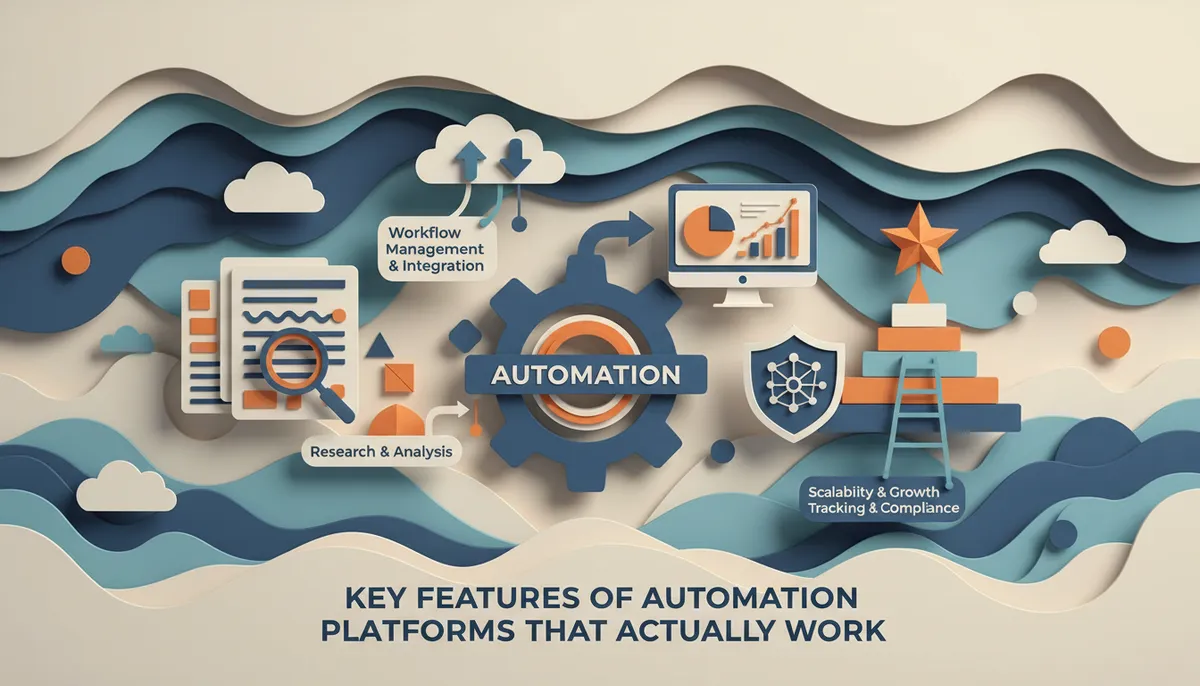
Key Features of Automation Platforms That Actually Work
Not all SEO content automation platforms deliver results. Many tools generate shallow 500-word posts, require constant manual editing, or fail to optimize for modern search engines. In 2026, working automation must include specific features that drive rankings and traffic.
When evaluating automation platforms, look for these critical features:
- Built-in keyword research engine with live SEO data (search volume, competition, and ranking difficulty).
- Long-form content generation (minimum 2,000-3,000 words per article) with proper structure and depth.
- AI search optimization for ChatGPT, Perplexity, Claude, Gemini, Copilot, and Grok, not just Google.
- Automated internal and external linking with contextually relevant anchor text.
- Real-time SEO scoring that flags issues and suggests fixes for metadata, readability, and structure.
- Direct CMS integration for WordPress, Webflow, Shopify, and Wix with automatic publishing.
- AI-generated images and video embeds to enhance engagement and reduce bounce rates.
- Visual content calendar that auto-fills with keyword opportunities and schedules articles.
These features eliminate manual work while maintaining quality. Automation should handle technical tasks like schema markup, metadata optimization, and link building so you can focus on strategy and growth.
Why Long-Form Content Matters for SEO Automation
Short articles do not rank in 2026. Google prioritizes comprehensive, in-depth content that fully answers user queries. Long-form content (2,000-3,000+ words) performs better because it covers topics thoroughly, includes semantic keywords naturally, and keeps readers on the page longer.
Automation platforms that only generate 500-1,500 word posts force you to manually expand content or accept poor rankings. Working automation produces long-form articles by default, structured with proper H2 and H3 headings, bullet lists, numbered steps, and detailed explanations.
Long-form content also captures more featured snippets and ranks for multiple related keywords. Instead of targeting one search term, a comprehensive 3,000-word article can rank for dozens of variations and long-tail queries.

How to Evaluate SEO Automation Tools in 2026
Choosing the right automation platform requires testing functionality, speed, and output quality. Many tools promise automation but still require significant manual work. Use this evaluation framework to identify platforms that actually deliver hands-free results.
Setup Speed and Complexity
Working automation should take less than 10 minutes to set up. If a platform requires hours of configuration, custom integrations, or technical expertise, it is not truly automated. Look for tools that connect directly to your website, auto-discover keyword opportunities, and start generating content immediately.
Ask these questions during setup:
- Does the platform connect to my CMS (WordPress, Webflow, Shopify, Wix) automatically?
- Can it discover keywords without manual input or research?
- Does it auto-populate a content calendar with publishing dates?
- Can I start generating articles on the same day I sign up?
Platforms that require complicated API setups, manual keyword uploads, or custom prompt engineering are not built for true automation.
Content Quality and Ranking Performance
Test content quality by generating sample articles before committing to a platform. Look for proper structure, natural keyword usage, accurate information, and engaging writing. Poorly written AI content hurts your brand and wastes time on edits.
Evaluate sample articles with this checklist:
- Does the article provide comprehensive coverage of the topic (2,000-3,000+ words)?
- Are headings descriptive and keyword-optimized without feeling forced?
- Does the content include bullet lists, numbered steps, and tables where appropriate?
- Are internal and external links contextually relevant and naturally placed?
- Does the article include original insights or just rehash common information?
- Is the tone consistent with your brand voice?
Quality automation produces content that requires minimal editing. If you spend hours rewriting every article, the automation is not working.
Cost Per Article vs. Agency Pricing
Traditional SEO agencies charge $3,000 to $5,000 per month for inconsistent content production and slow turnaround times. Working automation costs a fraction of that while delivering daily output and faster results.
Compare cost-per-article across different solutions:
| Solution | Monthly Cost | Articles Per Month | Cost Per Article |
|---|---|---|---|
| SEO Agency | $4,000 | 4-8 articles | $500-$1,000 |
| Freelance Writer | $2,000 | 8-10 articles | $200-$250 |
| Generic AI Tool | $200 | 20 articles (requires editing) | $10 + editing time |
| SEO Rocket Automation | $99 | 30 articles (fully automated) | $3.30 |
Automation that costs $99 per month and produces 30 fully optimized, published articles delivers significantly better ROI than agencies or freelancers. The key is ensuring the platform requires zero editing or manual work to achieve that cost efficiency.
AI Search Optimization: The 2026 Ranking Factor
Google is not the only search engine anymore. In 2026, AI platforms like ChatGPT, Perplexity, Claude, Gemini, Copilot, and Grok answer millions of queries daily. If your content does not appear in AI-generated answers, you miss massive traffic opportunities.
Working SEO automation must optimize content for AI search engines, not just Google. This means structuring articles so AI models can reference them as trusted sources, cite them in responses, and surface them in AI Overviews.
Here is how AI search optimization works in 2026:
- Clear, direct answers to common questions placed early in articles (ideal for featured snippets and AI citations).
- Structured data and schema markup that helps AI models understand content context and relevance.
- Authoritative citations and external links to trusted sources that establish credibility.
- Comprehensive topic coverage that makes your content the definitive source AI models reference.
- Consistent publishing that builds topical authority and signals expertise to AI algorithms.
Research shows 83% of companies with over 200 employees report measurable SEO performance improvements from AI use in 2026. Platforms like SEO Rocket build AI search optimization into every article automatically, ensuring your content ranks on Google AND gets referenced by AI search engines.
Agentic AI and Future-Proof Automation
Agentic AI represents the next evolution of automation. Instead of following fixed rules, agentic AI systems predict trends, identify content gaps, and optimize strategies dynamically based on real-time performance data.
In 2026, leading automation platforms use agentic AI to forecast which keywords will grow in popularity, recommend topics before competitors cover them, and adjust publishing schedules based on ranking velocity. This proactive approach keeps your content strategy ahead of market shifts.
Future-proof automation learns from your website’s performance and improves over time. It identifies which article types rank fastest, which internal linking patterns drive the most traffic, and which publishing frequencies maximize SEO growth.
Common Mistakes When Choosing SEO Automation
Many businesses waste money on automation tools that do not deliver results. Avoid these common mistakes when selecting a platform in 2026.
Choosing Tools That Require Manual Editing
If an automation tool generates rough drafts that need hours of editing, it is not truly automated. The entire point of automation is removing manual work. Tools that require constant prompt refinement, fact-checking, or rewriting defeat the purpose.
Look for platforms that produce publish-ready content out of the box. The best automation handles keyword research, writing, optimization, and publishing without requiring manual intervention after setup.
Ignoring Publishing Consistency
SEO success requires consistent publishing. Sporadic content production confuses search engines and fails to build topical authority. Platforms that do not automate daily publishing schedules leave gaps that hurt rankings.
Working automation publishes one article per day (or more for agency plans) without manual scheduling. Consistent output creates compounding SEO growth as Google indexes more pages and recognizes your site as an authoritative source.
Overlooking Integration with Marketing Automation
SEO content automation works best when integrated with broader marketing automation workflows. In 2026, leading platforms connect to email marketing, social media schedulers, and analytics dashboards to distribute content and measure performance automatically.
Choose automation that integrates with your existing marketing stack. This ensures published content gets promoted across channels, tracked for conversions, and optimized based on real-time feedback.
Why SEO Rocket Outperforms Traditional Automation
SEO Rocket is built specifically for businesses and agencies that want hands-free SEO content automation that actually ranks. Unlike generic AI tools that require constant editing or traditional SEO agencies that cost thousands per month, SEO Rocket delivers fully automated keyword research, long-form article generation, optimization, and publishing at $99 per month.
Here is what makes SEO Rocket different:
- Setup takes under 10 minutes: connect your website, review keyword opportunities, approve your content calendar, and SEO Rocket handles everything else.
- Daily publishing with zero maintenance: SEO Rocket generates and publishes one 3,000-word article per day automatically.
- Optimized for Google AND AI search engines: every article is structured for ChatGPT, Perplexity, Claude, Gemini, Copilot, and Grok citations.
- Real-time SEO scoring with automated fix suggestions: the platform flags issues and corrects metadata, headings, and links automatically.
- Direct publishing to WordPress, Webflow, Shopify, and Wix: no copy-pasting or manual uploads required.
- Unlimited rewrites and unlimited team members: refine content as needed without extra costs.
Traditional SEO agencies charge $3,000 to $5,000 per month and deliver inconsistent results. Freelance writers cost $200 per article and require project management. Generic AI tools generate shallow content that requires hours of editing. SEO Rocket costs $3.30 per article and produces fully optimized, published content automatically.
For agencies managing multiple clients, the Agency plan delivers 300 articles per month across 10 client workspaces for $799. This scales to approximately $2.67 per article while maintaining the same automation and quality.
Learn more about SEO Rocket’s pricing and features to see how automation drives better results at lower costs.
How to Get Started with SEO Content Automation in 2026
Starting with SEO content automation is straightforward when you choose the right platform. Follow this step-by-step process to launch automated content production quickly.
- Choose a platform with full automation: look for keyword research, long-form content generation, SEO optimization, and direct publishing in one tool.
- Connect your website: most platforms integrate directly with WordPress, Webflow, Shopify, and Wix through simple API connections.
- Review auto-discovered keywords: working automation identifies ranking opportunities based on your niche, competition, and search trends.
- Approve your content calendar: the platform should auto-populate a publishing schedule with targeted keywords and dates.
- Let automation run: once configured, the system should generate, optimize, and publish content daily without further input.
- Monitor performance: track rankings, traffic, and conversions through integrated analytics to measure ROI.
Setup should take less than 10 minutes. If a platform requires hours of configuration, custom prompts, or technical expertise, it is not built for true automation.
Testing and Optimizing Automated Content
Even the best automation benefits from periodic review. Schedule monthly check-ins to evaluate ranking performance, identify top-performing articles, and refine your keyword strategy based on real data.
Here is a simple monthly optimization workflow:
- Review which articles rank on the first page of Google within 30-60 days.
- Identify common patterns in top-performing content (word count, keyword usage, structure).
- Adjust future content strategy to emphasize high-performing topics and formats.
- Update older articles with new data, additional sections, or improved internal linking.
- Monitor AI search visibility by checking if your content appears in ChatGPT answers and Perplexity citations.
Automation handles daily execution, but strategic oversight ensures continuous improvement and maximizes ROI over time.
The Future of SEO Content Automation Beyond 2026
SEO content automation will continue evolving beyond 2026 as AI search engines become more sophisticated and ranking algorithms prioritize quality and authority. Platforms that adapt to these changes will dominate, while static tools fall behind.
Expect these trends to shape the future of automation:
- Deeper AI search integration: automation will optimize content specifically for ChatGPT citations, Perplexity answers, and Claude references, not just Google rankings.
- Predictive keyword discovery: agentic AI will forecast trending topics and recommend content before competitors identify opportunities.
- Automated video and multimedia generation: platforms will create video scripts, infographics, and interactive content automatically.
- Real-time content updates: automation will refresh articles dynamically based on new data, trending queries, and ranking changes.
- Personalized content for individual visitors: AI will generate unique variations of articles tailored to user behavior and preferences.
Businesses that adopt advanced automation now will build compounding SEO advantages that competitors cannot match. Consistent daily publishing creates topical authority that takes years to replicate.
Ready to Automate Your SEO Content?
SEO content automation works in 2026 when you choose a platform built for hands-free operation, long-form quality, and AI search optimization. Generic AI tools and traditional agencies cannot match the speed, cost efficiency, and consistency of true automation.
SEO Rocket delivers everything businesses and agencies need to rank consistently: automated keyword research, daily long-form article generation, real-time SEO optimization, and direct publishing to WordPress, Webflow, Shopify, and Wix. Setup takes under 10 minutes, and the platform requires zero monthly maintenance after configuration.
If you are ready to eliminate manual SEO work and start ranking faster, sign up for SEO Rocket today and get a free 3-day trial to see how automation transforms your content strategy. With plans starting at $99 per month for 30 fully automated articles, the ROI is immediate and measurable.
FAQs
Q: What is SEO content automation?
A: SEO content automation uses AI platforms to handle keyword research, article writing, optimization, and publishing automatically. Working automation eliminates manual work by generating long-form, SEO-optimized content daily without requiring constant editing or manual scheduling.
Q: Does automated content rank well on Google in 2026?
A: Yes, automated content ranks well when it is long-form (2,000-3,000+ words), properly optimized, and includes original insights. Human-in-the-loop automation performs best by combining AI drafting with human expertise to meet Google’s quality standards and E-E-A-T principles.
Q: How much does SEO content automation cost compared to agencies?
A: Traditional SEO agencies charge $3,000 to $5,000 per month for inconsistent output. Automation platforms like SEO Rocket cost $99 per month and produce 30 fully optimized articles, reducing cost per article to approximately $3.30 while delivering faster, more consistent results.
Q: Can automation optimize content for AI search engines like ChatGPT?
A: Yes, advanced automation platforms optimize content for AI search engines including ChatGPT, Perplexity, Claude, Gemini, Copilot, and Grok. This includes structuring articles for AI citations, adding clear answers early in content, and building topical authority that AI models recognize.
Q: How long does it take to set up SEO content automation?
A: Working automation platforms take less than 10 minutes to set up. You connect your website, review auto-discovered keywords, approve a content calendar, and the system handles everything else. Platforms requiring hours of configuration are not truly automated.