
Key Takeaways
-
By 2026, AI Overviews will reach over 1 billion users and traditional search volume could drop 25% as users shift to AI chat interfaces, making GEO essential alongside traditional SEO for complete search visibility.
-
GEO and traditional SEO are complementary strategies, not competitors—optimize content with clear structure, schema markup, FAQ blocks, and entity signals to rank in both Google results and AI-generated answers simultaneously.
-
AI systems prioritize content with direct answers, clear headings, FAQ sections, and schema markup; the same formats that win featured snippets in traditional SEO, creating significant overlap between both strategies.
-
Build topical authority through consistent, long-form (2,000+ word) structured content covering topics from multiple angles to signal expertise to both Google and AI systems while maintaining freshness.
-
Track AI citations, AI Overview appearances, and brand mentions using monitoring tools alongside traditional SEO metrics to measure GEO performance, as measurement capabilities are still evolving.
-
Content automation platforms can generate 3,000+ word schema-ready articles daily, enabling consistent publishing at scale needed to build topical authority and maintain visibility across both Google search and AI answers.
Search is changing fast. In 2026, it’s not enough to rank on page one. You also need to show up inside AI-generated answers. That’s where generative engine optimization (GEO) comes in.
GEO is the practice of optimizing your content so AI tools like ChatGPT, Perplexity, Google Gemini, and Google AI Overviews cite your brand in their answers. It’s a newer strategy, but it’s growing quickly. And it works alongside traditional SEO — not against it.
So which approach deserves your attention right now? Should you double down on traditional SEO, or shift your focus to GEO? The honest answer is: you need both. But understanding how they differ — and where they overlap — will help you build a smarter content strategy in 2026. Let’s break it all down in plain language.

What Is Generative Engine Optimization (GEO)?
Generative engine optimization is the process of making your content easy for AI systems to find, understand, and quote. When someone asks ChatGPT a question, it pulls from web sources it trusts. GEO helps your site become one of those trusted sources.
Think of it this way: traditional SEO helps you rank in Google’s blue-link results. GEO helps you show up inside the AI-written summaries that appear above, or instead of, those results. You can learn more in our guide on what is generative engine optimization (GEO).
GEO is closely related to answer engine optimization (AEO) and is often treated as an extra layer on top of SEO. You don’t replace your SEO strategy. You enhance it. If you’re curious how these disciplines compare side by side, check out the differences between AEO vs GEO vs LLMO.

What Is Traditional SEO?
Traditional SEO focuses on ranking your pages in search engine results pages (SERPs). The goal is simple: get your website onto page one of Google for keywords your audience searches.
It involves keyword research, on-page optimization, link building, and technical improvements. When done well, it drives consistent organic traffic to your site. You can explore the basics in our SEO content writing beginner’s guide for 2026.
Traditional SEO has been the backbone of digital marketing for over two decades. It still works. But it’s no longer the only game in town.
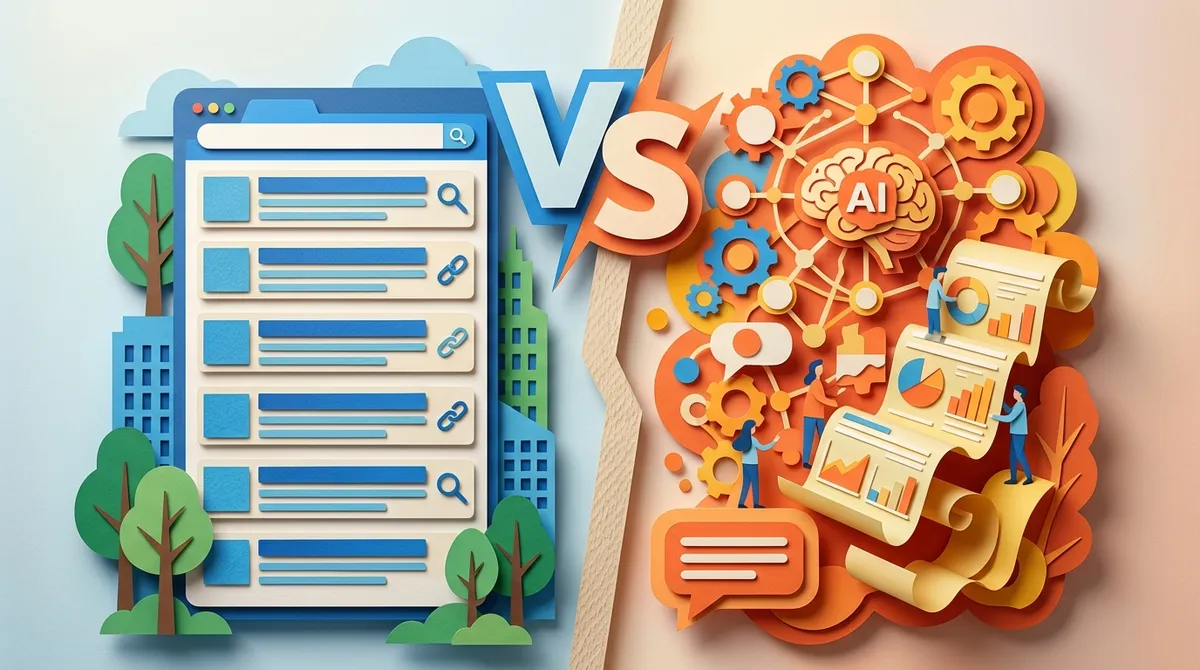
GEO vs. Traditional SEO: A Side-by-Side Comparison
Here’s a quick look at how these two strategies stack up across the most important factors:
| Factor | Traditional SEO | Generative Engine Optimization (GEO) |
|---|---|---|
| Goal | Rank in Google’s blue-link results | Get cited in AI-generated answers |
| Primary platforms | Google, Bing | ChatGPT, Perplexity, Gemini, AI Overviews |
| Key ranking signals | Backlinks, keywords, technical SEO | Structure, entities, authority, freshness |
| Content format | Long-form, keyword-rich pages | Clear answers, FAQ blocks, schema markup |
| Measurement | Rankings, organic traffic, clicks | AI citations, brand mentions, visibility |
| Maturity | Established, well-understood | Emerging, evolving rapidly |
| Replaces the other? | No | No — they work together |
As you can see, these strategies are more complementary than competitive. The smartest marketers in 2026 are doing both. To explore this comparison further, read our detailed article on GEO vs. SEO: which strategy wins in 2026.

Why GEO Matters More Than Ever in 2026
The numbers tell a clear story. Google said in 2024 that AI Overviews would reach more than 1 billion users by the end of that year. That’s a massive audience seeing AI-generated answers before they ever click a blue link.
Gartner predicted in 2024 that traditional search volume could drop by 25% by 2026 as users shift behavior toward AI chat interfaces. That prediction is playing out right now. If your content isn’t showing up in AI answers, you’re missing a growing slice of visibility. You can read more on how to improve your AI search visibility in 2026.
A BrightEdge study in 2024 found that AI Overviews appeared across a growing share of queries — especially informational searches. Those are exactly the kinds of searches your blog content targets. For deeper insights on this shift, explore what AI search means for your SEO strategy.
Key GEO Tactics That Actually Work
Good news: many GEO best practices align with what makes content great for traditional SEO too. Here are the top tactics to focus on:
1. Structure Your Content for AI Readability
AI systems love clear structure. Use descriptive headings, short paragraphs, and logical flow. Break up your content into sections that each answer a specific question. This makes it easy for AI to extract and quote the right information. Learn more about how to get cited on Google’s AI Mode.
2. Add FAQ-Style Content and Answer Blocks
AI systems favor content that directly answers questions. Add a clear FAQ section to important pages. Write answer blocks that start with a direct response in one or two sentences. This format helps with both GEO and traditional featured snippets. Our guide on how to get featured in AI Overviews covers this in depth.
3. Use Schema Markup
Schema markup tells AI and search engines what your content is about. It helps them trust and understand your pages faster. Use FAQ schema, Article schema, and Organization schema at minimum. This is one of the clearest GEO signals you can send. Explore 10 ways AI-powered schema markup automation boosts SEO.
4. Build Strong Entity Signals
Entity optimization means keeping your brand, product, and organization information consistent across the web. This includes your website, social profiles, Google Business Profile, and third-party mentions. AI systems use these signals to verify and trust your brand as a reliable source.
5. Earn Third-Party Mentions and Reviews
Digital PR, high-authority references, and reviews all help AI systems recognize your brand as trustworthy. When authoritative sites mention your brand, AI models are more likely to cite you in their answers. Think of it as link building — but for AI visibility.
6. Keep Content Fresh
AI systems often favor current information, especially for fast-changing topics like pricing, product details, and industry trends. Regular content updates signal freshness. Publishing new content consistently matters more than ever.
Where Traditional SEO Still Dominates
GEO is exciting, but traditional SEO isn’t going anywhere. Here are the areas where it still has a clear advantage:
- Local search: Google still dominates local intent queries. Traditional local SEO drives foot traffic and phone calls.
- E-commerce product pages: Shopping results and product rankings still rely heavily on classic SEO signals.
- High-competition keywords: Ranking for competitive terms still requires strong backlinks and domain authority.
- Technical site health: Page speed, crawlability, and Core Web Vitals remain foundational for all search visibility.
- Measurability: Traditional SEO metrics like rankings and organic traffic are easier to track and report on.
The Google Search Quality Rater Guidelines still apply fully to traditional search — and they increasingly influence GEO too, especially around E-E-A-T signals like experience, expertise, authoritativeness, and trustworthiness.
How to Build a Strategy That Covers Both
You don’t have to choose one or the other. Here’s a simple 5-step approach to running both strategies together:
- Do keyword research with intent in mind. Find informational keywords that attract both traditional search and AI-generated answer opportunities. Tools that show search intent make this much easier.
- Write long-form, structured content. Aim for 2,000+ word articles with clear headings, FAQ sections, and direct answer blocks. This format wins in both traditional SERPs and AI citations.
- Add schema markup to every page. Automate this where possible. Schema helps both Google and AI systems understand your content faster.
- Build topical authority through consistent publishing. Cover a topic from multiple angles. A strong topic cluster signals expertise to Google and AI systems alike. Our guide on how to build a topic cluster strategy is a great starting point.
- Monitor AI visibility and traditional rankings together. Track where your brand appears in AI answers alongside your keyword rankings. Both metrics matter now.
How Content Automation Supports Both GEO and Traditional SEO
Running both strategies manually is a lot of work. That’s where content automation tools shine. Platforms like SEO Rocket are built to handle both traditional SEO and GEO-friendly content at scale — automatically.
SEO Rocket generates 3,000+ word articles daily that are structured for AI citations, loaded with schema-ready formatting, and optimized for Google at the same time. It handles keyword research, content planning, writing, optimization, and publishing — all in one place. Setup takes under 10 minutes. You can explore how SEO Rocket works or browse the full feature list to see how it automates your entire content strategy.
For teams managing multiple clients or large websites, this kind of automation is a game-changer. Instead of spending hours manually writing and optimizing content, you get a consistent daily publishing system that’s built for both Google and AI search. You can also read our blog for the latest strategies, tips, and updates on SEO and GEO.
GEO Content Formats: What Works Best
Not all content formats perform equally well in generative search. Here are the formats most likely to earn AI citations:
- FAQ sections with direct, concise answers
- Definition paragraphs that clearly explain what something is
- Numbered lists for steps, rankings, or processes
- Comparison tables that organize information clearly
- Statistics and data points with clear sourcing
- Expert quotes and first-hand experience signals
Notice anything? These are also the formats that win featured snippets in traditional SEO. The overlap is real and significant.
Measuring GEO Performance
Measuring GEO is still evolving, but here are the key signals to track:
- Brand mentions in AI answers. Use tools that monitor whether your brand appears in ChatGPT, Perplexity, or Gemini responses for relevant queries.
- AI Overview appearances. Check Google Search Console and third-party tools to see how often your pages appear in AI Overviews.
- Zero-click traffic patterns. Watch for changes in impressions versus clicks. High impressions with low clicks can signal AI overview appearances.
- Referral traffic from AI platforms. Perplexity and other AI search tools can send direct referral traffic. Track this in your analytics.
As GEO matures, measurement tools will improve. For now, combining brand monitoring with traditional SEO analytics gives you the clearest picture. You can also check the SEO Rocket product roadmap to see upcoming GEO tracking features, and follow the SEO Rocket changelog for the latest platform updates.
The Bottom Line: Use Both, Automate Where You Can
GEO and traditional SEO are not rivals. They’re teammates. In 2026, the brands that win in search are the ones that show up both in Google’s blue-link results AND inside AI-generated answers.
The challenge is producing enough high-quality, structured content to compete on both fronts consistently. That’s why automation matters so much right now. Manual content production simply can’t keep up with the volume needed to build topical authority and maintain AI visibility at the same time.
If you’re ready to build a content system that works for both Google and AI search engines, get started with SEO Rocket today — or check out our simple pricing plans starting at $99/month to see which option fits your needs best.
FAQs
Q: What is generative engine optimization (GEO)?
A: Generative engine optimization (GEO) is the practice of optimizing your content so AI tools like ChatGPT, Perplexity, and Google Gemini cite your brand in their generated answers. It’s a newer layer on top of traditional SEO — and in 2026, it’s becoming essential for full search visibility.
Q: How is GEO different from traditional SEO?
A: Traditional SEO focuses on ranking in Google’s blue-link results, while GEO focuses on being cited inside AI-generated answers. They use slightly different tactics, but they share a foundation of great content, clear structure, and strong authority signals — so doing one well genuinely helps the other.
Q: What content formats work best for generative engine optimization?
A: FAQ sections, definition paragraphs, numbered lists, comparison tables, and direct answer blocks all perform well in GEO. These formats make it easy for AI systems to extract and quote your content — and they also happen to be great for traditional SEO featured snippets.
Q: How can I optimize for both GEO and traditional SEO at the same time?
A: The good news is that most GEO best practices — clear structure, schema markup, topical authority, and fresh content — also boost traditional SEO. Writing long-form, well-structured articles consistently is the most efficient way to improve visibility across both Google search and AI-generated answers.
Q: How does SEO content automation help with GEO?
A: Content automation platforms can produce structured, schema-ready articles daily — the exact format AI systems love to cite. Instead of spending hours writing and formatting content manually, automation lets you publish consistently at scale, which is one of the most important factors for both GEO and traditional SEO success.