Key Takeaways
-
GEO focuses on getting content cited in AI-generated responses, while SEO aims to rank higher in traditional search results and drive website traffic.
-
AI search engines evaluate content based on clarity, structure, and factual accuracy, not just keyword density.
-
Content should be optimized with clear headers, direct answers, and structured data to perform well in both traditional and AI search.
-
Success metrics differ: SEO tracks website traffic and rankings, while GEO measures citation frequency and brand mentions in AI outputs.
-
High-quality, well-structured content can perform effectively in both traditional search and AI-powered search engines.
-
Modern content automation platforms can simultaneously optimize content for SEO and GEO, reducing manual work.
-
Small businesses can compete in GEO by creating accurate, comprehensive content that AI models are likely to reference.
If you’re working in digital marketing, you’ve probably noticed something big happening. Search is changing. Fast. We’re not just talking about Google tweaking its algorithm again. We’re talking about a whole new way people find information online.
Two acronyms are battling for your attention: SEO and GEO. You know SEO—it’s been the bread and butter of online visibility for years. But GEO? That’s the new kid on the block, and it’s shaking things up in ways you need to understand right now.
Here’s the deal: AI search engines like ChatGPT, Perplexity, Claude, Gemini, Copilot, and Grok are changing how people search for answers. Instead of clicking through ten blue links, users are getting instant, synthesized responses. And if your content isn’t optimized for these AI engines, you’re missing out on a massive opportunity.
This article breaks down the real differences between GEO and SEO in 2026. You’ll learn what each strategy does, why both matter, and how modern content automation tools are helping businesses win on both fronts. Let’s jump in.

What Is SEO and Why Does It Still Matter?
SEO, or Search Engine Optimization, is the practice of improving your website’s visibility in traditional search engines like Google, Bing, and Yahoo. The goal? Rank higher in search results so more people click through to your site.
SEO focuses on keywords, backlinks, technical site health, and content quality. When someone types a query into Google, the search engine crawls billions of pages to find the most relevant matches. Your job is to make sure your content is one of those top matches.
In 2026, SEO isn’t dead—not even close. Google still processes over 8.5 billion searches per day. People still click on organic search results. Businesses still drive massive traffic and revenue through smart SEO strategies.
Core Elements of Traditional SEO
SEO has several key components that work together to boost your rankings:
- Keyword research: Finding the exact phrases your audience searches for
- On-page optimization: Using keywords strategically in titles, headers, and content
- Technical SEO: Ensuring fast load times, mobile-friendliness, and proper site structure
- Backlinks: Getting other reputable sites to link to your content
- Content quality: Creating valuable, informative articles that answer user questions
- User experience: Making sure visitors stay on your site and engage with content
Traditional SEO measures success through rankings, organic traffic, click-through rates, and conversions. If you rank on page one for your target keywords, you’re winning at SEO.
What Is GEO and Why It’s Becoming Critical
GEO stands for Generative Engine Optimization. It’s the practice of optimizing your content so AI-powered search engines cite, reference, or summarize your information in their generated responses.
Think about how you use ChatGPT or Perplexity. You ask a question, and the AI gives you a complete answer—often pulling information from multiple sources. GEO is about making sure YOUR content is one of those sources the AI references.
Instead of trying to rank #1 on a results page, GEO focuses on being mentioned, cited, or included in AI-generated answers. It’s a fundamentally different goal with fundamentally different tactics.
Why GEO Matters More Every Day
AI search is exploding. ChatGPT has over 200 million weekly active users. Perplexity is growing fast. Google’s AI Overviews now appear in billions of search results. People are getting answers without ever clicking a website link.
If your content isn’t optimized for these AI engines, you’re invisible in this new search landscape. GEO ensures you maintain visibility as search behavior shifts toward AI-generated responses.
Here’s what makes GEO different: AI engines don’t just look at keyword density or backlinks. They evaluate how clear, structured, and factually accurate your content is. They parse information in ways traditional crawlers never did.
The 7 Key Differences Between GEO and SEO
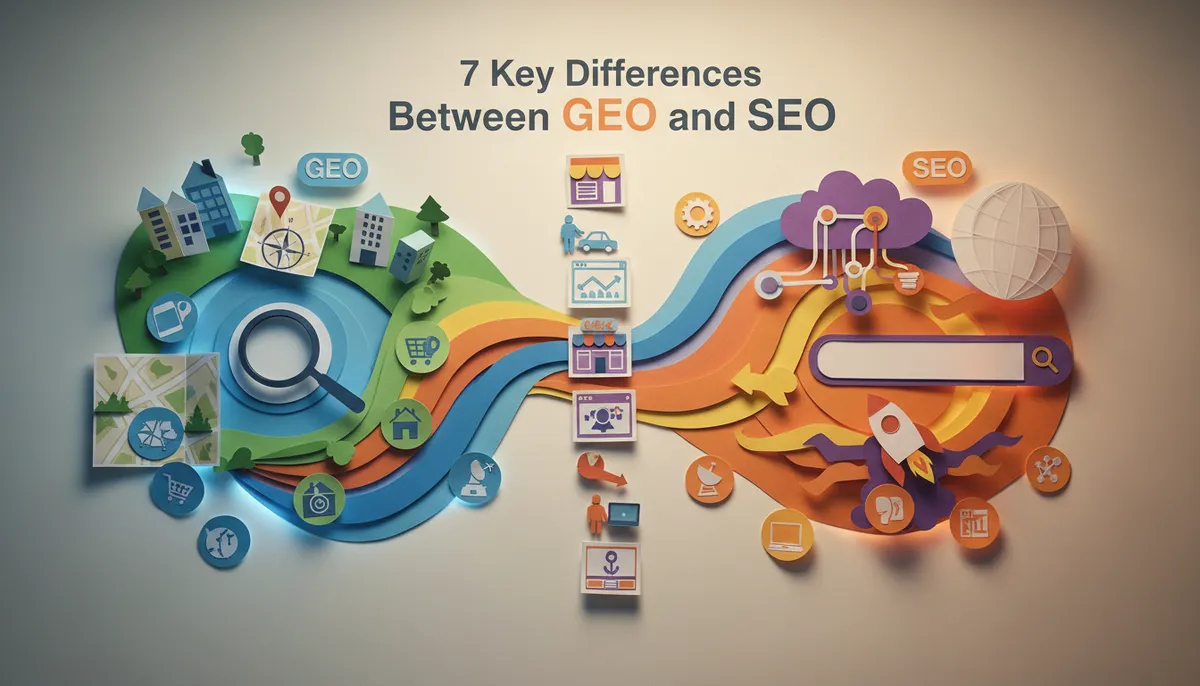
Understanding how GEO and SEO differ helps you create content that succeeds in both traditional and AI-powered search. Let’s break down the major distinctions.
1. Goal and Outcome
SEO aims to rank your page higher on search engine results pages so users click through to your website. The success metric is traffic—getting people to visit your site.
GEO aims to get your content cited or summarized within AI-generated responses. Success means being referenced as a source, even if users never click through to your site.
This is a massive shift in thinking. With SEO, you want the click. With GEO, you want the mention or citation within the AI’s answer.
2. Optimization Focus
Traditional SEO optimizes for keyword placement, meta descriptions, title tags, header hierarchy, and backlink profiles. You’re trying to match what search engine algorithms reward.
GEO optimizes for semantic completeness, factual precision, structured data, entity relationships, and conversational clarity. You’re making your content easy for AI models to understand and extract.
SEO asks: “Will this rank?” GEO asks: “Will an AI model cite this?”
3. Content Structure Requirements
SEO content typically follows long-form article structures with strategic keyword placement throughout. You might write 2,000-word articles optimized around specific search terms.
GEO content prioritizes scannable blocks, direct answers, statistical backing, and token-friendly chunking. AI models prefer information broken into digestible sections with clear headers and supporting data.
For example, GEO best practices suggest 40-word direct answers to questions and organizing content into roughly 800-token blocks that AI models can easily process and reference.
4. Success Metrics
SEO tracks rankings, organic traffic, click-through rates, bounce rates, time on page, and conversions. These metrics show how well you’re attracting and retaining visitors from search engines.
GEO tracks citation frequency, brand mentions in AI outputs, impression metrics in AI responses, and source attribution rates. You’re measuring visibility within AI-generated content rather than website traffic.
Both matter, but they measure completely different aspects of search visibility in 2026.
5. Technical Implementation
SEO implementation includes XML sitemaps, robots.txt optimization, schema markup for rich snippets, canonical tags, and internal linking strategies. You’re helping traditional crawlers understand your site structure.
GEO implementation emphasizes structured data specifically for AI parsing, entity markup, conversational phrasing, and semantic HTML that helps AI models extract meaning. You’re making your content machine-readable in a different way.
Modern content automation platforms now handle both SEO and GEO technical requirements automatically, saving massive amounts of manual work.
6. Keyword Strategy
SEO relies heavily on keyword research, keyword density calculations, long-tail keyword targeting, and exact-match optimization. You find keywords with good search volume and low competition.
GEO focuses more on intent mapping, natural language patterns, question-answer formatting, and topical authority over specific keyword density. AI models understand context better than keyword matching.
You still need keywords for GEO, but the approach is less about density and more about comprehensive coverage of a topic with clear, structured answers.
7. Link Building Approach
SEO values backlinks from high-authority domains as ranking signals. The more quality sites link to you, the more Google trusts your content.
GEO values source credibility and factual citations. AI models reference sites that provide accurate, well-sourced information regardless of traditional domain authority metrics.
Interestingly, studies show AI systems like ChatGPT will reference sites outside the top 10 Google results if those sites offer scoped, well-sourced explanations. This opens opportunities for newer sites with strong content.
How Content Automation Handles Both SEO and GEO
Here’s where things get exciting: you don’t have to choose between SEO and GEO. Modern content automation platforms integrate both optimization strategies into a single workflow.
SEO Rocket is built specifically for this dual-optimization approach. It automatically structures content to perform well in traditional Google search AND in AI-powered search engines like ChatGPT, Perplexity, Claude, and others.
Automated Semantic Structuring
Content automation tools chunk articles into AI-friendly blocks while maintaining SEO-optimized heading hierarchies. This means your content works for both Google’s crawlers and AI language models.
The platform automatically adds proper semantic HTML, entity markup, and structured data that both traditional search engines and AI models can parse effectively.
Intent Mapping Over Keyword Stuffing
Modern automation understands search intent rather than just matching keywords. It creates content that answers user questions comprehensively, which satisfies both SEO algorithms and AI citation requirements.
This approach produces articles that rank well in traditional search while also being cited frequently in AI-generated responses—the best of both worlds.
Factual Enhancement and Source Integration
Automated platforms integrate statistics, data points, and authoritative sources directly into content. This boosts E-E-A-T signals for SEO while also making content more likely to be cited by AI models.
AI engines prioritize factual accuracy. When your content includes verified data and proper sourcing, both traditional rankings and AI citations improve.
Why You Need Both Strategies Working Together
The future of search isn’t SEO OR GEO—it’s SEO AND GEO working in harmony. Here’s why both matter for your business in 2026 and beyond.
Traditional Search Isn’t Going Away
Despite AI’s rise, billions of people still use Google daily. They still click organic results. SEO-driven traffic remains a massive opportunity for businesses across all industries.
If you abandon SEO to focus only on GEO, you’re leaving money on the table. Traditional search traffic converts, builds brand awareness, and drives revenue.
AI Search Is Growing Exponentially
At the same time, AI search usage is skyrocketing. More people are asking ChatGPT, Perplexity, and other AI tools for answers instead of googling. Google itself is integrating AI Overviews into regular search results.
If you ignore GEO, you’re losing visibility in this rapidly growing search channel. Being cited in AI responses builds authority and reaches audiences who never click traditional search results.
High-Quality Content Succeeds at Both
The good news? The same high-quality, well-structured, factually accurate content performs well in both traditional and AI-powered search. You’re not creating two separate content strategies—you’re creating one excellent strategy that covers both bases.
Content that’s clear, comprehensive, properly structured, and backed by data will rank in Google AND get cited by AI models. Quality wins across the board.
Practical GEO and SEO Strategies for 2026
Let’s get tactical. Here are specific strategies you can implement right now to optimize for both GEO and SEO simultaneously.
Strategy 1: Structure Content with Clear Headers
Use descriptive H2 and H3 headers that summarize the content beneath them. This helps Google’s crawlers understand your content hierarchy while also helping AI models extract specific information sections.
Headers should answer specific questions or address specific subtopics. Think of each section as a standalone answer that could be cited independently.
Strategy 2: Provide Direct Answers Early
Start sections with clear, concise answers (around 40 words) before expanding with details. This satisfies both featured snippet optimization for SEO and citation-friendly formatting for GEO.
AI models often pull these direct answers when generating responses, while Google may feature them in position zero snippets.
Strategy 3: Integrate Statistics and Data
Include relevant numbers, percentages, dates, and research findings throughout your content. Cite authoritative sources for these data points.
This strategy boosts E-E-A-T for traditional SEO while making your content more citation-worthy for AI engines that prioritize factual accuracy.
Strategy 4: Use Lists and Tables
Break down complex information into numbered lists, bullet points, and comparison tables. These formats work beautifully for both human readers and AI parsing.
Lists improve readability (reducing bounce rate for SEO) while also creating scannable content blocks that AI models can easily reference.
Strategy 5: Answer Common Questions
Identify frequently asked questions related to your topic and answer them explicitly in your content. This targets both voice search optimization (SEO) and AI query responses (GEO).
Consider creating dedicated FAQ sections that address multiple related questions in one place.
Strategy 6: Automate Your Content Production
Manual optimization for both SEO and GEO is time-consuming. Automation platforms handle the technical heavy lifting while you focus on strategy and audience.
SEO Rocket’s automation handles keyword research, semantic structuring, metadata optimization, internal linking, image generation, and direct publishing—all optimized for both traditional and AI search.
This approach lets you publish daily content that compounds over time, building authority in both search channels without the manual workload.
Common Myths About GEO vs SEO
Let’s clear up some misconceptions floating around about these two strategies.
Myth 1: GEO Will Replace SEO
Not true. GEO is complementary to SEO, not a replacement. Both search methods coexist, and businesses need visibility in both channels to maximize reach.
Think of GEO as an expansion of your search strategy, not a replacement of existing tactics.
Myth 2: You Need Separate Content for Each
False. The same high-quality content optimized properly performs well in both traditional and AI search. You don’t need duplicate content strategies—just one excellent approach.
Smart structuring, clear writing, and factual accuracy benefit both SEO and GEO simultaneously.
Myth 3: GEO Doesn’t Drive Traffic
While GEO focuses on citations rather than clicks, being cited by AI engines builds brand authority, increases branded searches, and drives indirect traffic over time.
When ChatGPT or Perplexity mentions your business as a trusted source, readers remember that. They search for you directly later.
Myth 4: Small Businesses Can’t Compete in GEO
Actually, GEO can level the playing field. AI models cite content based on accuracy and completeness, not just domain authority. Smaller sites with excellent content can get cited alongside major brands.
This creates opportunities for businesses that might struggle to rank on page one in traditional SEO.
The Business Case for Dual Optimization
Let’s talk about the bottom line. Why should your business invest in both SEO and GEO optimization?
Maximize Your Visibility
By optimizing for both traditional and AI search, you capture audiences across multiple channels. Some people still Google and click links. Others ask ChatGPT and trust the AI’s recommendations. You need to show up in both places.
Dual optimization expands your total addressable audience significantly.
Future-Proof Your Strategy
Search behavior is evolving rapidly. Nobody knows exactly how the mix between traditional and AI search will shake out over the next few years. By covering both bases now, you’re protected regardless of how trends develop.
This hedging strategy protects your traffic and visibility as the search landscape continues changing.
Improve Content Quality Across the Board
The requirements for good GEO and good SEO overlap significantly. When you optimize for both, you’re forced to create genuinely excellent content—clear, accurate, well-structured, and comprehensive.
This quality improvement benefits your audience, your brand reputation, and your conversion rates beyond just search visibility.
Leverage Automation for Efficiency
Manual optimization for both strategies would be overwhelming. But automation makes it practical and affordable. Platforms like SEO Rocket generate and publish optimized content daily for roughly $3 per article—far less than hiring writers or agencies.
This efficiency makes dual optimization accessible even for small businesses and agencies managing multiple clients.
How SEO Rocket Optimizes for Both GEO and SEO
Let’s look specifically at how modern content automation handles both optimization strategies in one integrated platform.
Automated Keyword Discovery
The system starts with comprehensive keyword research that identifies opportunities in both traditional search and AI-powered queries. It finds questions people are asking across all search channels.
This dual-focused research ensures every article targets terms that work in Google AND in conversational AI search.
AI-Optimized Content Generation
SEO Rocket generates 3,000+ word articles structured specifically for AI readability while maintaining all traditional SEO best practices. Content includes proper headers, direct answers, supporting data, and natural language flow.
Each article is optimized for semantic completeness—covering topics thoroughly rather than just hitting keyword density targets.
Automatic Metadata and Markup
The platform automatically generates optimized meta titles, descriptions, alt text, and schema markup that benefits both traditional crawlers and AI parsing.
This technical optimization happens in the background—you don’t need to manually configure anything.
Daily Publishing for Compounding Growth
Consistent publishing is key for both SEO authority building and GEO citation opportunities. SEO Rocket publishes optimized articles daily, creating a growing library of content that ranks in traditional search while also being referenced by AI engines.
This daily cadence compounds over time. More content means more ranking opportunities and more potential citations.
Cross-Platform Optimization
The system doesn’t just optimize for Google—it structures content to perform well in ChatGPT, Perplexity, Claude, Gemini, Copilot, Grok, and other AI platforms. Your content reaches audiences wherever they search.
This multi-platform approach maximizes your total search visibility across the fragmented 2026 search landscape.
Getting Started with GEO and SEO Optimization
Ready to implement both strategies? Here’s how to get started, whether you’re doing it manually or using automation.
Manual Approach
- Conduct thorough keyword research that includes both search engine queries and conversational AI questions
- Create content outlines that address topics comprehensively with clear section headers
- Write articles that include direct answers, supporting data, proper structure, and natural language
- Optimize technical elements including meta tags, schema markup, and semantic HTML
- Publish consistently and track performance across both traditional and AI search channels
This approach works but requires significant time and expertise. Most businesses find it challenging to maintain this level of optimization manually.
Automated Approach
- Connect your website to an automation platform (takes about 10 minutes with SEO Rocket)
- Review automatically discovered keyword opportunities across both traditional and AI search
- Approve your content calendar with articles scheduled for daily publication
- Let the system handle generation, optimization, and publishing automatically
- Monitor performance and adjust strategy based on results
Automation dramatically reduces the time and expertise required while often producing better results through consistent optimization and daily publishing.
Measuring Success in Both Channels
How do you know if your dual optimization strategy is working? Track these key metrics.
Traditional SEO Metrics
- Keyword rankings for target terms
- Organic traffic volume and trends
- Click-through rates from search results
- Bounce rate and time on page
- Conversion rates from organic traffic
- Backlink growth and domain authority
GEO Metrics
- Citation frequency in AI-generated responses (test by querying AI platforms with relevant questions)
- Brand mention volume in AI outputs
- Source attribution rates when content is referenced
- Impression metrics in platforms that provide them
- Branded search volume (indirect indicator of AI citation impact)
Combined Success Indicators
- Total visibility across all search channels
- Overall traffic growth trends
- Lead generation and conversion improvements
- Brand awareness and authority increases
- Competitive positioning in both traditional and AI search
The Future of Search Optimization
Looking ahead, the lines between SEO and GEO will continue blurring. Future optimization will simply be “search optimization” that covers all channels where users look for information.
AI integration in traditional search engines means Google, Bing, and others will increasingly function like AI answer engines. Meanwhile, AI platforms will likely adopt more traditional ranking and source prioritization features.
The winning strategy will be creating genuinely excellent content that serves users regardless of how they search. Quality, clarity, accuracy, and comprehensive coverage will matter more than ever.
Businesses that start optimizing for both channels now will have a significant advantage as this convergence continues. Early adopters build authority in AI search before it becomes saturated, while maintaining their traditional search presence.
Conclusion: Win in Both Search Worlds
SEO and GEO aren’t competitors—they’re partners in a comprehensive search visibility strategy. Traditional search optimization gets you traffic from Google. Generative engine optimization gets you cited by AI platforms. Together, they maximize your reach across the evolving search landscape.
The key differences matter: SEO focuses on rankings and clicks, while GEO focuses on citations and mentions. SEO optimizes for keyword placement, while GEO optimizes for semantic completeness. But both require high-quality, well-structured, factually accurate content.
In 2026, you can’t afford to ignore either channel. People search in multiple ways, and your business needs visibility wherever your audience looks for information. The good news? Modern automation makes dual optimization practical and affordable.
Instead of choosing between SEO and GEO, choose both. Implement strategies that work across all search channels. Create content that ranks in Google AND gets cited by ChatGPT, Perplexity, and other AI platforms. Build a comprehensive search presence that drives results now and into the future.
Ready to dominate both traditional and AI search? Start automating your content optimization today and watch your visibility grow across every channel that matters.
FAQs
Q: What is Generative Engine Optimization (GEO)?
A: GEO is the practice of optimizing your content so AI-powered search engines like ChatGPT, Perplexity, Claude, and Gemini cite or reference your information in their generated responses. Unlike traditional SEO which focuses on rankings and clicks, GEO focuses on being mentioned as a trusted source within AI answers. It’s all about making your content clear, accurate, and structured in ways that AI models can easily understand and reference.
Q: Is GEO replacing traditional SEO in 2026?
A: No, GEO is not replacing SEO—it’s complementing it. Traditional search engines like Google still process billions of searches daily, and organic traffic remains a huge opportunity. GEO addresses the growing trend of AI-powered search, but both channels matter. The smartest strategy is optimizing for both traditional search and AI search simultaneously, since high-quality content performs well in both channels.
Q: How do I optimize content for both SEO and GEO?
A: Focus on creating clear, well-structured content with descriptive headers, direct answers to questions, supporting statistics, and proper semantic markup. Use lists and tables to organize information, answer common questions explicitly, and ensure factual accuracy throughout. Modern content automation platforms like SEO Rocket handle the technical optimization for both channels automatically, making dual optimization much easier than manual approaches.
Q: What metrics measure GEO success?
A: GEO success is measured by citation frequency in AI-generated responses, brand mentions in AI outputs, source attribution rates, and increases in branded search volume. You can test this by querying AI platforms with relevant questions to see if your content gets referenced. Unlike SEO metrics that focus on rankings and clicks, GEO metrics track how often AI engines cite your content as a trusted source.
Q: Can small businesses compete with GEO optimization?
A: Absolutely! GEO actually levels the playing field because AI models cite content based on accuracy and completeness, not just domain authority or backlink profiles. Smaller businesses with excellent, well-structured content can get cited alongside major brands. This creates opportunities that might not exist in traditional SEO where established sites dominate rankings. Focus on quality, clarity, and comprehensive coverage to win at GEO.