
Key Takeaways
-
Choose all-in-one automated DIY SEO platforms that handle keyword research, content creation, optimization, and publishing in one workflow to avoid wasting time juggling multiple disconnected tools.
-
Publish consistently and frequently (daily is ideal) because Google rewards regular publishing with faster crawling and indexing; automated platforms enable this without manual effort.
-
Target keywords based on intent and audience match, not just search volume, by using tools that reveal intent signals and competition levels to ensure content reaches the right people.
-
Create long-form content (3,000+ words) with clear subheadings, structured data, and internal links since Google consistently rewards comprehensive, in-depth articles over thin content.
-
Optimize content for both Google and AI search engines by structuring articles with clear headings and direct answers, as AI traffic through ChatGPT and Perplexity is now a significant traffic source.
-
Track performance metrics monthly including organic impressions, keyword rankings, traffic trends, and conversion rates to identify what’s working and continuously refine your strategy.
So you’ve decided to take your SEO into your own hands. That’s a smart move. DIY SEO software has made it easier than ever for small teams and business owners to grow organic traffic without hiring expensive agencies. But here’s the thing — most people make the same avoidable mistakes that quietly sabotage their results.
Whether you’re a small business owner, an in-house marketer, or running a content team, the tools you choose and how you use them matter enormously. Done right, DIY SEO can help you grow from hundreds to hundreds of thousands of daily impressions. Done wrong, it wastes your time and budget with little to show for it.
In this article, we’ll walk through the seven most common DIY SEO software mistakes — and show you exactly how to avoid them. Let’s make sure your SEO efforts actually pay off.

Mistake 1: Choosing Tools That Require Too Much Manual Work
One of the biggest mistakes people make with DIY SEO software is picking tools that require hours of manual work each week. You download a tool, run a report, export a spreadsheet, copy it into another tool, write the content yourself, and then manually publish it. That’s not DIY — that’s a second full-time job.
The best DIY SEO platforms handle the heavy lifting for you. They automate keyword research, content creation, optimization, and publishing in one seamless workflow. If your current setup involves juggling five different tools, you’re doing it the hard way. You can see how a fully automated SEO system works to understand what true automation looks like.
Here’s what a good DIY SEO tool should automate for you:
- Keyword discovery and opportunity mapping
- Content brief and article generation
- On-page optimization and metadata
- Internal linking across your site
- Direct publishing to your CMS
- Performance tracking and reporting
If your tool is missing most of these, it’s time to upgrade.
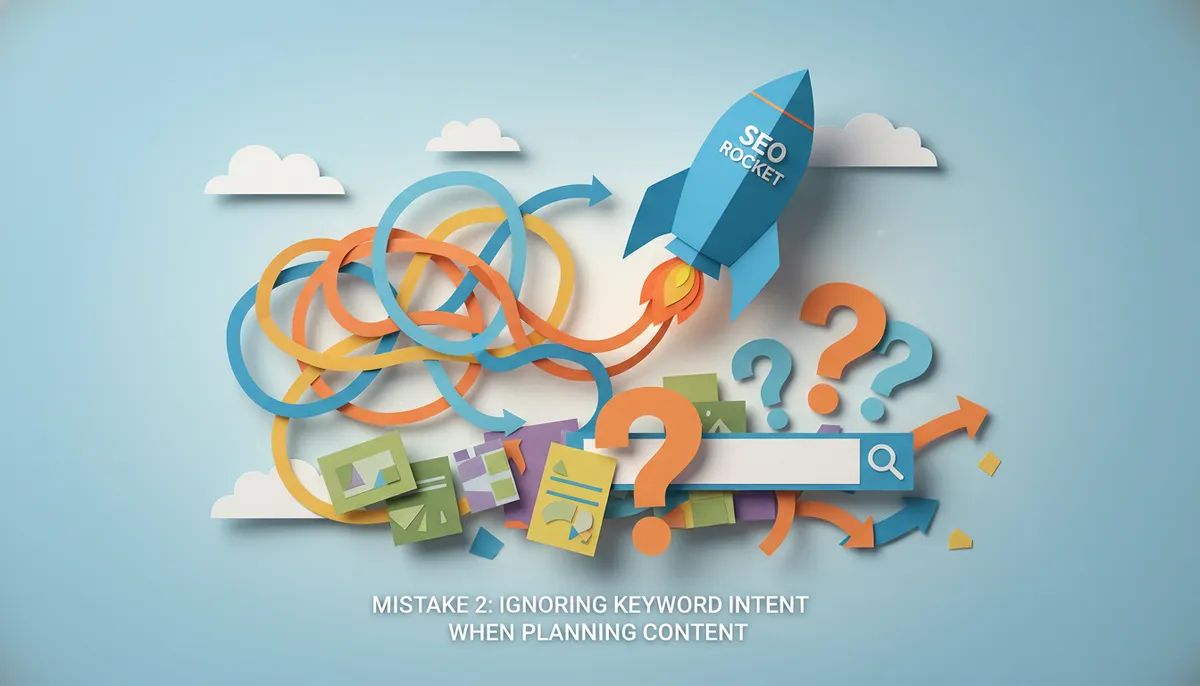
Mistake 2: Ignoring Keyword Intent When Planning Content
Many people pick keywords based on search volume alone. High volume looks impressive, but it means nothing if the people searching that term aren’t your target audience. Keyword intent — what someone actually wants when they type a query — is what drives conversions and rankings.
Good DIY SEO software shows you more than just volume. It reveals intent signals, competition levels, and whether a keyword is worth targeting based on your site’s current authority. If you’re skipping this step, you’re writing content for the wrong audience. For a deeper look at how to approach this, check out this SEO content writing guide for 2026.
When evaluating keywords, always ask:
- Is the searcher looking to buy, learn, or compare?
- Does this keyword match what my business actually offers?
- Can my site realistically rank for this term right now?
- Will ranking for this keyword bring in the right kind of traffic?

Mistake 3: Publishing Inconsistently
This is one of the most damaging mistakes you can make. Publishing three blog posts in January and then going quiet until April sends mixed signals to search engines. Google rewards sites that publish consistently. When you publish regularly, Google crawls your site more often and indexes your content faster.
The problem is that consistency is hard when you’re doing everything manually. Life gets busy. Deadlines stack up. Before you know it, two months have passed without a new post. That’s why content automation exists — to keep the publishing engine running even when you’re slammed. You can read about daily blog posting strategies that actually drive results to see how consistency translates into real traffic growth.
The compounding effect of daily publishing is massive. Consider this:
| Publishing Frequency | Monthly Articles | Articles After 6 Months | Expected Traffic Growth |
|---|---|---|---|
| Once per week | 4 | 24 | Moderate |
| 3x per week | 12 | 72 | Significant |
| Daily (automated) | 30 | 180 | Compounding |
Automated daily publishing isn’t just convenient — it’s a genuine competitive advantage.

Mistake 4: Writing Short, Thin Content
Short articles used to work. Those days are mostly gone. In 2026, Google consistently rewards in-depth, well-structured content that genuinely answers a searcher’s full question. Thin content — posts under 800 words with surface-level information — rarely ranks for competitive terms.
Many DIY SEO tools generate short articles of 500 to 1,500 words. That might seem like enough, but it usually isn’t. Comprehensive articles that cover a topic thoroughly tend to earn more backlinks, get more social shares, and rank for more related keyword variations. You can explore how AI blog writing produces long-form content that ranks effectively.
Here’s what quality long-form SEO content typically includes:
- 3,000+ words covering the topic in full depth
- Clear subheadings that answer related questions
- Structured data and FAQ sections
- Internal links to relevant pages on your site
- External references to build credibility
- Optimized images and metadata
Mistake 5: Optimizing Only for Google (Not AI Search)
Here’s a mistake that’s become more costly in 2026 than ever before. Most people using DIY SEO software only think about Google rankings. But a growing share of search traffic now flows through AI tools — ChatGPT, Perplexity, Claude, Gemini, and others. If your content isn’t structured to appear in AI answers and overviews, you’re missing a major traffic source.
AI search optimization — sometimes called Answer Engine Optimization (AEO) — requires content that’s clearly structured, factually accurate, and written in a way that AI models can easily reference. This means well-organized headings, direct answers, and authoritative writing. Check out this helpful resource on improving your AI search visibility in 2026 to get ahead of this trend.
You should also read up on how to get featured in AI Overviews — it’s a game-changer for organic visibility that most businesses are still ignoring.
Mistake 6: Not Tracking What’s Actually Working
You can’t improve what you don’t measure. Many people using DIY SEO software set it up, publish content, and then never look at the data. They don’t know which articles are driving traffic, which keywords are ranking, or which pages are converting visitors into customers.
Modern SEO automation platforms connect directly with Google Search Console and analytics tools to surface this data automatically. You should know at a glance which content is performing and where your best opportunities lie. According to Google’s Search Quality Rater Guidelines, content that demonstrates real expertise and is clearly useful to readers is what earns and maintains strong rankings — and tracking performance data helps you refine toward that standard.
The metrics you should monitor regularly include:
- Organic impressions and clicks from Google Search Console
- Keyword ranking positions for your target terms
- Pages that are gaining or losing traffic month over month
- Conversion rate from organic traffic to leads or sales
- Crawl errors and indexing issues affecting your site
Mistake 7: Spending Too Much on Too Many Tools
The DIY SEO tool market is huge. There are tools for keyword research, tools for content writing, tools for optimization, tools for publishing, tools for reporting — and the costs add up fast. Many businesses end up spending $300 to $500 per month on a patchwork of tools that don’t even talk to each other well.
This is both expensive and inefficient. When your tools don’t integrate seamlessly, you spend time manually transferring data between platforms. You also lose the compounding benefits of having one system that understands your full content strategy from keyword to published article.
Here’s a comparison of the typical DIY SEO tool cost landscape in 2026:
| Tool Type | Example Cost/Month | Limitation |
|---|---|---|
| Keyword research tool | $99–$165+ | No content generation |
| AI writing tool | $49–$99 | No keyword research or publishing |
| Content optimization tool | $15–$115 | No automation or scheduling |
| Publishing/scheduling tool | $20–$50 | No SEO features |
| All-in-one automated platform | $99 | None — everything included |
The math makes it obvious. An all-in-one platform is not just more affordable — it’s more effective because every part of the workflow is connected. You can explore SEO Rocket’s simple pricing to see how much you save compared to stacking multiple tools.
What Good DIY SEO Software Actually Looks Like
Now that we’ve covered what to avoid, let’s talk about what to look for. The best DIY SEO software in 2026 does more than generate a keyword list. It turns your entire SEO content operation into a system that runs on autopilot.
Platforms like SEO Rocket are built specifically for this. Setup takes under 10 minutes. You connect your website (WordPress, Webflow, Shopify, or Wix), approve your keyword opportunities, and the system generates and publishes one fully optimized, 3,000+ word article per day. That’s 30 high-quality articles per month at roughly $3 per article — a fraction of what you’d pay an agency or freelancer.
Every article includes:
- AI-generated images and metadata
- Automatic internal and external linking
- Real-time SEO scoring with fix suggestions
- Optimization for both Google and AI search engines
- Direct publishing to your CMS — no copy-pasting required
If you’re curious about how AI-powered content generation compares across platforms, this breakdown of the best AI blog writers compared for 2026 is worth a read. And if you’re still deciding which approach is right for you, this guide on how to choose the best AI blog post writer for your business walks through the key decision points clearly.
How to Avoid These Mistakes Starting Today
Avoiding these seven mistakes doesn’t require a huge budget or a team of SEO experts. It mostly comes down to choosing the right tool and setting up a system that runs consistently without constant manual effort.
Here’s a quick action plan to get started:
- Audit your current tools. List everything you’re paying for and identify gaps or overlaps.
- Choose a platform that covers the full workflow. Keyword research, content creation, optimization, and publishing should all connect.
- Set up a consistent publishing schedule. Daily is best. Weekly is acceptable. Less than weekly won’t give you the momentum you need.
- Optimize for AI search, not just Google. Structure your content with clear headings, direct answers, and authoritative facts.
- Track your results monthly. Know which content is ranking and double down on what’s working.
Want to go deeper on any of these steps? Our SEO Rocket blog covers all of them in detail, and you can also browse the FAQs page to get answers to common questions about SEO automation. You can also stay up to date with new platform capabilities by checking out the latest platform changelog for recent updates.
Conclusion
DIY SEO software is one of the smartest investments a business can make in 2026. It puts powerful, agency-level SEO capabilities in your hands without the agency price tag. But only if you use it correctly. Avoiding these seven common mistakes — choosing manual tools, ignoring keyword intent, publishing inconsistently, writing thin content, skipping AI optimization, not tracking results, and overspending on disconnected tools — puts you miles ahead of most competitors.
The goal isn’t just to have SEO software. It’s to have an SEO system that works for you every single day, even when you’re focused on running your business. That’s exactly what automated DIY SEO platforms are designed to deliver.
Ready to stop making these mistakes and start building a content engine that actually grows your traffic? Try SEO Rocket free for 3 days and see what fully automated SEO content looks like in action — no long setup, no manual work, just consistent results.
FAQs
Q: What is DIY SEO software and who is it best for?
A: DIY SEO software is a self-service platform that lets you manage your own SEO without hiring an agency. It’s ideal for small business owners, in-house marketing teams, content managers, and digital consultants who want reliable organic traffic without the high agency costs.
Q: Can DIY SEO software really replace an SEO agency?
A: For most small to mid-sized businesses, yes! Modern DIY SEO platforms automate the same tasks agencies handle — keyword research, content creation, optimization, and publishing — at a fraction of the cost. Traditional agencies often charge $3,000–$5,000/month, while automated platforms start at just $99/month.
Q: How long does it take to see results with DIY SEO software?
A: Results vary depending on your site’s authority and how consistently you publish. That said, businesses that publish daily using automated content platforms have reported dramatic growth — one case study showed a jump from 700 to over 750,000 daily impressions in just three months. Consistency is the key ingredient!
Q: Does DIY SEO software help with AI search engines like ChatGPT and Perplexity?
A: The best DIY SEO platforms in 2026 are built for AI search as well as Google. Look for tools that optimize content structure for Answer Engine Optimization (AEO), which helps your content appear inside AI Overviews and responses from tools like ChatGPT, Perplexity, Claude, and Gemini.
Q: How much does good DIY SEO software cost in 2026?
A: Pricing ranges widely depending on features. Individual tools for keyword research, writing, or optimization each cost $15–$165 per month. An all-in-one automated platform that handles everything from keyword discovery to daily publishing can cost as little as $99/month — making it far more cost-efficient than stacking multiple tools.