
Key Takeaways
-
GEO (Generative Engine Optimization) won’t replace SEO, but both are now essential—SEO drives clicks and traffic from Google, while GEO gets your content cited by AI models like ChatGPT and Perplexity as direct answer sources.
-
Optimize for both SEO and GEO simultaneously by writing 2,000-3,000+ word comprehensive content with clear H2/H3 headings, numbered lists, bullet points, and direct answers to questions in opening paragraphs.
-
AI models prioritize long-form, well-structured, authoritative content with E-E-A-T signals (Experience, Expertise, Authoritativeness, Trustworthiness)—thin 500-word articles won’t get cited or ranked effectively.
-
Publishing consistency is critical for both strategies; aim for at least weekly publishing, ideally daily, to build authority and earn AI citations; single articles won’t generate sustained visibility.
-
Common costly mistakes include treating GEO and SEO as separate strategies, ignoring AI search entirely, failing to structure content properly for AI parsing, and overlooking author credentials and backlinks that signal trustworthiness.
-
Automation tools enable daily publishing at scale without manual writing effort, making consistent content production feasible for small teams while maintaining quality standards for both search platforms.
The search landscape is changing fast. If you run a business or manage content, you’ve probably noticed that AI tools like ChatGPT, Perplexity, Claude, and Google’s AI Overviews now answer questions directly—without requiring users to click through to a website. This shift has introduced a new term: GEO, or Generative Engine Optimization. And it raises an urgent question: Will GEO replace SEO?
The short answer is no—but that doesn’t mean you can ignore it. GEO and SEO are evolving together, and if you want your content to stay visible in 2026 and beyond, you need to understand both. This article breaks down the key differences, what’s changing, and how you can adapt without starting from scratch.
Let’s clear up the confusion and help you future-proof your content strategy.
What Is GEO and Why Does It Matter?
GEO stands for Generative Engine Optimization. It’s the practice of optimizing content so AI models can find it, understand it, and use it as a trusted source when generating answers. Think of it as SEO for AI search engines like ChatGPT, Perplexity, Claude, Gemini, Copilot, and Grok.
Here’s why it matters: traditional search engines show you a list of links. AI search engines give you direct answers. If your content isn’t structured to be referenced by AI, you become invisible in this new search experience.
GEO focuses on making your content clear, authoritative, and easy for AI to cite. It’s not about gaming the system—it’s about earning trust with AI models the same way you’ve always earned trust with Google.
How GEO Differs From SEO
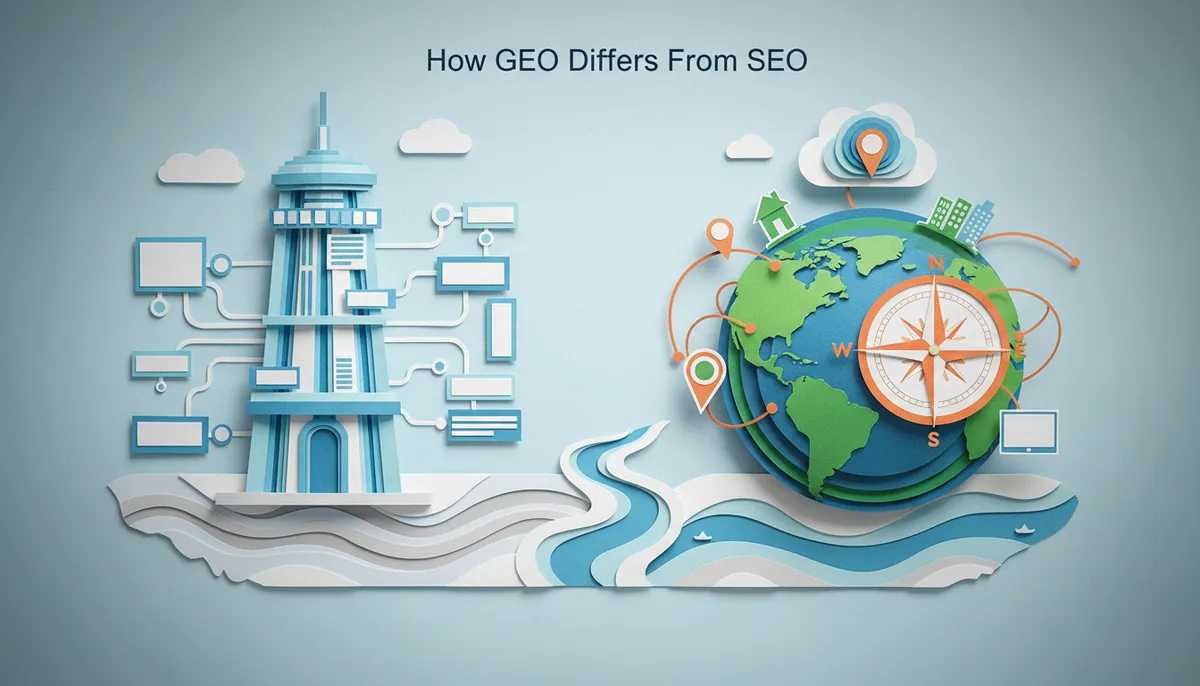
SEO and GEO share the same goal: getting your content in front of people who are searching for it. But the tactics are different because the platforms work differently.
SEO Focuses on Rankings
SEO is about ranking high on search engine results pages (SERPs). You optimize for keywords, build backlinks, improve page speed, and focus on user experience. The goal is to get clicked.
GEO Focuses on Citations
GEO is about being cited by AI models. When someone asks ChatGPT or Perplexity a question, the AI pulls information from trusted sources and generates an answer. If your content is one of those sources, you get visibility—even if the user never clicks your link.
This is a fundamental shift. With SEO, you compete for position 1 through 10. With GEO, you compete to be referenced inside the answer itself.
|
Factor |
SEO |
GEO |
|---|---|---|
|
Platform |
Google, Bing |
ChatGPT, Perplexity, Claude, Gemini |
|
User Action |
Click a link |
Read AI-generated answer |
|
Goal |
Rank high in results |
Be cited as a source |
|
Content Style |
Keyword-focused |
Clear, structured, authoritative |
|
Success Metric |
Organic traffic |
AI citations + brand mentions |

Why SEO Isn’t Going Anywhere
Despite all the hype around AI search, SEO is not dead. In fact, it’s still the foundation of online visibility. Here’s why SEO will remain essential in 2026 and beyond:
-
Google still dominates search volume. Billions of searches happen on Google every day. People still rely on traditional search for shopping, local services, product comparisons, and detailed research.
-
SEO drives traffic to your website. GEO might get you cited, but SEO gets you clicks. Clicks turn into leads, sales, and email subscribers.
-
Google is integrating AI. Google’s AI Overviews are just enhanced search results. They still rely on the same ranking factors SEO has always used: quality content, backlinks, E-E-A-T (Experience, Expertise, Authoritativeness, Trustworthiness), and technical performance.
-
SEO builds long-term authority. A well-optimized website with consistent content earns trust with both users and search engines. That trust compounds over time.
SEO isn’t being replaced—it’s being expanded. The principles you’ve been following (quality content, keyword research, user experience) still work. You just need to apply them to new platforms.
The Biggest Mistakes Businesses Make With GEO
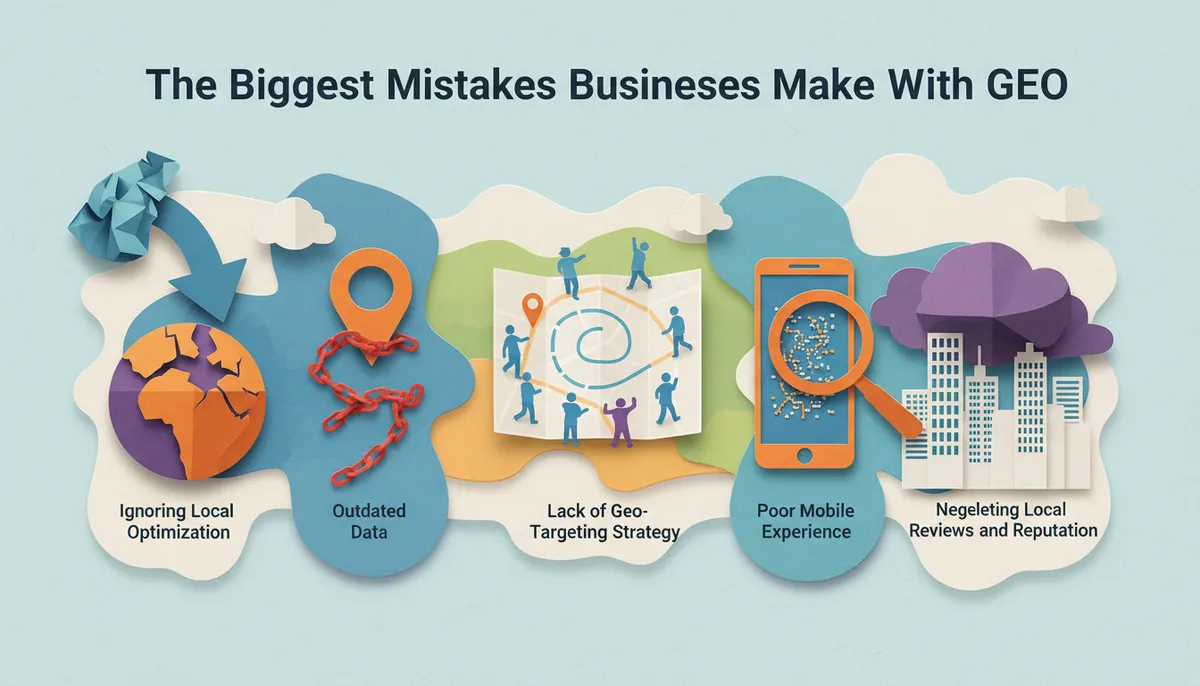
As GEO gains traction, many businesses are making avoidable mistakes. Here are the most common ones:
Ignoring AI Search Completely
Some businesses assume AI search is a trend that will fade. That’s a risky bet. AI search usage is growing fast, and early adopters are already capturing visibility while others wait.
Treating GEO and SEO as Separate Strategies
GEO and SEO aren’t competing strategies—they’re complementary. If you optimize only for Google and ignore AI, you miss out. If you optimize only for AI and ignore Google, you lose traffic. The smart move is to do both.
Writing Short, Thin Content
AI models prefer long-form, detailed content because it provides more context and value. If your articles are only 500 words, you’re not giving AI enough to work with. Aim for 2,000 to 3,000+ words packed with useful information.
Failing to Structure Content Properly
AI models rely on structure to understand content. If your article lacks clear headings, lists, and organized sections, it’s harder for AI to cite. Use H2 and H3 tags, numbered lists, and bullet points to make your content easy to parse.
Not Publishing Consistently
Both SEO and GEO reward consistency. Publishing one great article won’t cut it. You need a steady stream of optimized content to build authority and earn citations over time.
Overlooking E-E-A-T Signals
AI models prioritize authoritative sources. If your content lacks author credentials, citations, or trustworthy backlinks, you won’t get cited. Make sure your content demonstrates expertise and credibility.
How to Optimize for Both SEO and GEO in 2026
The good news is that optimizing for GEO doesn’t mean abandoning SEO. In fact, many GEO best practices overlap with what you’re already doing. Here’s how to cover both bases:
Write Long-Form, Comprehensive Content
Both Google and AI models prefer detailed, in-depth articles. Aim for at least 2,000 words per post. Cover the topic thoroughly, answer common questions, and provide actionable advice.
Use Clear, Descriptive Headings
Headings help both search engines and AI models understand your content structure. Use H2 and H3 tags with descriptive, keyword-rich headings that clearly indicate what each section covers.
Include Numbered Lists and Bullet Points
Lists make your content scannable for users and easier for AI to extract. Use numbered lists for steps, rankings, or sequences. Use bullet points for features, benefits, or quick takeaways.
Answer Questions Directly
AI models love clear, direct answers. If someone searches “How do I optimize for GEO?” your content should provide a straightforward answer in the first paragraph, then elaborate.
Add Structured Data and Schema Markup
Schema markup helps search engines and AI models understand your content better. Use FAQ schema, article schema, and how-to schema to make your content more accessible.
Build Authority With Backlinks and Citations
AI models trust sources that are already trusted by others. Earn backlinks from authoritative sites, cite credible sources in your content, and establish your brand as a thought leader in your industry.
Publish Daily or Weekly
Consistency signals authority. Publishing one optimized article per day builds momentum over time. This is where automation tools like SEO Rocket make a huge difference—they handle the heavy lifting so you can focus on strategy.
The Role of Automation in SEO and GEO
Here’s the reality: optimizing for both SEO and GEO manually takes a lot of time. Keyword research, content writing, optimization, publishing, and tracking performance can eat up hours every day. That’s why automation is becoming essential.
Platforms like SEO Rocket are built to handle the entire content workflow—from keyword discovery to daily publishing. The system identifies keyword opportunities, generates long-form articles optimized for both Google and AI search engines, and publishes them directly to your website.
Why Automation Works for SEO and GEO
-
Speed: You can produce and publish optimized content daily without spending hours writing.
-
Consistency: Automation ensures you never miss a publishing day, which builds authority over time.
-
Quality: Automated tools can generate 3,000+ word articles that meet both SEO and GEO standards.
-
Scalability: Whether you manage one website or ten, automation scales without adding manual work.
-
Cost Efficiency: Automation costs a fraction of hiring writers, agencies, or freelancers.
If you’re serious about staying visible in 2026, automation isn’t optional—it’s strategic. Sign up for SEO Rocket and see how automated content can transform your traffic and rankings.
What the Future Looks Like for SEO and GEO
So, will GEO replace SEO? Not entirely. But GEO will become just as important—and in some cases, more important—for certain types of searches.
Here’s what we expect in the coming years:
-
AI search usage will grow. More people will use ChatGPT, Perplexity, and other AI tools for quick answers, research, and recommendations.
-
Google will blend SEO and GEO. Google’s AI Overviews are already doing this. They pull from the same content that ranks well in traditional search, but present it differently.
-
Content depth will matter more. Thin, generic content will lose visibility on both platforms. Long-form, authoritative content will dominate.
-
Brand mentions will become a ranking factor. AI models cite sources they trust. Building brand recognition and earning mentions across the web will boost your visibility.
-
Automation will become standard. Businesses that rely on manual content creation will struggle to keep up. Automated platforms will handle the bulk of content production while humans focus on strategy and creativity.
How to Get Started Today
If you’re ready to optimize for both SEO and GEO, here’s a simple action plan:
-
Audit your existing content. Identify which articles are already long-form and well-structured. Update them with better headings, lists, and clear answers.
-
Start publishing consistently. Aim for at least one optimized article per week. If you can publish daily, even better.
-
Focus on topics your audience cares about. Use keyword research to find opportunities where you can provide real value.
-
Structure your content for AI. Use headings, lists, tables, and direct answers to make your content easy to parse.
-
Automate what you can. Use tools like SEO Rocket to handle keyword research, content generation, and publishing so you can scale without burning out.
The businesses that win in 2026 will be the ones that adapt early. Don’t wait until your competitors are already dominating AI search. Start optimizing now.
Common Questions About GEO and SEO
Let’s address some of the most common concerns business owners and marketers have about this shift:
Do I Need to Rewrite All My Old Content?
No. Focus on updating your best-performing articles first. Add structure, expand the content, and make sure it answers questions clearly. You don’t need to start from scratch.
Can I Rank Well on Google and Still Be Cited by AI?
Absolutely. In fact, content that ranks well on Google is often the same content AI models cite. The overlap is significant, especially if you follow E-E-A-T principles and write comprehensive, authoritative articles.
Is GEO Only for Big Brands?
Not at all. Small businesses and individual creators can compete in GEO just as effectively as large brands. AI models care about content quality and authority, not company size. If you publish valuable, well-structured content consistently, you can earn citations.
How Long Does It Take to See Results?
Just like SEO, GEO is a long-term strategy. You might see citations within a few weeks, but building consistent visibility takes months of publishing. The key is consistency and quality.
Final Thoughts
Will GEO replace SEO? No. But GEO is becoming just as critical for online visibility in 2026. The businesses that thrive will be the ones that optimize for both—leveraging the traffic and authority SEO provides while earning citations and brand mentions through GEO.
The shift to AI search isn’t something to fear. It’s an opportunity to reach new audiences, build authority, and future-proof your content strategy. The sooner you adapt, the bigger your advantage.
If you’re ready to start publishing optimized content daily without spending hours on manual work, get started with SEO Rocket for just $99 per month. Automate your entire SEO and GEO workflow, publish 3,000+ word articles every day, and watch your visibility grow across Google and AI search engines.
The future of search is here. Make sure your content is ready for it.
FAQs
Q: Will GEO completely replace SEO?
A: No, GEO won’t replace SEO. They work together. SEO drives traffic from Google and traditional search engines, while GEO helps you get cited by AI models like ChatGPT and Perplexity. You need both for full visibility in 2026.
Q: Do I need different content for SEO and GEO?
A: Not really. The best practice is to create long-form, well-structured content that works for both. Use clear headings, lists, and direct answers. This makes your content easy for Google to rank and easy for AI to cite.
Q: How can I optimize my content for AI search engines?
A: Focus on writing comprehensive, authoritative content with clear structure. Use H2 and H3 headings, numbered lists, bullet points, and answer questions directly. Publish consistently and build authority through backlinks and citations.
Q: Is GEO only important for big businesses?
A: No, GEO is valuable for businesses of all sizes. AI models care about content quality and authority, not company size. Small businesses and creators can compete effectively by publishing valuable, well-structured content regularly.
Q: How long does it take to see results from GEO?
A: Like SEO, GEO is a long-term strategy. You might see AI citations within a few weeks, but building consistent visibility takes months. The key is publishing high-quality content regularly and building authority over time.