
Key Takeaways
-
Dual optimization for both traditional SEO and AI-powered search (GEO) is now essential in 2026; optimizing only for Google means missing millions of users asking questions to ChatGPT, Perplexia, and Claude instead.
-
Daily publishing with 2,500-3,500 word articles is critical; a business publishing daily generates 365 articles yearly versus 12 monthly, creating 30x more content for rankings and establishing topical authority that AI tools favor.
-
GEO requires fundamentally different optimization than traditional SEO: AI models prioritize comprehensive explanations, structured data, and authoritative answers rather than keyword placement and exact-match phrases.
-
Topical authority matters more than individual keywords; websites with 50 related articles on a subject outperform sites with one perfectly optimized article because AI evaluates your overall expertise across topics.
-
Well-structured content with clear headers, lists, tables, and FAQ sections is essential for both SEO and GEO; AI models use structure to evaluate credibility and extract accurate information for citations.
-
Automation platforms are now practical necessities, not luxuries; manually producing daily long-form articles costs $5,000+ monthly in writer/editor salaries versus $99-200 for automated systems handling both SEO and GEO.
-
Short-form content (500-1,000 words) fails in 2026; first-page Google results average 2,500+ words, and AI models need substantial information to generate accurate answers and cite your content as a source.
-
Track both SEO and GEO metrics separately: monitor keyword rankings and organic traffic for traditional search, plus AI citation frequency and referral traffic from ChatGPT and Perplexia to measure complete search visibility.
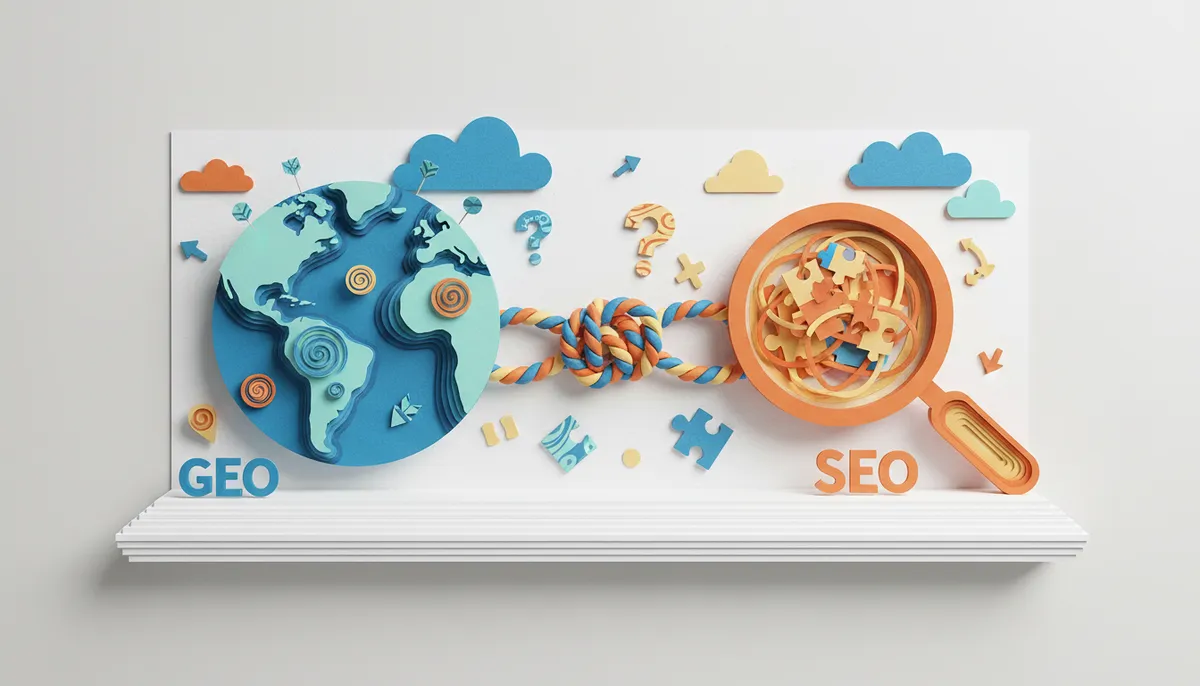
The search landscape has changed dramatically in 2026. While most businesses focus exclusively on traditional SEO (Search Engine Optimization), a new player has entered the game: GEO (Generative Engine Optimization). Understanding the difference between these two approaches can mean the difference between ranking in Google and appearing in AI-powered answers from ChatGPT, Perplexity, Claude, and other AI search tools.
Many businesses are making critical mistakes by treating GEO and SEO as the same thing, or worse, ignoring GEO entirely. This guide will help you understand both strategies, avoid common pitfalls, and build a content approach that works for both traditional and AI-powered search in 2026.
Let’s explore what separates these two approaches and why getting this wrong could cost you thousands of visitors every month.

What is SEO and Why It Still Matters
SEO remains the foundation of organic visibility. It’s the practice of optimizing your website and content to rank higher in traditional search engines like Google, Bing, and Yahoo. When someone types a query into Google, SEO determines whether your website appears on page one or gets buried on page ten.
Traditional SEO focuses on several key elements:
-
Keyword research and targeting specific search terms
-
On-page optimization including title tags, meta descriptions, and header structure
-
Technical SEO elements like site speed, mobile responsiveness, and crawlability
-
Backlinks from authoritative websites pointing to your content
-
User experience signals like time on page and bounce rate
-
Content quality, depth, and relevance to search intent
In 2026, SEO continues to drive significant traffic for businesses. Google still processes over 8.5 billion searches per day, making it an essential channel for customer acquisition. The challenge is that SEO has become increasingly competitive, with businesses fighting for limited top-ranking positions.
The Traditional SEO Publishing Approach
Most businesses approach SEO by publishing occasional blog posts when they have time. This sporadic publishing creates inconsistent results. Search engines reward websites that publish regularly and demonstrate topical authority through comprehensive content coverage.
Here’s where many businesses make their first mistake: they publish one article, wait for results, then publish another weeks or months later. This approach fails because search engines prioritize websites with consistent publishing schedules and deep topic coverage.
Tools like SEO Rocket solve this problem by automating daily content creation and publishing, ensuring your website maintains the consistency that search engines reward.

Understanding GEO: The New Frontier of Search Visibility
GEO (Generative Engine Optimization) is the practice of optimizing content so AI-powered search tools cite your website as a source when generating answers. Unlike traditional search engines that show a list of links, AI search tools like ChatGPT, Perplexity, Claude, Gemini, and Copilot generate direct answers by synthesizing information from multiple sources.
When someone asks ChatGPT a question in 2026, it doesn’t just retrieve pre-indexed results like Google. Instead, it generates a custom answer by understanding the query and pulling relevant information from sources it trusts. If your content is structured correctly, AI tools will reference your website as a source.
How GEO Differs From Traditional SEO
The fundamental difference lies in how visibility is achieved:
|
Aspect |
SEO (Traditional) |
GEO (AI-Powered) |
|---|---|---|
|
Goal |
Rank in search results pages |
Get cited in AI-generated answers |
|
Content Format |
Keyword-focused articles |
Structured, authoritative explanations |
|
User Experience |
Click-through to website |
Answer displayed with source attribution |
|
Optimization Focus |
Keywords, backlinks, technical elements |
Clarity, authority, structured data |
|
Traffic Source |
Google, Bing, Yahoo |
ChatGPT, Perplexity, Claude, Gemini |
GEO requires content that AI models can easily understand and trust. This means clear explanations, factual accuracy, proper structure, and demonstrable expertise. Articles optimized for GEO tend to be longer, more comprehensive, and focused on answering questions thoroughly rather than just targeting keywords.
Mistake #1: Treating GEO and SEO as the Same Thing
The biggest mistake businesses make in 2026 is assuming that content optimized for Google automatically works for AI search tools. While there’s overlap, the optimization strategies differ significantly.
Traditional SEO content often focuses heavily on keyword placement, exact-match phrases, and optimizing for specific search terms. This approach works for Google’s algorithm, which still relies on keyword matching and relevance signals.
GEO-optimized content prioritizes comprehensive explanations, natural language, and authoritative answers. AI models don’t just look for keywords; they evaluate whether your content provides trustworthy, complete information that answers user questions accurately.
Why This Mistake Costs You Traffic
When you optimize only for traditional SEO, you miss opportunities in AI-powered search. Millions of users now ask questions directly to ChatGPT, Perplexity, and other AI tools instead of typing queries into Google. If your content isn’t optimized for these platforms, you’re invisible to this growing audience.
The solution isn’t choosing one over the other. The smart approach in 2026 is dual optimization: creating content that ranks in Google while also getting cited by AI search tools. Platforms like SEO Rocket are built specifically to handle both SEO and GEO optimization automatically.

Mistake #2: Publishing Too Infrequently
Both SEO and GEO reward consistent publishing, yet most businesses publish sporadically. They might write one article per month or publish in bursts followed by long periods of silence. This inconsistency undermines both traditional search rankings and AI citation opportunities.
Search engines use publishing frequency as a signal of authority and relevance. Websites that publish daily demonstrate commitment to their topic and provide fresh content that keeps users coming back. AI models similarly favor sources that regularly update their knowledge base with current information.
The Compounding Effect of Daily Publishing
Consider this scenario:
-
A business publishes one article per month for twelve months (12 articles total)
-
Another business publishes one article per day for twelve months (365 articles total)
-
The second business has 30 times more content competing for rankings
-
Each article creates internal linking opportunities and topical authority
-
The cumulative effect creates exponential growth in traffic over time
Daily publishing isn’t just about quantity. It’s about building comprehensive topical coverage that establishes your website as an authority. When AI tools look for sources to cite, they gravitate toward websites with depth and breadth on a subject.
Manual daily publishing is unrealistic for most businesses. This is why automation through platforms like SEO Rocket’s daily posting system has become essential in 2026.
Mistake #3: Ignoring Content Length and Depth
Short articles (500-1,000 words) rarely succeed in 2026. Both traditional search engines and AI models favor comprehensive, in-depth content that thoroughly addresses topics.
Google’s algorithm has evolved to reward content depth. Articles that comprehensively cover a subject, answer related questions, and provide detailed explanations consistently outrank superficial content. The average first-page result in 2026 contains over 2,500 words.
Why AI Models Prefer Long-Form Content
AI search tools need substantial information to generate accurate answers. When ChatGPT or Perplexity synthesizes a response, it pulls details from sources that provide complete explanations rather than surface-level summaries.
Long-form content offers several advantages:
-
Greater opportunity to demonstrate expertise and authority
-
More comprehensive coverage of subtopics and related questions
-
Better context for AI models to understand your perspective
-
Higher likelihood of matching diverse user queries
-
Stronger signals of content quality and trustworthiness
The mistake many businesses make is creating short articles because they’re easier to produce. While this saves time initially, it costs traffic long-term. A single 3,000-word comprehensive article will outperform three 1,000-word superficial pieces.
Platforms designed for both SEO and GEO, like SEO Rocket, automatically generate 3,000+ word articles that satisfy both traditional search engines and AI models.
Mistake #4: Neglecting Structured Information
Both SEO and GEO benefit from well-structured content, but most businesses publish unstructured walls of text. Proper content structure helps search engines understand your content hierarchy and helps AI models extract accurate information.
Structured content includes:
-
Clear heading hierarchy (H2, H3 tags) that organizes information logically
-
Numbered lists for sequential steps or ranked information
-
Bullet points for features, benefits, or non-sequential items
-
Tables comparing options, pricing, or specifications
-
Schema markup providing additional context to search engines
-
FAQ sections answering common questions directly
How Structure Impacts AI Citations
When AI models scan your content to determine if it’s a credible source, they evaluate how information is organized. Clear structure signals professionalism and makes it easier for AI to extract specific facts or explanations.
For example, if your article about email marketing includes a table comparing different platforms, an AI model can quickly reference that table when answering questions about feature differences. Without that structure, the AI might skip your content in favor of a better-organized source.
Similarly, traditional SEO benefits from structure through featured snippets and rich results. Google pulls information from well-structured content to display in position zero, above traditional search results.
Mistake #5: Focusing Only on Keywords Instead of Topics
Traditional keyword-focused SEO is evolving into topic-focused optimization. Both Google and AI search tools now understand topics holistically rather than just matching individual keywords.
The old approach targeted specific keywords:
-
Find a keyword with search volume
-
Write an article targeting that exact phrase
-
Optimize title, headers, and content for the keyword
-
Hope to rank for that one term
The modern approach builds topical authority:
-
Identify a topic cluster relevant to your business
-
Map out all subtopics and related questions
-
Create comprehensive content covering the entire topic
-
Interlink related articles to demonstrate expertise
-
Establish authority across the topic, not just individual keywords
Why Topical Authority Matters for GEO
AI models don’t just look at individual articles in isolation. They evaluate your website’s overall expertise on a subject. If you’ve published dozens of articles about content marketing, AI tools recognize you as an authority and are more likely to cite your content.
This is why comprehensive topic coverage matters more than targeting individual high-volume keywords. A website with 50 related articles on a subject will outperform a site with one perfectly optimized article.
Building topical authority requires consistent content creation across a subject area. Manual content production struggles to achieve this scale, which is why businesses increasingly rely on automated content systems that can produce daily articles covering topic clusters comprehensively.
Building a Dual SEO-GEO Strategy for 2026
The most effective approach in 2026 combines both SEO and GEO optimization. Rather than choosing one over the other, successful businesses optimize for traditional search engines and AI-powered search simultaneously.
Key Elements of a Dual Strategy
A comprehensive SEO-GEO strategy includes:
-
Daily Publishing Schedule: Consistent content creation that builds authority over time
-
Long-Form Content: Articles of 2,500-3,500 words that thoroughly cover topics
-
Clear Structure: Organized content with headers, lists, tables, and logical flow
-
Topical Clusters: Comprehensive coverage of related subjects rather than isolated keywords
-
Authority Signals: Expert-level explanations that demonstrate deep knowledge
-
Natural Language: Conversational tone that AI models can easily process
-
Updated Information: Current facts and examples relevant to 2026
-
Source Attribution: References to authoritative sources that boost credibility
Automation as the Practical Solution
Executing this strategy manually is overwhelming for most businesses. Writing one 3,000-word article takes hours of keyword research, writing, editing, and optimization. Doing this daily is simply impractical without dedicated content teams.
This is where automation becomes essential. Modern content platforms can handle the entire process:
-
Automated keyword research identifying opportunities
-
AI-powered article generation producing long-form content
-
Optimization for both SEO and GEO simultaneously
-
Scheduling and publishing directly to your website
-
Internal linking to build topical authority
-
Performance tracking to measure results
The investment in automation pays off quickly. Compare the cost of hiring writers, editors, and SEO specialists (potentially $5,000+ per month) to automated platforms at a fraction of the price. SEO Rocket starts at $99 per month and handles everything automatically.
Measuring Success in SEO vs GEO
Traditional SEO metrics are well-established: keyword rankings, organic traffic, backlinks, and domain authority. GEO metrics are newer but equally important in 2026.
|
Metric Category |
SEO Measurements |
GEO Measurements |
|---|---|---|
|
Visibility |
Keyword rankings in Google |
Citation frequency in AI answers |
|
Traffic |
Organic visitors from search engines |
Referral traffic from AI platforms |
|
Authority |
Domain authority and backlinks |
Source attribution and trust signals |
|
Engagement |
Time on page and bounce rate |
Answer completeness and accuracy |
Tracking GEO Performance
Measuring GEO success requires new approaches. Monitor how often AI tools reference your content by:
-
Querying ChatGPT, Perplexity, and Claude with questions your content answers
-
Checking if your website appears as a cited source
-
Tracking referral traffic from AI platforms in analytics
-
Monitoring brand mentions in AI-generated responses
-
Evaluating the quality and accuracy of AI citations
As AI search grows in 2026, businesses that track both traditional SEO and GEO metrics gain a competitive advantage. They can optimize their strategy based on comprehensive data rather than focusing on just one channel.
The Cost of Getting SEO and GEO Wrong
Mistakes in either SEO or GEO optimization carry real financial consequences. Consider the impact of these common errors:
Publishing inconsistently means you produce 12 articles per year while competitors publish 365. Each missed article is a missed ranking opportunity. Over time, this gap compounds, leaving you with a fraction of the traffic competitors generate.
Focusing only on short articles (under 1,500 words) might feel efficient, but these articles rarely rank or get cited by AI. You spend time creating content that delivers minimal results, wasting resources on ineffective work.
Ignoring GEO entirely means you’re invisible to the growing population using AI search tools. In 2026, millions of people get information from ChatGPT, Perplexity, and similar platforms. If your content isn’t optimized for these tools, you miss this entire audience.
The Opportunity Cost Calculation
Let’s calculate the actual cost of these mistakes:
-
Average value per website visitor: $5 (conservative estimate)
-
Daily publishing generates approximately 1,000 additional monthly visitors within 6 months
-
Monthly traffic value: 1,000 visitors × $5 = $5,000
-
Annual traffic value: $5,000 × 12 = $60,000
-
Over 3 years, the missed opportunity costs $180,000+ in potential revenue
These aren’t hypothetical numbers. Businesses that implement consistent, dual-optimized publishing strategies see measurable traffic growth that directly impacts revenue. The ROI of improving AI search visibility compounds over time as content accumulates and authority builds.
Choosing the Right Tools for SEO and GEO Success
The tools you use determine whether your SEO and GEO strategy succeeds or fails. Traditional approaches require multiple platforms:
-
Keyword research tools for finding opportunities
-
Writing tools or hiring writers for content creation
-
SEO plugins for optimization
-
Scheduling tools for planning publication
-
Analytics platforms for tracking performance
Managing five or more separate tools creates complexity, costs add up quickly, and the manual work between platforms wastes time.
The All-in-One Automation Advantage
Modern content automation platforms consolidate these functions into one system. Everything happens automatically from keyword discovery through publication.
For example, SEO Rocket handles:
-
Built-in keyword research with live SEO data
-
Automated long-form article generation (3,000+ words)
-
Dual optimization for both Google SEO and AI-powered GEO
-
Visual content calendar for planning
-
Direct publishing to WordPress, Webflow, Shopify, and Wix
-
Real-time SEO scoring with automated fix suggestions
-
Internal linking and business mention automation
-
Unlimited rewrites and team member access
The time savings alone justify automation. Instead of spending 4-6 hours creating each article manually, automation reduces this to minutes of setup time. For businesses publishing daily, this represents hundreds of hours saved monthly.
Cost efficiency is equally compelling. Manual content creation through freelancers costs $100-300 per article. Agencies charge $3,000-5,000 per month for content services. Automated platforms deliver the same output at a fraction of the cost, often around $3 per article.
Implementation: Getting Started with Dual Optimization
Implementing a successful SEO-GEO strategy doesn’t require months of preparation. With the right approach, you can start seeing results within weeks.
Step-by-Step Implementation Process
-
Audit Current Content: Evaluate what you’ve already published and identify gaps in topical coverage
-
Map Topic Clusters: Define the main topics relevant to your business and related subtopics
-
Set Up Automation: Choose a platform that handles both SEO and GEO optimization
-
Build Content Calendar: Schedule articles covering your topic clusters systematically
-
Enable Auto-Publishing: Let automation handle daily content creation and publication
-
Monitor Performance: Track both traditional SEO metrics and GEO citation frequency
-
Adjust Strategy: Refine topics and approaches based on performance data
The entire setup process takes under 10 minutes with modern automation platforms. Connect your website, review discovered keyword opportunities, approve your content calendar, and the system handles everything else.
This contrasts sharply with traditional SEO setup, which can take weeks of keyword research, content planning, writer onboarding, and workflow development. Automation eliminates these barriers and lets you start publishing immediately.
The Future of Search: Why Both SEO and GEO Matter
Looking ahead, the search landscape will continue evolving. Traditional search engines aren’t disappearing, but AI-powered search is growing rapidly. By 2027, analysts predict that 40% of all search queries will happen through AI tools rather than traditional engines.
Businesses that optimize for both channels position themselves for success regardless of how search evolves. If traditional SEO remains dominant, your Google rankings drive traffic. If AI search takes over, your GEO-optimized content gets cited. Most likely, both channels will coexist, and dual optimization captures traffic from both sources.
The mistake to avoid is betting everything on one approach. Focusing only on traditional SEO leaves you vulnerable if AI search adoption accelerates. Focusing only on GEO ignores the massive existing traffic from Google and other traditional engines.
Preparing for Continued Evolution
Search technology will keep changing. New AI models will emerge, algorithms will evolve, and user behavior will shift. The constant in this evolution is the need for high-quality, comprehensive, well-structured content that demonstrates expertise.
Whether future search happens through Google, ChatGPT, or platforms that don’t exist yet, content that thoroughly addresses topics, provides clear answers, and demonstrates authority will remain valuable. Investing in this content foundation prepares you for whatever changes come next.
Automated content systems adapt more easily to algorithm changes than manual processes. When Google updates its ranking factors or AI models change how they evaluate sources, automated platforms can adjust optimization strategies across your entire content library. Manual content requires individual updates, making adaptation slow and expensive.
Taking Action: Moving Beyond Mistakes to Results
Understanding the mistakes is valuable, but implementation drives results. The businesses that succeed in 2026 move quickly from learning to execution.
Start by acknowledging where you currently stand. Are you publishing consistently? Is your content long-form and comprehensive? Are you optimizing for both SEO and GEO? Most businesses answer no to at least one of these questions, revealing clear opportunities for improvement.
The next step is choosing your implementation approach. You can build an in-house content team, hire an agency, or implement automation. Each option has tradeoffs:
|
Approach |
Monthly Cost |
Setup Time |
Scalability |
|---|---|---|---|
|
In-House Team |
$8,000-15,000+ |
1-3 months |
Limited by headcount |
|
Agency Services |
$3,000-8,000 |
2-4 weeks |
Limited by contract |
|
Automation Platform |
$99-799 |
Under 10 minutes |
Unlimited |
For most businesses, automation provides the best combination of affordability, speed, and scalability. The cost per article drops to around $3, setup happens in minutes, and scaling means adding more keywords to your calendar rather than hiring more people.
If you’re ready to implement a comprehensive SEO-GEO strategy that actually drives traffic, start your free trial with SEO Rocket today. You’ll see firsthand how automation transforms content production from a manual chore into a systematic growth engine.
Conclusion: Stop Making These Costly Mistakes
The five mistakes we’ve covered represent the most common and expensive errors businesses make when approaching SEO and GEO in 2026:
-
Treating GEO and SEO as identical strategies
-
Publishing too infrequently to build authority
-
Creating short articles instead of comprehensive content
-
Neglecting proper content structure
-
Focusing on keywords instead of topical authority
Each mistake costs you traffic, authority, and revenue. Together, they can mean the difference between a thriving online presence and invisibility in search results.
The good news is that these mistakes are completely avoidable. Modern content automation makes it possible to publish daily, create long-form articles, maintain proper structure, and build topical authority without massive teams or budgets.
The businesses winning in 2026 understand that consistent, comprehensive, dual-optimized content is non-negotiable for growth. They’ve moved beyond treating content creation as an occasional task and transformed it into a systematic process that compounds results over time.
Ready to stop making these costly mistakes and start seeing real results from your content? Get started with SEO Rocket for just $99 per month and let automation handle your entire SEO and GEO strategy. Your future traffic growth starts with the decision to publish consistently today.
FAQs
Q: What is the main difference between GEO and SEO?
A: SEO (Search Engine Optimization) focuses on ranking in traditional search engines like Google, while GEO (Generative Engine Optimization) optimizes content to be cited by AI-powered search tools like ChatGPT, Perplexity, and Claude. SEO aims for click-throughs from search results, whereas GEO aims for source attribution in AI-generated answers.
Q: Do I need to choose between SEO and GEO strategies?
A: No, the best approach in 2026 is dual optimization that targets both traditional search engines and AI-powered search simultaneously. Content optimized for both channels captures traffic from Google while also getting cited by AI tools, maximizing your overall visibility and reach.
Q: How often should I publish content for effective SEO and GEO?
A: Daily publishing delivers the best results for both SEO and GEO in 2026. Consistent daily content builds topical authority, demonstrates expertise to search engines and AI models, and creates compounding traffic growth over time. Automated platforms make daily publishing practical and affordable.
Q: Why does content length matter for GEO optimization?
A: AI models prefer comprehensive, in-depth content because they need substantial information to generate accurate answers. Articles of 2,500-3,500 words provide the context and detail that AI search tools look for when deciding which sources to cite and reference.
Q: Can automation really handle both SEO and GEO optimization effectively?
A: Yes, modern content automation platforms are specifically designed to optimize for both traditional search engines and AI-powered search simultaneously. They handle keyword research, long-form content creation, proper structure, and dual optimization automatically, delivering better results than manual approaches while saving significant time and money.