
Key Takeaways
-
AI SEO automates keyword research, content creation, and technical audits, reducing manual marketing efforts significantly.
-
Machine learning algorithms analyze massive datasets to identify keyword opportunities and predict search trends with unprecedented accuracy.
-
AI content generation tools can now produce comprehensive, SEO-optimized 3,000-word articles that match Google’s quality standards.
-
Technical SEO automation continuously crawls websites, identifying and fixing issues without manual intervention.
-
AI SEO agents can manage entire workflow autonomously, from strategy development to content publication and performance tracking.
-
Advanced AI systems integrate with content management platforms to implement SEO optimizations directly and in real-time.
-
Google does not penalize AI-generated content, focusing instead on whether the content provides accurate, valuable information to users.
AI SEO is transforming how businesses approach search engine optimization. Instead of spending hours on manual keyword research, content creation, and technical audits, artificial intelligence now automates these processes while delivering better results. In 2026, AI-powered SEO tools have become essential for businesses that want consistent organic traffic without overwhelming their marketing teams.
The shift toward AI SEO represents more than just automation. It marks a fundamental change in how search engines evaluate content and how businesses compete for visibility. With Google’s AI Overviews and platforms like ChatGPT, Perplexity, Claude, Gemini, Copilot, and Grok changing search behavior, traditional SEO methods no longer provide enough advantage. Businesses need intelligent systems that adapt to both traditional search engines and AI-powered search platforms.
This article explores seven practical AI SEO strategies that deliver measurable results. Whether you manage a small agency, lead an in-house marketing team, or run an e-commerce site, these approaches will help you harness artificial intelligence to improve rankings, increase traffic, and reduce the time you spend on repetitive SEO tasks.
What Is AI SEO and Why It Matters
AI SEO refers to using artificial intelligence and machine learning to automate and enhance search engine optimization activities. This includes content generation, keyword research, technical audits, competitor analysis, and performance tracking. The technology processes massive datasets that humans cannot analyze manually, identifying patterns and opportunities that traditional methods miss.
Unlike traditional SEO that relies heavily on manual research and intuition, AI SEO uses algorithms to predict what content will rank, which keywords offer the best opportunities, and how to structure articles for maximum visibility. The system learns from billions of search queries and ranking signals to make data-driven decisions.
The importance of AI SEO has grown significantly in 2026. According to recent industry data, 70% of businesses report that AI tools have accelerated their content production. Cloud-based SEO automation tools now hold 68% of the market share, demonstrating widespread adoption across industries. These numbers reflect a clear trend: businesses that embrace AI SEO gain competitive advantages while those relying solely on manual methods fall behind.
For small SEO agencies and in-house marketing teams, AI SEO solves a critical problem. You can produce high-quality, optimized content at scale without expanding your team. For e-commerce SEO specialists managing hundreds or thousands of product pages, AI automation makes it possible to optimize entire catalogs efficiently. Digital marketing consultants can deliver faster results to clients, while small business owners access enterprise-level SEO capabilities at affordable prices.
AI SEO also addresses the evolution of search itself. Traditional search engines now incorporate AI to understand context and intent. Platforms like ChatGPT and Perplexity answer questions directly, pulling information from trusted sources. To appear in these AI-generated answers, your content must be structured specifically for machine interpretation. AI SEO tools optimize for both traditional rankings and AI-powered search visibility.

Strategy 1: Automate Keyword Research with Machine Learning
Manual keyword research consumes hours of valuable time. You explore multiple tools, compare search volumes, analyze competition levels, and try to predict which terms will drive actual conversions. AI-powered keyword research changes this process completely by analyzing massive datasets in minutes rather than hours.
Machine learning algorithms process billions of search queries to identify patterns humans cannot detect. These systems evaluate search volume, competition intensity, user intent, seasonal trends, and ranking difficulty simultaneously. Instead of reviewing keywords one by one, AI presents you with a prioritized list of opportunities tailored to your specific business and industry.
The technology goes beyond basic metrics. AI keyword research tools understand semantic relationships between terms, identifying related keywords and topic clusters that strengthen your content strategy. They predict which keywords will grow in popularity based on trending topics and search behavior changes. This predictive capability helps you create content before competition increases.
How AI Keyword Research Works
AI keyword research engines connect to live SEO databases that track real-time search volume and competition data. When you input your business information and target audience, the system automatically generates keyword suggestions that match your goals. Advanced platforms like SEO Rocket include built-in keyword research with automated opportunity scoring.
The process involves natural language processing to understand search intent. The AI distinguishes between informational queries (users seeking knowledge), commercial queries (users comparing options), and transactional queries (users ready to purchase). This intent analysis ensures your content matches what searchers actually want, improving conversion rates alongside rankings.
AI also identifies keyword gaps by analyzing competitor content. The system discovers terms your competitors rank for that you have not targeted yet. This competitive intelligence reveals immediate opportunities where you can capture traffic with strategic content creation.
Benefits of Automated Keyword Research
- Reduces research time from hours to minutes
- Discovers high-potential keywords competitors overlook
- Provides accurate search volume and competition data
- Identifies long-tail keywords with lower competition
- Tracks keyword trends and seasonal patterns automatically
- Scales keyword research across multiple projects or clients
For content managers responsible for maintaining large websites, automated keyword research becomes essential. Instead of manually planning each article topic, the AI continuously suggests new opportunities as search trends evolve. Digital marketing consultants use this capability to quickly identify winning keywords for multiple clients without duplicating effort across accounts.

Strategy 2: Generate SEO-Optimized Content at Scale
Creating consistent, high-quality content remains one of the biggest challenges in SEO. Traditional content production involves research, outlining, writing, editing, and optimization. For businesses needing multiple articles weekly, this process becomes a bottleneck that limits growth. AI content automation solves this by generating complete, SEO-optimized articles automatically.
Modern AI writing systems use advanced language models trained on billions of web pages. These models understand how to structure articles for readability, incorporate keywords naturally, and provide valuable information that satisfies search intent. The technology has evolved significantly from early AI writing tools that produced generic, low-quality content.
In 2026, AI content generation focuses on creating long-form, comprehensive articles that match the depth Google rewards with high rankings. Systems like leading AI blog writers produce 3,000-word articles with proper structure, internal linking, metadata, and semantic keyword integration. This automation maintains quality while dramatically increasing output.
Key Features of AI Content Generation
Effective AI content systems include several critical capabilities. They research the target keyword and related topics before writing, ensuring comprehensive coverage. They structure content with proper heading hierarchy, making articles easy to scan and understand. They incorporate semantic keywords naturally throughout the text, avoiding keyword stuffing while maintaining relevance.
Advanced platforms generate meta descriptions, title tags, and image alt text automatically. They suggest internal links to related content on your site and external links to authoritative sources. Some systems even create custom images and embed relevant videos to enhance engagement.
The best AI content tools allow customization for brand voice and tone. You define your writing style preferences, and the system adapts its output accordingly. This ensures consistency across all published content while maintaining your unique brand identity.
Content Quality Considerations
A common concern about AI-generated content involves quality and originality. Google has stated clearly that it does not penalize AI content based on creation method alone. The Search Quality Rater Guidelines evaluate content based on helpfulness, accuracy, and value regardless of whether humans or AI created it.
The key is ensuring AI content meets quality standards. It should provide accurate information, demonstrate expertise, and serve user needs effectively. Human oversight remains important for fact-checking, adding unique insights, and ensuring content aligns with brand messaging. However, AI handles the heavy lifting of research, structure, and initial drafting.
For small business owners with limited resources, AI content generation provides access to professional-quality SEO content without hiring full-time writers. In-house marketing teams use AI to multiply their output, focusing human effort on strategy and high-value creative work while AI handles routine content production.
Strategy 3: Implement Technical SEO Automation
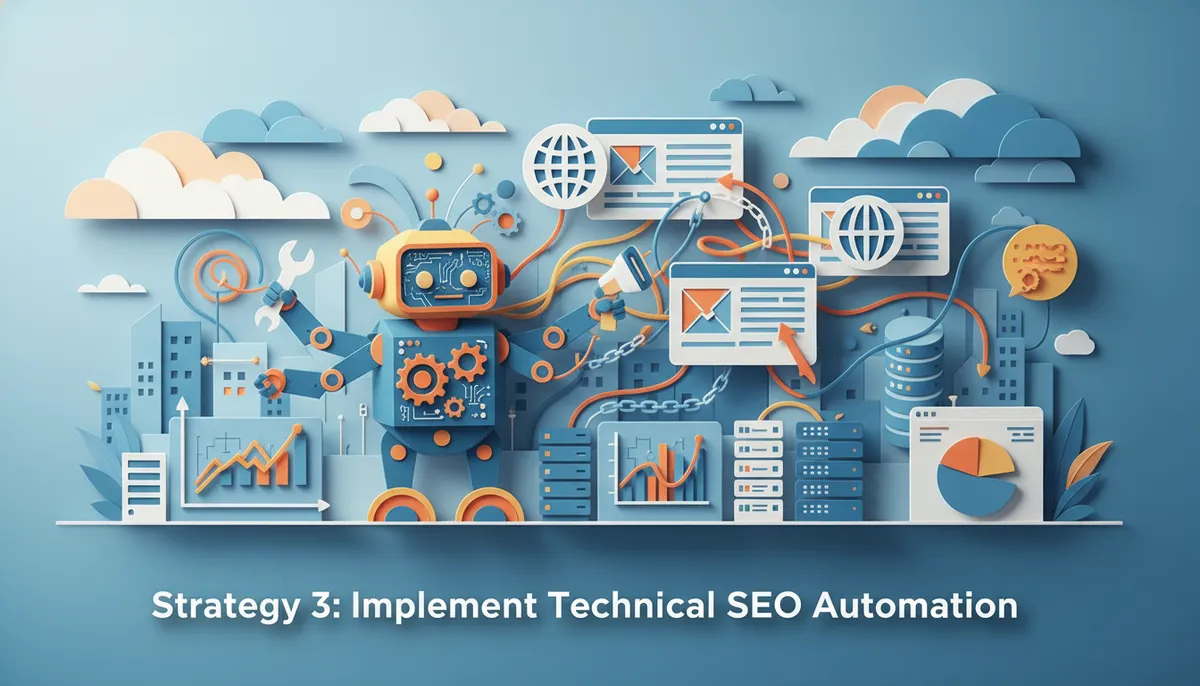
Technical SEO involves behind-the-scenes optimization that affects how search engines crawl, index, and rank your website. Tasks include fixing broken links, optimizing site speed, implementing schema markup, creating XML sitemaps, and ensuring mobile responsiveness. These technical elements require specialized knowledge and ongoing monitoring.
AI-powered technical SEO tools automate these complex tasks. They continuously crawl your website, identifying issues and either fixing them automatically or providing specific recommendations. This proactive approach prevents technical problems from harming your rankings.
Technical SEO automation becomes especially valuable for e-commerce sites with hundreds or thousands of pages. Manual audits cannot keep pace with constantly changing inventories and product pages. AI systems monitor all pages continuously, ensuring technical optimization across your entire site.
Automated Technical SEO Tasks
- Site crawling and error detection identifies broken links, missing pages, and redirect chains
- Schema markup implementation adds structured data automatically to improve rich snippet display
- XML sitemap generation and updates ensure search engines discover new content immediately
- Page speed optimization compresses images, minifies code, and implements caching automatically
- Mobile responsiveness testing identifies display issues across different devices
- Duplicate content detection prevents cannibalization and consolidates ranking signals
Advanced AI systems integrate with your content management system to implement fixes directly. Instead of generating reports that require manual action, the automation makes corrections automatically. This hands-free approach ensures your technical SEO remains optimal without constant intervention.
For small SEO agencies managing multiple client websites, technical SEO automation provides enormous time savings. Instead of performing manual audits for each client monthly, the AI monitors all sites continuously and alerts you only when human attention is required. This efficiency allows agencies to serve more clients without expanding their technical team.
Schema Markup and Structured Data
Schema markup tells search engines exactly what information your pages contain. Proper implementation increases your chances of appearing in rich snippets, knowledge panels, and other enhanced search results. However, implementing schema correctly requires technical expertise and ongoing maintenance.
AI technical SEO tools automatically add appropriate schema markup based on your content type. For articles, they add Article schema. For products, they add Product schema with pricing, availability, and review data. For local businesses, they add LocalBusiness schema with location and contact information.
This automation ensures you capture opportunities for enhanced visibility without needing to understand schema implementation details. The AI keeps your markup updated as standards evolve, preventing technical debt that accumulates when schema is implemented once and never maintained.
Strategy 4: Deploy AI SEO Agents for End-to-End Workflow Automation
AI SEO agents represent the most advanced level of automation available in 2026. These intelligent systems manage entire SEO workflows autonomously, from initial strategy through execution and ongoing optimization. Unlike tools that automate individual tasks, AI agents coordinate multiple processes to deliver complete SEO management.
An AI SEO agent acts as a virtual SEO manager. It analyzes your site and competitors, identifies opportunities, creates content strategies, generates optimized articles, publishes them to your website, monitors performance, and adjusts tactics based on results. This comprehensive automation removes the need for constant human intervention while maintaining strategic focus.
The technology behind AI agents combines multiple artificial intelligence capabilities. Natural language processing understands content and search intent. Machine learning predicts which strategies will succeed. Computer vision analyzes images and visual elements. All these components work together to execute sophisticated SEO strategies automatically.
AI Agent Capabilities
Modern AI SEO agents perform competitor analysis by examining what top-ranking sites do differently. They identify content gaps where competitors have not fully addressed topic areas. They analyze backlink profiles to discover link building opportunities. This competitive intelligence informs strategy without requiring manual research.
Content planning becomes fully automated with AI agents. The system creates editorial calendars based on keyword opportunities, seasonal trends, and strategic priorities. It schedules content publication to maintain consistent output, which search engines reward with improved rankings. Platforms like SEO Rocket use this approach to publish optimized articles daily without manual scheduling.
Real-time optimization represents another powerful agent capability. As Google updates its algorithms or as your content begins ranking, the AI adjusts metadata, internal linking, and content structure to maximize visibility. This adaptive approach responds to ranking changes faster than humans can manually optimize.
Benefits of AI SEO Agents
- Complete workflow automation from strategy to execution
- Continuous monitoring and real-time adjustments
- Scalable across unlimited projects or websites
- Consistent execution without human error or oversight gaps
- Strategic decision-making based on comprehensive data analysis
- Integration across all SEO functions in one system
For agencies managing multiple clients, AI SEO agents provide unprecedented scalability. A single agent can manage comprehensive SEO for multiple websites simultaneously, each with customized strategies. This multiplies agency capacity without requiring proportional team growth. Content managers at large organizations use agents to maintain consistency across numerous content properties and regional websites.
The investment in AI agent technology pays off through time savings and improved results. Instead of coordinating multiple tools and manual processes, everything runs through one intelligent system. This consolidation reduces complexity while increasing effectiveness, making enterprise-level SEO accessible to businesses of all sizes.
Strategy 5: Optimize for AI-Powered Search Engines
Traditional SEO focuses on ranking in Google’s standard search results. In 2026, that represents only part of the visibility opportunity. AI-powered search platforms like ChatGPT, Perplexity, Claude, Gemini, Copilot, and Grok now answer millions of queries daily. These platforms pull information from trusted sources to generate comprehensive answers.
Appearing in AI-generated answers requires different optimization than traditional SEO. AI search engines evaluate content structure, factual accuracy, source credibility, and information comprehensiveness. Your content must be authoritative, well-organized, and easy for AI models to parse and reference.
This evolution in search behavior creates new opportunities for visibility. When users ask ChatGPT or Perplexity a question related to your expertise, you want your content cited as a trusted source. This AI visibility drives awareness and authority even when users never click through to your website directly.
Structuring Content for AI Search
AI search engines prefer content with clear structure and direct answers. Start articles with concise definitions or summaries that directly address the main query. Use descriptive headings that frame each section clearly. Provide specific facts, data points, and examples rather than vague generalizations.
Include structured data markup that helps AI understand your content relationships. Use schema types appropriate to your content, whether articles, products, recipes, or other formats. This structured information makes it easier for AI to extract relevant facts and present them accurately in generated answers.
Credibility signals matter significantly for AI search. Include author information demonstrating expertise. Link to authoritative external sources supporting your claims. Maintain factual accuracy and provide evidence for statements. These trust signals influence whether AI systems reference your content or ignore it.
AI Overview Optimization
| Traditional SEO Focus | AI Search Optimization |
|---|---|
| Keyword placement and density | Semantic meaning and context |
| Backlink quantity | Source authority and credibility |
| Page speed and technical factors | Content structure and clarity |
| Click-through rate optimization | Information accuracy and completeness |
| User engagement metrics | Machine-readable data formats |
Google’s AI Overviews feature now appears for many searches, providing AI-generated summaries above traditional results. To appear in these overviews, your content must rank well in standard results and demonstrate exceptional expertise. Focus on comprehensive coverage of topics, including related questions users commonly ask. Tools designed for AI search optimization automatically structure content to maximize visibility across both traditional and AI-powered platforms.
For businesses in competitive industries, AI search optimization provides differentiation opportunities. While competitors focus solely on traditional rankings, you capture visibility in the growing segment of AI-powered search. This forward-thinking approach positions your business for continued success as search behavior evolves.
Strategy 6: Leverage Automated Internal Linking and Content Clustering
Internal linking connects related pages on your website, distributing authority and helping search engines understand your site structure. Strong internal linking improves rankings for both linked pages and the overall site. However, managing internal links manually becomes impossible as content libraries grow.
AI automation identifies optimal internal linking opportunities automatically. The system analyzes all your content, understanding topic relationships and relevance connections. It suggests links between related articles and implements them automatically, ensuring your content cluster strategy remains strong as you publish new material.
Content clustering groups related articles around pillar topics. This topical authority signals expertise to search engines, improving rankings for all content within the cluster. AI systems identify cluster opportunities based on keyword relationships and automatically structure your content library accordingly.
AI-Powered Internal Linking Benefits
- Automatically identifies relevant linking opportunities across your entire content library
- Maintains optimal link density without over-optimization
- Updates older content with links to newly published articles
- Creates topical clusters that demonstrate subject matter expertise
- Distributes page authority strategically to priority pages
- Improves user navigation by connecting related information
The automation ensures consistency in linking strategy. Every new article receives appropriate internal links from existing content, and provides links back to related pages. This bidirectional linking strengthens topical relevance signals throughout your site. Manual implementation would require reviewing every existing article when publishing new content, a task that becomes impractical with large content libraries.
For e-commerce SEO specialists, automated internal linking connects product pages, category pages, and informational content strategically. The AI understands product relationships and buyer journey stages, creating links that guide users toward conversions while strengthening SEO. Content managers benefit from automated cluster identification that reveals content gaps and opportunities for expansion within existing topic areas.
Advanced systems like SEO Rocket’s content automation implement internal linking as part of the article generation process. When the AI creates new content, it automatically includes links to relevant existing pages and adds links from older articles to the new piece. This seamless integration ensures your internal linking remains optimized without requiring manual link audits.
Strategy 7: Implement Continuous Performance Tracking and Automated Optimization
SEO success requires ongoing monitoring and adjustment. Rankings fluctuate, competitors publish new content, and search algorithms evolve. Manual performance tracking involves checking rankings, analyzing traffic, reviewing engagement metrics, and identifying optimization opportunities. This constant monitoring consumes significant time.
AI-powered performance tracking automates this entire process. Systems monitor your rankings across all target keywords continuously, alerting you to significant changes. They track traffic patterns, identifying which content drives conversions and which underperforms. Most importantly, they automatically implement optimizations based on performance data.
This continuous improvement cycle ensures your SEO strategy adapts to changing conditions. When rankings drop, the AI analyzes why and implements corrections. When certain content performs exceptionally well, the system identifies success factors and applies those insights to future content. This data-driven optimization delivers better results than periodic manual reviews.
Automated Optimization Actions
AI systems perform various optimization actions automatically. They update title tags and meta descriptions when click-through rates underperform. They adjust keyword density when relevance scores decline. They modify internal linking when page authority needs redistribution. These technical adjustments happen continuously without requiring manual intervention.
Content refreshing represents another powerful automated capability. The AI identifies older articles that could benefit from updates, adds new information, incorporates current data, and republishes improved versions. This keeps your content library fresh and maintains rankings for established pages that might otherwise decline.
Real-time SEO scoring provides immediate feedback as content is created. The system evaluates articles against ranking factors, providing scores for readability, keyword optimization, content depth, and technical implementation. Automated fix suggestions tell you exactly what to improve. Some platforms implement fixes automatically, ensuring every published article meets optimization standards.
Performance Metrics to Track
- Keyword rankings across all target terms and their movement trends
- Organic traffic volume and traffic quality measured by engagement
- Click-through rates from search results to your pages
- Bounce rates and time on page indicating content relevance
- Conversion rates from organic traffic to desired actions
- Backlink acquisition and overall domain authority growth
For digital marketing consultants managing client results, automated performance tracking provides transparent reporting without manual data compilation. Clients receive regular updates showing ranking improvements, traffic growth, and conversion increases. The data demonstrates ROI clearly, making it easier to retain clients and justify continued investment in SEO.
Small business owners benefit from simplified performance understanding. Instead of interpreting complex analytics, the AI presents clear insights about what works and what needs improvement. This accessibility makes strategic decision-making possible without requiring deep SEO expertise.
Choosing the Right AI SEO Platform
Selecting an AI SEO solution requires evaluating several factors. Different platforms offer varying levels of automation, integration capabilities, and pricing models. Understanding your specific needs helps identify the best fit for your business or agency.
Consider whether you need complete end-to-end automation or prefer tools that automate specific tasks while leaving strategic decisions to you. Some businesses want full automation from keyword research through publishing, while others prefer more control over individual steps. Platforms like SEO Rocket provide complete automation, handling everything from strategy through daily publishing automatically.
Integration capabilities matter significantly. Your AI SEO platform should connect directly with your content management system, whether WordPress, Webflow, Shopify, or Wix. Direct integration enables automatic publishing without manual content transfers. It also allows the system to analyze your existing content and site structure for better optimization recommendations.
Key Evaluation Criteria
| Feature | Why It Matters | What to Look For |
|---|---|---|
| Automation Level | Determines how much manual work remains | End-to-end workflow automation vs. individual task tools |
| Content Quality | Affects rankings and user engagement | Long-form content generation with proper structure |
| Integration Options | Enables seamless workflow without manual transfers | Direct publishing to major CMS platforms |
| Scalability | Supports growth without proportional cost increases | Multi-site management and unlimited content options |
| AI Search Optimization | Captures visibility in modern search platforms | Optimization for both Google and AI search engines |
Pricing models vary significantly across platforms. Subscription-based pricing typically ranges from budget options around $99 per month to enterprise solutions exceeding $1,000 monthly. Some platforms offer lifetime access plans that eliminate ongoing subscription costs. Evaluate pricing against the value provided, considering both features and the volume of content you need.
For agencies, multi-client management capabilities are essential. Look for platforms supporting multiple workspaces with separate content calendars, keyword research, and publishing workflows for each client. This separation ensures organization while maintaining efficiency. Agency-focused platforms often include white-label options and client reporting features.
Implementation Considerations
Setup time affects how quickly you see results from AI SEO. The best platforms require minimal setup, typically under 10 minutes to connect your website and begin generating content. More complex systems might require extensive configuration, training, or ongoing maintenance that reduces their efficiency benefits.
Training requirements also vary. Some AI SEO platforms require significant learning curves to use effectively. Others provide intuitive interfaces that anyone can use immediately. Consider your team’s technical expertise and available time for learning new systems when evaluating options.
Support and documentation availability ensures you can resolve issues quickly. Look for platforms offering comprehensive knowledge bases, video tutorials, and responsive customer support. Active development and regular feature updates indicate the platform will continue improving and adapting to SEO evolution.
The Future of AI SEO Beyond 2026
AI SEO continues evolving rapidly. The strategies effective in 2026 will expand and improve as artificial intelligence capabilities advance. Understanding emerging trends helps position your business to capitalize on future opportunities rather than reacting after competitors gain advantages.
Voice search optimization will become increasingly important as conversational AI assistants handle more queries. Content optimized for voice differs from text-based search, requiring natural language patterns and direct answer formats. AI SEO systems will automatically adapt content for both text and voice search contexts.
Video content generation represents another frontier. AI systems already create simple videos from text content. As these capabilities improve, automated video production will become standard for SEO strategies. Video visibility in both traditional search and AI platforms will provide additional traffic sources beyond written content.
Personalization will reach new levels as AI understands individual user preferences better. Search results increasingly vary based on user history, location, and context. AI SEO tools will optimize content for these personalized search experiences, ensuring visibility across different user segments rather than focusing solely on generic rankings.
Preparing for AI SEO Evolution
- Choose platforms with active development and regular updates to benefit from new capabilities automatically
- Focus on building comprehensive topic coverage rather than isolated keyword targeting for future-proof authority
- Implement structured data extensively to remain compatible with evolving search technologies
- Monitor emerging AI search platforms and adapt strategies to capture visibility across new channels
- Maintain human oversight for creativity and strategic direction while expanding automation scope
The role of human expertise will shift but remain essential. Instead of executing tactical SEO tasks, professionals will focus on strategic direction, creative differentiation, and ensuring brand authenticity. AI handles execution and optimization while humans provide judgment, creativity, and strategic vision that algorithms cannot replicate.
For businesses starting AI SEO implementation in 2026, the timing is ideal. Technology has matured beyond early experimental stages into reliable, effective systems. However, the competitive landscape continues shifting, with early adopters gaining compounding advantages. Businesses implementing comprehensive AI SEO now position themselves ahead of competitors still using manual methods.
The cost efficiency of AI SEO makes it accessible across business sizes. Small businesses access capabilities previously available only to large enterprises with dedicated SEO teams. This democratization levels the competitive playing field, allowing smaller players to compete effectively for visibility and traffic.
Conclusion: Transform Your SEO Strategy with AI Automation
AI SEO represents the most significant advancement in search engine optimization since Google introduced its core algorithms. The strategies outlined in this article provide practical approaches any business can implement to improve rankings, increase traffic, and reduce time spent on manual SEO tasks.
From automated keyword research that identifies opportunities in minutes to AI agents managing complete workflows autonomously, these technologies deliver results that manual methods cannot match. The key is selecting the right combination of strategies for your specific situation and implementing them systematically.
For small agencies, in-house marketing teams, content managers, and e-commerce specialists, AI SEO solves the fundamental challenge of producing consistent, optimized content at scale. It eliminates the bottleneck between strategy and execution, ensuring your SEO plans actually get implemented rather than remaining good intentions.
The competitive landscape in 2026 demands AI SEO adoption. Businesses using comprehensive automation publish more content, optimize more effectively, and adapt faster than those relying on manual processes. This operational advantage translates directly to improved visibility and market share.
Getting started with AI SEO is simpler than many businesses expect. Modern platforms handle the technical complexity, providing user-friendly interfaces and complete automation. Setup takes minutes rather than days, and results begin accumulating immediately as the system publishes optimized content consistently.
If you are ready to transform your SEO strategy with complete automation, explore SEO Rocket’s plans starting at $99 per month. The platform handles everything from keyword research through daily publishing, delivering the consistent content production that drives long-term organic growth. Stop spending hours on manual SEO tasks and let intelligent automation deliver better results with less effort.
FAQs
Q: What is the main difference between AI SEO and traditional SEO?
A: AI SEO uses artificial intelligence and machine learning to automate tasks like keyword research, content creation, and technical audits, while traditional SEO relies on manual processes. AI SEO processes massive datasets to identify opportunities and optimize content faster and more accurately than manual methods, delivering better results with less time investment.
Q: Can AI-generated content actually rank well in Google?
A: Yes, AI-generated content can rank well in Google. Google evaluates content based on helpfulness, accuracy, and value regardless of how it was created. The key is ensuring AI content meets quality standards, provides accurate information, and serves user needs effectively. Many businesses using AI content automation see improved rankings due to consistent publishing and comprehensive optimization.
Q: How long does it take to see results from AI SEO strategies?
A: Initial results from AI SEO typically appear within 4-8 weeks as new optimized content gets indexed and starts ranking. However, significant traffic growth usually takes 3-6 months as you build content volume and topical authority. The advantage of AI SEO is consistent daily publishing that creates compounding results over time, with traffic continuing to grow as your content library expands.
Q: Do I still need human involvement with AI SEO automation?
A: Yes, human oversight remains valuable even with comprehensive AI SEO automation. Humans provide strategic direction, creative differentiation, brand voice consistency, and fact-checking for accuracy. However, the role shifts from executing tactical tasks to focusing on strategy and high-value activities while AI handles repetitive optimization work, research, and content production.
Q: How does AI SEO optimize for both Google and AI-powered search engines?
A: AI SEO optimizes for both traditional search and AI platforms by structuring content with clear organization, accurate information, and machine-readable data formats. It includes schema markup for structured data, provides direct answers to common questions, demonstrates expertise through credible sources, and maintains comprehensive topic coverage that both Google algorithms and AI language models can parse and reference effectively.