
Key Takeaways
-
SEO Rocket generates 3,000+ word articles automatically daily and publishes directly to your CMS for ~$3 per article, eliminating manual writing, editing, and publishing tasks that consume hours.
-
AI search engines like ChatGPT and Perplexity are now major traffic sources, but most optimization-only tools ignore them; SEO Rocket structures content specifically for AI search visibility alongside Google rankings.
-
Full automation platforms set up in under 10 minutes and require zero ongoing management, while optimization-only tools demand hours of configuration and continuous manual effort for keyword research, writing, and scheduling.
-
Content depth matters in 2026—3,000+ word articles outrank shorter 500-1,500 word content; automation tools generate comprehensive articles with integrated keywords, links, and metadata that optimization-only tools cannot.
-
Daily publishing compounds traffic growth over time; manual workflows cannot match the consistency needed to build keyword coverage and AI answer visibility that full automation delivers without a large content team.
-
Freelance writers cost $100-$200 per article while agencies charge $500+, making SEO Rocket's $3 per article on the Business plan significantly more cost-effective for scaling content production.
Picking the right SEO content tool can feel overwhelming. There are so many options out there, and they all promise to boost your rankings. So how do you know which one is actually worth your money? If you’ve been comparing platforms and wondering which one will truly do the heavy lifting for you, you’re in the right place.
In 2026, the landscape has shifted. SEO isn’t just about Google anymore. AI search engines like ChatGPT, Perplexity, and Gemini are changing how people find information. Your content needs to show up everywhere — not just in traditional search results. That raises the stakes when choosing a tool.
This article breaks down what to look for in an SEO content automation platform. We’ll look at key features, automation levels, pricing, and who each type of tool is built for. By the end, you’ll have a clear picture of what fits your needs best — and why full automation might be the smartest move you make this year. You can also read our blog for more tips on growing organic traffic.

What Are SEO Content Automation Tools?
SEO content tools help you create, optimize, and publish blog articles. They use AI to speed up the writing process and improve your chances of ranking on search engines. But not all tools work the same way.
Some tools focus on optimization. They analyze your existing content and tell you what to fix. You still do most of the writing yourself. Others go further and actually generate content for you. And then there are fully automated platforms that handle everything — from keyword research to publishing — without you lifting a finger.
Understanding these differences is key. If you want to learn more about writing for search engines, check out this SEO content writing beginner’s guide for 2026.
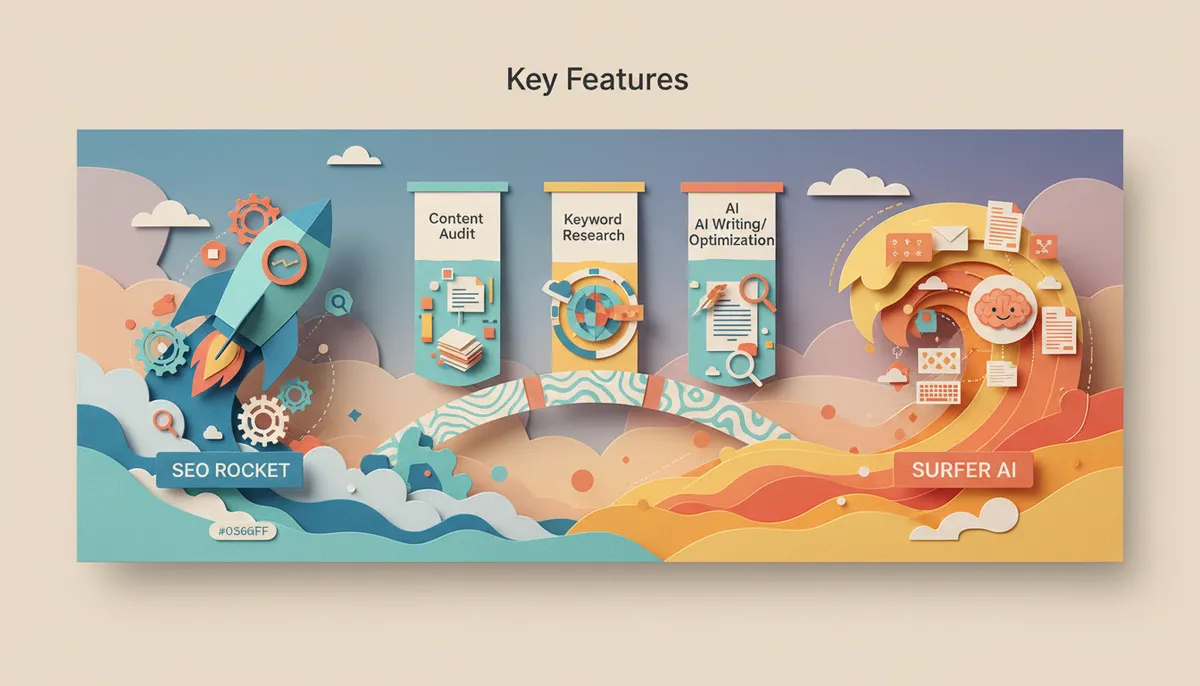
Key Features to Compare
When evaluating any SEO content platform, there are several must-have features to look for. Here’s a clear breakdown of what matters most:
| Feature | Optimization-Only Tools | Fully Automated Platforms |
|---|---|---|
| Keyword Research | Manual or basic | Built-in, automated |
| Content Writing | Manual with suggestions | Fully AI-generated |
| Publishing | Copy-paste required | Direct to your CMS |
| Article Length | 500–1,500 words typical | 3,000+ words standard |
| AI Search Optimization | Google only | Google + AI engines |
| Daily Publishing | Manual scheduling | Automated daily |
| Setup Time | Hours of configuration | Under 10 minutes |
| Cost | Mid to high range | ~$3 per article |
How Optimization-Focused Tools Work
Optimization-focused tools are popular because they help you score your content before publishing. You paste in your article, and the tool tells you how well it’s optimized. It suggests where to add keywords, how to adjust headings, and what to change in your content structure.
These tools can be helpful. But they have one big limitation: you still have to do most of the work. You write the article. You research the keywords. You schedule the publish date. You copy and paste content into your website. That takes time — a lot of it.
For busy business owners, agency teams, or content managers handling large websites, this manual process quickly becomes a bottleneck. You end up spending more time managing the tool than actually growing your traffic.

The Case for Full SEO Automation
Full automation platforms take a completely different approach. Instead of helping you write better, they handle the entire content process for you. That includes keyword discovery, article generation, SEO optimization, image creation, and direct publishing to your website.
This is where SEO Rocket truly stands out. It’s not just a writing assistant — it’s a complete content engine. Here’s what the full automation workflow looks like:
- Connect your site — Works with WordPress, Webflow, Shopify, and Wix in under 10 minutes.
- Discover keyword opportunities — SEO Rocket’s built-in keyword engine finds real opportunities based on search volume, competition, and intent.
- Approve your content calendar — Review your schedule, and the platform fills in the rest automatically.
- Articles are generated daily — One 3,000+ word SEO-optimized article published every single day.
- Track your growth — Monitor rankings and traffic through built-in performance tracking.
Once set up, you don’t need to touch anything. The system runs on its own. That’s a huge deal for teams that are already stretched thin.
Content Quality and Article Length
One of the most important ranking factors in 2026 is content depth. Google and AI search engines reward articles that fully cover a topic. Short posts of 500 to 1,500 words often struggle to compete against longer, more thorough content.
Optimization-only tools don’t solve this problem. They tell you what to fix, but they don’t write the in-depth content for you. You’d still need to hire a writer or spend hours doing it yourself.
SEO Rocket generates 3,000+ word articles by default. Every article includes:
- Naturally integrated target keywords
- Internal and external links added automatically
- AI-generated images and video embeds
- Optimized metadata for search and AI discovery
- Business mentions for brand consistency
- Real-time SEO scoring with auto-fix suggestions
This level of completeness is hard to replicate with manual tools. And if you’re curious about what great AI-written articles look like, you can check out some writing examples directly on the SEO Rocket website.
AI Search Visibility: The 2026 Difference
Here’s something many SEO tools miss entirely: AI search engines are now a major traffic source. Tools like ChatGPT, Perplexity, Claude, Gemini, Copilot, and Grok are answering millions of questions every day. If your content isn’t structured to appear in those answers, you’re leaving traffic on the table.
Most optimization tools were built with Google in mind. They haven’t caught up with the shift toward AI-powered search. That’s a problem if you want to grow your reach in 2026 and beyond.
SEO Rocket is built specifically for this new reality. Every article is structured so AI models can reference it as a trusted source. That means your content can show up inside AI Overviews, chat answers, and AI summaries — not just traditional Google results. Learn more about how to improve your AI search visibility in 2026.
Pricing Comparison
Cost is always a factor. Let’s look at how different options stack up:
| Option | Monthly Cost | Articles Per Month | Cost Per Article |
|---|---|---|---|
| Traditional SEO Agency | $3,000 – $5,000 | 4–8 | $500+ |
| Freelance Writer | $1,000 – $3,000 | 10–20 | $100–$200 |
| Optimization-Only Tool | $89 – $249 | Depends on your effort | Variable |
| SEO Rocket (Business) | $99 | 30 | ~$3.30 |
| SEO Rocket (Agency) | $799 | 300 | ~$2.66 |
| SEO Rocket (Lifetime) | $1,499 one-time | Permanent access | Virtually zero |
The numbers speak for themselves. At roughly $3 per fully automated, 3,000-word article, SEO Rocket’s pricing is hard to beat. See the full breakdown and start for $99/month to get your first month rolling.
Who Each Tool Type Is Best For
Not every tool fits every situation. Here’s a quick guide to help you figure out what suits your needs:
Optimization-Only Tools Are Good For
- Writers who enjoy the writing process and want scoring feedback
- Teams that have dedicated content creators already
- Those publishing fewer than 4 articles per month
- Users who want granular control over every word
Full Automation Platforms Like SEO Rocket Are Best For
- Small business owners who need SEO results without spending hours on content
- Marketing teams managing tight deadlines and limited budgets
- SEO agencies serving multiple clients and needing to scale fast
- E-commerce specialists generating content for dozens of category pages
- Digital marketing consultants who want to deliver faster results to clients
- Content managers responsible for high-volume publishing schedules
If you’re managing multiple clients or a large website, full automation isn’t just convenient — it’s essential. Check out how daily blog posting strategies drive results when you have the right system behind them.
The Compounding Power of Daily Publishing
One of the most overlooked advantages of full automation is consistency. Ranking on Google and AI search engines isn’t just about writing great articles — it’s about publishing them regularly over time.
Think of it like compounding interest. Each new article you publish builds on the last. More pages means more keyword coverage. More content means more chances to appear in AI answers. Over weeks and months, this compounds into serious organic traffic growth.
Manual processes can’t keep up with this pace. You’d need a full team of writers, editors, and SEO specialists to match what automation delivers daily. That’s why platforms built for automation consistently outperform manual workflows at scale.
SEO Rocket’s built-in features include a visual content calendar that automatically fills with keyword opportunities. You approve the plan, and articles roll out every single day — no micromanaging required.
What to Look for in a Final Decision
Before you pick a tool, run through this checklist:
- Does it automate publishing? — Copy-pasting content is a time drain. Look for direct CMS integration.
- Does it generate long-form content? — Short articles struggle to rank in 2026. Aim for 3,000+ words.
- Is it optimized for AI search? — If the tool ignores AI engines, you’re missing half the traffic opportunity.
- Can it scale with your needs? — Whether you have one site or ten clients, your tool should grow with you.
- What’s the true cost per article? — Factor in your time, not just the subscription price.
When you ask these questions honestly, full automation platforms come out ahead for most businesses and agencies. You can also explore the best AI writing tools for content creation in 2026 to see how the landscape looks this year.
For a deeper dive into what makes a great AI blog generator, this guide to the best AI blog post generators in 2026 is a great resource. And the SEO Rocket product roadmap shows exactly where the platform is headed next — which is always a good sign of a tool that’s actively improving.
Conclusion
Choosing the right SEO content tool in 2026 comes down to one question: how much of the work do you want to do yourself? Optimization-focused tools are useful — but they put the burden on you. Full automation platforms eliminate that burden entirely.
SEO Rocket is the most complete solution available right now. It handles keyword research, writing, optimization, images, linking, and publishing — all automatically, every single day. At just $3 per article and a free 3-day trial, the value is clear.
Whether you’re a solo business owner, a growing agency, or a content team under pressure, automation is the smart path forward. You deserve a tool that works as hard as you do — so you can focus on the parts of your business that need you most.
Ready to let SEO run on autopilot? Create your free SEO Rocket account today and see what consistent, automated content can do for your traffic in 2026.
FAQs
Q: What makes full SEO automation better than optimization-only tools?
A: Full automation handles everything — keyword research, writing, publishing, and even image creation — so you don’t have to. Optimization-only tools still require you to write and schedule content manually, which takes a lot of time and effort. If you want consistent results without the daily grind, automation wins every time!
Q: How long does it take to set up an automated SEO content platform?
A: With SEO Rocket, setup takes under 10 minutes. You simply connect your website (WordPress, Webflow, Shopify, or Wix), review your keyword opportunities, approve your content calendar, and the platform takes care of the rest. It’s genuinely one of the fastest onboarding experiences in the industry.
Q: Is automated SEO content good enough to rank on Google in 2026?
A: Absolutely! SEO Rocket generates 3,000+ word articles that follow SEO best practices, include proper internal and external links, optimized metadata, and AI-generated images. These articles are structured to rank on Google and appear in AI search engines like ChatGPT and Perplexity.
Q: How much does automated SEO content cost compared to hiring writers?
A: Hiring freelance writers can cost $100–$200 per article, and agencies charge even more. With SEO Rocket, you get fully automated 3,000-word articles for around $3 each on the Business plan. That’s a massive saving without sacrificing quality or consistency.
Q: Can SEO automation tools handle content for multiple clients or websites?
A: Yes! SEO Rocket’s Agency plan supports up to 10 client workspaces and generates 300 articles per month — all automated. It’s a fantastic solution for small SEO agencies and digital marketing consultants who need to scale content production without growing their team.