
Key Takeaways
-
Write 3,000+ word articles with clear answers, step-by-step explanations, and supporting data to signal authority to AI engines that reference your content.
-
Target question-based keywords like ‘what are the best content automation tools for small businesses in 2026?’ instead of short phrases to match how people query AI search engines.
-
Build topical authority by publishing new content daily or weekly across multiple angles of your niche to establish your site as a trusted source AI models reference consistently.
-
Structure content with clear H2/H3 headings, bullet points, FAQ sections, and summary boxes so AI engines can easily parse and extract information for their answers.
-
Strengthen E-E-A-T signals by adding author credentials, citing reputable sources, including original data or case studies, and maintaining consistent publishing to build trust with AI engines.
-
Use content automation tools to execute your complete GEO strategy at scale without a large team, enabling daily publishing of optimized articles that build topical authority over time.
If you’ve been watching the SEO landscape shift over the past year, you’ve probably noticed something big happening. AI-powered search engines are changing the game entirely. Traditional SEO still matters, but there’s a new player in town: Generative Engine Optimization (GEO). In 2026, GEO tactics are no longer optional — they’re essential for anyone who wants their content to show up inside AI-generated answers on platforms like ChatGPT, Perplexity, Claude, Gemini, Copilot, and Grok.
The good news? GEO and SEO work really well together. If you’re already doing content marketing, you’re halfway there. This guide will walk you through the exact GEO tactics that work in 2026, in a clear, step-by-step way. Whether you run a small business, manage a content team, or handle SEO for multiple clients, these strategies will help you show up where your audience is searching. Let’s dive in!

What Is GEO and Why Does It Matter in 2026?
GEO stands for Generative Engine Optimization. It’s the practice of structuring your content so that AI search engines choose it as a trusted source. When someone asks ChatGPT or Perplexity a question, those AI models pull from content they consider authoritative. GEO helps your content become one of those trusted sources.
According to Google’s own Search Quality Rater Guidelines, trustworthiness, expertise, and helpfulness are core signals. These same signals matter deeply for AI engines. If your content checks those boxes, AI models are far more likely to reference it in their answers.
In 2026, more searches are happening inside AI tools than ever before. That means a huge portion of your potential audience might never see a traditional search results page. GEO bridges that gap, making sure your content reaches people through AI-generated answers, not just blue links.
Step 1 — Write Long-Form, Authoritative Content
AI engines love depth. Short blog posts of 500–800 words rarely get referenced in AI answers. In 2026, the sweet spot for GEO-optimized content is 3,000+ words. Longer content signals that you’ve covered a topic thoroughly, which is exactly what AI models want to reference.
Here’s what long-form GEO content should include:
-
Clear, direct answers to specific questions
-
Step-by-step explanations that are easy to follow
-
Supporting data, stats, or examples
-
Structured headings that break up the content logically
-
Definitions, comparisons, and summaries
Writing at this length consistently is a challenge for most teams. That’s where automation helps. See how SEO Rocket works to generate daily 3,000+ word, GEO-optimized articles automatically — without you lifting a finger after setup.
Step 2 — Structure Content for AI Readability
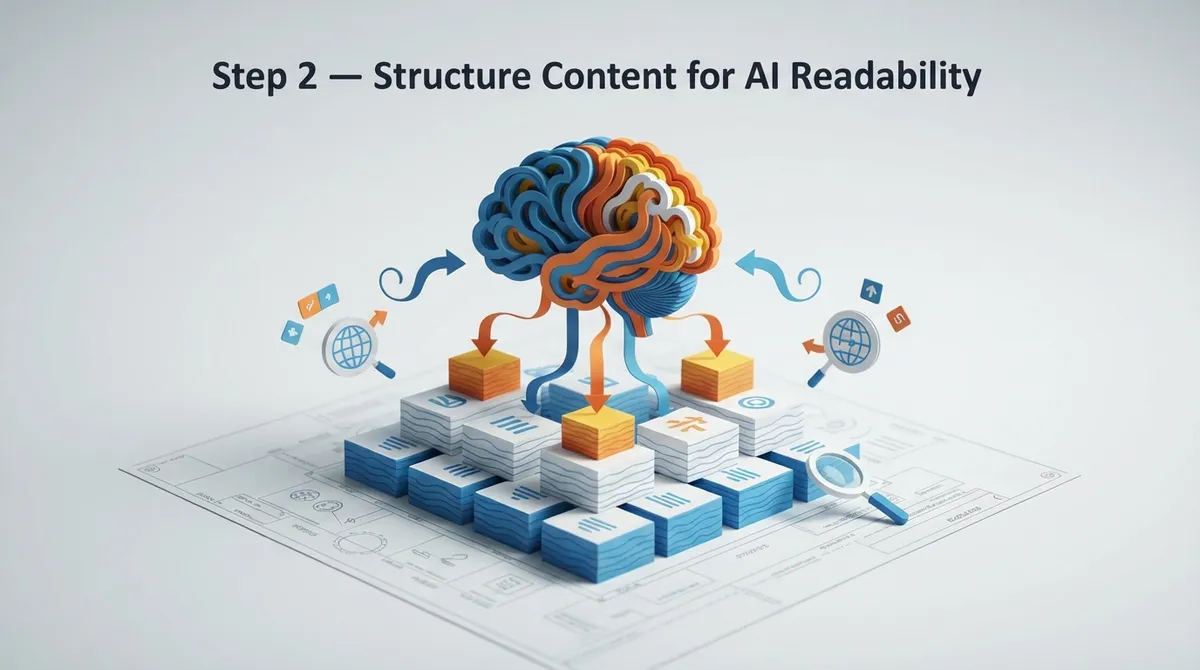
AI engines don’t read content the way humans do. They scan for structured, well-organized information. If your content is a wall of text with no clear hierarchy, AI models will likely skip it in favor of better-organized sources.
Follow these formatting rules for GEO success:
-
Use clear H2 and H3 headings — These help AI models understand your content’s structure at a glance.
-
Write short, punchy paragraphs — Two to four sentences per paragraph is the sweet spot.
-
Use bullet points and numbered lists — AI engines pull these for direct answers and featured snippets.
-
Include FAQ sections — These match the question-based format that AI search engines respond to.
-
Add summary boxes or key takeaways — These make it easy for AI to extract the most important points.
Think of structuring your content like building a well-organized filing cabinet. Every drawer is labeled, every folder is in its place. AI models can find what they need quickly, and they’ll reward you for it.
Step 3 — Target Question-Based Keywords
People search AI engines with full questions, not just short keyword phrases. Instead of targeting “content automation tools,” think about targeting “what are the best content automation tools for small businesses in 2026?” This shift in keyword strategy is a core GEO tactic.
Here’s a quick comparison of traditional SEO keywords vs. GEO-optimized keywords:
|
Traditional SEO Keyword |
GEO-Optimized Keyword |
|---|---|
|
content automation |
how does content automation work for SEO in 2026? |
|
AI blog writer |
what is the best AI blog writer for small businesses? |
|
SEO content tools |
which SEO content tools save the most time for agencies? |
|
publish blog posts daily |
how do I publish blog posts every day without writing them manually? |
|
GEO tactics |
what GEO tactics actually work for ranking in AI search in 2026? |
To find these question-based keywords, you can explore tools with built-in keyword research features that surface real user questions. If you want a head start, read our beginner’s guide to SEO content writing in 2026 for practical keyword targeting advice.
Step 4 — Build Topical Authority with Consistent Publishing
One article isn’t enough to establish authority with AI engines. GEO rewards websites that have published extensively on a topic. The more thorough your content library is around a specific niche, the more AI models will trust your site as a go-to source.
This is called topical authority, and it’s one of the most powerful GEO tactics in 2026. Here’s how to build it:
-
Publish new content daily or at least weekly
-
Cover your topic from multiple angles (beginner, intermediate, advanced)
-
Link related articles together using internal links
-
Answer every question your audience might have about your niche
-
Keep content fresh and updated as the industry evolves
The challenge most businesses face is consistency. Writing one great article is manageable. Writing one great article every single day for months is a different story. This is exactly the problem that SEO automation tools solve. Explore SEO Rocket’s features to see how daily automated publishing builds topical authority on autopilot.
Also worth reading: 4 daily blog posting strategies that actually drive results in 2026.
Step 5 — Optimize for AI Overviews and Featured Snippets
AI Overviews (previously called SGE) appear at the very top of Google search results. They pull content directly from websites and summarize it. Getting featured in these overviews is pure gold for visibility. The same principles that win featured snippets also win AI Overview placements.
Here’s how to optimize for both:
-
Answer the question directly in the first sentence — Don’t bury your answer three paragraphs down.
-
Use the target keyword naturally in your answer — AI engines look for relevance signals.
-
Keep your answer concise but complete — 40–60 words is ideal for featured snippet pulls.
-
Follow up with depth — After the concise answer, provide a thorough explanation for readers who want more.
If you want to go deeper on this topic, learn how to get featured in AI Overviews with proven strategies tailored to 2026’s search landscape.
Step 6 — Strengthen E-E-A-T Signals
E-E-A-T stands for Experience, Expertise, Authoritativeness, and Trustworthiness. These signals tell both Google and AI engines that your content is worth referencing. In 2026, E-E-A-T is more important than ever for GEO success.
Here are practical ways to strengthen your E-E-A-T signals:
-
Add author bios with real credentials and experience
-
Cite reputable external sources throughout your content
-
Include original data, case studies, or firsthand insights
-
Get backlinks from authoritative websites in your niche
-
Keep your website’s About page up to date and detailed
-
Maintain a consistent publishing schedule to show reliability
Trust is the currency of AI search. The more trustworthy signals your content sends, the more often AI engines will reference it in their answers. This is a long-term game, but the payoff is enormous.
Step 7 — Use Internal Linking Strategically
Internal links are a GEO tactic that many marketers overlook. When AI models crawl your website, they follow your internal links to discover related content. A strong internal linking structure tells AI engines that your content ecosystem is well-organized and comprehensive.
Follow these internal linking best practices:
-
Link related articles together naturally — Every article should link to at least 3–5 related pieces.
-
Use descriptive anchor text — Instead of “click here,” use phrases like “learn more about AI content writing.”
-
Create content clusters — Build pillar pages with multiple supporting articles linked to them.
-
Keep links relevant — Only link when it genuinely adds value for the reader.
For example, if you’re writing about GEO tactics, linking to an article about improving AI search visibility in 2026 makes perfect sense. It helps readers and signals to AI engines that your content is interconnected and authoritative.
Step 8 — Automate Your GEO Content Strategy
Here’s the honest truth: doing all of this manually is exhausting. Keyword research, writing 3,000-word articles, formatting for GEO, optimizing metadata, adding internal links, publishing daily — it’s a full-time job. For small business owners, marketing teams, and agencies managing multiple clients, this isn’t realistic without help.
That’s where content automation changes everything. With the right platform, you can automate your entire GEO content pipeline:
-
Keyword discovery based on real search data and intent
-
Automatic generation of long-form, GEO-optimized articles
-
Built-in internal and external linking
-
Metadata and SEO scoring on autopilot
-
Daily publishing directly to your website
Get started with SEO Rocket for just $99/month and let the platform handle everything from keyword research to daily publishing — so you can focus on running your business instead of chasing search rankings.
Want to explore what great automated content looks like? See writing examples from SEO Rocket to get a feel for the quality and depth of content the platform produces.
GEO Tactics Checklist for 2026
Use this quick-reference checklist every time you create content for GEO optimization:
|
GEO Tactic |
Action Required |
Priority |
|---|---|---|
|
Long-form content |
Write 3,000+ word articles |
High |
|
Structured formatting |
Use H2/H3 headings, bullet points, lists |
High |
|
Question-based keywords |
Target full questions, not just phrases |
High |
|
Topical authority |
Publish consistently on your niche |
High |
|
AI Overview optimization |
Answer questions directly and concisely |
Medium |
|
E-E-A-T signals |
Add credentials, citations, original data |
Medium |
|
Internal linking |
Link 3–5 related articles per post |
Medium |
|
Content automation |
Use tools to maintain daily publishing |
High |
Common GEO Mistakes to Avoid
Even with the best intentions, it’s easy to make mistakes when starting out with GEO. Here are the most common pitfalls to watch for:
-
Writing thin content — Short articles rarely get referenced by AI engines. Always go deep.
-
Ignoring structure — Walls of text are hard for AI to parse. Always use headings and lists.
-
Publishing inconsistently — A sporadic publishing schedule undermines topical authority. Consistency is everything.
-
Skipping FAQ sections — FAQs directly match the question-based format AI engines use. Never skip them.
-
Neglecting internal links — Without internal links, your content ecosystem appears disconnected to AI crawlers.
If you’d like to see real examples of content built for both Google and AI search, you can also read our blog for regularly updated insights on GEO, SEO, and content automation best practices.
And don’t forget to check the latest platform developments at the SEO Rocket Changelog to stay updated on new features built to support your GEO strategy. You can also peek at what’s coming next on the product roadmap to plan ahead.
Start Winning with GEO Tactics Today
GEO tactics that work in 2026 come down to one simple idea: create content that AI engines can trust, understand, and reference. Write long, structured, authoritative articles. Target questions your audience is actually asking. Publish consistently to build topical authority. And strengthen your E-E-A-T signals over time.
The businesses that commit to GEO now will have a massive advantage as AI search continues to grow. The longer you wait, the harder it becomes to catch up with competitors who are already building their content authority today.
You don’t have to do it all manually. Automation makes it possible to execute a complete GEO content strategy without a large team or a big budget. Ready to let the system do the heavy lifting? Sign up for SEO Rocket today and start publishing GEO-optimized content every single day — automatically.
FAQs
Q: What does GEO stand for in SEO and content marketing?
A: GEO stands for Generative Engine Optimization! It’s all about structuring your content so that AI-powered search engines like ChatGPT, Perplexity, and Google’s AI Overviews choose your content as a trusted reference. Think of it as SEO’s exciting new cousin built for the AI search era.
Q: How is GEO different from traditional SEO?
A: Great question! Traditional SEO focuses on ranking in Google’s blue-link results, while GEO focuses on getting your content referenced inside AI-generated answers. The good news is that many GEO tactics — like writing quality content, using proper structure, and building authority — overlap beautifully with traditional SEO best practices.
Q: How long should my content be to rank in AI search engines?
A: For the best GEO results in 2026, aim for 3,000+ words per article. AI engines tend to trust longer, more comprehensive content because it signals that you’ve covered a topic thoroughly. Short articles of 500–800 words rarely get referenced in AI-generated answers.
Q: Can small businesses implement GEO tactics without a big team?
A: Absolutely! You don’t need a large content team to win at GEO. Content automation platforms can handle keyword research, long-form article writing, formatting, and daily publishing for you. This levels the playing field and lets small businesses compete with much larger organizations.
Q: How quickly can I see results from GEO optimization?
A: GEO is a compounding strategy — results build over time as your content library grows and your topical authority strengthens. Most businesses start seeing meaningful results within 2–3 months of consistent publishing. The key is staying consistent, which is exactly why daily automated publishing is such a game-changer!