
Key Takeaways
-
SEO AI tools automate keyword research, content creation, and optimization, transforming content strategy from manual to efficient workflows.
-
Choose an AI tool based on your primary need: keyword research, content optimization, full automation, or comprehensive SEO workflow.
-
Advanced SEO AI platforms can generate, optimize, and publish content automatically, reducing manual work and ensuring consistent publishing.
-
Modern SEO tools now track visibility across traditional search engines and AI platforms like ChatGPT, expanding content reach.
-
Real-time SEO scoring allows instant feedback on content optimization, preventing low-quality publications before they impact rankings.
-
Multi-platform publishing features eliminate manual copy-pasting by directly integrating with CMS platforms like WordPress and Webflow.
-
Enterprise-level tools handle technical SEO at scale, managing site audits, crawl analysis, and large-scale website optimizations.
Finding the right SEO AI tools can transform your content strategy from a time-consuming manual process into a streamlined, results-driven system. In 2026, businesses face constant pressure to produce high-quality content that ranks on Google and appears in AI-powered search platforms like ChatGPT, Perplexity, and Gemini. The challenge isn’t just creating content—it’s creating optimized, ranking content consistently without burning out your team or budget.
SEO AI tools solve this problem by automating keyword research, content creation, optimization, and publishing. These platforms use machine learning and natural language processing to handle tasks that once took hours or days. For small SEO agencies, in-house marketing teams, and content managers, the right tools mean more traffic, better rankings, and significantly less manual work.
This guide explains what SEO AI tools are, how they work, which categories exist, and how to choose the best solution for your business in 2026.

Understanding SEO AI Tools and Their Role in Content Automation
SEO AI tools are software platforms that use artificial intelligence to automate and optimize search engine optimization workflows. Instead of manually researching keywords, writing content, and optimizing every page, these tools handle the heavy lifting through automation.
Modern SEO AI tools combine several technologies: machine learning analyzes SERP data to identify ranking patterns, natural language processing ensures content reads naturally while maintaining keyword optimization, and predictive analytics forecast traffic potential before you publish.
In the SEO content automation industry, these tools serve a specific purpose: they eliminate repetitive manual tasks so teams can focus on strategy and growth. Platforms like SEO Rocket take automation further by handling everything from keyword discovery to daily publishing without requiring constant supervision.
The biggest benefit is consistency. Manual content creation leads to irregular publishing schedules, inconsistent quality, and missed opportunities. Automated systems publish optimized content daily, creating compounding SEO growth over time.
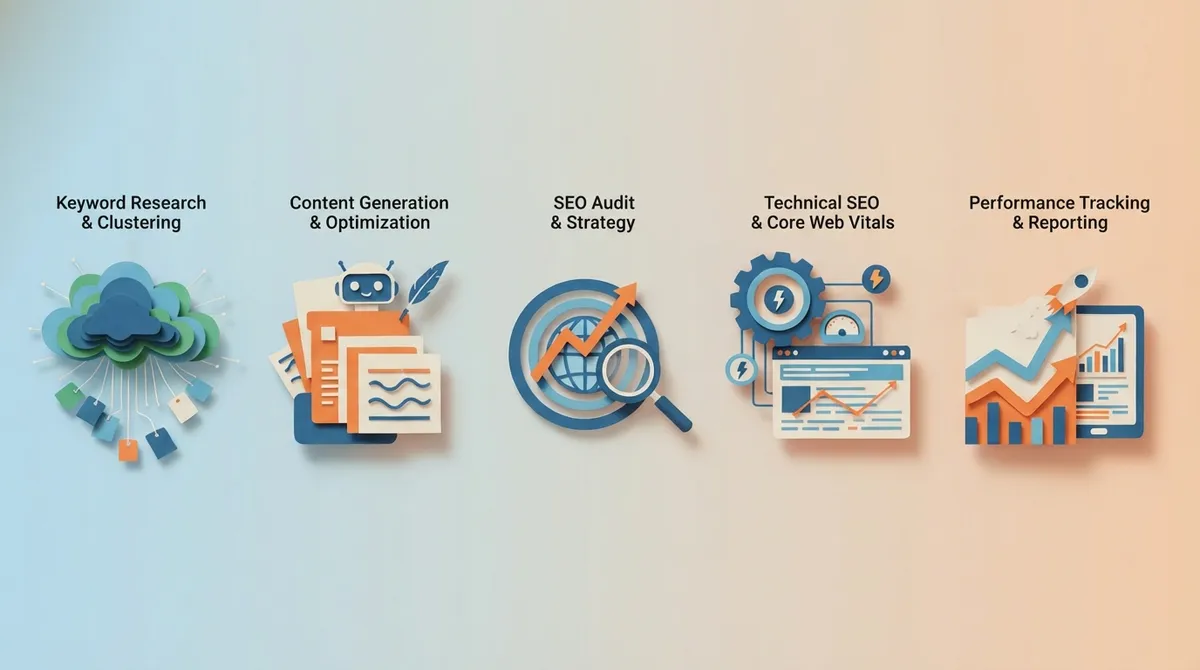
Five Main Categories of SEO AI Tools
SEO AI tools fall into distinct categories based on their primary function. Understanding these categories helps you choose tools that match your specific needs.
Keyword Research and Competitor Intelligence Tools
These platforms analyze search volume, competition levels, and keyword difficulty to identify content opportunities. Tools like Semrush and Ahrefs provide comprehensive keyword databases with live SEO data.
Key features include:
-
Search volume tracking across multiple search engines
-
Keyword difficulty scores to identify low-competition opportunities
-
Competitor analysis showing what keywords rivals rank for
-
Search intent classification (informational, commercial, transactional)
-
Related keyword suggestions and topic clustering
The challenge with standalone keyword tools is they stop at research. You still need to manually create content around those keywords, which is where content automation platforms become essential.
Content Optimization Platforms
Content optimization tools like Surfer SEO, Clearscope, and Frase analyze top-ranking pages and generate actionable guidelines for your content. They use natural language processing to understand SERP patterns and provide specific recommendations.
These tools typically offer:
-
Recommended heading structure based on competitor analysis
-
Keyword frequency targets to match top-ranking pages
-
Paragraph length and readability suggestions
-
Internal linking opportunities within your existing content
-
Content brief generation with target word counts
Content optimization platforms improve existing content but still require manual writing. They work best when combined with AI writing tools or full automation systems.
AI Writing and Content Generation Tools
AI writing assistants like Jasper, Writesonic, and SEO Rocket generate content from prompts or keywords. Modern tools in this category combine content creation with built-in SEO optimization.
Advanced features include:
-
Long-form article generation (2,000-5,000+ words)
-
Keyword-aware drafting that maintains natural language
-
Brand tone customization for consistent voice
-
Automatic metadata creation (titles, descriptions, tags)
-
Content rewriting to improve clarity and optimization
SEO Rocket differs from basic AI writers by automating the entire workflow—not just content generation. It handles keyword research, content planning, optimization, and publishing without requiring manual prompts or editing for every article.
Technical and Enterprise SEO Platforms
Enterprise-focused tools like BrightEdge and Botify handle technical SEO at scale. These platforms manage site audits, crawl analysis, and technical optimization across large websites.
Core capabilities include:
-
Automated site audits identifying technical issues
-
Crawl budget optimization for large websites
-
Schema markup deployment and validation
-
Page speed monitoring and recommendations
-
Mobile usability analysis
Technical SEO tools complement content automation platforms but serve different purposes. They ensure your site structure supports your content, while automation tools create the content itself.
Guided SEO Execution and Automation Platforms
Full automation platforms like SEO Rocket, Alli AI, and AirOps handle end-to-end SEO workflows. These tools don’t just suggest improvements—they implement changes automatically.
Automation features include:
-
Automatic title tag optimization across hundreds of pages
-
Meta description generation and deployment
-
Internal link insertion without manual editing
-
Schema markup creation and implementation
-
Daily content publishing to your CMS
These platforms reduce implementation time dramatically. Instead of manually updating each page, automation tools apply optimizations at scale. SEO Rocket’s automation goes further by eliminating keyword research, content creation, and publishing tasks entirely.

How AI Content Optimization Actually Works
AI content optimization analyzes SERP data to understand what makes content rank. The process involves several steps that happen automatically in modern platforms.
First, the AI tool crawls top-ranking pages for your target keyword. It analyzes headings, paragraph structure, keyword usage, readability scores, and content depth. This creates a benchmark showing what Google currently rewards.
Next, the tool generates specific recommendations for your content. These include suggested headings, target keyword frequency, related terms to include, optimal content length, and internal linking opportunities.
Finally, advanced platforms apply these recommendations automatically. Instead of manually editing your content, the AI implements changes and publishes the optimized version.
The result is content that matches ranking patterns without requiring hours of manual optimization. This approach works because AI can analyze patterns across hundreds of top-ranking pages faster than any human team.

On-Page SEO Automation: How It Eliminates Manual Work
On-page SEO automation handles optimization tasks at scale without human intervention. This technology has evolved significantly in 2026, allowing teams to implement changes across thousands of pages simultaneously.
What Gets Automated
Modern automation platforms handle these on-page elements:
-
Title tag creation and optimization for target keywords
-
Meta description generation with compelling CTAs
-
Header tag structuring for proper hierarchy
-
Internal link insertion based on semantic relevance
-
Image alt text generation for accessibility and SEO
-
Schema markup implementation for rich snippets
-
Readability improvements and sentence restructuring
These automations happen behind the scenes. You approve the strategy, and the platform executes changes without requiring developer involvement or manual page edits.
The Speed Advantage
Manual on-page optimization takes 30-60 minutes per page. For a website with 500 pages, that’s 250-500 hours of work. Automation platforms complete the same task in hours, not weeks.
This speed advantage becomes critical when you’re competing in fast-moving markets. While competitors manually optimize pages, automated systems continuously improve and update content based on ranking changes.
SEO content automation doesn’t just save time—it creates a competitive advantage through consistent execution that manual processes can’t match.
Choosing the Right AI SEO Tool for Your Business
Selecting the right SEO AI tool depends on your specific needs, budget, and existing workflow. Here’s how to evaluate options systematically.
Assess Your Primary Need
Start by identifying your biggest challenge:
-
Need keyword ideas but have writing resources? Choose a keyword research tool.
-
Have content but need optimization? Select a content optimization platform.
-
Need consistent content production? Consider an AI writing tool.
-
Want complete automation from research to publishing? Choose a full automation platform.
Most businesses eventually need complete automation. Starting with partial solutions (keyword tool + writing tool + optimization tool) costs more and requires more manual coordination than an integrated platform.
Evaluate Automation Capabilities
True automation means the tool works without daily supervision. Ask these questions:
-
Does it automatically discover new keyword opportunities?
-
Can it generate content without manual prompts for each article?
-
Does it optimize content based on real-time SERP data?
-
Can it publish directly to your website without copy-pasting?
-
Does it handle images, internal links, and metadata automatically?
Many tools claim automation but still require significant manual work. SEO Rocket’s automation handles all five capabilities, making it a true set-and-forget system.
Consider Integration and Workflow
The tool should fit your existing technology stack. Check for:
-
Direct publishing to WordPress, Webflow, Shopify, or Wix
-
API access for custom integrations
-
Team collaboration features for multiple users
-
Content calendar management
-
Performance tracking and analytics
Tools that integrate directly with your CMS eliminate manual publishing steps. This saves hours per week and reduces the chance of errors or inconsistencies.
Calculate True Cost per Article
Compare pricing by calculating cost per article, not just monthly fees. Factor in time spent on manual tasks.
For example, a tool that costs $500/month but generates 100 optimized articles costs $5 per article. A tool that costs $200/month but requires 2 hours of manual work per article actually costs much more when you factor in labor.
Full automation platforms typically offer the lowest cost per article because they eliminate labor costs entirely.
|
Tool Type |
Monthly Cost Range |
Manual Work Required |
Best For |
|---|---|---|---|
|
Keyword Research Only |
$99-$499 |
High (writing, optimization, publishing) |
Agencies with in-house writers |
|
Content Optimization |
$49-$299 |
Medium (writing, publishing) |
Teams with existing content |
|
AI Writing Assistant |
$29-$199 |
Medium (research, editing, publishing) |
Solo creators and bloggers |
|
Full Automation Platform |
$99-$799 |
Minimal (review and approve) |
Businesses wanting hands-off SEO |
AI Search Engine Optimization: Beyond Google in 2026
Traditional SEO focuses exclusively on Google rankings. AI search engine optimization (AI-SEO) extends visibility to AI-powered platforms like ChatGPT, Perplexity, Claude, Gemini, Copilot, and Grok.
These AI platforms answer user questions by referencing web content. When your content is well-structured and authoritative, AI models cite it as a source in their answers. This creates a new traffic channel beyond traditional search engines.
How AI-SEO Works
AI models prefer content with specific characteristics:
-
Clear structure with descriptive headings
-
Concise, accurate information without fluff
-
Data, statistics, and factual statements
-
Natural language that answers specific questions
-
Authoritative sources and citations
Content optimized for AI search follows these patterns naturally. The same principles that help you rank on Google—comprehensive coverage, clear structure, expertise—also make your content valuable to AI platforms.
Tracking AI Visibility
New SEO AI tools in 2026 include AI visibility tracking. These features monitor how often your brand or content appears in AI-generated answers across different platforms.
This metric matters because AI search is growing rapidly. Users increasingly ask questions to AI assistants instead of searching Google. Being visible in these answers drives traffic and builds authority.
Improving AI search visibility requires optimizing for both traditional search engines and AI models. Platforms designed for 2026 handle both automatically.
Key Features to Look for in Modern SEO AI Tools
The best SEO AI tools in 2026 share several critical features that separate effective platforms from outdated solutions.
Real-Time SEO Scoring
Advanced tools provide instant feedback on content optimization. Real-time scoring shows how your content compares to top-ranking pages before you publish.
Look for tools that score:
-
Keyword optimization and density
-
Content structure and heading hierarchy
-
Readability and sentence complexity
-
Internal and external linking
-
Meta element optimization
Real-time scoring prevents publishing under-optimized content. You catch issues before they hurt rankings, not after.
Automated Fix Suggestions
Identifying problems is helpful. Automatically fixing them is better. The best tools suggest specific improvements and offer one-click implementation.
For example, if your title tag is too long, the tool should automatically generate an optimized alternative. If keyword density is low, it should suggest specific places to add keywords naturally.
This feature saves hours of manual editing and ensures consistent optimization quality across all content.
Multi-Platform Publishing
Direct publishing to your CMS eliminates manual copy-pasting. Modern SEO AI tools connect directly to WordPress, Webflow, Shopify, Wix, and custom platforms through APIs.
Publishing automation includes:
-
Automatic formatting with proper HTML structure
-
Image insertion and optimization
-
Internal link deployment
-
Category and tag assignment
-
Scheduling for optimal publishing times
This integration transforms content production from a multi-step manual process into a single automated workflow.
Unlimited Rewrites and Iterations
Content often needs adjustments after initial creation. Tools with unlimited rewrites let you refine content without hitting usage limits or paying per generation.
This feature is essential for:
-
Testing different angles and approaches
-
Updating content as search intent evolves
-
Refreshing older articles to maintain rankings
-
Customizing content for different audience segments
Platforms that limit rewrites create artificial constraints that slow down content improvement.
The Difference Between AI Writing Tools and Full Automation Platforms
Understanding the distinction between AI writing assistants and full automation platforms helps you choose the right solution.
AI Writing Assistants
Tools like Jasper and Writesonic generate content from prompts. You provide a topic or keyword, and the tool creates a draft. These platforms work well for creating individual pieces of content.
Typical workflow:
-
Research keywords manually
-
Create a content prompt
-
Generate content draft
-
Manually edit and optimize
-
Add images and formatting
-
Copy content to your CMS
-
Publish manually
This process is faster than writing from scratch but still requires significant manual involvement for each article.
Full Automation Platforms
Platforms like SEO Rocket handle the entire workflow automatically. You set up the system once, and it generates, optimizes, and publishes content daily without ongoing manual work.
Automated workflow:
-
System discovers keyword opportunities automatically
-
Content calendar fills with scheduled articles
-
Platform generates optimized articles daily
-
Articles publish directly to your website
-
System monitors performance and adjusts strategy
The key difference is ongoing manual work versus true automation. AI writing tools are assistants that speed up writing. Automation platforms are systems that replace manual content production entirely.
Pricing Models and Cost Considerations for 2026
SEO AI tool pricing varies significantly based on features and automation level. Understanding pricing models helps you make cost-effective decisions.
Common Pricing Structures
Most tools use one of these models:
-
Per-article pricing: Pay $15-$50 per generated article
-
Monthly subscription: Fixed fee for unlimited or capped usage
-
Tiered plans: Different feature levels at different price points
-
Lifetime deals: One-time payment for permanent access
Per-article pricing seems affordable initially but becomes expensive at scale. Monthly subscriptions with unlimited usage provide better value for consistent content production.
Hidden Costs to Consider
The listed price doesn’t always reflect true cost. Factor in:
-
Time spent on manual tasks the tool doesn’t automate
-
Additional tools needed to complete your workflow
-
Team training and learning curve
-
Content editing and optimization time
-
Publishing and formatting labor
A tool that costs $200/month but requires 20 hours of manual work costs more than a $500/month platform that eliminates manual tasks entirely.
|
Platform Type |
Typical Monthly Cost |
Articles per Month |
Cost per Article |
|---|---|---|---|
|
Basic AI Writer |
$49-$99 |
20-50 |
$1-$5 |
|
Content Optimization |
$99-$299 |
Unlimited |
Variable (manual writing required) |
|
Full Automation |
$99-$799 |
30-300 |
$3-$10 |
|
SEO Agency Service |
$3,000-$5,000 |
4-8 |
$400-$1,000 |
ROI Calculation
Calculate return on investment based on traffic and revenue, not just cost. An SEO AI tool that costs $500/month but drives 10,000 monthly visitors worth $5,000 in revenue provides 10x ROI.
Compare this to hiring writers at $100-$200 per article or working with agencies at $3,000-$5,000 monthly. Automation platforms typically deliver higher ROI because they produce more content at lower cost per article.
Daily publishing strategies amplify ROI by creating compounding traffic growth over time. Consistent publishing beats sporadic high-quality content in most cases.
Agency-Specific Considerations for SEO AI Tools
SEO agencies and digital marketing consultants need tools with specific capabilities that solo businesses don’t require.
Multi-Client Management
Agency plans must support multiple client workspaces with separate settings, content calendars, and publishing destinations. Look for:
-
Unlimited or high client limits (10+ workspaces)
-
Separate branding and tone settings per client
-
Individual reporting and analytics dashboards
-
Client collaboration and approval workflows
-
White-label options for branded reporting
Managing multiple clients with single-user tools creates chaos. Switching between accounts, losing context, and mixing up client settings wastes time and creates errors.
Volume Requirements
Agencies need significantly higher article volumes than individual businesses. A typical agency manages 5-10 clients, each needing 10-30 articles monthly.
Calculate your volume needs:
-
Count current and projected clients
-
Determine articles per client per month
-
Add 25% buffer for growth
-
Choose a plan that exceeds this total
Running out of article credits mid-month disrupts client schedules. Choose plans with volume that exceeds your needs rather than barely meeting them.
Team Collaboration
Agency tools need robust team features:
-
Unlimited team member seats
-
Role-based permissions (writer, editor, admin)
-
Content review and approval workflows
-
Internal commenting and feedback
-
Activity tracking and audit logs
These features prevent bottlenecks and ensure quality control without micromanagement. Team members can work independently while maintaining consistency.
Avoiding common AI SEO mistakes becomes easier with proper team collaboration and approval processes built into your platform.
Why SEO Rocket Outperforms Traditional SEO AI Tools
Most SEO AI tools handle one or two parts of the content workflow. SEO Rocket automates the entire process from keyword discovery to daily publishing, making it a complete system rather than a partial solution.
End-to-End Automation
SEO Rocket eliminates manual work at every stage. The platform automatically discovers keyword opportunities by analyzing your niche and competition. It builds a content calendar filled with high-potential topics. Then it generates, optimizes, and publishes articles daily without requiring prompts or manual editing.
This complete automation means you spend 10 minutes on initial setup, then the system runs independently. You review content if desired, but the platform doesn’t wait for approval to continue working.
AI Search Optimization Built In
Unlike competitors focused only on Google, SEO Rocket optimizes content for both traditional search engines and AI platforms like ChatGPT, Perplexity, and Claude. Articles are structured to serve as authoritative sources that AI models reference in their answers.
This dual optimization creates visibility in both traditional and AI search channels, maximizing traffic potential from every article.
Consistent Daily Publishing
SEO Rocket publishes one article daily on the Business plan or ten daily on the Agency plan. This consistency creates compounding growth that sporadic publishing can’t match.
Daily publishing builds topical authority, signals freshness to search engines, and continuously expands your keyword coverage. Over months and years, this consistency compounds into significant traffic growth.
True Cost Efficiency
At approximately $3 per article, SEO Rocket provides content at a fraction of agency or freelance costs. The Business plan ($99/month) generates 30 optimized articles monthly. The Agency plan ($799/month) produces 300 articles across 10 client workspaces.
Compare this to agency content at $400-$1,000 per article or freelance writers at $100-$200 per article. The cost difference is substantial, especially at scale.
Lifetime Plan Availability
SEO Rocket offers a $1,499 lifetime plan with permanent access. This eliminates subscription fatigue and provides long-term cost predictability that monthly plans can’t match.
For businesses planning to publish consistently for years, the lifetime plan pays for itself quickly compared to ongoing subscriptions.
Ready to eliminate manual SEO work and start building consistent organic traffic? Try SEO Rocket with a free trial and see how automation transforms your content strategy.
Implementation: Getting Started with SEO AI Tools
Implementing SEO AI tools correctly ensures you maximize value from day one. Follow this systematic approach.
Step 1: Audit Your Current Workflow
Document exactly how you currently produce content. List every step from keyword research through publishing. Identify which steps take the most time and which create bottlenecks.
This audit reveals where automation provides the biggest impact. Focus on tools that eliminate your most time-consuming tasks first.
Step 2: Define Success Metrics
Determine how you’ll measure tool effectiveness before you start. Common metrics include:
-
Time saved per article produced
-
Cost per article versus previous methods
-
Articles published per month compared to baseline
-
Organic traffic growth over 90 days
-
Keyword ranking improvements
Tracking these metrics from the beginning helps you quantify ROI and justify continued investment in automation tools.
Step 3: Connect Your Publishing Platform
Link the SEO AI tool to your WordPress, Webflow, Shopify, or Wix site. Proper integration enables direct publishing and eliminates manual content transfer.
Test the connection by publishing a draft article to verify formatting, images, and links appear correctly. Fix any integration issues before scaling up production.
Step 4: Configure Brand Settings
Set up brand voice, tone preferences, and content guidelines within the tool. This ensures generated content matches your existing style and maintains consistency across all articles.
Include information about your target audience, preferred sentence length, technical detail level, and any topics to avoid. Quality tools adapt to these preferences automatically.
Step 5: Build Your Initial Content Calendar
Populate your content calendar with 30-60 days of planned articles. This provides the automation system with a runway to work from and ensures consistent publishing from day one.
Choose keywords with varying difficulty levels to build authority gradually. Mix informational and commercial content to address different stages of the buyer journey.
Common Mistakes When Using SEO AI Tools
Understanding common pitfalls helps you avoid wasting time and money on ineffective implementations.
Expecting Instant Results
SEO takes time regardless of whether you use AI tools or manual methods. Expecting immediate rankings and traffic leads to disappointment and premature tool abandonment.
Realistic timeline: New websites see initial ranking improvements in 60-90 days. Established sites may see faster results. Consistent publishing over 6-12 months creates significant, sustainable traffic growth.
Not Customizing Output
Using default settings produces generic content that doesn’t stand out. Take time to configure brand voice, tone, and content preferences so output matches your needs.
Quality AI tools adapt to your specifications. Spending 30 minutes on proper configuration saves hours of editing later.
Publishing Without Review
Even automated content benefits from light review before publishing. Check for factual accuracy, ensure examples are relevant, and verify links work correctly.
A quick 5-minute review catches obvious issues and maintains content quality without eliminating automation benefits.
Choosing Tools Based Only on Price
The cheapest tool often costs more in the long run when you factor in time spent on manual tasks it doesn’t automate. Evaluate total cost of ownership, not just subscription fees.
A more expensive tool that eliminates 20 hours of monthly work provides better value than a cheap tool requiring significant manual effort.
Ignoring Analytics and Performance
Publishing content without tracking results means you can’t improve over time. Monitor which articles rank well, which drive traffic, and which convert visitors.
Use these insights to refine your content strategy. Double down on topics and formats that work. Adjust approaches that underperform.
The Future of SEO AI Tools Beyond 2026
SEO AI tools continue evolving rapidly. Understanding emerging trends helps you stay ahead of competitors.
Predictive Traffic Forecasting
Advanced tools now predict expected traffic and ranking potential before you publish. This capability helps prioritize content with the highest ROI potential.
Predictive analytics analyze competition levels, search volume trends, and your site’s authority to forecast realistic outcomes. This data-driven approach replaces guesswork in content planning.
Deeper AI Search Integration
As AI-powered search platforms grow, tools will offer more sophisticated AI-SEO features. Expect capabilities like AI citation tracking, AI answer optimization, and strategies specifically designed for visibility in AI-generated content.
Early adopters of AI-SEO gain competitive advantages as search behavior shifts toward conversational AI platforms.
More Sophisticated Automation
Current automation handles content creation and publishing. Future tools will manage entire marketing funnels, from content to lead nurturing to conversion optimization.
This holistic automation transforms SEO from a traffic generation tactic into a complete customer acquisition system.
Better Content Personalization
AI tools will generate content variations for different audience segments automatically. One keyword might produce multiple articles tailored to beginners, intermediates, and experts.
This personalization improves user experience and engagement metrics, leading to better rankings and higher conversion rates.
Final Thoughts on Choosing SEO AI Tools
The right SEO AI tool transforms content production from a constant struggle into a systematic growth engine. In 2026, businesses that adopt effective automation gain significant competitive advantages through consistent publishing, optimized content, and scalable processes.
Focus on tools that provide complete automation rather than partial solutions. Evaluate based on total value—time saved, results produced, and cost per article—not just monthly subscription fees. Choose platforms optimized for both traditional and AI-powered search to maximize visibility across all channels.
For most businesses and agencies, full automation platforms like SEO Rocket deliver the best combination of results, efficiency, and cost-effectiveness. The platform handles everything from keyword discovery through daily publishing, creating consistent traffic growth without requiring constant manual work.
Ready to transform your SEO strategy with complete automation? Explore SEO Rocket’s pricing plans and start building sustainable organic traffic with minimal ongoing effort.
FAQs
Q: What is the difference between SEO AI tools and traditional SEO software?
A: SEO AI tools use machine learning and natural language processing to automate tasks like keyword research, content creation, and optimization. Traditional SEO software requires manual input for each step. AI tools analyze patterns across thousands of pages and make data-driven decisions automatically, while traditional tools provide data that humans must interpret and act on manually.
Q: How do content optimization tools determine what recommendations to make?
A: Content optimization tools crawl top-ranking pages for your target keyword and analyze their structure, keyword usage, readability, and content depth. They identify common patterns across high-performing content and generate specific recommendations to match those patterns. The AI compares your content against this benchmark and suggests improvements to increase ranking potential.
Q: Can SEO AI tools really replace human writers?
A: Modern SEO AI tools can handle the technical aspects of content creation—research, structure, optimization, and publishing—at scale. They work best for informational content, product descriptions, and data-driven articles. Human oversight remains valuable for brand voice refinement, strategic direction, and ensuring factual accuracy. The best approach combines AI automation with light human review rather than full replacement.
Q: What is AI search engine optimization and why does it matter?
A: AI search engine optimization (AI-SEO) focuses on making your content visible in AI-powered platforms like ChatGPT, Perplexity, and Claude. These platforms reference web content when answering user questions. AI-SEO structures content so AI models cite it as an authoritative source. This matters because search behavior is shifting toward conversational AI platforms, creating a new traffic channel beyond traditional Google search.
Q: How long does it take to see results from SEO AI tools?
A: Initial ranking improvements typically appear within 60-90 days for new websites, faster for established sites with existing authority. Significant traffic growth builds over 6-12 months of consistent publishing. SEO AI tools accelerate results by enabling daily publishing and consistent optimization, but they don’t bypass the time required for search engines to index, evaluate, and rank your content.