Key Takeaways
-
WordPress content plugins only optimize existing content but don't create, schedule, or publish articles automatically—you still need writers and manual management.
-
Full SEO content automation platforms like SEO Rocket generate 3,000+ word articles daily and auto-publish to WordPress for ~$3 per article, versus plugins costing $49-99/year plus ongoing writer fees.
-
Most WordPress plugins lack AI search optimization for ChatGPT, Perplexity, and Gemini—critical in 2026 for visibility beyond traditional Google rankings.
-
Standalone plugins require you to handle keyword research, content writing, publishing schedules, and consistency enforcement, making scaling difficult without hiring additional staff.
-
Full automation platforms can be set up in under 10 minutes and run hands-off daily, while WordPress plugins require hours of setup and ongoing weekly management.
-
Use WordPress plugins only if you have writers on staff, publish irregularly, or manage small sites under 20 pages—otherwise automation delivers better ROI and consistency.
If you run a business website on WordPress, you’ve probably heard about content plugins. They promise to make SEO easier, faster, and less painful. And honestly? Many of them do help. But here’s the big question: is using a standalone WordPress content plugin really the best way to grow your organic traffic in 2026?
Or is there a smarter, more automated approach that saves you even more time and delivers better results? In this article, we’re breaking down the world of WordPress content plugins — what they do, what they can’t do, and how full SEO content automation stacks up against them. Whether you’re a small business owner, a content manager, or a busy marketing team, this comparison will help you make the right call.

What Is a WordPress Content Plugin?
A WordPress content plugin is a tool you install directly on your WordPress site. It helps you optimize your content for search engines. Most plugins offer features like on-page SEO scoring, meta title and description editing, schema markup, and readability analysis.
Popular options in 2026 include tools that use AI to suggest keywords, generate titles, and even flag content gaps. For example, tools like Rank Math’s Content AI provide live on-page scoring, contextual keyword suggestions, and AI-generated titles and meta descriptions. Others like SEOPress support multiple AI providers like GPT-5 for content generation and even include llms.txt for AI crawler compatibility — a must-have in 2026.
These plugins are genuinely useful. But they all share a common limitation: they still require you to do most of the work. You still need to write the content, publish it, and manage your schedule manually.

Top WordPress Content Plugin Features in 2026
Let’s take a quick look at what the best WordPress content plugins currently offer. This gives us a solid baseline for comparison.
| Plugin Feature | What It Does | Still Manual? |
|---|---|---|
| On-page SEO Scoring | Rates your content and gives optimization tips | Yes — you fix it |
| AI Meta Generation | Suggests or writes title tags and meta descriptions | Partially |
| Schema Markup | Auto-generates structured data for rich results | Partially |
| Keyword Suggestions | Shows related terms to include in your content | Yes — you write it |
| Readability Analysis | Checks sentence length, passive voice, and flow | Yes — you rewrite it |
| Internal Linking | Suggests relevant pages to link to | Yes — you add them |
| Content Gap Detection | Finds topics your competitors cover that you don’t | Yes — you create it |
Notice anything? Almost every feature still requires you to take action. These plugins are really advisors, not doers. They point out problems and opportunities, but you’re the one who has to roll up your sleeves and fix them. If you want to go deeper on SEO content writing strategies for 2026, that’s a great place to start understanding why the writing itself is still the hardest part.
The 5 Biggest Limitations of WordPress Content Plugins
We love that WordPress content plugins exist. But let’s be honest about where they fall short, especially if you’re trying to scale your SEO content efforts.
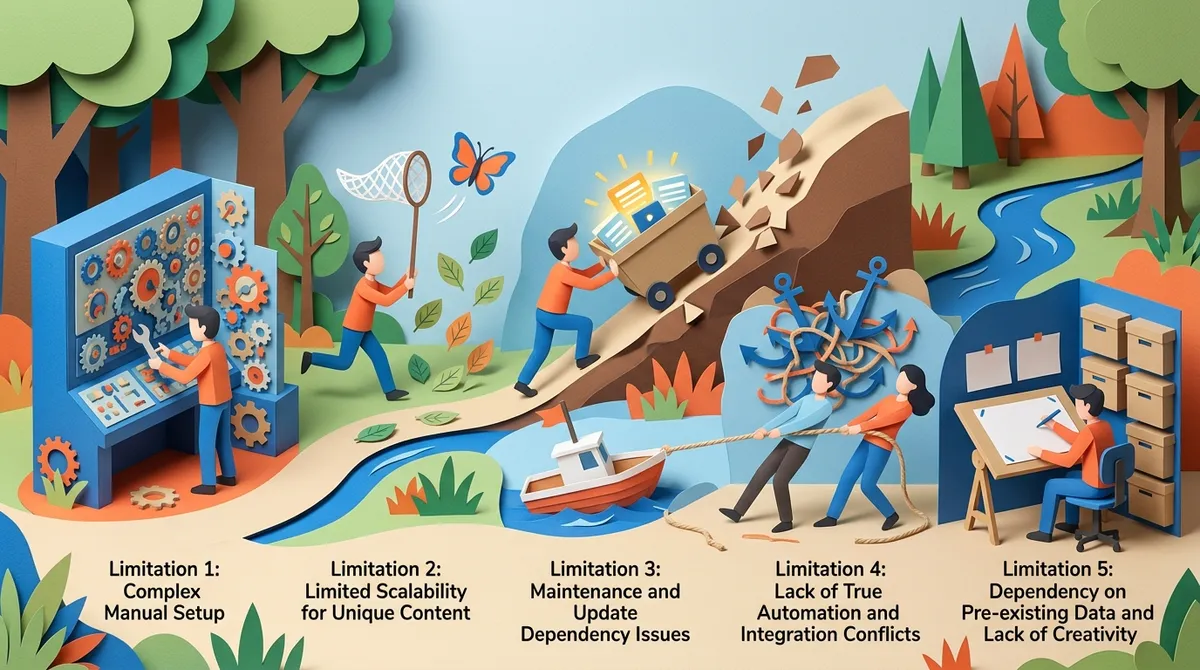
- You still have to write the content. Plugins optimize what you give them. They don’t create long-form, SEO-optimized articles from scratch. That’s still on you — or your writer.
- There’s no publishing automation. Most plugins don’t schedule and publish content daily on your behalf. You still have to manage an editorial calendar manually.
- Keyword research is separate. Many plugins offer keyword suggestions, but none of them give you a full, actionable keyword research system with live data and content planning built in together.
- Consistency is hard to maintain. Plugins don’t remind you to publish. Without daily publishing, your SEO growth stalls. Google rewards consistency, and plugins can’t enforce it for you.
- They don’t optimize for AI search. In 2026, showing up in AI Overviews on Google, or being cited in ChatGPT, Perplexity, or Gemini answers, is just as important as ranking on page one. Most plugins are still Google-first and don’t structure content for AI search engines.
If you’re curious about how to improve your AI search visibility in 2026, you’ll quickly see why optimization for AI platforms is no longer optional.

What Full SEO Content Automation Actually Looks Like
Here’s where things get exciting. Full SEO content automation doesn’t just optimize content — it creates, schedules, and publishes it for you, every single day. Think of it as replacing your entire content team with a smart, always-on system.
A platform like SEO Rocket is built for exactly this. It’s not a plugin that sits inside WordPress waiting for you to use it. It’s a complete content engine that handles everything from keyword discovery to daily publishing — automatically.
Here’s how full automation compares to using a standalone WordPress content plugin:
| Capability | WordPress Content Plugin | Full SEO Automation (SEO Rocket) |
|---|---|---|
| Keyword Research | Basic suggestions | Full engine with live data and intent mapping |
| Content Creation | You write it | 3,000+ word articles auto-generated daily |
| Publishing | You publish manually | Auto-published to WordPress, Webflow, Shopify, Wix |
| SEO Optimization | You follow the suggestions | Auto-optimized with real-time scoring and fixes |
| AI Search Visibility | Rarely supported | Built for ChatGPT, Perplexity, Gemini, and more |
| Setup Time | Hours of setup and ongoing management | Under 10 minutes, then fully hands-off |
| Cost per Article | Varies (plus your time) | ~$3 per 3,000-word article |
| Consistency | Depends on your schedule | One article published every day, automatically |
When a WordPress Content Plugin Makes Sense
To be fair, a WordPress content plugin is still a great tool in specific situations. Here are the cases where using one makes the most sense:
- You already have a team of writers and just need optimization guidance
- You publish content irregularly and don’t need daily automation
- You’re running a very small site with fewer than 20 pages
- You want to manually control every aspect of your content
- You’re in an extremely niche market where AI-generated content needs heavy customization
In these cases, a plugin like Rank Math’s free tier — which offers unlimited keyword optimization, schema, and Search Console integration — can be a solid, cost-effective choice. You can even pair it with other tools to build a semi-automated workflow. Check out the best AI writing tools for content creation in 2026 if you’re looking to build a custom stack.
When Full SEO Content Automation Is the Better Choice
For most growing businesses, full automation is the smarter move. Here’s when you should skip the plugin and go straight to a complete automation platform:
- You want to publish content every day without hiring a writer
- You’re managing multiple websites or clients
- You need articles that are 3,000+ words and optimized out of the box
- You want to rank in AI search engines, not just Google
- You have a small budget but need big results
- You’ve tried plugins but still aren’t seeing consistent traffic growth
If you’re running a small business or a growing agency, spending hours each week on content just isn’t sustainable. Automation gives you the consistency that plugins can’t. As Google’s Search Quality Rater Guidelines make clear, E-E-A-T signals and consistent, authoritative content are more important than ever in 2026.
How SEO Rocket Goes Beyond Any WordPress Content Plugin
SEO Rocket isn’t a plugin — it’s a complete SEO content automation platform. Once you connect your WordPress site (setup takes less than 10 minutes), the system takes over completely.
Here’s what happens automatically every single day:
- Keyword discovery: The system finds high-opportunity keywords based on search volume, competition, and intent — no spreadsheets needed.
- Content planning: A visual content calendar fills itself with article ideas. You approve or adjust, then let it run.
- Article generation: SEO Rocket writes a 3,000+ word, fully optimized article using AI — complete with metadata, internal links, images, and business mentions.
- Publishing: The article publishes directly to your WordPress site. No copy-pasting, no manual uploads.
- Ongoing optimization: Real-time SEO scoring and auto-fix suggestions keep your content competitive over time.
Explore the full SEO Rocket features to see just how much heavy lifting the platform handles for you. And if you want to see real results, take a look at writing examples to understand the content quality you can expect.
The Cost Comparison You Need to See
Let’s talk money, because this is where full automation really shines.
- A traditional SEO agency: $3,000–$5,000/month
- Freelance writers (for daily content): $2,000–$4,000/month
- WordPress plugin (like SEOPress Pro): ~$49/year — but you still pay for writers
- SEO Rocket Business Plan: $99/month for 30 articles (~$3 per article)
- SEO Rocket Agency Plan: $799/month for 300 articles across 10 client workspaces
The math is pretty clear. If you’re serious about scaling your SEO, a plugin alone won’t cut it — and an agency is too expensive. Automation hits the sweet spot. You can explore SEO Rocket’s pricing plans to find the right fit for your team or agency.
If you’re curious about building a consistent publishing strategy, these daily blog posting strategies show exactly why frequency and automation drive the best long-term results. And for agencies looking to scale content production, the best AI blog writers compared for 2026 is worth a read too.
The Verdict: Plugin or Full Automation?
Here’s the bottom line. A WordPress content plugin is a helpful tool. It’s great for optimizing content you’ve already written. But it won’t write your content, publish it daily, or make sure you show up in AI search results.
Full SEO content automation does all of that. It replaces not just the plugin, but the writer, the editor, the SEO manager, and the publisher — all in one system that runs while you focus on running your business.
If you want faster traffic growth, lower costs, and true hands-off SEO, automation wins every time. You can always learn how to choose the best AI blog post generator to find the right fit before committing. And when you’re ready, you can also check the SEO Rocket roadmap to see what’s coming next.
Ready to stop managing plugins and start growing automatically? Get started with SEO Rocket today and experience what hands-free SEO content automation really feels like — with a free 3-day trial and no long-term commitment needed.
FAQs
Q: What is a WordPress content plugin and what does it do?
A: A WordPress content plugin is a tool you install on your WordPress site to help optimize your content for search engines. It typically offers features like on-page SEO scoring, keyword suggestions, schema markup, and meta description editing — but you still need to write and publish the content yourself.
Q: Can a WordPress content plugin replace a full SEO content automation platform?
A: Not quite! A WordPress content plugin is great for optimizing content you’ve already written, but it can’t write articles, publish them daily, or optimize for AI search engines like ChatGPT and Perplexity. Full automation platforms handle the entire workflow from keyword research to publishing, which is a whole different level of power.
Q: Which is more cost-effective: a WordPress content plugin or SEO content automation?
A: Plugins like SEOPress Pro cost around $49/year, but you still need to pay for writers and spend time managing everything manually. SEO Rocket’s automation plan starts at $99/month and generates 30 full 3,000-word articles — that’s about $3 per article with zero manual effort, making automation the better value for scaling teams.
Q: Do WordPress content plugins work for AI search visibility in 2026?
A: Most WordPress content plugins are still primarily built for traditional Google SEO and don’t structure content for AI search engines like ChatGPT, Gemini, or Perplexity. In 2026, AI search visibility is a big deal, so you’ll want a platform that’s specifically designed to help you show up in AI-powered search results.
Q: How long does it take to set up full SEO content automation compared to a WordPress plugin?
A: A WordPress content plugin typically takes an hour or more to configure, and ongoing management can eat up several hours per week. SEO Rocket takes less than 10 minutes to set up, and after that, the platform runs on autopilot — no ongoing maintenance required. Pretty amazing, right?