
Key Takeaways
-
Backlink software is a research and organization tool, not a magic link builder—it only works effectively when paired with genuinely valuable, link-worthy content that gives people a real reason to link to you.
-
Avoid buying links or using automated mass link creation, as Google classifies these as spam and can result in ranking penalties or removal from search results entirely.
-
Quality beats quantity in backlinks: a single link from a relevant, trusted, well-trafficked site typically outperforms ten links from low-quality directories or random sources.
-
Connect backlink software to your content calendar, CMS, analytics, and reporting dashboard so your research, outreach timing, and campaign tracking work as one integrated system instead of manual busywork across five tools.
-
Monitor and maintain your existing links monthly by checking for broken links, nofollow changes, and deleted pages, since sites redesign and links disappear—protecting the SEO value you already earned.
-
Consistent, high-quality content publishing (3,000+ word articles with proper structure and research) creates a steady stream of link-worthy assets, making outreach more effective than running occasional big campaigns around thin content.
If you have ever typed “backlink software” into Google at midnight, hoping for a magic button that builds authority links while you sleep, you are not alone. So many business owners and marketers land here looking for a shortcut. Here is the good news: there is a smarter way to think about this whole thing, and it does not involve buying sketchy links or crossing your fingers. Let’s walk through what backlink software really does, how it fits into a modern content plan, and why the best results come from pairing smart tools with genuinely useful content.
This guide is written for small SEO agencies, in-house marketers, content managers, consultants, e-commerce teams, and small business owners alike. Whether you manage one website or fifty client accounts, you deserve a clear, honest explanation. No hype, no jargon overload. Just friendly, practical advice you can actually use starting today.

What Is Backlink Software, Really?
Backlink software is a category of tools that helps you research, find, organize, and track links pointing to your website. Think of it as your command center for everything link-related. It does not wave a wand and create trustworthy links out of thin air. Instead, it helps you work smarter by handling the research and busywork.
Most tools in this space help with a few core jobs:
- Finding out which sites already link to you (and your competitors)
- Spotting new link opportunities based on your topic and industry
- Finding contact information for outreach
- Managing outreach emails and follow-ups
- Watching your links to see if any go missing or change
- Reporting on what is working and what is not
When you connect backlink software to a strong content system, the whole process gets a lot easier. Your content becomes the reason someone wants to link to you in the first place. Without something worth linking to, even the best software will not get you far.
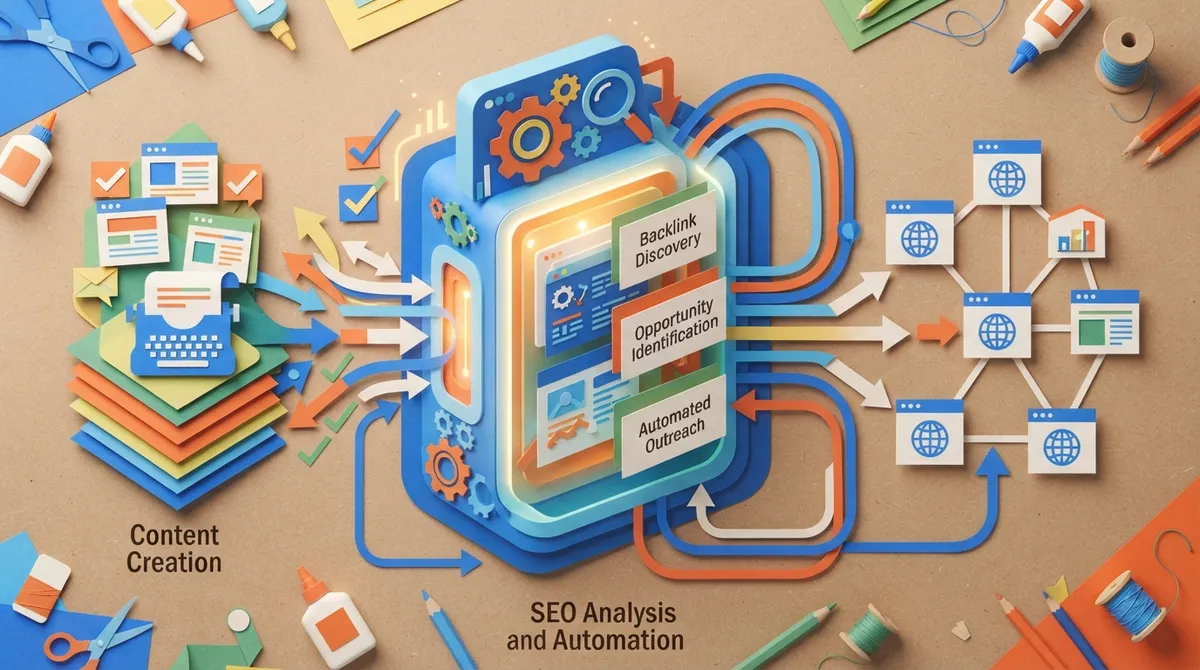
How Backlink Software Fits Into SEO Content Automation
Here is the part a lot of people miss. Backlink tools work best when they are not operating alone. They need to be connected to your content calendar, your publishing schedule, and your overall SEO strategy.
Picture this simple workflow:
- Your content system creates a genuinely useful article, guide, or resource
- Backlink software helps you find people and sites likely to reference that resource
- You (or your team) send a thoughtful, personalized note explaining why it might help their readers
- The tool tracks replies and monitors whether the link goes live
- You measure results, like traffic, rankings, and referral visits
This is why pairing content automation with backlink tools makes so much sense. If you are publishing consistently with a platform like SEO Rocket’s automated content system, you always have fresh, link-worthy material ready to go. That steady stream of quality content gives your outreach efforts something real to point to, instead of an empty blog with three posts from last year.
What Backlink Software Can (and Cannot) Do
Let’s be honest with each other here, because that is what friends do. Backlink software is genuinely helpful, but it has limits. Understanding these limits will save you time, money, and future headaches.
What It Can Do Well
- Show you where your competitors are getting their links
- Filter out spammy or low-quality sites so you focus on good opportunities
- Speed up finding email addresses and contact details
- Send personalized outreach at scale, with your review
- Alert you the moment a link disappears or changes
- Organize campaigns so nothing falls through the cracks
What It Cannot Do
- Guarantee that someone will actually link to you
- Create trust or authority for a website that has thin or repetitive content
- Replace human judgment about which prospects are actually relevant
- Protect you from penalties if used for buying links or mass automated placements
According to Google’s official spam policies, using automated programs to create links, buying or selling links for ranking purposes, and excessive link exchanges are all considered manipulative behavior. Sites that break these rules can rank lower or get removed from search results entirely. That is a risk that simply is not worth taking, no matter how tempting a shortcut looks.
Types of Backlink Software You Will Come Across
Not all backlink tools do the same job. Knowing the categories helps you pick the right one (or combination) for your needs.
| Tool Category | Main Purpose | Best For |
|---|---|---|
| All-in-one SEO platforms | Backlink data plus keyword research, site audits, and rank tracking | Agencies and in-house teams wanting one dashboard |
| Backlink intelligence databases | Deep link data, competitor analysis, historical link history | Consultants doing detailed research |
| Outreach CRM tools | Managing prospects, emails, and follow-ups | Teams running frequent outreach campaigns |
| Email-finding and sequencing platforms | Finding contact details and automating email sequences | Small teams without a dedicated outreach person |
| Link monitoring services | Tracking lost, broken, or changed links | Anyone who wants to protect existing link value |
Common examples in this space include Ahrefs, Semrush, Majestic, Moz Pro, BuzzStream, Pitchbox, Respona, Hunter, and Linkody. Pricing varies quite a bit. A 2026 tool comparison found starting prices ranging from about $24 per month on the lower end to roughly $500 per month for more advanced outreach platforms. Always check current pricing directly with each vendor, since these numbers shift often.
A Step-by-Step Workflow That Actually Works
If you want a repeatable process that keeps you safe and effective, follow these steps:
- Pick your target page. Decide which page or article deserves link-building attention. It should already be helpful and well-written.
- Make it genuinely link-worthy. Add original data, a helpful visual, a tool, or an in-depth guide people actually want to reference.
- Research relevant prospects. Use your backlink software to find sites in your topic area, especially ones linking to similar content.
- Verify before you reach out. Check that the site is real, active, and relevant. Skip anything that feels spammy.
- Personalize your outreach. A short, specific note explaining why your resource helps their readers works far better than a generic template.
- Track responses and follow up. Most replies come after a polite second message, so do not give up too soon.
- Monitor your links. Once a link goes live, keep an eye on it in case it gets removed or changed later.
- Measure real outcomes. Look at referral traffic, indexed pages, keyword rankings, and actual leads or sales, not just the number of links.
This process takes patience, but it builds something that lasts. If you want a deeper look at how strong on-page content supports this whole process, check out our guide on building a topic cluster strategy that boosts SEO.
How to Judge Link Quality (Without Getting a Headache)
Not every link is worth the same. Here is what actually matters when you are reviewing a potential link opportunity:
- Is the site relevant to your topic or industry?
- Is the page actually indexed in Google?
- Does the surrounding content make sense next to your link?
- Is the anchor text natural, not stuffed with keywords?
- Does the site get real traffic, not just a big-sounding domain score?
- Is the link followed, or is it nofollow or sponsored?
A single link from a relevant, trusted, well-trafficked site usually beats ten links from random low-quality directories. Quality really does beat quantity here.
Where AI-Generated Content Fits Into This Picture
You might be wondering if AI-written content can still earn quality backlinks. The honest answer is yes, as long as the content is genuinely useful, accurate, and well-sourced. AI-generated content is not automatically penalized. What matters is originality, expert-level accuracy, and real value to readers.
This is where a platform built for both speed and quality really shines. SEO Rocket’s content features are designed to produce long-form, well-researched articles that are structured to earn trust from both readers and search engines. Instead of publishing thin, generic posts, you get 3,000-word articles with proper linking, metadata, and structure built in from day one. That kind of foundation makes your outreach efforts so much more effective, because you actually have something worth sharing.
Scaling up large volumes of thin, low-value pages purely to manipulate rankings can trigger what Google calls scaled content abuse. The fix is simple: keep quality high no matter how fast you are publishing. Automation should speed up good work, not replace it with shortcuts.
Connecting Backlink Software to Your Content System
The real magic happens when your tools talk to each other. Your backlink software should ideally connect with your content calendar, your CMS, your analytics platform, and your reporting dashboard. This saves you from manually copying data between five different tabs every week.
Here is a simple way to think about the connection points:
- Content calendar: Know what is being published and when, so outreach timing lines up with new assets
- CMS integration: Publish directly instead of copying and pasting content manually
- Analytics: See which pages attract links and traffic so you can create more of what works
- Reporting: Show clients or stakeholders clear, simple results without spreadsheet chaos
If you are managing this for multiple clients, this kind of integration becomes even more important. Small SEO agencies especially benefit from systems that reduce manual work across many accounts at once. You can learn more about setting this up smoothly by exploring how CMS integration automates your SEO content.
Common Questions Teams Ask Before Choosing a Tool
Before you commit to any backlink software, it helps to compare a few key factors. Here is a simple checklist:
| Factor | Why It Matters |
|---|---|
| Backlink index size | Bigger, fresher databases mean more accurate competitor data |
| Spam filtering | Saves you from wasting time on low-quality prospects |
| Contact accuracy | Fewer bounced emails, better outreach results |
| CRM features | Keeps your campaigns organized as they grow |
| Link alerts | Lets you fix lost links before they hurt rankings |
| Integrations | Connects your workflow instead of creating extra manual steps |
| Pricing | Should match your team size and campaign volume |
Take your time comparing these points. A tool that looks cheap upfront but lacks good filtering can end up costing you more time than it saves.
Why Consistent, Quality Content Is Your Best Link-Building Asset
Here is the honest truth: no backlink software replaces the need for genuinely useful content. Original research, helpful guides, real statistics, and practical tools are what earn editorial links naturally. Publishers link to things that actually help their readers, not to random pages stuffed with keywords.
This is exactly why consistent publishing matters so much. When you produce fresh, valuable content regularly, you create more and more chances for people to discover and link to your work. Instead of running one big outreach campaign every few months, you build a steady stream of link-worthy assets over time.
Platforms built for daily, automated publishing make this so much easier to manage. With real writing examples showing the kind of long-form, well-structured articles that get produced daily, you can see how automation and quality can absolutely work together. This approach beats trying to manually write, optimize, and publish articles one at a time, especially if you are running an agency with multiple clients or managing a large e-commerce catalog.
Keeping an Eye on Your Existing Links
Once you have earned good backlinks, do not just forget about them. Sites redesign, pages get deleted, and links sometimes quietly disappear. Regular monitoring protects the SEO value you already worked hard to build.
A solid monitoring routine includes:
- Checking for lost or broken links monthly
- Watching for links that changed from followed to nofollow
- Confirming that linked pages are still indexed
- Reaching out politely if an important link disappears, since sometimes it can be restored
This kind of ongoing care is often overlooked, but it protects months or years of outreach effort. For a broader view of measuring these efforts, our piece on how Google Analytics integration boosts your SEO content is worth a look.
Bringing It All Together
Backlink software is a genuinely useful part of a modern SEO toolkit. It helps you research smarter, reach out faster, and keep track of results without drowning in spreadsheets. But the real secret sauce is what you pair it with: content that people actually want to reference.
When you combine a reliable backlink tool with a steady stream of high-quality, well-optimized articles, you create a system that compounds over time. Every new piece of content becomes another chance to earn attention, trust, and links. According to the Search Quality Rater Guidelines, expertise, trust, and genuine usefulness remain central to how content gets evaluated, which is exactly why shortcuts rarely hold up long term.
If you want to see how this all comes together in practice, feel free to read our blog for more strategies on content automation and SEO growth. And if you are ready to stop juggling five different tools and start publishing consistent, link-worthy content on autopilot, you can start for $99 a month and let automation handle the heavy lifting while you focus on strategy and outreach.
Ready to Build a Content Engine That Attracts Real Links?
Backlink software works best when it has great content to work with. Instead of guessing what to write or spending hours on manual publishing, you can sign up today and let a full content automation system handle keyword research, writing, optimization, and daily publishing for you. Your future backlinks will thank you.
FAQs
Q: What is backlink software and how does it work?
A: Backlink software helps you research, find, and track links pointing to your website. It gathers data on who links to you and your competitors, then helps you organize outreach and monitor results, all in one friendly dashboard.
Q: Can backlink software automatically build high-quality links?
A: Not on its own, and that is okay! Great links come from genuinely useful content plus thoughtful outreach. The software handles research and organization, but the human touch still matters for real, lasting results.
Q: Is automated link building against Google’s guidelines?
A: It depends on how you use it. Using automated programs to mass-create links or buying links for rankings breaks Google’s spam policies. Using software for research, monitoring, and reviewed outreach is perfectly fine.
Q: How much does backlink software cost for a small agency?
A: Prices vary quite a bit, with some tools starting around $24 a month and more advanced outreach platforms reaching several hundred dollars monthly. Always check current pricing directly since it changes often.
Q: How can I connect backlink software with my content calendar?
A: Many modern platforms integrate with your CMS and analytics tools, so new articles automatically become outreach opportunities. This keeps your content and link-building efforts working together instead of living in separate silos.