Key Takeaways
- SEO Rocket offers complete end-to-end automation, handling content research, generation, optimization, and publishing with minimal human intervention.
- Pricing for SEO Rocket starts at $99/month for 30 fully optimized articles, delivering exceptional value compared to traditional content production methods.
- The platform uniquely optimizes content for both traditional search engines and AI search platforms like ChatGPT, expanding potential organic visibility.
- SEO Rocket automatically generates 3,000+ word articles with internal linking, image generation, and video embedding, eliminating manual content creation tasks.
- For small agencies and marketing teams, SEO Rocket enables scaling content production without hiring additional writers or investing significant time.
- Unlike Writesonic, SEO Rocket provides a truly hands-off content workflow with daily automated publishing directly to connected websites.
- The platform offers real-time SEO scoring and auto-fix suggestions, ensuring consistently high-quality content across different projects and clients.
Choosing the right AI content platform in 2026 can dramatically impact your SEO success and content production efficiency. As businesses face increasing pressure to produce high-quality, optimized content at scale, two platforms have emerged as popular solutions: SEO Rocket and Writesonic. While both leverage artificial intelligence to streamline content creation, they serve fundamentally different purposes and deliver vastly different results. Understanding which platform aligns with your specific needs—whether you’re a small SEO agency, in-house marketing team, content manager, digital marketing consultant, e-commerce specialist, or small business owner—is crucial for maximizing your investment and achieving sustainable organic growth.
Understanding the Core Difference: SEO Automation vs Content Generation
The fundamental distinction between SEO Rocket and Writesonic lies in their primary purpose and execution. Writesonic is an AI content generation platform that focuses on helping users create various types of content quickly, including blog posts, ads, product descriptions, and social media copy. It provides templates, tone customization, and brand voice options, allowing users to generate first drafts that require refinement and manual optimization before publishing.
SEO Rocket, conversely, is a comprehensive SEO content automation platform that eliminates manual work entirely. Rather than simply generating content, SEO Rocket handles the complete SEO workflow: keyword discovery, competitor analysis, 3,000+ word article generation, optimization for both Google and AI search engines (ChatGPT, Perplexity, Claude, Gemini, Copilot, and Grok), and automatic daily publishing directly to your website. This end-to-end automation represents a paradigm shift from traditional content tools that still require significant human intervention.
For small business owners and marketing teams operating with limited resources, this distinction is critical. Writesonic helps you write faster, but you still need to handle research, optimization, formatting, and publishing manually. SEO Rocket removes you from the equation entirely after a 10-minute setup, automatically producing and publishing one optimized article daily (Business plan) or ten articles daily (Agency plan).
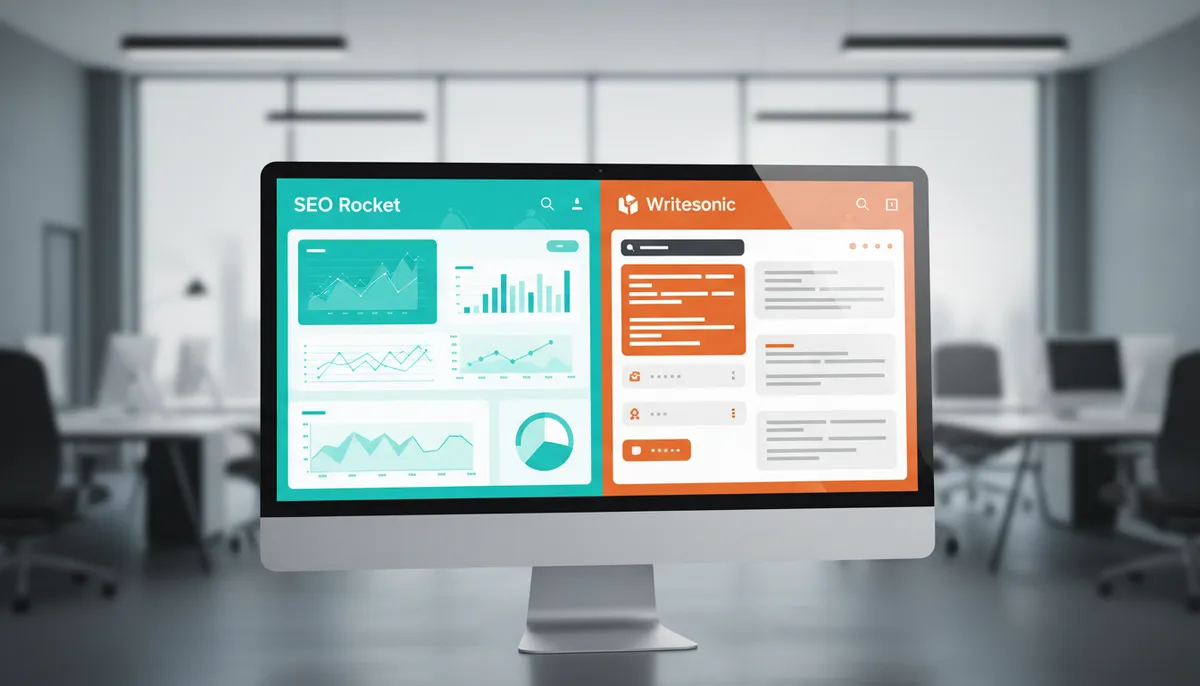
Feature-by-Feature Comparison
To understand which platform delivers superior value for different use cases, let’s examine their capabilities across key dimensions that matter most to SEO professionals and content managers in 2026:
| Feature | SEO Rocket | Writesonic |
|---|---|---|
| Keyword Research | Automated discovery with market opportunity mapping | Manual research required or basic suggestions |
| Content Length | 3,000+ words per article (long-form default) | Variable, often 500-1,500 words requiring expansion |
| Automation Level | Fully automated end-to-end (research to publishing) | Semi-automated (user prompts required, manual publishing) |
| Publishing Integration | Direct publishing to WordPress, Webflow, Shopify, Wix | WordPress integration available, manual copy-paste for others |
| AI Search Optimization | Optimized for Google + 6 AI search engines | Primarily Google-focused with Surfer SEO integration |
| Daily Output | 1-10 articles automatically published daily | Unlimited generation, but requires manual workflow |
| Setup Time | Under 10 minutes, zero monthly maintenance | Ongoing prompts and editing required per article |
| SEO Scoring | Real-time scoring with auto-fix suggestions | SEO checker evaluates keyword density and readability |
| Internal Linking | Automated internal/external link insertion | Manual linking required |
| Image Generation | AI-generated images automatically included | Available through separate features |
| Video Integration | Automatic relevant video embeds | Manual embedding required |
| Multi-language Support | Optimized for English with expansion planned | Approximately 25 languages supported |
| Agency Features | 10 client workspaces, 300 monthly articles | Team collaboration features available |
| Content Calendar | Visual calendar auto-filled with opportunities | Manual planning and scheduling |
This comparison reveals that while Writesonic excels at rapid content generation with multilingual capabilities and flexible content types, it still requires substantial human oversight and manual optimization. SEO Rocket’s true automation eliminates these bottlenecks, making it ideal for businesses seeking hands-off, consistent content production that compounds SEO results over time.
Pricing Analysis: Cost Per Article and ROI
Pricing structure significantly impacts long-term affordability, especially for agencies and businesses producing content at scale. Writesonic’s pricing starts at approximately $16 per month for startups, making it budget-friendly for beginners. However, higher-volume plans increase costs substantially, and users must factor in the time investment required for research, editing, optimization, and publishing—often 2-4 hours per article when accounting for quality standards.
SEO Rocket offers straightforward, value-focused pricing designed for scalability:
- Business Plan: $99/month for 30 articles (one per day), approximately $3.30 per fully-optimized, 3,000-word article
- Agency Plan: $799/month for 300 articles (ten per day), approximately $2.66 per article with 10 client workspaces
- Lifetime Plan: $1,499 one-time payment for permanent access with no subscription
When comparing cost-per-article, SEO Rocket delivers extraordinary value. Traditional SEO agencies charge $3,000-$5,000 monthly for similar output, while freelance writers typically charge $200-$500 per long-form article. Even accounting for Writesonic’s low monthly fee, the time investment required to produce publication-ready content often exceeds the monetary savings, particularly for in-house marketing teams and digital marketing consultants managing multiple clients.
For e-commerce SEO specialists managing hundreds of product and category pages, SEO Rocket’s Agency plan transforms economics entirely. Publishing 300 optimized articles monthly at $2.66 each versus outsourcing at $200+ each represents over $59,000 in monthly savings while maintaining consistent quality and SEO standards.
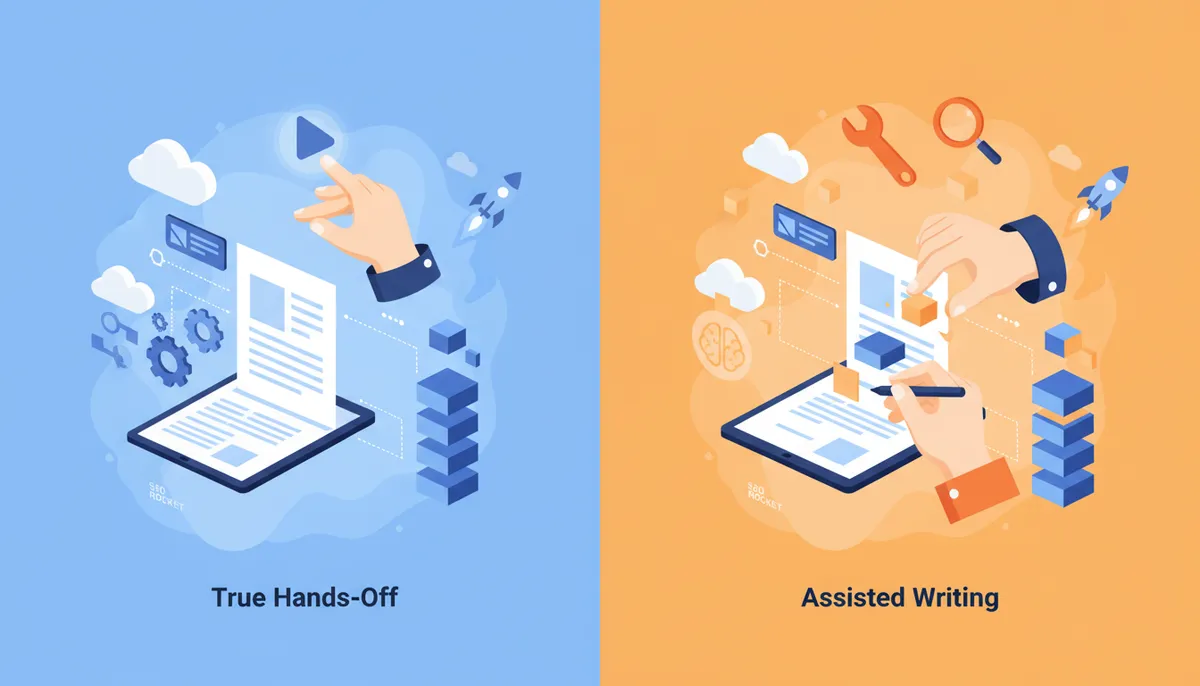
Automation Capabilities: True Hands-Off vs Assisted Writing
The automation gap between these platforms represents their most significant differentiator for time-strapped marketing teams. Writesonic accelerates the writing process through AI-generated drafts, but users must still:
- Conduct keyword research using separate tools
- Create content briefs and outlines
- Input prompts with specific instructions
- Review and edit AI-generated content for accuracy and brand voice
- Optimize content using SEO checkers or plugins
- Add internal and external links manually
- Source and insert images
- Format content for web publishing
- Upload to CMS and schedule publication
This workflow, while faster than writing from scratch, still requires 1-3 hours per article for quality output. For content managers overseeing large websites producing 20-30 articles monthly, this represents 20-90 hours of labor—more than two full-time weeks.
SEO Rocket eliminates this entire workflow through genuine automation. After the initial 10-minute setup where you connect your website and review the automatically generated content calendar, the platform:
- Discovers and prioritizes keyword opportunities through competitor analysis
- Generates comprehensive 3,000+ word articles with proper structure
- Inserts relevant internal links to strengthen site architecture
- Adds authoritative external links to boost credibility signals
- Naturally mentions your business where contextually appropriate
- Generates and embeds AI-created images
- Embeds relevant videos to increase engagement
- Optimizes metadata (titles, descriptions, alt text)
- Scores content in real-time with auto-fix suggestions
- Publishes directly to your website daily
This represents true automation—not assisted writing. For small SEO agencies serving multiple clients, this distinction is transformative. Rather than hiring additional writers or limiting client capacity, agencies can scale indefinitely using SEO Rocket’s multi-client workspace management while maintaining consistent quality across all accounts.
SEO Optimization: Google-Only vs Multi-Platform AI Visibility
The SEO landscape has fundamentally changed in 2026 with the rise of AI search engines. While Google remains dominant, ChatGPT, Perplexity, Claude, Gemini, Copilot, and Grok now handle billions of searches monthly, fundamentally altering how users discover information and how businesses must optimize content.
Writesonic focuses primarily on traditional Google SEO through features like Surfer SEO integration, which evaluates content against top-ranking pages for keyword density, readability, and SERP trend alignment. This approach ensures content ranks well in Google searches, which remains valuable for traditional organic traffic generation.
However, SEO Rocket goes further by optimizing for both traditional search engines AND modern AI search platforms—a strategy called GEO (Generative Engine Optimization). Articles are structured so AI models can reference them as trusted sources when answering user queries. This means your business appears inside AI-generated answers and overviews, not just traditional search results. Given that AI search usage has grown 340% year-over-year according to industry analyses, this optimization approach future-proofs your content strategy.
For businesses concerned about visibility in an AI-dominated search landscape, this distinction matters enormously. Traditional SEO focuses on ranking in position 1-10 on Google. GEO focuses on being cited as a source by AI models, which can drive traffic even without traditional rankings. SEO Rocket’s dual optimization approach ensures your content performs across both channels, maximizing total organic visibility.

Content Quality and Readability
Content quality determines both search rankings and user engagement, making it a critical evaluation criterion. Writesonic produces content with an 88% readability score according to 2025 testing, generating coherent first drafts that capture topic essentials. However, users consistently report in reviews that content requires refinement, fact-checking, and brand voice alignment before publication—particularly for specialized or technical topics.
The platform’s strength lies in generating multiple content variations quickly, allowing users to select the best starting point. Its weakness appears in depth and expertise signals—AI-generated content often lacks the nuanced understanding and authoritative tone that Google’s Search Quality Rater Guidelines reward under E-E-A-T principles (Experience, Expertise, Authoritativeness, Trustworthiness).
SEO Rocket addresses quality through its long-form content approach and automated optimization. By defaulting to 3,000+ words rather than short-form content, articles provide comprehensive coverage that search engines reward. The platform’s real-time SEO scoring evaluates content against 200+ ranking factors, automatically suggesting improvements for keyword placement, semantic relevance, readability, and structural elements.
Additionally, SEO Rocket’s automated internal linking strengthens topical authority by connecting related content across your website—a ranking factor that tools like Writesonic require users to handle manually. For digital marketing consultants delivering client results, this automated quality control ensures consistent standards across all published content without requiring article-by-article review.
Use Case Recommendations: Which Platform for Your Needs
Selecting between these platforms depends on your specific requirements, resources, and growth objectives. Here’s guidance for different user segments:
Small SEO Agencies
If you’re managing 5-10 clients with limited staff, SEO Rocket’s Agency plan delivers unmatched scalability. Publishing 300 optimized articles monthly across 10 client workspaces without hiring additional writers transforms your service economics and competitive positioning. Writesonic would require significant time investment per client, limiting your capacity and profitability.
In-House Marketing Teams
For mid-sized companies with 1-3 person marketing teams, SEO Rocket eliminates content production bottlenecks that prevent consistent publishing. Rather than spending 60-80 hours monthly on content creation, your team can focus on strategy, promotion, and conversion optimization while SEO Rocket handles production automatically. Writesonic might work for occasional content needs but won’t solve systematic resource constraints.
Content Managers
Managing large websites with hundreds of pages requires both volume and consistency. SEO Rocket’s daily automated publishing creates compounding SEO growth through continuous fresh content, while its visual content calendar provides oversight without micromanagement. Writesonic’s manual workflow makes maintaining this publication cadence challenging without expanding headcount.
Digital Marketing Consultants
Consultants differentiate through results and efficiency. SEO Rocket allows you to deliver faster client results with less time investment, improving margins while maintaining quality. The platform’s competitive pricing starting at $99 monthly allows you to include content production in client packages without significantly impacting profitability. Writesonic requires more hands-on management, reducing the number of clients you can effectively serve.
E-commerce SEO Specialists
E-commerce sites need enormous content volume for product pages, category pages, buying guides, and comparison content. SEO Rocket’s automation handles this scale effortlessly, publishing optimized content daily to support thousands of SKUs. The platform’s low cost-per-article ($2.66-$3.30) makes comprehensive content coverage economically viable. Writesonic’s manual workflow makes producing hundreds of product-focused articles prohibitively time-consuming.
Small Business Owners
With limited time and marketing expertise, small business owners need simple, effective solutions that deliver results without steep learning curves. SEO Rocket’s 10-minute setup and zero monthly maintenance make it ideal for busy entrepreneurs who want SEO growth without becoming SEO experts. Writesonic requires more marketing knowledge and ongoing time commitment, which many small business owners cannot sustain consistently.
Integration and Publishing Workflow
Publishing efficiency directly impacts content consistency and operational overhead. Writesonic offers WordPress integration allowing users to publish directly from the platform, which streamlines workflow compared to copy-pasting. However, users must still schedule publication, configure settings, and ensure proper formatting—steps that accumulate into significant time investment across dozens of articles.
For other platforms like Webflow, Shopify, and Wix, Writesonic requires manual content transfer, which introduces friction and increases the likelihood of publication delays or errors. This fragmented workflow creates bottlenecks, particularly for agencies managing clients across different CMS platforms.
SEO Rocket provides native direct publishing to WordPress, Webflow, Shopify, and Wix with zero manual intervention. After initial setup, the platform automatically publishes one article daily (or ten for Agency users) at optimal times without requiring login, review, or approval. This truly hands-off publishing creates the consistent content cadence that search engines reward while eliminating the operational burden that derails most content strategies.
The platform’s visual content calendar provides transparency into upcoming publications and historical output without requiring active management. For compliance-conscious businesses or agencies needing client reporting, this audit trail demonstrates consistent value delivery without additional administrative work.
Scalability: Growing From 10 to 1,000 Articles Monthly
Scalability determines whether a platform supports your growth or becomes a constraint requiring replacement. Writesonic scales through user effort—you can generate unlimited content, but each article requires comparable time investment. Producing 10 articles monthly might be manageable; producing 100 requires hiring writers or accepting reduced quality through insufficient editing.
This limitation particularly impacts agencies experiencing client growth. Adding new clients means proportionally increasing content production time, eventually forcing difficult decisions about hiring, reducing service scope, or limiting new client acquisition.
SEO Rocket scales algorithmically rather than linearly. Whether you publish 30 articles monthly or 300, your time investment remains constant at approximately 10 minutes during initial setup. The platform handles increased volume through automation rather than human labor, allowing agencies to grow from 3 clients to 30 without increasing content production overhead.
The Agency plan’s 10 client workspace structure supports this scalability, allowing you to manage multiple client accounts from one dashboard with separate content calendars, performance tracking, and automated publishing for each. This multi-tenant architecture specifically addresses agency needs that general content tools like Writesonic weren’t designed to accommodate.
Performance Tracking and Optimization
Understanding content performance enables data-driven optimization and client reporting. Writesonic focuses on content creation rather than performance analytics, requiring users to leverage separate tools like Google Analytics, Google Search Console, or third-party SEO platforms for tracking rankings, traffic, and engagement metrics.
SEO Rocket includes integrated performance tracking that connects published content to organic traffic growth, ranking improvements, and AI search citations. This closed-loop visibility demonstrates ROI without requiring complex analytics setup or interpretation. For clients and stakeholders questioning content marketing investment, this direct attribution between automated publishing and measurable results provides compelling justification.
The platform’s real-time SEO scoring also provides proactive optimization, identifying potential improvements before publication rather than requiring post-publication revisions. This preemptive approach ensures higher quality initial publication and reduces the iterative refinement that consumes time with other platforms.
Long-Term Investment: Subscription vs Lifetime Access
Financial structure impacts total cost of ownership over multi-year periods. Both platforms offer subscription pricing, with Writesonic starting around $16 monthly and SEO Rocket at $99 monthly for business users. Over 36 months, Writesonic costs approximately $576 while SEO Rocket costs $3,564—a significant difference that requires justification through superior results or time savings.
However, SEO Rocket offers a unique $1,499 lifetime plan providing permanent access with no ongoing subscription—a rare option among SaaS platforms. For businesses planning multi-year content strategies, this one-time payment breaks even at month 16 compared to monthly subscription costs, with unlimited value thereafter. No comparable lifetime option exists for Writesonic, making it exclusively an ongoing operational expense.
For agencies and established businesses committed to long-term SEO investment, the lifetime plan represents extraordinary value, eliminating subscription costs while ensuring permanent access to automation capabilities that would otherwise require ongoing software fees plus labor costs.
Customer Support and Learning Curve
User experience and support quality determine how quickly teams achieve value and how effectively they resolve issues. Writesonic receives positive reviews for ease of use and intuitive interface, allowing users to begin generating content within minutes. The platform offers tutorials, templates, and documentation supporting various content types and use cases.
However, mastering effective prompt engineering—crafting instructions that produce optimal output—requires practice and experimentation. Users report varying quality based on prompt specificity, topic complexity, and desired outcome, creating a learning curve that impacts initial productivity.
SEO Rocket’s 10-minute setup minimizes learning curve entirely. The platform’s automated workflow means users don’t need to master prompt engineering, SEO optimization techniques, or publishing procedures—the system handles these complexities automatically. For teams without dedicated SEO expertise, this simplicity accelerates time-to-value dramatically.
Support resources include documentation, direct contact options, and a transparent changelog showing continuous platform improvements. The public roadmap provides visibility into upcoming features, allowing users to plan around anticipated capabilities.
Making Your Decision: Key Questions to Consider
Selecting the right platform requires honest assessment of your specific situation, capabilities, and objectives. Consider these critical questions:
Do you need occasional content assistance or systematic automation? If you write 2-3 articles monthly and have time for research and optimization, Writesonic’s flexible content generation might suffice. If you need consistent, high-volume output without increasing headcount, SEO Rocket’s automation delivers superior results.
What’s your team’s SEO expertise level? Writesonic assumes users understand keyword research, on-page optimization, and technical SEO requirements. SEO Rocket builds this expertise into automation, making it accessible to teams without specialized knowledge.
How important is AI search visibility? If you’re focused exclusively on traditional Google rankings, Writesonic’s optimization might be adequate. If you want visibility across AI search platforms gaining market share rapidly, SEO Rocket’s GEO optimization becomes essential.
What’s your content production budget? Consider not just platform subscription costs but total cost including labor. Writesonic’s lower subscription fee might be offset by the time investment required per article. SEO Rocket’s higher subscription eliminates labor costs entirely through automation.
Are you managing multiple clients or properties? Agency operations require multi-tenant architecture, client segregation, and scalable workflows. SEO Rocket’s Agency plan specifically addresses these requirements, while Writesonic requires workarounds or separate subscriptions.
What’s your long-term content strategy? Short-term content needs favor flexible tools like Writesonic. Multi-year systematic content strategies benefit from SEO Rocket’s lifetime plan and compound growth from daily automated publishing.

Conclusion: Choosing the Right Platform for 2026 and Beyond
Both SEO Rocket and Writesonic leverage artificial intelligence to improve content production, but they solve fundamentally different problems. Writesonic accelerates writing through AI-generated drafts, offering flexibility across content types with multilingual support and affordable entry pricing. It works well for occasional content needs, teams with strong SEO expertise, and situations requiring maximum creative control.
However, for businesses, agencies, and marketing teams seeking genuine automation that eliminates manual work entirely, SEO Rocket represents a transformative solution. Its end-to-end workflow—from keyword discovery through automated daily publishing—creates consistent content production that compounds SEO results over time. The platform’s optimization for both Google and modern AI search engines future-proofs your strategy, while its scalable pricing and lifetime plan option deliver superior long-term value.
For small SEO agencies, in-house marketing teams, content managers, digital marketing consultants, e-commerce specialists, and small business owners, the choice ultimately depends on whether you want a tool that helps you work faster or a platform that works for you automatically. If your goal is sustainable SEO growth without proportionally increasing headcount or workload, SEO Rocket’s automation eliminates the bottlenecks that prevent most businesses from achieving their content marketing potential.
The content landscape in 2026 rewards consistency, quality, and multi-platform optimization—requirements that manual processes struggle to deliver sustainably. As AI search continues disrupting traditional SEO, platforms built specifically for this new reality provide competitive advantages that general-purpose writing tools cannot match. Start your automated content strategy today and experience the difference that true SEO automation makes for sustainable organic growth.
FAQs
Q: What are the main differences between SEO Rocket and Writesonic?
A: SEO Rocket is a fully automated SEO content platform that handles keyword research, 3,000+ word article generation, optimization, and daily publishing without manual work. Writesonic is an AI writing assistant that helps generate content drafts quickly but requires manual research, editing, optimization, and publishing. SEO Rocket focuses on complete automation and AI search optimization, while Writesonic provides flexible content generation tools requiring human oversight.
Q: Which platform is better for SEO optimization in 2026?
A: SEO Rocket provides superior optimization for modern search landscapes because it optimizes content for both traditional Google search and emerging AI search engines like ChatGPT, Perplexity, Claude, Gemini, Copilot, and Grok. This dual optimization (SEO + GEO) ensures visibility across all platforms where users search for information. Writesonic focuses primarily on Google SEO through features like Surfer integration, which is valuable but doesn’t address AI search visibility.
Q: Can Writesonic replace SEO Rocket for automated content publishing?
A: No, Writesonic cannot replace SEO Rocket’s automation level. While Writesonic offers WordPress integration and speeds up content creation, it still requires users to conduct keyword research, create content briefs, input prompts, edit drafts, optimize content, add links and images, and manage publishing schedules. SEO Rocket eliminates all these manual steps through complete automation, making it fundamentally different from assisted writing tools like Writesonic.
Q: What is the cost-per-article comparison between these platforms?
A: SEO Rocket delivers approximately $2.66-$3.30 per fully-optimized 3,000-word article including all automation features. While Writesonic’s subscription starts lower at around $16 monthly, users must factor in 1-3 hours of labor per article for research, editing, optimization, and publishing. When accounting for time investment, SEO Rocket provides dramatically better cost efficiency, especially at scale. Traditional agencies charge $3,000-$5,000 monthly for comparable output.
Q: Which platform is better for agencies managing multiple clients?
A: SEO Rocket’s Agency plan is specifically designed for multi-client management with 10 separate client workspaces, 300 monthly articles, and automated publishing across all accounts. This architecture allows agencies to scale without increasing content production labor. Writesonic lacks dedicated agency features and requires manual workflow for each client, limiting scalability. For agencies seeking systematic client content production, SEO Rocket delivers superior efficiency and profitability.