Key Takeaways
- SEO Rocket automates complete SEO workflows from keyword research to publishing, eliminating manual content creation tasks for businesses.
- The platform generates and publishes daily SEO-optimized articles that are designed to rank in both traditional and AI search engines.
- SEO Rocket’s pricing starts at $99/month for 30 comprehensive articles, offering massive cost savings compared to hiring freelancers or agencies.
- Unlike ChatGPT, SEO Rocket provides end-to-end content optimization including keyword placement, internal linking, metadata, and AI-generated images.
- The platform is specifically engineered to optimize content for emerging AI search platforms like ChatGPT Search, Perplexity, and Gemini.
- SEO Rocket enables consistent daily publishing, creating a steady stream of fresh content that compounds SEO growth over time.
- The system handles content creation in under 10 minutes of initial setup, freeing marketing teams from time-consuming manual workflows.
The rise of artificial intelligence has fundamentally transformed how businesses approach search engine optimization and content creation. Two prominent names dominate conversations in 2026: SEO Rocket, a specialized SEO content automation platform, and ChatGPT, OpenAI’s versatile language model now integrated into search through ChatGPT Search. While both leverage AI technology, they serve distinctly different purposes in the digital marketing ecosystem. SEO Rocket is purpose-built to automate end-to-end SEO content workflows—from keyword research to daily publishing—while ChatGPT functions primarily as a conversational AI tool that users increasingly turn to for information discovery. Understanding the differences between these platforms is critical for small SEO agencies, in-house marketing teams, content managers, and business owners who need to maximize their organic visibility while managing limited resources.
This comprehensive comparison examines seven key differences between SEO Rocket and ChatGPT, analyzing their capabilities in automation, content optimization, search visibility, cost efficiency, scalability, and long-term SEO impact. Whether you’re a digital marketing consultant seeking reliable tools for clients or an e-commerce SEO specialist managing hundreds of product pages, this analysis will help you determine which solution best fits your specific needs and business objectives.
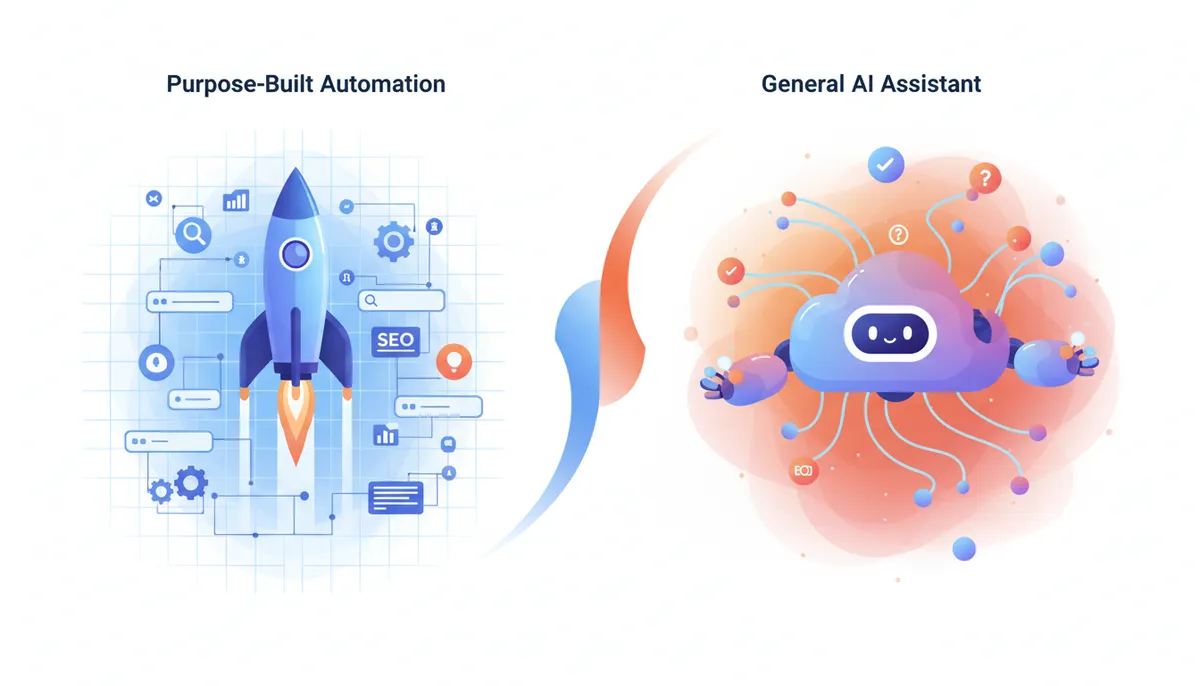
1. Purpose-Built Automation vs. General AI Assistant
The most fundamental difference between SEO Rocket and ChatGPT lies in their core design philosophy and operational approach. SEO Rocket is an all-in-one SEO content automation platform specifically engineered to eliminate manual SEO work. The system handles keyword discovery, competitor analysis, market opportunity mapping, long-form content generation, metadata optimization, internal and external linking, business mentions, AI-generated images, video embeds, real-time SEO scoring, auto-fix suggestions, and direct publishing to your website—all without requiring daily input or management.
Setup takes under 10 minutes: you connect your website through integrations with WordPress, Webflow, Shopify, or Wix, review automatically discovered keyword opportunities, approve your content calendar, and the platform handles everything else. SEO Rocket’s features include a visual content calendar that automatically populates with high-opportunity keywords based on competitive analysis and search demand. The Business plan generates and publishes one SEO-optimized, 3,000+ word article daily, while the Agency plan produces ten articles per day across multiple client workspaces.
ChatGPT, by contrast, operates as a general-purpose conversational AI assistant. While it excels at answering questions, generating content drafts, and providing information synthesis, it requires continuous manual prompting and lacks built-in SEO automation. Users must craft specific prompts for each piece of content, manually conduct keyword research using separate tools, optimize the output for search engines, format the content, add links and images, create metadata, and then copy-paste everything into their content management system. This process demands significant time investment and SEO expertise for every single article.
According to research from Rocket Agency, approximately 2.2% of their SEO traffic in 2025 came from AI tools like ChatGPT, with this traffic showing a 9-10% higher conversion rate than other sources. However, this represents user behavior—people using ChatGPT to find information—rather than ChatGPT’s capability to automate SEO workflows. For businesses needing consistent, scalable content production, the manual nature of ChatGPT creates bottlenecks that SEO Rocket’s automation eliminates entirely.
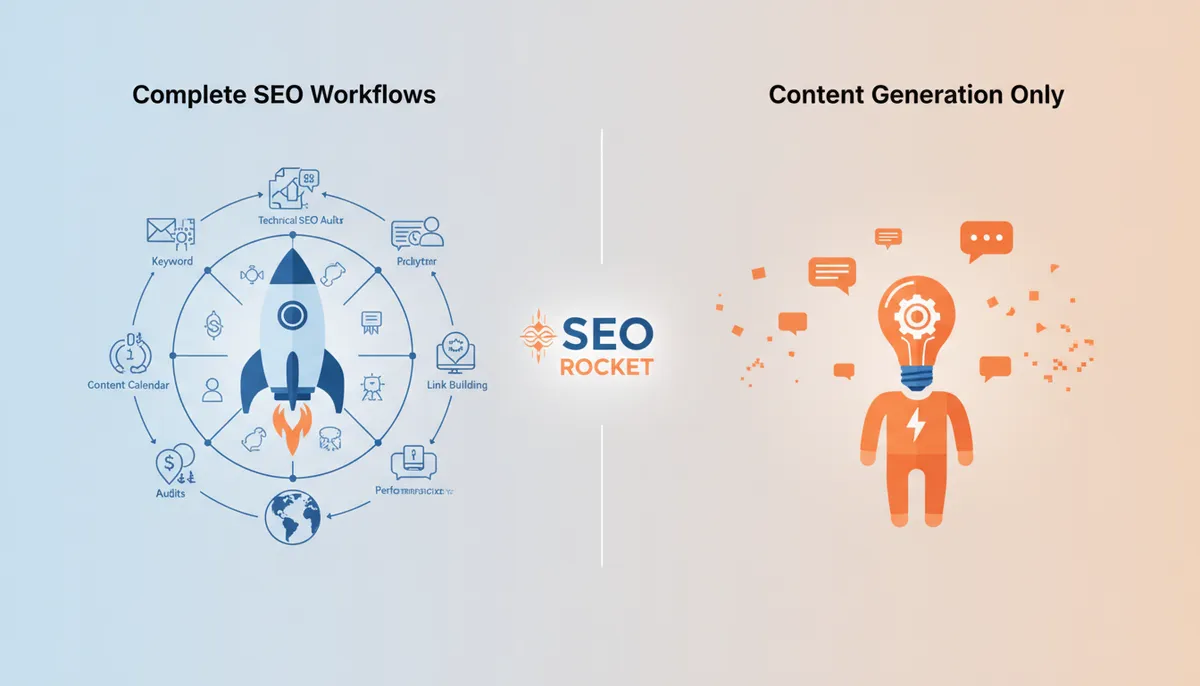
2. Complete SEO Workflows vs. Content Generation Only
SEO Rocket delivers end-to-end workflow automation that addresses every aspect of the content SEO process. The platform begins with intelligent keyword research, analyzing your industry, competitors, and market gaps to identify high-opportunity terms that balance search volume, competition levels, and commercial intent. It then automatically maps these keywords to content topics, creates a publishing calendar, and executes daily content creation without additional input.
Each article generated by SEO Rocket includes comprehensive on-page optimization: strategic keyword placement maintaining natural density around 1.5%, semantic keyword integration, properly structured H2 and H3 headings, optimized title tags and meta descriptions, internal linking to relevant pages on your website, external links to authoritative sources, contextual business mentions, AI-generated relevant images, embedded videos where appropriate, FAQ sections optimized for featured snippets, and real-time SEO scoring with automated improvement suggestions. The system then publishes directly to your website on schedule, creating a consistent flow of fresh, optimized content that compounds over time.
ChatGPT, while capable of generating quality content drafts, stops at text creation. Users must separately perform keyword research using tools like Ahrefs, SEMrush, or Google Keyword Planner. They need to manually structure the content for SEO, add appropriate headings, optimize keyword density, create compelling meta descriptions, research and insert relevant internal links, find and link to authoritative external sources, source or create images, format the content for web publishing, upload to their CMS, configure SEO settings, schedule publication, and track performance. This fragmented workflow requires expertise across multiple disciplines and can take several hours per article.
For content managers responsible for large websites with dozens or hundreds of pages, this difference is transformative. SEO Rocket’s automated workflow enables one person to manage the content output that would typically require a full team. The platform functions as an integrated alternative to hiring SEO agencies at $3,000-$5,000 monthly, freelance writers at $100-$300 per article, SEO specialists for optimization, and web developers for publishing—all while maintaining consistency and quality standards.
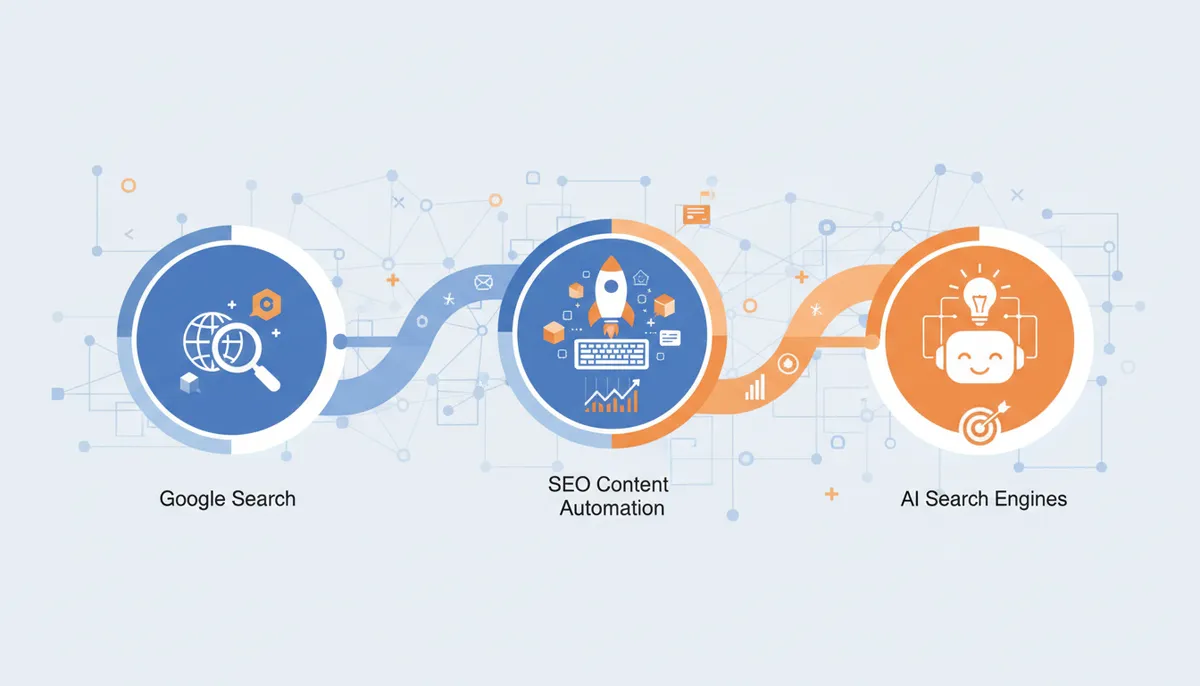
3. Optimization for Google AND AI Search Engines
A critical distinction that becomes increasingly important in 2026 is optimization strategy across different search platforms. SEO Rocket is specifically designed to rank in both traditional search engines like Google AND emerging AI search platforms including ChatGPT Search, Perplexity, Claude, Gemini, Microsoft Copilot, and Grok. The platform structures content so AI models can reference it as a trusted source, helping businesses appear inside AI-generated answers and overviews—a capability that represents the future of search visibility.
Traditional SEO focused exclusively on Google’s ranking algorithms, but the landscape has fundamentally shifted. According to Google’s Search Quality Rater Guidelines, search engines increasingly prioritize content demonstrating Experience, Expertise, Authoritativeness, and Trustworthiness (E-E-A-T). SEO Rocket builds these signals into every article through proper citation, authoritative external linking, structured data implementation, comprehensive topic coverage, and clear, factual writing that AI models can confidently reference.
Research from 2025 shows that AI chatbot SEO differs significantly from traditional SEO. Rather than presenting ranked lists of links, AI platforms like ChatGPT synthesize information from multiple sources and provide direct answers with citations. Ahrefs found that 76.1% of URLs cited in AI Overviews also rank in Google’s top 10, but importantly, 28.3% of ChatGPT’s most cited pages have zero organic visibility in traditional search results. This means businesses need content optimized for both ranking in Google SERPs and citation in AI-generated responses—exactly what SEO Rocket provides.
ChatGPT itself, while now offering search functionality through ChatGPT Search, is not designed to help businesses optimize their content for multi-platform visibility. When users ask ChatGPT to write content, the output follows general content creation best practices but lacks the specific optimization signals required for AI citation. ChatGPT doesn’t automatically add schema markup, implement FAQ structured data, create proper heading hierarchies optimized for answer extraction, or structure content for featured snippet capture—all elements SEO Rocket builds into every article by default.
The AI Search Opportunity
ChatGPT handles less than 1% of global search volume compared to Google’s 93-94% market share as of 2025, but this represents a massive growth opportunity. Early adopters who optimize for AI search now will gain significant competitive advantages as these platforms capture increasing market share. ChatGPT Search performs approximately 2 searches per query, with each search averaging 5-6 words, demonstrating more exploratory, conversational search behavior that requires different content optimization approaches.
SEO Rocket’s dual optimization strategy ensures your content ranks in Google for immediate traffic while positioning your brand for citation in AI-generated answers as these platforms grow. This forward-looking approach protects against future search disruption and diversifies traffic sources beyond dependence on any single platform.
4. Cost Efficiency and ROI Comparison
Financial considerations often determine which solution businesses ultimately choose, and the cost structures of SEO Rocket versus ChatGPT reveal dramatically different value propositions. SEO Rocket operates on straightforward subscription pricing: $99 monthly for the Business plan (30 articles per month, one per day) or $799 monthly for the Agency plan (300 articles per month, supporting 10 client workspaces). The platform also offers a unique $1,499 lifetime plan with permanent access and no recurring fees—an option virtually no competitor provides.
Breaking down the Business plan cost reveals extraordinary value: $99 for 30 long-form, 3,000+ word articles equals approximately $3.30 per article. These aren’t short blog posts—they’re comprehensive, SEO-optimized pieces with images, links, metadata, and direct publishing included. Traditional content creation costs range from $100-$300 per article for freelance writers alone, not including keyword research, SEO optimization, image sourcing, formatting, or publishing. Hiring an SEO agency typically costs $3,000-$5,000 monthly for far fewer articles and less comprehensive automation.
ChatGPT’s pricing appears simpler on the surface: the free tier offers limited access with standard response times, while ChatGPT Plus costs $20 monthly for priority access, faster responses, and access to ChatGPT Search. However, this subscription only provides the tool itself—it doesn’t include the substantial additional costs required to execute a complete SEO content strategy. Users still need to pay for keyword research tools (Ahrefs starts at $99/month, SEMrush at $119.95/month), image creation or stock photo subscriptions ($10-$30/month), hosting and CMS costs, and most significantly, the time investment to manually execute every step of the workflow.
True Cost of Manual Workflows
The hidden cost of using ChatGPT for SEO content creation is human time. Consider the realistic time investment for a single optimized article: keyword research (30-45 minutes), crafting effective prompts and generating content (45-60 minutes), editing and optimizing the output (30-45 minutes), formatting for web (15-20 minutes), sourcing and adding images (15-20 minutes), creating metadata (10-15 minutes), adding internal and external links (20-30 minutes), publishing and configuring SEO settings (15-20 minutes). This totals 3-4 hours per article minimum.
For small business owners, this represents $150-$300 in opportunity cost per article (at $50-$75/hour). For in-house marketing teams at mid-sized companies, it’s $200-$400 per article (at $50-$100/hour for marketing professionals). For digital marketing consultants serving clients, it’s $300-$600 per article (at $75-$150/hour client billing rates). Multiply these costs by 30 articles monthly, and ChatGPT’s apparent affordability disappears—businesses end up spending $4,500-$18,000 in time costs plus subscription fees.
SEO Rocket eliminates these time costs entirely through automation. The 10-minute initial setup and minimal ongoing management (reviewing the auto-generated calendar takes minutes weekly) means the true cost remains around $3 per article with negligible time investment. For agencies, the ROI becomes even more compelling: the $799 Agency plan producing 300 articles monthly costs $2.66 per article, which agencies can deliver to clients at $50-$100+ per article, creating substantial profit margins. Check SEO Rocket’s pricing options to calculate ROI for your specific situation.
5. Daily Publishing Consistency vs. Manual Scheduling
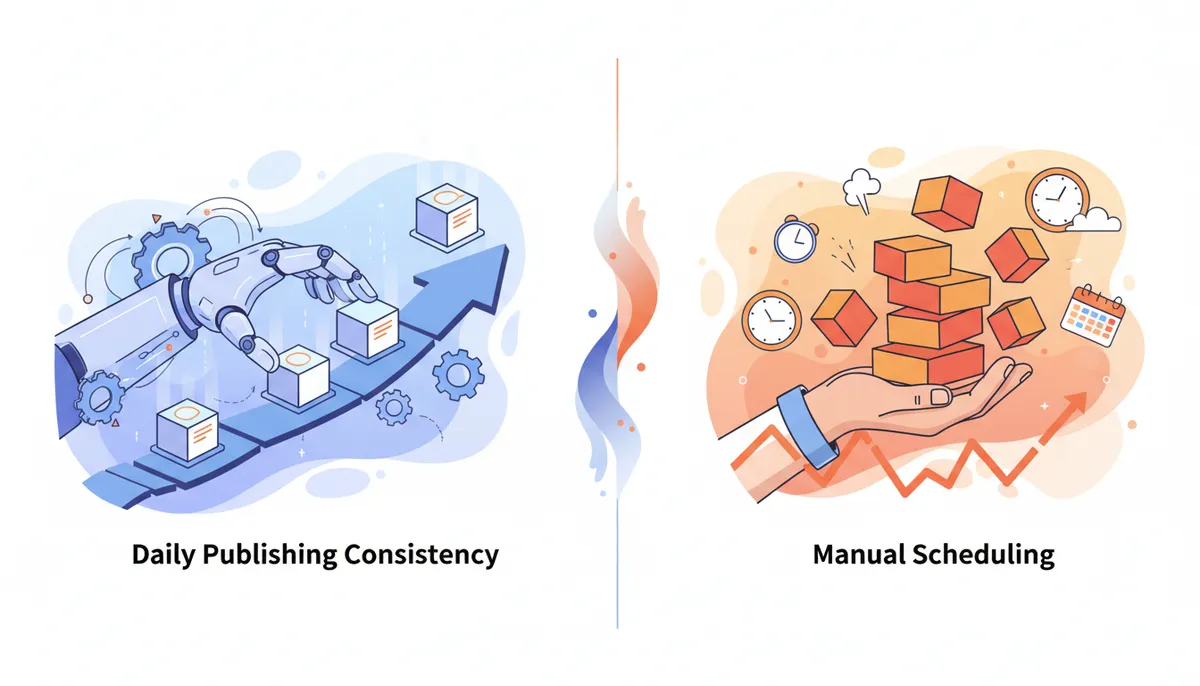
Search engines reward publishing consistency, and this is where automation delivers compounding advantages. SEO Rocket’s automated daily publishing creates a steady stream of fresh content that signals to Google and other search platforms that your website is active, authoritative, and continually expanding its knowledge base. The Business plan publishes one 3,000+ word article every single day without requiring any manual intervention—365 articles annually that build topical authority, capture long-tail keywords, and create internal linking networks that boost your entire site’s ranking potential.
This consistency creates compounding SEO growth. Each new article provides fresh content for search engines to index, targets additional keyword opportunities, links to and strengthens existing content through internal linking, captures traffic from informational queries that convert to product/service pages, and improves overall domain authority. Over time, this accumulation creates exponential rather than linear traffic growth—a phenomenon impossible to achieve with sporadic, manual content creation.
ChatGPT requires users to maintain their own publishing discipline and schedule management. While ambitious marketers may start with daily publishing goals, the reality of manual workflows almost inevitably leads to inconsistency. The time investment required for each article (3-4 hours as detailed above) makes daily publishing unsustainable for most businesses without dedicated content teams. The result is typically irregular publishing—perhaps 2-4 articles monthly instead of 30—which dramatically reduces SEO impact and lengthens the time required to see meaningful traffic increases.
The Compounding Effect of Consistent Publishing
SEO experts consistently observe that websites publishing daily significantly outperform those publishing weekly or monthly, even when total annual word count is similar. This occurs because search engines index new content quickly, establish crawling patterns based on update frequency, and reward sites demonstrating ongoing investment in content quality. A website publishing 30 articles monthly will typically rank faster and higher than one publishing the same content sporadically over the year.
For e-commerce SEO specialists managing hundreds of product and category pages, this difference is particularly impactful. SEO Rocket can systematically build supporting content around product categories, creating hub-and-spoke content architectures that boost product page rankings through strategic internal linking. The automated system ensures every category receives consistent content support rather than leaving gaps that manual workflows inevitably create.

6. Scalability for Agencies and Multi-Client Management
Agency and multi-client scalability represents another critical differentiator. SEO Rocket’s Agency plan is specifically designed to support agencies and consultants managing multiple clients, offering 10 separate client workspaces within a single subscription. Each workspace functions independently with its own keyword research, content calendar, publishing schedule, and website integration. This structure allows agencies to manage 300 articles monthly (10 per day) across their client portfolio, with the flexibility to allocate more articles to larger clients and fewer to smaller ones based on specific needs and contracts.
The platform includes unlimited team members, enabling agencies to grant clients direct access to review content calendars, approve articles before publication, track performance metrics, and collaborate on content strategy—all without additional licensing costs. This transparency builds client trust and reduces the communication overhead typically required to keep clients informed about ongoing SEO activities. The visual content calendar provides clients with clear visibility into planned content, making it easy to demonstrate the value being delivered.
ChatGPT offers no built-in multi-client management capabilities. Agencies using ChatGPT for client content must maintain separate workflows, tracking systems, and quality control processes for each client. They need separate keyword research tool subscriptions or shared accounts with careful organization to avoid mixing client data. Content generation requires remembering context and brand voice for each client with every new prompting session. Publishing requires separate CMS access and manual processes for each client website. This fragmentation creates operational inefficiency and increases the risk of errors like publishing content to the wrong client’s website or mixing brand voices.
Agency Business Model Implications
The scalability difference directly impacts agency profitability and growth potential. With SEO Rocket, a small agency can realistically serve 10 clients with comprehensive monthly content (30 articles each) using the $799 Agency plan. If charging clients $2,000-$5,000 monthly for SEO content services, this creates $20,000-$50,000 in monthly recurring revenue against $799 in platform costs—a compelling profit margin that allows for team salaries, overhead, and profit while remaining price-competitive with larger agencies.
Using ChatGPT for the same client load would require either hiring a team of content creators (each producing 3-4 articles daily—unrealistic) or limiting services to far fewer articles per client, reducing the SEO impact and value proposition. Most agencies attempting to scale with manual tools hit capacity constraints around 3-5 clients before needing to expand their team, increasing costs and complexity significantly.

7. Long-Form Content Depth vs. Prompt-Limited Output
Content length and depth significantly impact search rankings, particularly for competitive keywords. SEO Rocket generates 3,000+ word articles by default—comprehensive pieces that thoroughly cover topics, incorporate semantic keywords naturally, provide detailed answers to user questions, and demonstrate topical authority. This length isn’t arbitrary; research consistently shows that top-ranking pages for competitive keywords average 2,000-3,000+ words, with longer content correlating strongly with higher rankings (though length alone doesn’t cause rankings—it enables comprehensive coverage).
Each SEO Rocket article follows best-practice structure: engaging introduction (150-200 words) that hooks readers and establishes context, multiple H2 sections covering distinct subtopics, H3 subsections for detailed exploration, strategic keyword integration maintaining natural density, internal links to related content on your website, external links to authoritative sources, data and statistics supporting key points, FAQ sections optimized for featured snippets, images and visual elements enhancing comprehension, and strong conclusion with clear call-to-action. This comprehensive approach addresses user intent completely, reducing bounce rates and increasing time-on-page—both ranking signals.
ChatGPT can certainly generate long-form content when prompted appropriately, but this requires careful prompting strategy and often multiple iterations. Users need to specifically request 3,000+ word articles, provide detailed outlines, request incorporation of specific keywords and semantic terms, ask for section-by-section generation if hitting response length limits, manually review for keyword density and SEO optimization, add all images, links, and formatting elements themselves, and ensure topical comprehensiveness without gaps. This process demands SEO expertise and significant time investment.
Content Quality and Ranking Potential
The distinction matters because incomplete or shallow content rarely ranks well in 2026. Google’s algorithms have become sophisticated at assessing content comprehensiveness, evaluating semantic keyword coverage, identifying topical authority signals, measuring user engagement metrics, and comparing content quality against competing pages. A 1,500-word ChatGPT article that skims a topic will typically lose to SEO Rocket’s 3,000+ word comprehensive treatment that addresses user questions thoroughly, incorporates relevant data and examples, and demonstrates deeper subject matter expertise.
For content managers at companies with extensive product catalogs or service offerings, this difference affects how quickly you can build topical authority in your niche. Publishing comprehensive content consistently signals to search engines that your site is a primary resource in your industry, which boosts rankings across all your pages through domain-wide authority improvements. SEO Rocket’s writing examples demonstrate the depth and quality the platform consistently delivers across diverse industries and topics.
Making the Right Choice for Your Business
The comparison between SEO Rocket and ChatGPT ultimately comes down to your specific business needs, resources, and SEO objectives. ChatGPT serves effectively as a versatile AI assistant for various tasks: answering questions and providing information, brainstorming content ideas and outlines, drafting initial content that requires significant editing, generating social media posts and short-form content, providing research assistance and information synthesis, and supporting various business tasks beyond content creation. It’s an excellent general-purpose tool that belongs in most marketers’ toolkits for its flexibility and conversational capabilities.
However, for businesses prioritizing SEO traffic growth, consistent content production, workflow automation, and cost efficiency, SEO Rocket delivers dramatically superior results. The platform is specifically purpose-built for businesses needing automated end-to-end SEO content workflows, agencies managing multiple clients with scalable content production, companies wanting to reduce SEO costs while increasing output, organizations lacking in-house SEO expertise, businesses targeting both Google and AI search visibility, and teams seeking compounding traffic growth through consistent daily publishing.
The choice isn’t necessarily either/or—many businesses use both tools strategically. They might use ChatGPT for customer support, social media content, quick research tasks, and brainstorming, while relying on SEO Rocket for their core SEO content strategy and automated publishing. This combination provides flexibility for various content needs while ensuring SEO initiatives don’t depend on manual workflows that inevitably create bottlenecks and inconsistency.
Evaluation Framework
Consider these questions when deciding which solution fits your needs: How many pieces of SEO-optimized content do you need monthly? Do you have the time and expertise to manually optimize content for search engines? Are you managing content for multiple clients or websites? What’s your monthly budget for content creation including time costs? Do you need content optimized for AI search platforms beyond Google? How important is publishing consistency to your SEO strategy? Does your team have the SEO expertise to optimize ChatGPT output effectively? Do you need comprehensive automation or are you comfortable with manual workflows?
For most businesses answering these questions honestly, the analysis reveals that true SEO content automation delivers better ROI than manual workflows, regardless of how sophisticated the AI writing assistant. SEO Rocket’s comprehensive platform eliminates the gaps between content creation and SEO results—gaps that inevitably exist when using general-purpose tools for specialized needs.
Future-Proofing Your SEO Strategy
Looking ahead to 2026 and beyond, the search landscape continues evolving rapidly. AI-powered search platforms are gaining market share, user search behavior is becoming more conversational and exploratory, search engines increasingly prioritize content demonstrating genuine expertise and authority, and the technical complexity of SEO optimization continues increasing. These trends favor specialized, automated solutions over manual workflows requiring constant adaptation to algorithm changes and new platform features.
SEO Rocket’s architecture is built for this evolving landscape, with continuous updates incorporating latest SEO best practices, automatic adaptation to algorithm changes, optimization for emerging AI search platforms, and integration of new features like enhanced schema markup, video content, and interactive elements. The platform’s development roadmap—which you can review at SEO Rocket’s roadmap—shows ongoing innovation that keeps your content strategy current without requiring you to become an SEO expert or constantly learn new techniques.
ChatGPT, while continuously improving as a language model, will likely remain a general-purpose tool rather than evolving into a specialized SEO platform. OpenAI’s focus is on broad AI capabilities serving diverse use cases rather than deep specialization in search optimization, automated publishing workflows, and SEO-specific features. This means businesses using ChatGPT for SEO will need to continually supplement it with additional tools, maintain manual optimization processes, and invest time staying current with SEO best practices—an ongoing cost that specialized platforms eliminate.
Conclusion: Automation Wins for Serious SEO Growth
The comparison between SEO Rocket and ChatGPT reveals a fundamental truth about modern content marketing: specialized automation tools designed for specific outcomes consistently outperform general-purpose tools requiring manual workflows, regardless of how sophisticated those tools may be. ChatGPT represents remarkable AI technology that serves valuable roles across many business functions, but it’s not purpose-built to automate SEO content strategies from keyword research through publishing and performance tracking.
SEO Rocket delivers what serious businesses need for SEO success in 2026: comprehensive workflow automation that eliminates manual bottlenecks, consistent daily publishing that compounds over time, optimization for both Google and emerging AI search platforms, scalability that supports agency growth and multi-client management, cost efficiency that dramatically undercuts traditional agencies and freelancers, long-form content depth that ranks competitively, and ongoing innovation that keeps pace with search engine evolution. These capabilities combine to create measurable traffic growth and ROI that manual workflows simply cannot match.
For small SEO agencies, in-house marketing teams, content managers, digital marketing consultants, e-commerce SEO specialists, and small business owners, the question isn’t whether AI should power your content strategy—that’s already decided. The question is whether you’ll rely on general AI tools requiring constant manual work, or purpose-built automation that runs your SEO content strategy while you focus on other business priorities. The data, cost analysis, and practical considerations all point toward the latter.
If you’re ready to transform your SEO content strategy with true end-to-end automation, comprehensive optimization for modern search platforms, and consistent daily publishing that compounds into significant traffic growth, it’s time to experience what specialized automation can deliver. Start your SEO Rocket journey today and join forward-thinking businesses building sustainable organic traffic through intelligent automation rather than manual labor.
FAQs
Q: What is the main difference between SEO Rocket and ChatGPT for content creation?
A: SEO Rocket is a specialized, fully automated SEO content platform that handles everything from keyword research to daily publishing, generating 3,000+ word optimized articles without manual work. ChatGPT is a general-purpose AI assistant that requires manual prompting, optimization, formatting, and publishing for each piece of content. SEO Rocket costs approximately $3 per article with complete automation, while ChatGPT requires 3-4 hours of manual work per article plus separate tool subscriptions.
Q: Can ChatGPT replace SEO Rocket for automated content publishing?
A: No, ChatGPT cannot replace SEO Rocket’s automated workflows because it lacks built-in keyword research, SEO optimization, content calendar management, automatic publishing, image generation, internal/external linking automation, and multi-client management features. While ChatGPT can generate content drafts, users must manually handle all other aspects of the SEO content workflow, which takes hours per article and requires significant SEO expertise.
Q: How does SEO Rocket optimize content for AI search engines like ChatGPT Search?
A: SEO Rocket structures content specifically for citation by AI search platforms including ChatGPT Search, Perplexity, Claude, Gemini, and others. It implements proper schema markup, FAQ structured data, authoritative external linking, comprehensive topic coverage, and clear factual writing that AI models can confidently reference. This dual optimization ensures content ranks in Google while positioning your brand for citation in AI-generated answers as these platforms gain market share.
Q: What is the true cost comparison between SEO Rocket and using ChatGPT for SEO content?
A: SEO Rocket costs $99/month for 30 articles (approximately $3.30 per article) with full automation included. Using ChatGPT appears cheaper at $20/month, but requires 3-4 hours of manual work per article (worth $150-$600 depending on hourly rate), plus separate subscriptions for keyword research tools ($99-$120/month), image tools, and CMS hosting. The true monthly cost of ChatGPT for comparable output is $4,500-$18,000 in time costs plus subscription fees, versus $99 with SEO Rocket.
Q: Which platform is better for agencies managing multiple clients?
A: SEO Rocket is significantly better for agencies, offering an Agency plan at $799/month with 10 separate client workspaces, 300 articles monthly (10 per day), unlimited team members, and centralized management. ChatGPT has no multi-client features, requiring agencies to manually manage separate workflows, tracking systems, and publishing processes for each client. SEO Rocket enables one person to manage content output that would typically require a full team, with profit margins of $20,000-$50,000 monthly when charging standard agency rates.