Key Takeaways
-
Automated keyword research platforms can reduce research time from 6-10 hours to just 10 minutes, enabling massive productivity gains for content teams.
-
AI tools automatically cluster keywords, analyze SERP features, and identify content gaps with 90-95% accuracy, surpassing manual research limitations.
-
Modern AI keyword research platforms integrate directly with content production workflows, eliminating manual data transfer and enabling consistent daily publishing.
-
Automated keyword research can reduce per-article research costs from $35-80 to approximately $3, making SEO content production more accessible for businesses.
-
Topic clustering becomes instantaneous with AI platforms, creating comprehensive content architectures that identify strategic content relationships in minutes.
-
AI search tools now analyze keywords across multiple platforms including Google and conversational AI engines like ChatGPT, providing more comprehensive visibility.
-
Automated SERP analysis tools process thousands of keywords simultaneously, extracting structured data about ranking factors and competition in seconds.
Choosing the right SEO keyword research method can transform your content strategy from guesswork into a systematic growth engine. In 2026, the debate between manual and AI-powered keyword research approaches has intensified as businesses demand faster, more efficient ways to scale organic traffic. The stakes are higher than ever—selecting low-competition keywords, understanding search intent, and maintaining consistent content velocity directly impact rankings across Google and emerging AI search platforms like ChatGPT, Perplexity, and Claude.
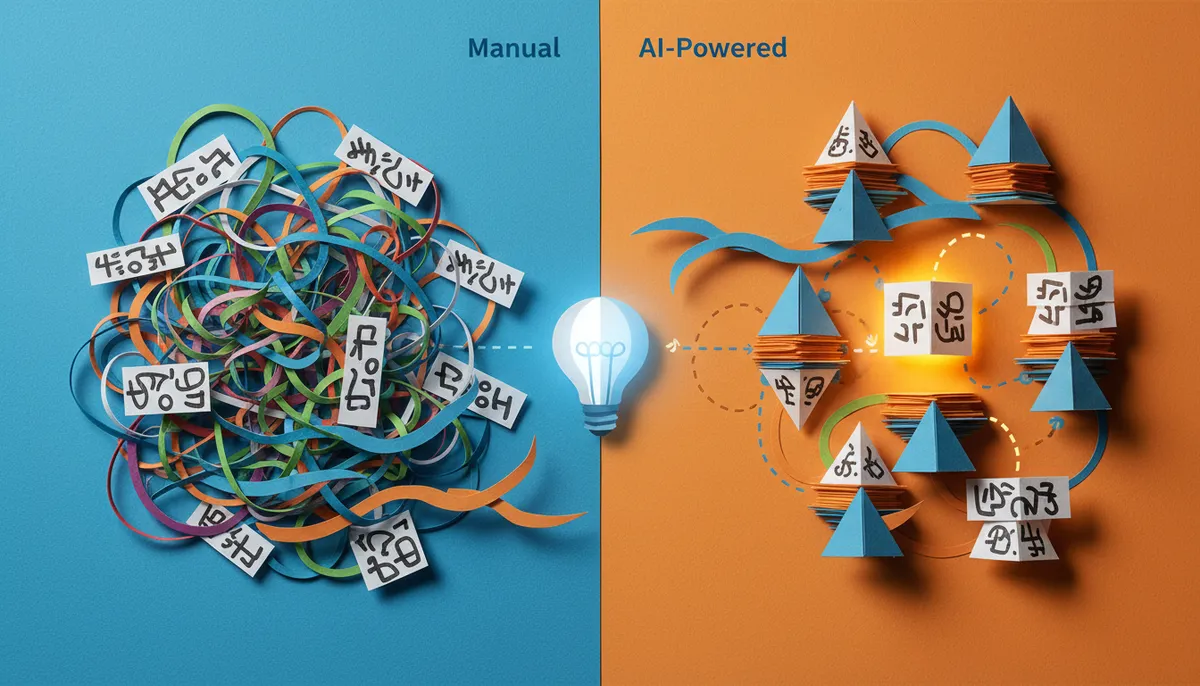
Manual keyword research typically involves hours of spreadsheet work, checking metrics across multiple tools, analyzing SERP features individually, and making educated guesses about content opportunities. AI-powered automation platforms now handle these tasks in seconds, grouping keywords into topic clusters, filtering by intent, and integrating directly into content production workflows without human intervention. The question is no longer whether AI can assist with keyword research, but whether manual methods can keep pace with modern content demands.
This comparison examines both approaches through real-world metrics, practical workflows, and specific tool capabilities available in 2026. Whether you’re a small SEO agency managing multiple clients, an in-house marketing team with limited resources, or an e-commerce specialist optimizing hundreds of product pages, understanding these differences helps you choose the method that delivers measurable results.

Traditional Manual Keyword Research Process
Manual keyword research follows a predictable sequence that most digital marketers recognize. The process begins with brainstorming seed keywords, entering them into tools like SEMrush or Ahrefs, and manually reviewing thousands of keyword suggestions. Marketers export data into spreadsheets, manually calculate difficulty scores versus search volume ratios, and spend hours categorizing keywords by topic and intent.
The workflow demands continuous tool-switching. A typical research session involves jumping between Google Keyword Planner for search volume, competitor websites for content gap analysis, SERP preview tools to assess ranking difficulty, and spreadsheet software for organization. According to industry data from 2026, most marketers spend 6-10 hours per week on keyword research activities alone, not including the content creation phase.
Manual methods provide granular control over selection criteria. Experienced SEO professionals can spot nuanced opportunities that automated filters might initially miss. They can manually assess whether a keyword’s competition level truly matches their domain authority, evaluate SERP features that suggest intent misalignment, and make judgment calls about trending topics before data fully surfaces.
However, this approach creates significant bottlenecks for content teams needing to publish consistently. When agencies manage 5-10 clients simultaneously, manual keyword research becomes the primary constraint preventing scalable content production. The human decision-making advantage becomes a liability when speed and volume determine competitive positioning.

AI-Powered Keyword Research Automation
AI-powered keyword research fundamentally changes the workflow by eliminating manual data processing steps. Platforms like Boltic.io, Gumloop, and SEO Rocket analyze millions of keyword combinations in seconds, automatically grouping related terms into topic clusters and applying intent filters without human input. These systems continuously refresh data from live SEO sources, providing real-time insights that manual research cannot match.
The automation advantage appears immediately in time savings. What requires 6-10 hours manually can be accomplished in under 10 minutes with modern AI platforms. Automated systems process competitor analysis, identify content gaps, calculate keyword difficulty adjusted for your specific domain, and queue opportunities directly into content calendars—all without switching between tools or managing spreadsheets.
Key Capabilities of Modern AI Keyword Tools
- Automatic keyword clustering that groups related search terms into pillar content opportunities
- Intent classification filters separating informational, commercial, and transactional queries
- Real-time SERP analysis identifying low-competition keywords with high conversion potential
- Integrated competitor gap analysis showing exactly which keywords competitors rank for that you don’t
- Predictive traffic modeling estimating ranking potential based on your domain authority
- One-click export to content production systems eliminating manual data transfer
Tools like LowFruits specialize in automating SERP analysis for long-tail keyword discovery, starting at $29.99/month in 2026. Gumloop offers comprehensive SEO workflow automation including web scraping and outline generation, with pricing beginning at $37/month after a free trial. These platforms demonstrate that automation no longer sacrifices quality for speed—they enhance both simultaneously.

Comparing Speed and Efficiency Metrics
The efficiency gap between manual and automated keyword research becomes quantifiable when measuring real-world workflows. A content manager researching keywords for 30 articles manually requires approximately 15-20 hours including data export, organization, and decision-making. The same manager using AI automation completes identical research in 30-45 minutes, representing a 95% time reduction.
| Task | Manual Method | AI Automation | Time Savings |
|---|---|---|---|
| Initial keyword discovery | 2-3 hours | 3-5 minutes | 97% |
| Competitor analysis | 3-4 hours | 5 minutes | 96% |
| SERP feature review | 2-3 hours | 2 minutes | 98% |
| Clustering and organization | 4-5 hours | Automatic | 100% |
| Integration with content calendar | 3-4 hours | Automatic | 100% |
These metrics translate directly into business outcomes. Small SEO agencies using automation can handle 3-5x more clients without expanding staff. In-house teams redirect saved research time toward content quality improvements and distribution strategy. E-commerce specialists optimize product page keywords at scale rather than selecting only high-priority items manually.
Accuracy represents another critical efficiency factor. Manual research introduces human error through data entry mistakes, outdated metrics from cached tool results, and subjective bias in keyword selection. AI platforms pulling live data from sources like Ahrefs’ database of 10+ billion keywords eliminate these accuracy issues while maintaining consistency across all research projects.

Cost Analysis: Manual Tools vs. Automated Platforms
Cost considerations extend beyond software subscription fees. Manual keyword research requires multiple tool subscriptions—SEMrush at $129.95/month, Ahrefs starting at similar pricing, plus supplementary tools for specific analysis tasks. The combined monthly cost for comprehensive manual research capabilities easily exceeds $300-400 before accounting for the largest expense: human labor hours.
When factoring specialist time at $50-100/hour, manual research for 30 monthly articles costs $750-2,000 in labor alone. Combined with tool subscriptions, the true monthly cost ranges from $1,050-2,400. This explains why traditional SEO agencies charge $3,000-5,000 monthly retainers—manual processes demand significant resource allocation.
Automated Platform Pricing Comparison
- Jasper AI: Starting at $39/month with integrated keyword research and content generation templates
- Gumloop: Free plan available, paid automation workflows from $37/month
- LowFruits: SERP analysis and clustering beginning at $29.99/month
- SEO Rocket: Complete automation from keyword research through publishing at $99/month for businesses, $799/month for agencies managing 10 clients
- Surfer AI: Integrated research and content optimization with pricing varies by usage
The cost per article difference reveals the automation advantage clearly. Manual methods produce content at approximately $35-80 per article when accounting for research time. Automated platforms like SEO Rocket reduce this to approximately $3 per 3,000+ word article by eliminating manual labor from the entire workflow, not just keyword research.
For agencies, the economics become even more compelling. The Agency plan at $799/month supporting 300 articles across 10 clients costs $2.66 per article while maintaining quality and SEO optimization that matches or exceeds manual production standards. This pricing structure makes automation accessible to businesses previously unable to afford consistent SEO content production.
Topic Clustering and Content Strategy
Topic clustering represents one area where AI automation dramatically outperforms manual methods. Manual clustering requires marketers to review hundreds of keywords, mentally group related terms, identify parent topics, and manually assign supporting content pieces—a process taking 8-12 hours for comprehensive topic mapping.
AI platforms like Boltic.io and Surfer AI automatically group keywords into logical content clusters based on semantic relationships, search intent alignment, and user journey stage. These systems instantly identify pillar content opportunities and supporting cluster articles, creating complete content architectures that would take days to develop manually.
The strategic impact extends beyond time savings. Automated clustering identifies content relationships that human researchers might miss, ensuring comprehensive topic coverage that signals topical authority to search engines. This systematic approach to content architecture directly improves rankings by creating internal linking structures that reinforce relevance signals across related articles.
| Clustering Feature | Manual Approach | AI Automation |
|---|---|---|
| Semantic grouping accuracy | 70-80% (subjective) | 90-95% (algorithmic) |
| Time to cluster 200 keywords | 6-8 hours | 2-3 minutes |
| Identifying content gaps | Incomplete (limited by human pattern recognition) | Comprehensive (systematic analysis) |
| Updates for new keywords | Manual re-analysis required | Automatic real-time updates |
Content managers benefit most from automated clustering when planning quarterly or annual content strategies. Rather than spending weeks mapping topics manually, they receive instant content architectures showing exactly which articles to produce, in what order, and how they interconnect. This systematic planning enables consistent daily publishing schedules that compound ranking improvements over time.
SERP Analysis and Competition Assessment
Understanding SERP features and competition levels determines keyword targeting success. Manual SERP analysis involves searching each keyword individually, reviewing top 10 results, noting featured snippets, analyzing domain authority of ranking sites, and subjectively assessing ranking difficulty. This process takes 10-15 minutes per keyword, creating bottlenecks when researching hundreds of opportunities.
Automated SERP analysis tools like AlliAI and seoClarity process thousands of keywords simultaneously, extracting structured data about every SERP feature, competitor, and ranking factor in seconds. These platforms identify specific content gaps where competitors provide weak answers, highlighting quick-win opportunities that manual research might overlook.
Real-time tracking represents another automation advantage. Manual methods provide snapshots requiring repeated searches to monitor changes. AI platforms continuously monitor SERP positions, instantly alerting teams when competitors lose rankings or new opportunities emerge. Tools like seoClarity process 100+ technical SEO factors automatically in their site audits, correlating SERP performance with technical optimization needs.
Competition Metrics That Matter in 2026
- Domain authority gap analysis: Automated comparison of your domain strength versus top-ranking competitors
- Content depth assessment: Word count, section structure, and media usage of ranking pages analyzed automatically
- Backlink requirement estimation: Average backlinks needed to compete calculated from competitor profiles
- Featured snippet opportunities: Questions currently answered poorly or not at all by existing content
- AI search visibility: Keywords appearing in ChatGPT, Perplexity, and Claude responses
The fifth metric—AI search visibility—represents a critical advantage of modern automated platforms. Traditional manual methods focus exclusively on Google rankings, missing opportunities in conversational AI platforms. Systems built for 2026 analyze how keywords perform across multiple AI search engines, positioning content to appear in AI-generated responses where user attention increasingly concentrates.
Integration with Content Production Workflows
The connection between keyword research and actual content creation determines overall efficiency. Manual research creates disconnects—keywords live in spreadsheets while content exists in separate documents, requiring manual reference and copy-pasting between systems. This fragmentation introduces errors, forgotten keywords, and inconsistent optimization across articles.
AI automation platforms eliminate these disconnects through direct workflow integration. When SEO Rocket identifies keyword opportunities, they automatically populate content calendars with article assignments. The system then generates complete 3,000+ word articles optimized for those exact keywords, including automated image generation, internal linking, metadata creation, and business mentions—all without manual data transfer.
This integration advantage appears most dramatically in daily publishing scenarios. Manual methods struggle to maintain consistent output because each article requires separate keyword research, outline creation, writing, optimization, and publishing steps. Automated workflows chain these steps together, enabling platforms like SEO Rocket to publish one fully optimized article daily on the Business plan or 10 daily on the Agency plan.
The quality consistency automation provides matches or exceeds manual production. AI systems apply identical optimization standards to every article—proper keyword density, semantic keyword inclusion, appropriate internal linking density, and E-E-A-T compliance. Manual production varies by writer skill, attention level, and time pressure, creating inconsistent results across content libraries.
Scalability for Agencies and Multi-Client Management
Small SEO agencies face unique challenges managing keyword research across multiple clients simultaneously. Manual methods require dedicated research time for each client, creating capacity constraints that limit growth. An agency serving 5 clients might spend 30-40 hours weekly on keyword research alone, leaving insufficient time for actual content production and strategy refinement.
Automated platforms designed for agency use transform this constraint into a competitive advantage. SEO Rocket’s Agency plan supports 10 client workspaces with 300 monthly articles, automating keyword research, content production, and publishing for all clients simultaneously. This structure enables small agencies to serve enterprise-level client rosters without proportional staff increases.
Agency-Specific Automation Benefits
- Unlimited team members across all client accounts eliminating per-seat licensing costs
- Separate content calendars per client with automatic keyword discovery for each
- Consistent quality across all clients regardless of account size or priority
- White-label capabilities allowing agencies to present research as proprietary
- Centralized performance tracking across entire client portfolio
- Rapid onboarding of new clients without workflow disruption
The economic impact for agencies using automation versus manual methods is substantial. An agency producing 300 articles monthly manually requires 4-6 full-time content staff plus tools, costing $25,000-40,000 monthly in overhead. The same output automated through platforms like SEO Rocket costs $799 monthly, representing 95%+ cost reduction while maintaining quality and enabling faster delivery times that improve client retention.
Digital marketing consultants benefit similarly from automation’s scalability. Rather than limiting client rosters based on available research time, consultants can accept more engagements knowing keyword research and initial content production occur automatically. This allows them to focus on higher-value strategic consulting rather than execution tasks that automation handles more efficiently.
Real-Time Data and Predictive Insights
Timing determines keyword targeting success as much as selection accuracy. Manual research relies on cached data that may be days or weeks old depending on when tools last refreshed their databases. By the time marketers discover opportunities and produce content, competitive landscapes may have shifted, reducing targeting effectiveness.
AI platforms providing real-time data eliminate this latency problem. Systems pulling live metrics from SEO databases instantly reflect current search volumes, competition levels, and trending topics. When search behavior changes—as it frequently does in response to news events, seasonal factors, or industry developments—automated research adapts immediately rather than operating on outdated assumptions.
Predictive insights represent the next evolution beyond real-time data. Advanced AI platforms like AlliAI now forecast keyword performance based on historical patterns, domain authority trajectories, and emerging search trends. These predictions help content teams prioritize keywords likely to generate traffic within specific timeframes rather than guessing which opportunities mature fastest.
The compounding effect of real-time automation appears over months rather than days. Platforms publishing daily based on current opportunities build momentum that compounds ranking improvements continuously. Manual methods producing content sporadically based on outdated research cannot match this consistent optimization cycle, falling progressively further behind in competitive niches.
AI Search Optimization: The 2026 Differentiator
The most significant advantage AI-powered keyword research provides in 2026 relates to optimization beyond traditional Google rankings. Conversational AI platforms like ChatGPT, Perplexity, Claude, Gemini, Copilot, and Grok increasingly answer user queries directly without referring to websites. Content optimized only for Google misses these emerging traffic sources.
Manual keyword research focuses exclusively on Google metrics because that’s where historical data exists. Researchers cannot easily analyze how keywords perform across AI platforms or how to structure content so AI models reference it as trusted sources. This limitation becomes critical as user behavior shifts toward asking AI assistants rather than searching Google directly.
AI-powered content platforms built for modern search ecosystems solve this problem by optimizing for both traditional and AI search simultaneously. SEO Rocket structures articles so they rank in Google while also appearing as reference sources in AI-generated responses. This dual optimization ensures content captures traffic regardless of where users search.
AI Search Optimization Elements
- Direct answer formatting: Structure content with clear, extractable answers AI models can quote
- Authority signals: Include citations, data sources, and expert quotes AI platforms recognize as credible
- Comprehensive coverage: Address topics thoroughly so AI models view content as definitive resources
- Structured data markup: Implement schema helping AI platforms understand content context and relationships
- Multi-platform keyword targeting: Optimize for natural language queries matching conversational AI usage patterns
E-commerce SEO specialists particularly benefit from AI search optimization as product discovery increasingly occurs through conversational queries. Users asking AI platforms for product recommendations, comparisons, or solutions receive responses citing optimized content, driving traffic that traditional Google-only optimization misses entirely. This expanded search presence becomes essential for competitive positioning in 2026 and beyond.
Performance Tracking and Continuous Improvement
Keyword research effectiveness depends on measuring actual ranking and traffic outcomes. Manual tracking requires spreadsheets recording targeted keywords per article, periodic rank checking, and manual correlation between keywords and traffic changes. This retrospective analysis happens weekly or monthly, delaying strategy adjustments by weeks.
Automated platforms provide continuous performance monitoring built into workflow systems. When SEO Rocket publishes an article targeting specific keywords, it automatically tracks rankings, traffic, and engagement metrics without manual data entry. This immediate feedback loop enables rapid strategy refinement based on what actually works rather than assumptions about keyword quality.
The improvement cycle automation enables compounds over time. Manual methods struggle to analyze which keyword characteristics correlate with ranking success because tracking limitations provide insufficient data points. AI platforms analyzing hundreds of articles identify patterns—specific keyword difficulty ranges that work best for your domain, optimal article lengths for different query types, and topic clusters generating strongest traffic growth.
| Tracking Metric | Manual Approach | Automated Platform |
|---|---|---|
| Rank tracking frequency | Weekly or monthly | Real-time continuous |
| Traffic attribution to keywords | Manual correlation | Automatic association |
| Pattern recognition | Limited by human analysis capacity | Machine learning across all content |
| Strategy adjustment speed | 2-4 weeks | Immediate |
Content managers using automated tracking discover opportunities manual methods miss. When specific keyword types consistently outperform others, automated systems can prioritize similar opportunities in future research. When certain content structures generate better engagement, systems adapt templates accordingly. This continuous learning creates improving results that manual processes cannot replicate.
Making the Right Choice for Your Business
Selecting between manual and AI-powered keyword research depends on specific business constraints and goals. Small businesses with limited budgets might initially consider manual methods to minimize software costs. However, this calculation typically overlooks the largest expense—time required to execute manual research properly.
In-house marketing teams at mid-sized companies benefit most dramatically from automation. These teams face constant pressure to produce more content with limited resources and tight deadlines. Automating keyword research redirects team capacity toward strategic planning, distribution, and optimization refinement rather than repetitive research tasks.
For businesses currently outsourcing SEO to traditional agencies, automation platforms like SEO Rocket eliminate the need for expensive retainers entirely. Rather than paying $3,000-5,000 monthly for services that include significant manual research overhead, businesses can access superior automation for $99 monthly while maintaining full control over strategy and content direction.
When Manual Research Still Makes Sense
- Highly specialized technical niches requiring deep subject matter expertise in keyword selection
- Brands with complex compliance requirements needing manual review of every keyword before content production
- Companies producing only 1-2 articles monthly where setup time for automation exceeds manual effort
- Situations requiring custom keyword analysis methodologies not supported by existing automated tools
These exceptions apply to fewer than 10% of businesses pursuing organic search traffic. For the vast majority, AI-powered automation delivers superior results at lower cost with faster implementation. The question becomes not whether to automate, but which platform provides the most comprehensive automation matching specific business needs.
Future-Proofing Your SEO Strategy
Search behavior continues evolving toward conversational AI interactions and away from traditional keyword-based queries. This shift makes keyword research methodologies designed for past search behavior progressively less effective. Manual research approaches optimizing for Google’s 2020 algorithms miss opportunities in 2026’s multi-platform search ecosystem.
Future-proof keyword research requires platforms built for emerging search behaviors rather than historical patterns. AI automation systems designed for modern search optimize simultaneously for Google, conversational AI platforms, and future search innovations not yet mainstream. This forward-looking approach protects content investments from premature obsolescence.
The development velocity of AI search makes manual adaptation impossible. When new AI platforms launch or existing ones change how they source and cite information, manual researchers must study new systems, test optimization approaches, and gradually adapt workflows. Automated platforms update algorithms in response to platform changes, maintaining optimization effectiveness without requiring user intervention.
Content teams choosing automation now position themselves ahead of competitors still using manual methods. As AI search adoption accelerates, the gap between automated and manual approaches widens rather than narrows. Early automation adopters benefit from months or years of compounding ranking improvements while manual competitors struggle to adapt legacy processes.
Start Automating Your Keyword Research Today
The evidence clearly favors AI-powered keyword research automation over manual methods for businesses serious about scaling organic traffic. Time savings, cost reduction, integration benefits, scalability advantages, and modern AI search optimization combine to make automation the only viable choice for competitive content strategies in 2026.
For small SEO agencies managing multiple clients, automation transforms capacity constraints into growth opportunities. In-house marketing teams redirect saved time toward strategic priorities that manual research prevented. E-commerce specialists optimize product catalogs at scale rather than selectively. Content managers maintain consistent publishing schedules that compound ranking improvements continuously.
The setup barrier that once justified manual methods no longer exists. Modern platforms like SEO Rocket complete implementation in under 10 minutes—connecting your site, discovering keyword opportunities, and beginning automated content production faster than conducting a single manual keyword research session. This accessibility removes the primary excuse for maintaining inefficient manual processes.
The financial case for automation becomes undeniable when comparing true costs including labor. Manual keyword research and content production cost $35-80 per article when properly accounting for professional time. Automated platforms reduce this to approximately $3 per article while maintaining or improving quality through consistent optimization standards and modern AI search targeting.
If you’re currently spending hours weekly on manual keyword research, struggling to maintain consistent content velocity, or paying premium retainers to traditional agencies, start your automated workflow today. The compounding benefits of systematic daily publishing begin immediately, creating ranking momentum that expands monthly as your content library grows and internal linking strengthens across related topics.
FAQs
Q: What is the main difference between manual and AI-powered SEO keyword research?
A: Manual keyword research requires hours of work using multiple tools, spreadsheets, and human analysis to discover and organize keywords. AI-powered keyword research automates this entire process in minutes, using machine learning to discover opportunities, cluster related terms, analyze competition, and integrate directly into content workflows without manual data transfer or decision-making.
Q: How much time can AI automation save on keyword research?
A: AI automation typically saves 95-98% of keyword research time compared to manual methods. What takes 6-10 hours manually—including discovery, analysis, clustering, and organization—can be completed in 10-30 minutes with modern automation platforms. For agencies or teams researching keywords for 30+ articles monthly, this represents saving 15-20 hours weekly.
Q: Does automated keyword research maintain the same quality as manual research?
A: Automated keyword research typically provides equal or superior quality compared to manual methods because it analyzes more data points, updates in real-time, eliminates human error, and applies consistent optimization standards. AI platforms process millions of keyword combinations and competitive factors that would be impossible to analyze manually, identifying opportunities human researchers might miss while maintaining systematic quality across all research projects.
Q: How much does AI-powered keyword research cost compared to manual methods?
A: Manual keyword research costs $1,050-2,400 monthly when accounting for tool subscriptions and labor hours at professional rates. AI automation platforms range from $30-99 monthly for most businesses, reducing costs by 85-95%. When measuring cost per article, manual methods produce content at $35-80 per piece while automated platforms reduce this to approximately $3 per article, making automation significantly more cost-effective for consistent content production.
Q: Can automated keyword research optimize for AI search engines like ChatGPT and Perplexity?
A: Yes, modern AI-powered keyword research platforms built for 2026 optimize for both traditional Google rankings and emerging AI search platforms like ChatGPT, Perplexity, Claude, and others. These systems structure content with direct answer formatting, authority signals, and comprehensive coverage that AI models recognize as trustworthy sources, ensuring visibility across multiple search ecosystems rather than Google alone.