
Key Takeaways
-
Distinguish between process automation (research, outreach, scheduling) which is safe, and placement automation (auto-generating/inserting links) which violates Google guidelines and risks penalties.
-
Automate only the repetitive, non-strategic tasks like prospect research, contact finding, follow-up sequences, and internal linking while keeping humans in charge of personalization and final approval.
-
Internal linking is the only area where full automation is both safe and effective since you control your own website with no third-party risk involved.
-
Strong, consistently published content is the foundation that makes link building automation effective—tools can't earn links for thin or outdated content no matter how automated.
-
Avoid tools promising fully automatic backlinks with zero effort; they typically rely on low-quality directories, spammy networks, or unnatural link patterns that get devalued or flagged.
-
Personalize the first line of every outreach email, segment lists by niche, limit follow-ups to 2-3 touches, and track responses to maintain domain reputation while automating workflows.
If you have ever typed “seo automated link building” into Google late at night, hoping for a magic fix, you are not alone. Building backlinks is one of the most time-consuming parts of SEO. It is also one of the most misunderstood. Many tools promise to “build backlinks automatically,” but the truth is a little more nuanced than that.
The good news? Automation really can help you build links faster and smarter. The key is knowing which parts of the process are safe to automate, and which parts still need a human touch. In this guide, we will break down what automated link building actually means today, how it fits into a bigger SEO content strategy, and how to avoid the traps that get sites penalized.
Whether you run a small agency, manage an in-house marketing team, or handle SEO for your own business, this article will help you separate smart automation from risky shortcuts. Let’s dig in.

What Does SEO Automated Link Building Actually Mean?
Automated link building does not mean a robot creates high-quality backlinks out of thin air. That is not how it works, no matter what a flashy sales page tells you. Instead, automation in link building means using software to handle the repetitive, time-eating tasks around the link building process.
Think of it like this: automation is your assistant, not your strategist. It can find prospects, track outreach, and flag opportunities. But the judgment calls, like deciding if a site is worth a link from, still need a real person.
Process Automation vs. Placement Automation
This is the most important distinction to understand. There are two very different types of automation, and they carry very different levels of risk.
- Process automation: Automating research, outreach scheduling, follow-ups, and reporting. This is generally safe and widely recommended.
- Placement automation: Automatically generating or inserting backlinks across many sites without human review. This is where things get risky.
Reputable sources are clear on this point. Automating your workflow is smart. Automating the actual placement of links at scale, especially through link exchanges or mass guest-post networks, can violate Search Quality Rater Guidelines and put your rankings at risk.
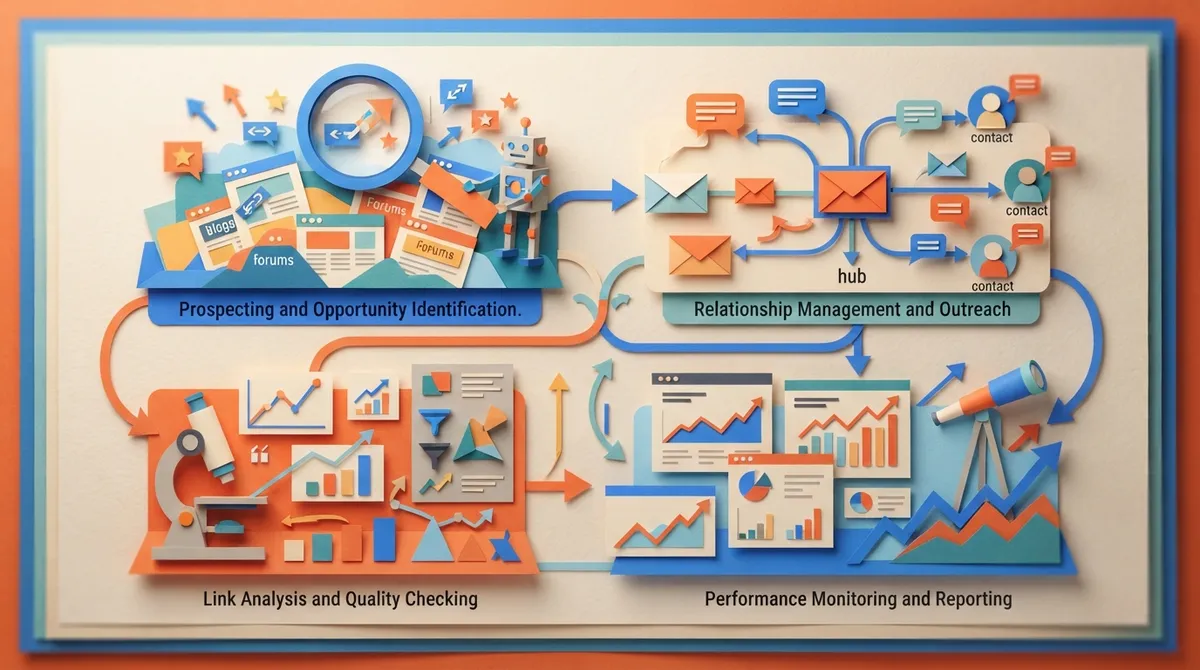
The Four Core Functions of Modern Link Building Tools
Most legitimate link building tools focus on four main jobs. Understanding these will help you evaluate any tool you are considering.
- Research and analysis: Finding relevant sites in your niche and scoring them based on authority and relevance.
- Contact finding and enrichment: Locating the right person to reach out to and gathering their contact details.
- Outreach and CRM: Sending personalized emails, tracking replies, and managing follow-ups.
- Monitoring and verification: Checking that links are live, tracking their status, and alerting you if one gets removed.
Notice what is missing from this list? Nothing here involves auto-generating or auto-placing links. That is intentional. The safest tools help you work faster, not skip the human parts of the process.
Why Internal Linking Is the Safest Place to Automate
Here is some genuinely good news. Internal linking is one of the few areas where full automation is both safe and effective. Since you control your own website, there is no third-party risk involved.
Tools can scan your content, find related pages, and suggest or even place internal links automatically. This helps search engines understand your site structure and helps readers find more of your content. If you want to go deeper on this, check out our guide on how to use automated internal linking to boost SEO fast.
Is Automated Link Building Safe for SEO?
The honest answer is: it depends entirely on what you are automating. Google’s spam policies have gotten stricter over time, specifically targeting large-scale, low-quality link schemes. Automation that mimics natural, one-at-a-time outreach is fine. Automation that mass-produces links or buys placements is not.
Here is a simple table to help you sort the safe practices from the risky ones.
| Practice | Risk Level | Why |
|---|---|---|
| Automated prospect research | Low | No links are created, just data gathering |
| Automated outreach sequencing | Low | Still requires human-written, personalized messages |
| Automated internal linking | Low | You control the destination and context |
| Automated link monitoring | Low | Simply tracks existing links, creates nothing new |
| Mass guest post networks | High | Often low-quality, flagged as spam by Google |
| Paid link placements | High | Violates Google’s link spam policies |
| Automatic link exchanges | High | Creates artificial, unnatural link patterns |
If you want a deeper dive into vetted, reputable options, our roundup of the 7 best backlink building tools for SEO in 2026 is a great next read.
How to Build an Automated Link Building Workflow the Right Way
You do not need to choose between “fully manual” and “fully automated.” The smartest approach blends both. Here is a step-by-step workflow that keeps you efficient and safe.
- Use software to find prospects. Let a tool scan for relevant, high-authority sites in your niche.
- Score and filter automatically. Set criteria like domain authority, topic relevance, and traffic to narrow your list.
- Review the shortlist yourself. Spend five minutes checking that these sites actually make sense for your brand.
- Personalize your first outreach message. Automation can draft a template, but you should add a personal touch before sending.
- Automate follow-up sequences. Let the tool handle reminder emails so nothing falls through the cracks.
- Approve every placement manually. Never let software publish a link on someone else’s site without your sign-off.
- Monitor link health regularly. Use automated alerts to catch broken or removed links quickly.
This approach saves hours every week while keeping the judgment-heavy decisions in human hands. It is the same philosophy behind good content automation in general: let software handle the repetitive grind, and let people handle strategy.
Common Questions About Tools That Claim to “Build Backlinks Automatically”
Be skeptical of any tool that promises fully automatic backlinks with zero effort. These claims usually mean one of a few things:
- The tool relies on low-quality directories or spammy networks
- Links are placed on sites with little to no real traffic or authority
- The “backlinks” may disappear or get devalued quickly
- Your site could be flagged for unnatural link patterns
Legitimate automation speeds up research and outreach. It does not manufacture trust with other websites out of nowhere. Trust still has to be earned, one relevant, useful piece of content at a time.
How Automated Link Building Fits Into a Bigger Content Strategy
Here is something a lot of people miss: the best link building strategy starts with content worth linking to. If your blog posts are thin, outdated, or generic, no amount of outreach automation will save you.
This is where SEO content automation really shines. When your site consistently publishes strong, well-researched articles, you naturally attract more backlink opportunities. Other sites want to reference content that is genuinely useful, current, and well organized.
This is exactly the gap that SEO Rocket is built to fill. Instead of spending hours writing content and then separately chasing links, SEO Rocket handles the keyword research, writing, and publishing side of your SEO so you can focus your energy on outreach and relationship building. It generates long-form, SEO-optimized articles daily, which means your site becomes the kind of resource other sites actually want to cite.
Why Consistent Publishing Supports Link Growth
Search engines and other website owners both notice consistency. A site that publishes fresh content regularly looks more active and trustworthy than one that posts once a quarter.
- Fresh content gives outreach teams new angles to pitch to journalists and bloggers
- Regularly updated blogs tend to earn more organic, unprompted mentions
- A steady content calendar means you always have something timely to promote
- More indexed pages create more opportunities for natural internal and external links
If you are curious how a content calendar works in practice, our article on content calendar tool mistakes killing your SEO is worth a look before you build your own system.
Choosing the Right Tools for Your Team
Not every business needs the same setup. A small agency juggling multiple clients has different needs than a solo business owner managing one site. Here is a quick breakdown by audience.
- Small agencies: Need tools that scale across clients without adding headcount. Look for CRM-style outreach tracking and reporting dashboards.
- In-house marketing teams: Benefit most from simple automation that saves time on research and follow-up, freeing up hours for strategy.
- Content managers: Should prioritize internal linking automation, since it directly supports the large volume of pages they manage.
- Digital consultants: Need transparent reporting tools to show clients real progress, not just vanity metrics.
- E-commerce specialists: Should focus on automating internal links between product and category pages to boost crawlability.
- Small business owners: Often do best with an all-in-one platform that reduces the number of separate tools they have to manage and pay for.
No matter which group you fall into, pairing your link building efforts with strong on-site content is non-negotiable. You can learn more about building that foundation in our guide on internal linking strategy mistakes you must avoid in 2026.
Avoiding Spam Risks With Automated Outreach
Outreach automation is genuinely helpful, but it can backfire if it feels robotic. Here are some simple ways to keep your automated outreach human and effective.
- Always personalize the first line of every email, referencing something specific about the recipient’s site
- Avoid sending identical templates to hundreds of contacts at once
- Set reasonable follow-up limits, two or three touches is usually enough
- Segment your list by niche relevance instead of blasting everyone the same message
- Track responses and remove unresponsive contacts instead of repeatedly emailing them
These small habits make a big difference in response rates and keep your domain reputation healthy. Sending thoughtful, relevant outreach at scale is possible, it just requires a bit of setup discipline.
Bringing It All Together
Automated link building, done right, is about saving time on the boring parts of the process while keeping humans in charge of the important decisions. Automate your research, your scheduling, your monitoring, and your internal linking. Keep a real person involved in outreach personalization and final approval on every placement.
The businesses that win at SEO in 2026 are the ones that treat automation as a productivity multiplier, not a replacement for good judgment. If you want to see how the wider world of SEO automation is evolving, our piece on what is SEO automation software and how does it work in 2026 is a helpful companion read.
And if you would rather stop stressing over content gaps and start building the kind of site that naturally earns links, SEO Rocket’s features can show you what full content automation looks like when it is done properly. You can also browse real writing examples to see the quality for yourself.
Ready to spend less time chasing links manually and more time on strategy that actually moves the needle? Start for $99/month and let SEO Rocket handle your daily content while you focus on outreach and growth.
FAQs
Q: What is automated link building in SEO?
A: It’s using software to speed up the repetitive parts of link building, like finding prospects, sending outreach emails, and tracking results. It does not mean a tool magically creates high-quality backlinks with zero human involvement. Think of it as a helpful assistant, not a replacement for strategy.
Q: Is automated link building safe for SEO?
A: It depends on what you’re automating. Automating research, outreach scheduling, and monitoring is generally safe and smart. Automating actual link placement through mass schemes or paid networks is risky and can violate Google’s spam policies.
Q: Which parts of link building can be automated without penalties?
A: Prospect research, contact finding, outreach follow-ups, reporting, and internal linking are all safe to automate. These tasks involve workflow and organization, not the actual creation of unnatural links, so they carry very little risk.
Q: Can AI build backlinks automatically?
A: Not in a trustworthy way, and you should be cautious of any tool that claims otherwise. AI can help you find opportunities and draft outreach messages, but earning a genuine backlink still depends on human relationships and good content.
Q: What is the difference between link building automation and link buying?
A: Automation speeds up honest tasks like research and outreach, while link buying pays for placements outright, which violates Google’s guidelines. One saves you time on legitimate work, the other risks your entire site’s rankings.