

Key Takeaways
-
Use AI to speed up production (outlines, drafts, metadata) but always add human expertise, fact-checking, and original insights before publishing to avoid low-quality content penalties.
-
Google allows AI-generated content but penalizes scaled content abuse—mass-producing thin, repetitive pages; focus on answering real user questions with distinct value instead of targeting every keyword variation separately.
-
Build a strict editorial workflow: human topic selection → AI drafting → expert additions → fact verification → metadata optimization → consistent publishing; never publish without human review.
-
Automate keyword research, outlines, first drafts, and metadata, but never automate original opinions, fact verification, or brand voice confirmation, as AI can confidently generate false information.
-
Track organic traffic, keyword rankings, engagement metrics, and conversions—not page count; regularly update or remove underperforming content to maintain site credibility and avoid ranking damage.
-
Consider transparent disclosure of AI use, especially for health, finance, or legal topics, as 48% of companies with AI policies now address transparency and it builds reader trust.
So you want to use AI for SEO content, but you’re worried about doing it wrong. Good news: you’re asking the right question. Lots of business owners jump straight to “let’s generate 500 articles this week” without thinking about quality. That approach can backfire fast. This guide will walk you through the smart way to use AI for SEO content in 2026, step by step, so you get real traffic instead of a Google penalty.
Here’s the good part. Google has been clear about this. It does not ban content just because AI helped write it. What it does care about is whether your content is actually useful to real people. We’ll cover exactly what that means, how to build a workflow that keeps you safe, and how tools like SEO Rocket’s automation system can do the heavy lifting while you stay in control of quality.
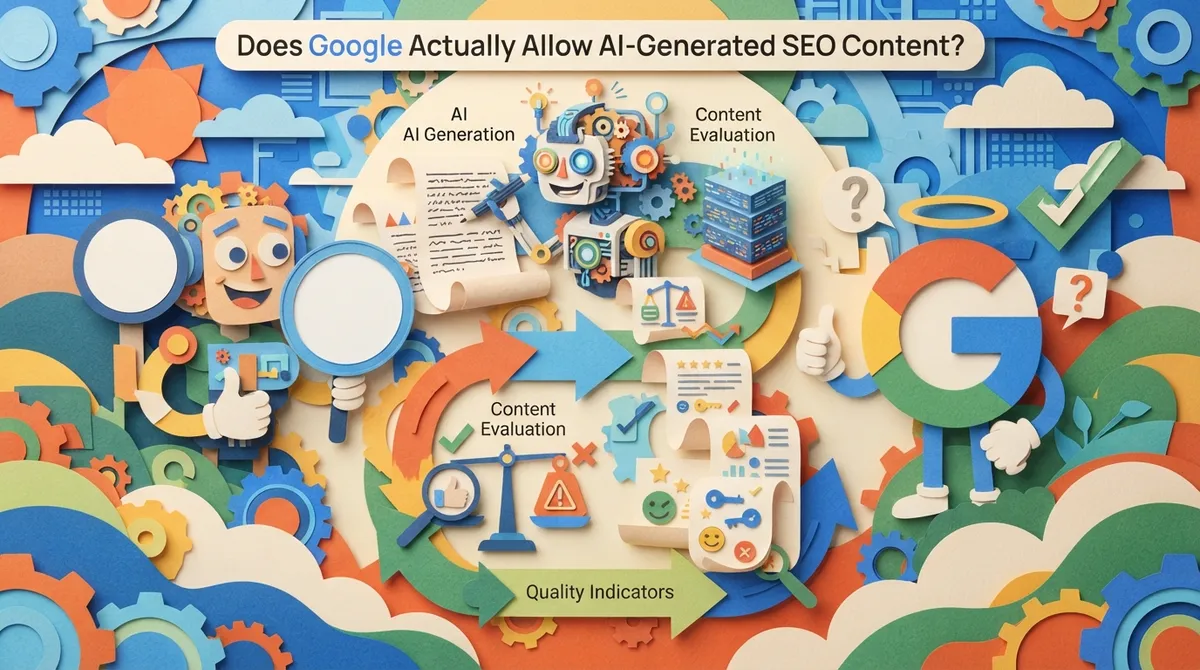
Does Google Actually Allow AI-Generated SEO Content?
Yes, it does. Google’s own guidance says content quality matters more than how it was made. Whether a human typed every word or AI drafted it first, the rules are the same: be accurate, be helpful, and follow Search Quality Rater Guidelines for what counts as trustworthy content.
What Google does punish is something called scaled content abuse. This means publishing tons of low-value, repetitive pages just to grab rankings. It doesn’t matter if a person, an AI, or a mix of both created those pages. If the goal is manipulation instead of helping readers, it’s a problem.
The fix is simple to understand, even if it takes some discipline to follow. Use AI to speed up the process, not to replace thinking. Every article should answer a real question a real person is typing into Google.
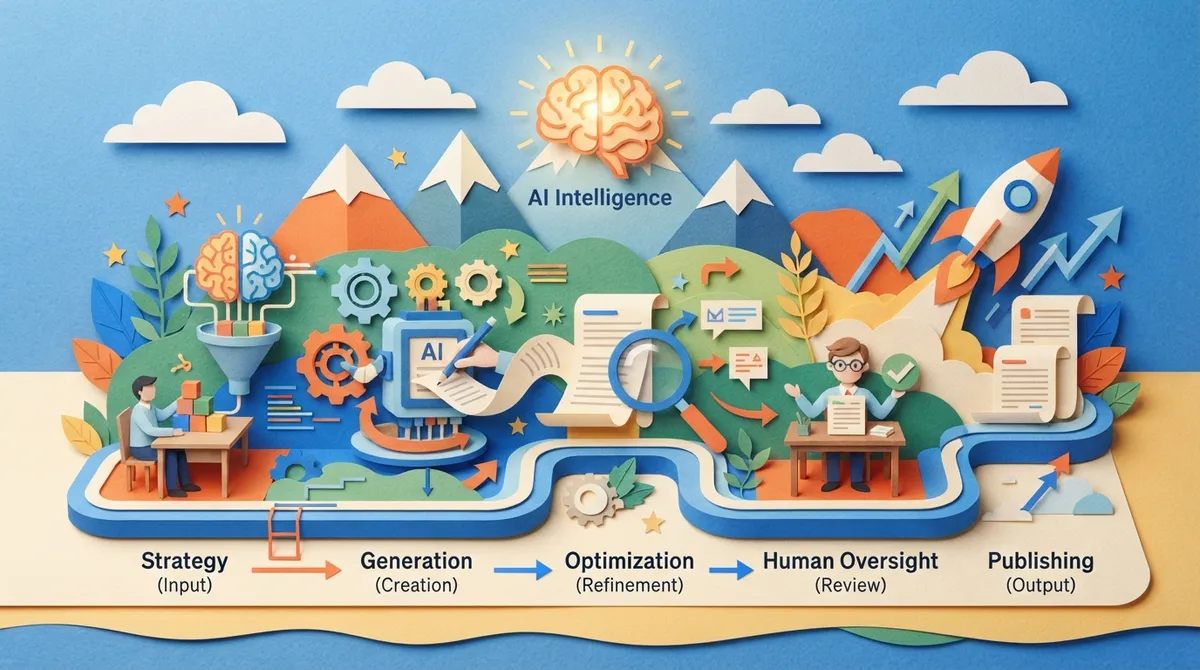
The Right Way to Build an AI-Powered SEO Content Workflow
Here’s a step-by-step process that keeps your content both fast to produce and safe from penalties.
- Start with human-led topic selection. Pick topics based on what your customers actually search for and need. Don’t let AI pick blindly.
- Use keyword research to confirm demand. Look at search volume, competition, and intent before writing anything. A keyword discovery tool can speed this up a lot.
- Let AI build outlines and first drafts. This is where AI saves you hours. It can structure headings, suggest angles, and write a rough draft fast.
- Add human expertise and real examples. This is the step people skip, and it’s the most important one. Add your own experience, case studies, or unique insight.
- Fact-check everything. Never trust AI-generated stats, quotes, or dates without checking them against a real source.
- Optimize metadata and structure. Use AI to help write titles, meta descriptions, and alt text, then review each one for accuracy.
- Publish consistently, not in bulk. Steady, planned publishing beats dumping 50 articles overnight.
This workflow is exactly what SEO Rocket’s platform is built around. It handles keyword research, drafting, and optimization automatically, but it still produces full, long-form articles instead of short, thin pages that could raise red flags.
What Parts of SEO Content Can Actually Be Automated?
Not every part of the process should be handed off to AI. Some tasks are perfect for automation. Others still need a human touch.
| Task | Good for AI Automation? | Why |
|---|---|---|
| Keyword research | Yes | Data-driven, repetitive, and fast to process |
| Content outlines | Yes | Structure follows predictable SEO patterns |
| First drafts | Yes | Speeds up writing without losing quality if edited well |
| Meta descriptions & titles | Yes | Formulaic and easy to review quickly |
| Internal linking suggestions | Yes | Pattern-based and easy to verify |
| Original expert opinions | No | Requires real experience and judgment |
| Fact verification | No | AI can be confidently wrong, so humans must check |
| Brand voice and tone | Partial | AI can mimic style, but humans should confirm accuracy |
This is a big reason why fully automated tools need strong guardrails. SEO Rocket’s system is designed to include real-time SEO scoring and auto-fix suggestions, so quality checks happen before anything goes live.
Avoiding Scaled Content Abuse: What It Is and How to Stay Safe
Scaled content abuse is Google’s term for mass-producing low-value pages. It’s not about the tool you use. It’s about the purpose behind the content.
Here are the warning signs to watch for:
- Publishing dozens of near-identical articles targeting slightly different keyword variations
- Creating pages that don’t answer a clear question or solve a clear problem
- Skipping fact-checking because “the AI probably got it right”
- Measuring success only by page count, not by traffic or engagement
- Ignoring user intent in favor of keyword stuffing
Instead, build pages around distinct needs. If two keywords mean the same thing to a searcher, combine them into one strong page instead of two thin ones. This is one reason search intent optimization matters so much before you even start writing.
How to Fact-Check and Edit AI-Generated Content
Treat every AI draft like a smart intern wrote it. Helpful, fast, but not always right. Here’s a simple checklist to run through before hitting publish:
- Check every statistic against its original source.
- Verify names, dates, and product details.
- Remove any claim you can’t confirm is true.
- Add citations where they strengthen trust.
- Read the whole piece out loud. If it sounds robotic, rewrite it.
- Make sure the content matches your brand’s actual voice and values.
This step matters more than people realize. According to the 2025 B2B Content Marketing Benchmarks report, 78% of companies with AI guidelines already address acceptable use cases for content marketing. That means most serious teams already know editing is non-negotiable.
Should You Disclose AI Use in Your Content?
There’s no single legal rule requiring disclosure for SEO blog content. But being transparent builds trust with readers and protects your brand. Many companies now include a short note about their editorial process, especially for topics involving health, finance, or legal advice.
The CMI report also found that 48% of companies with AI policies address transparency about AI-generated content. It’s becoming a normal part of responsible content practices, not just a nice-to-have.
How to Measure Whether Your AI SEO Content Is Actually Working
Page count is not a success metric. Real results come from outcomes, not output. Track these instead:
- Organic traffic growth over time
- Keyword rankings for target terms
- Engagement metrics like time on page and bounce rate
- Conversion rates from blog traffic
- Whether your content gets referenced in AI answers on platforms like ChatGPT or Perplexity
Around 51% of marketers already use AI tools to optimize content for search, based on SurveyMonkey’s marketing research. But the ones getting real results are the ones pairing automation with regular performance reviews. Old or inaccurate pages should be updated or removed, not left to sit and hurt your site’s credibility.
Why Full Automation Still Needs a Smart System Behind It
Manually managing keyword research, writing, optimization, and publishing takes hours every single week. Most small teams simply don’t have that time. This is exactly where a complete platform makes sense instead of stitching together five different tools.
SEO Rocket was built to solve this exact problem. It handles keyword discovery, competitor analysis, and long-form article generation, then optimizes and publishes directly to your site. Setup takes under 10 minutes. You connect your site, whether it’s WordPress, Webflow, Shopify, or Wix, review the keyword opportunities it finds, and approve your content calendar. From there, it produces a 3,000-word, SEO-optimized article every single day.
Unlike tools that only think about Google, SEO Rocket also structures content so it can show up inside AI answers on ChatGPT, Perplexity, Claude, Gemini, Copilot, and Grok. That matters more every month as more searches happen through AI assistants instead of traditional search bars. You can read more about this shift in our piece on improving AI search visibility.
Here’s what makes the system different from doing this manually or piecing together separate tools:
- Fully automated keyword research based on live SEO data
- One long-form, 3,000+ word article generated and published daily
- Built-in real-time SEO scoring with automatic fix suggestions
- Direct publishing to your CMS, no copy-pasting required
- Auto-generated images, internal links, and metadata
- Unlimited rewrites and unlimited team members
- A visual content calendar you can plan weeks or months ahead
Compare that to hiring a traditional agency, which often costs $3,000 to $5,000 a month for a fraction of the output. At roughly $3 per article, the cost efficiency is hard to match. You can see the full breakdown on the pricing page.
A Quick Comparison: Manual SEO Content vs. Automated SEO Content
| Factor | Manual Process | Automated with SEO Rocket |
|---|---|---|
| Time per article | 4-8 hours | Minutes of review time |
| Keyword research | Manual spreadsheets | Built-in engine with live data |
| Publishing frequency | Inconsistent | Daily, automatic publishing |
| Cost per article | $100-$500+ (freelancers/agencies) | ~$3 per article |
| AI search optimization | Rarely considered | Built into every article |
| Scalability for agencies | Requires more staff | Up to 300 articles/month, 10 client workspaces |
If you’re a small agency juggling multiple clients, or an in-house marketer with limited time, this kind of system removes the bottleneck completely. You can check real examples of the output quality on the writing examples page or see what current users say on the reviews page.
Common Mistakes to Avoid When Using AI for SEO Content
Even with the best tools, some mistakes keep showing up. Watch out for these:
- Publishing without any human review, ever.
- Targeting every keyword variation with a separate page instead of consolidating topics.
- Ignoring your own brand voice in favor of generic AI phrasing.
- Forgetting to update or remove outdated content.
- Chasing volume instead of value.
You can dig deeper into these pitfalls in our guide on AI writing mistakes that hurt rankings. Avoiding them is often the difference between steady growth and a content strategy that stalls out.
Getting Started the Smart Way
Using AI for SEO content isn’t about replacing your judgment. It’s about giving yourself more time to focus on strategy while the repetitive work gets handled for you. Start small, stay consistent, and always keep a human eye on quality.
If you’re ready to stop doing keyword research, writing, and publishing manually, you can start for $99/month and let the entire process run on autopilot. Setup takes less than 10 minutes, and you’ll have your first optimized article live before the day is over. For more background on building a solid content foundation first, check out our beginner’s guide to SEO content writing.
Whether you’re running an agency, managing an in-house team, or growing your own small business, the goal is the same: consistent, high-quality content that actually ranks. You can also sign up here to see how the full system works for your specific site. And if you want to keep learning, our team regularly shares practical tips over on our blog.
FAQs
Q: Can AI-generated content rank on Google?
A: Yes, absolutely! Google cares about quality and usefulness, not whether a human or AI typed the words. As long as your content genuinely helps readers and follows good SEO practices, it has every chance to rank well.
Q: Does Google penalize AI-written SEO content?
A: Google doesn’t penalize content just for being AI-assisted. What gets penalized is scaled content abuse, meaning tons of low-value pages made purely to manipulate rankings. Keep your content useful and original, and you’ll be just fine.
Q: What parts of SEO content creation can be automated with AI?
A: Keyword research, outlines, first drafts, metadata, and internal linking are all great candidates for automation. Just make sure a human still reviews everything for accuracy and adds real expertise before it goes live.
Q: How do I fact-check and edit AI-generated articles?
A: Treat every AI draft like a rough first attempt. Check every stat, date, and quote against a reliable source, then read the piece out loud to catch anything that sounds off. It only takes a few extra minutes and it makes a huge difference.
Q: How do I measure whether AI-assisted SEO content is working?
A: Look at organic traffic, keyword rankings, engagement, and conversions instead of just counting published pages. If a piece isn’t performing after a few months, it’s totally okay to update it or retire it.




