
Key Takeaways
-
Modern SEO providers must blend strategy with automation to handle keyword research, content creation, optimization, and publishing without manual bottlenecks, replacing outdated agency models that charge $3,000-$5,000 monthly with slow turnaround times.
-
Top SEO solutions require built-in keyword research, automated content planning, direct CMS publishing, real-time SEO scoring, and AI search optimization to compete in 2026, where consistency and long-form content (3,000+ words) significantly outperform short articles.
-
Automation platforms cost $99-$799 monthly and produce articles at roughly $3 per piece versus traditional agencies charging thousands per article, making them ideal for small businesses and agencies managing multiple clients without scaling headcount.
-
Before choosing any provider, identify your biggest bottleneck—whether content creation, technical fixes, or reporting—and select a solution that solves that specific pain point first rather than attempting a complete strategy overhaul simultaneously.
-
Evaluation checklist must verify: live keyword data, automatic long-form content generation, direct publishing capability, transparent pricing, AI search support, multi-client scalability, and real reporting before committing to any provider.
-
Content must be structured for AI tools like ChatGPT, Perplexity, and Gemini to reference as trusted sources, not just optimized for Google crawling, since AI-generated answers are now major traffic and visibility sources in 2026.
Picking the best search engine optimization company used to mean interviewing agencies, checking case studies, and hoping for the best. That whole process feels outdated now. In 2026, the smartest businesses are choosing platforms and providers that blend real SEO strategy with automation, so content gets written, optimized, and published without weeks of back-and-forth emails.
If you have ever felt stuck between hiring an expensive agency or trying to do everything yourself, you are not alone. This guide walks through exactly what to look for in a modern SEO partner, whether that is a full-service agency, a software platform, or a hybrid of both. We will also share real numbers, practical comparisons, and a few honest opinions along the way. By the end, you will know exactly what separates a truly great provider from one that just talks a good game.

What Does “Best Search Engine Optimization Company” Mean in 2026?
The definition has changed a lot. It used to mean an agency with a big client roster and flashy testimonials. Now it means something more practical: a company or platform that can actually get content written, optimized, and live on your site without you doing all the heavy lifting.
Today’s top providers are judged on how well they combine strategy with automation. That includes keyword research, content drafting, on-page optimization, publishing, and reporting. According to a recent breakdown from Gitnux’s 2026 automated SEO comparison, the best providers are the ones that remove manual bottlenecks instead of just offering advice.
Why Traditional Agencies Are Losing Ground
Traditional agencies still have value, especially for complex technical audits or brand strategy. But many small businesses simply cannot afford $3,000 to $5,000 a month for ongoing content and SEO work. That price gap is why more companies are turning to automation-first platforms instead.
Here are a few reasons traditional agency models are struggling to keep up:
- High monthly retainers that do not scale well for small teams
- Slow turnaround times on content, often weeks per article
- Limited transparency into what work is actually being done
- Difficulty keeping up with both classic SEO and newer AI search demands
- Manual processes that do not scale across multiple clients or brands
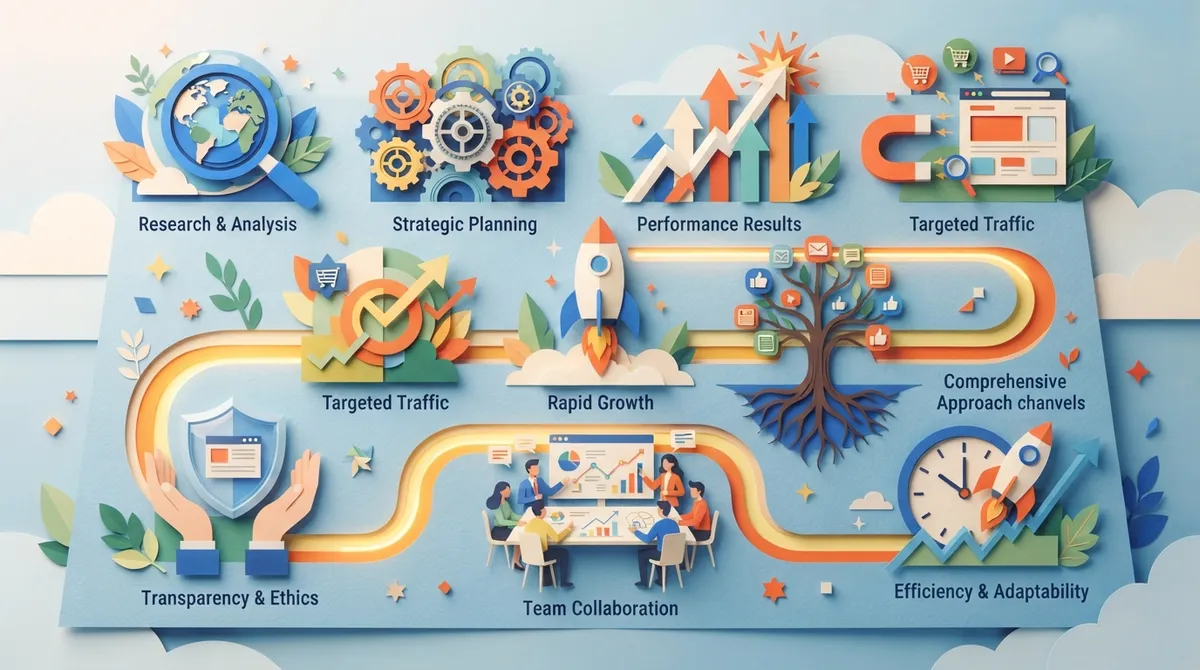
9 Traits of the Best Search Engine Optimization Company
So what should you actually look for? Below are the nine traits that separate the best providers from the rest of the pack in 2026.
1. Built-In Keyword Research
A great provider should never make you guess what to write about. Instead, they should show you real keyword opportunities based on search volume, competition, and intent. This is one of the biggest time-savers available today.
Manual keyword research can eat up hours every single week. Tools with built-in research engines pull live data and turn it into a ready-to-use content plan.
2. Automated Content Planning and Calendars
Spreadsheets and sticky notes are not a content strategy. The best providers offer a visual calendar where you can plan weeks or months of content in advance. You add a keyword, and the system handles scheduling it for production.
This is exactly how SEO Rocket’s workflow operates. You approve a keyword, and it gets turned into a full article automatically, following SEO best practices for consistent publishing.
3. Long-Form, High-Quality Content
Short 500-word blog posts rarely rank well anymore. The best companies produce long-form content, often 3,000 words or more, that actually answers reader questions in depth. Longer, well-structured articles tend to perform better in both traditional search and AI-generated answers.
4. Direct Publishing to Your Website
Copy-pasting articles from a document into your CMS is tedious and error-prone. Top providers publish directly to WordPress, Webflow, Shopify, or Wix without any manual steps. This alone can save hours every week for content teams.
5. Real-Time SEO Scoring and Fixes
Writing content is only half the battle. The best providers score your content in real time and suggest fixes before it ever goes live. This catches issues with keyword usage, structure, and readability before they become ranking problems.
6. Support for AI Search and GEO Optimization
Google is no longer the only game in town. Tools like ChatGPT, Perplexity, Claude, Gemini, and Copilot are now major sources of traffic and visibility. The best companies structure content so it can be referenced and cited by AI models, not just crawled by traditional search bots.
Our guide on how to improve your AI search visibility in 2026 breaks this down in more detail if you want to go deeper.
7. Transparent, Predictable Pricing
Nobody likes surprise invoices. The best providers offer clear, published pricing instead of custom quotes that change every month. This matters a lot for small businesses trying to plan a marketing budget.
8. Scalability for Agencies and Teams
If you manage content for multiple clients or a large website, you need a system that scales. That means multiple workspaces, unlimited team members, and the ability to produce dozens or hundreds of articles per month without hiring more writers.
9. Consistency Without Manual Labor
Publishing once a month will not move the needle. The best companies make it possible to publish daily, which compounds over time into serious organic growth. Consistency is often the single biggest factor separating winning content strategies from stalled ones.
Agency vs. Software Platform vs. Hybrid: Which Should You Choose?
This is one of the most common questions business owners ask. Should you hire a traditional agency, buy software, or find something in between? Here is a simple breakdown to help you decide.
| Option | Best For | Typical Monthly Cost | Speed |
|---|---|---|---|
| Traditional Agency | Complex technical audits, brand strategy | $3,000 – $5,000+ | Slow (weeks per deliverable) |
| Content Optimization Tool Only | Teams that already write but need optimization help | $99 – $500 | Moderate (still requires manual writing) |
| Full Automation Platform | Businesses wanting hands-off, consistent publishing | $99 – $799 | Fast (daily publishing) |
Notice the price range here. According to industry roundups, automated SEO and content tools in 2026 span from about $19 a month to $2,499 a month, depending on features and scale. Some full-service providers, like Embarque’s offering, start around $599 a month and scale up to $3,499 for advanced service. That is a massive range, which is why matching the tool to your actual needs matters so much.
How to Evaluate an SEO Automation Company: A Simple Checklist
Before signing up for anything, run through this checklist. It will save you from wasted money and disappointing results.
- Does it include built-in keyword research with live data?
- Can it generate long-form content automatically, not just outlines?
- Does it publish directly to your CMS, or do you have to copy-paste?
- Is pricing clear and published, or do you need a custom quote?
- Does it support AI search optimization, not just classic Google SEO?
- Can it scale if you add more clients or more content needs later?
- Does it offer real reporting so you can see what is actually working?
If a provider cannot check most of these boxes, keep looking. The market has enough options in 2026 that you should not settle for partial solutions.
What This Means for Different Types of Businesses
Different teams have different pain points, so the “best” choice really depends on your situation. Here is how this plays out across common business types.
Small SEO Agencies
Agencies juggling multiple clients need tools that scale without adding headcount. A platform that supports multiple workspaces and produces content for many brands at once is a game-changer here. Check out our thoughts on why marketing agencies should use content automation for more on this.
In-House Marketing Teams
Marketing teams at mid-sized companies often lack the bandwidth for daily content creation. Automation frees up time for strategy and campaigns instead of manual writing and formatting.
Content Managers
If you manage a large blog or website, consistency is everything. Automated publishing keeps your content calendar full without constant oversight.
Digital Marketing Consultants
Consultants can use automation to deliver faster results for clients, which helps differentiate their services from competitors still doing everything by hand.
E-commerce SEO Specialists
Product and category pages need constant optimization at scale. Automated tools can handle the volume that manual writing simply cannot keep up with.
Small Business Owners
Owners with limited budgets need cost-effective solutions that still deliver real results. This is often where automation platforms shine brightest, since they remove the need for a large marketing team.
Why SEO Rocket Stands Out Among Automated Providers
SEO Rocket was built to solve the exact problems outlined above. Setup takes under 10 minutes. You connect your website, review keyword opportunities the system finds automatically, and approve a content calendar. From there, SEO Rocket handles keyword discovery, competitor analysis, article writing, optimization, and daily publishing without any manual work on your end.
The Business plan produces 30 articles a month at $99, while the Agency plan generates 300 articles across 10 client workspaces for $799 a month. There is also a $1,499 lifetime plan for businesses that want permanent access without an ongoing subscription. That works out to roughly $3 per long-form article, which is a fraction of what most agencies charge for a single blog post.
Every article includes AI-optimized metadata, internal and external linking, auto-generated images, and real-time SEO scoring with fix suggestions. Content is also structured to be referenced by AI search tools like ChatGPT, Perplexity, and Gemini, not just crawled by Google. You can see real examples of this output on the writing examples page, and browse actual user feedback on the reviews page.
If you want to explore the full feature list, the features page covers everything from unlimited rewrites to unlimited team members. And if you are curious how pricing compares across plans, the pricing page lays it out clearly with no hidden fees.
Common Mistakes to Avoid When Choosing a Provider
Even with a good checklist, it is easy to make mistakes when picking an SEO partner. Watch out for these common pitfalls:
- Choosing based on price alone without checking content quality
- Ignoring whether the tool supports direct publishing to your CMS
- Overlooking AI search optimization in favor of classic SEO only
- Signing long-term contracts before testing the actual output
- Failing to check how easily the platform scales as your needs grow
Taking a little extra time upfront to compare options can save you months of frustration and wasted budget later. For more on evaluating tools versus manual work, check out our comparison on manual SEO vs. automated SEO.
Start Your Bottleneck Analysis First
Before choosing any provider, figure out your biggest bottleneck. Is it content creation? Technical fixes? Reporting? Most SEO automation guidance in 2026 recommends solving the biggest pain point first instead of trying to fix everything at once.
Here is a simple way to think through it:
- List your top three SEO or content challenges right now
- Rank them by how much time or money they cost you monthly
- Choose a provider that solves your top challenge first
- Expand into other features once you see results
This approach keeps things manageable and avoids the trap of trying to overhaul your entire strategy overnight. According to Google’s own Search Quality Rater Guidelines, high-quality, helpful content consistently outperforms thin or rushed pages, which is exactly why picking the right long-term partner matters so much.
Final Thoughts on Choosing the Best Search Engine Optimization Company
The best search engine optimization company in 2026 is not necessarily the biggest name or the most expensive option. It is the one that removes your biggest bottlenecks, produces genuinely good content, and keeps your site publishing consistently without draining your budget or your time.
Whether you run a small agency, manage an e-commerce site, or handle marketing for a growing business, automation has changed what is possible. You no longer need a massive team or a huge retainer to compete for search visibility. For more background on getting started, our beginner’s guide to SEO content writing is a great next stop, and you can always browse our blog for more practical guides.
Ready to see it in action for yourself? You can start for $99 a month and get your first articles published this week, or sign up to try the platform with your own site today.
FAQs
Q: What does the best search engine optimization company mean in SEO Content Automation?
A: It means a provider that combines real SEO strategy with automation, so keyword research, writing, optimization, and publishing all happen without hours of manual work. In 2026, this usually points to platforms that handle the entire content workflow, not just give advice.
Q: How do SEO automation companies differ from traditional SEO agencies?
A: Traditional agencies often charge thousands per month and take weeks to deliver content. Automation companies handle keyword research, writing, and publishing directly, usually at a fraction of the cost and much faster turnaround.
Q: How much does SEO content automation typically cost in 2026?
A: Pricing ranges widely, from about $19 a month for basic tools up to $2,499 a month for full-stack platforms. Many solid options, like SEO Rocket, sit around $99 to $799 a month depending on how much content you need.
Q: Should a business choose an agency, software platform, or hybrid SEO service?
A: It depends on your biggest bottleneck. If you need consistent content without a huge budget, a software platform is usually the easiest and most cost-effective choice. Agencies still make sense for complex strategy work or major technical audits.
Q: How does SEO Content Automation support AI search and GEO optimization?
A: Good automation platforms structure content so AI tools like ChatGPT, Perplexity, and Gemini can reference it as a trusted source. This means your content can show up in AI-generated answers, not just traditional search results.