Key Takeaways
-
SEO-focused article writing AI must handle the entire content workflow including keyword research, outline creation, on-page optimization, internal linking, and publishing—not just text generation—to achieve actual rankings.
-
Google ranks AI-written articles the same as human-written ones based on helpfulness, accuracy, and trustworthiness; human review before publishing is essential to catch errors and confirm facts.
-
General chatbots fall short for SEO because they lack keyword research, competitor analysis, and readability optimization; specialized SEO tools provide real-time optimization scoring and search volume data.
-
Complete content automation workflows that connect keyword discovery, content planning, outline generation, optimization, and periodic refreshes outperform isolated writing tools that create ranking gaps.
-
AI-generated content requires ongoing updates every few months to maintain rankings as competition shifts and search algorithms change; treating articles as living assets rather than one-time tasks is critical.
-
Fully automated platforms costing ~$99/month producing daily 3,000+ word articles provide better ROI than traditional agencies charging $3,000-$5,000/month or freelancers taking days per article.
You hit publish on another AI-written article. You wait. And wait. Nothing happens. Sound familiar? You’re not alone, and honestly, this is one of the most common frustrations we hear from marketers and agency owners every single week.
Here’s the good news. The problem usually isn’t the idea of using article writing ai. The problem is how it’s being used. Most tools focus only on writing words. They skip the parts that actually help content rank, like keyword research, structure, internal links, and ongoing optimization. In this guide, we’ll break down what article writing ai really means for SEO, why so many articles fail to rank, and how a smarter, more automated approach can change your results completely.

What Is Article Writing AI in SEO Content Automation?
Article writing ai refers to software that creates blog posts and web pages using artificial intelligence. But in the SEO Content Automation world, it means something bigger than just generating sentences.
A true SEO-focused article writing ai handles the entire content journey. It doesn’t just write. It plans, optimizes, and often publishes too. Think of it like the difference between a person who types fast and a person who understands how to build something people actually want to read and Google wants to rank.
Modern tools in this space combine several jobs into one system:
- Keyword research based on real search demand
- Outline creation that follows proven content structures
- Draft writing that sounds natural, not robotic
- On-page optimization for readability and keyword placement
- Internal linking to connect related pages
- Direct publishing to your website or CMS
This is a big shift from just typing a prompt into a chatbot. It’s a full workflow, not a single step.

Why General Chatbots Fall Short for SEO Content
Many small business owners start with a general AI chatbot because it’s free and easy. That’s a reasonable first step. But there’s a catch.
General-purpose chatbots aren’t built with ranking in mind. They don’t check search volume. They don’t study your competitors. They don’t know if your article is missing key subtopics that Google expects to see.
SEO writing ai tools are different because they’re built specifically for ranking-oriented tasks. These include:
- Readability checks that make content easy to scan
- Keyword coverage that matches what top-ranking pages include
- On-page optimization scoring in real time
- Competitor content analysis before writing even starts
Surfer AI, for example, asks users to start with a target keyword, then lets you refine the outline, tone, and competitor list before generating a draft. Semrush’s AI Article Generator goes even further, folding optimization, repurposing, and publishing options directly into its Content Toolkit. These extra steps matter more than most people realize.
If you want a deeper look at how these tools stack up, our guide on best AI blog writer options compared for 2026 breaks it down clearly.
How Article Writing AI Fits Into a Bigger Content Automation Workflow
Writing the article is really just one piece of the puzzle. The real magic happens when writing connects to everything else in your SEO process.
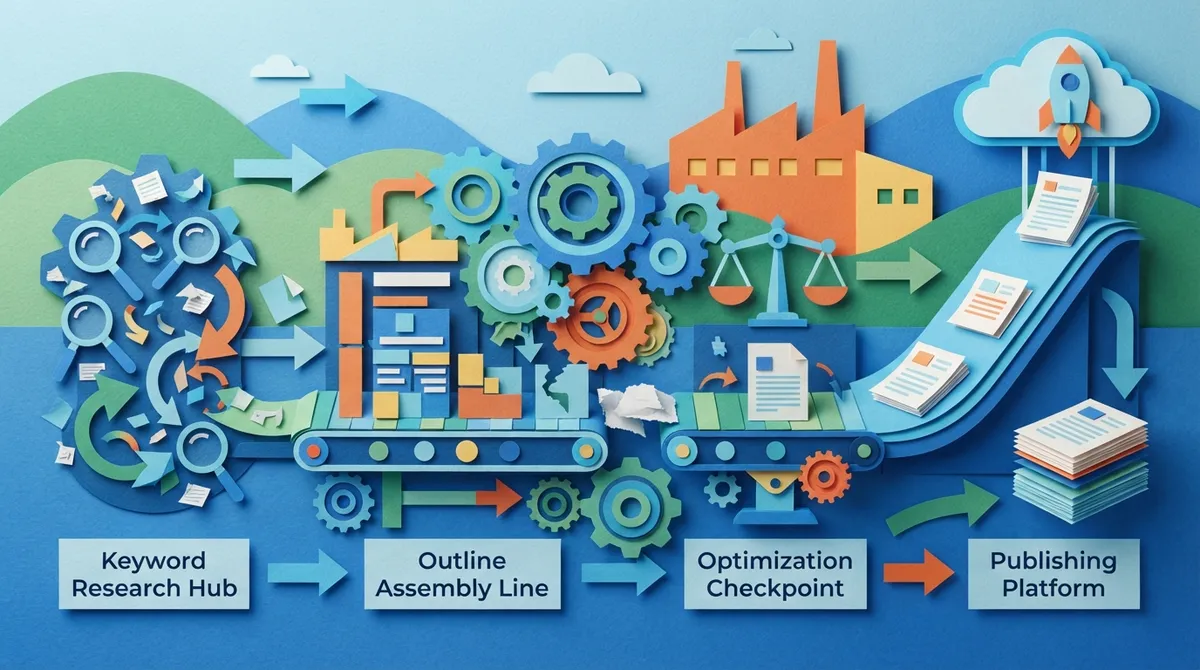
Here’s what a complete workflow looks like, step by step:
- Keyword discovery based on live search data and competition levels
- Content calendar planning so topics get scheduled, not forgotten
- Outline and draft generation using SEO best practices
- On-page optimization including headers, meta tags, and links
- Human review for accuracy, tone, and trust
- Publishing directly to your website or blog
- Performance tracking to see what’s working
- Periodic content refreshes to protect rankings over time
Skipping any of these steps creates gaps. And gaps are exactly why so many AI-written articles never show up on page one.
This is exactly the kind of system SEO Rocket’s automated workflow was built to solve. Instead of juggling five different tools, everything happens inside one connected system.
Can AI-Written Articles Actually Rank on Google?
Yes, AI-written articles can rank on Google. But there’s an important condition attached to that answer.
Google doesn’t care if a human or a machine wrote your content. What it cares about is whether the content is helpful, accurate, and trustworthy. This lines up with Google’s own Search Quality Rater Guidelines, which focus on expertise, experience, and trust signals rather than who or what typed the words.
That means the following factors matter more than the writing tool itself:
- Does the article actually answer the searcher’s question?
- Is the information accurate and up to date?
- Does it include real examples, data, or unique insight?
- Is it well-structured with clear headings and easy reading?
- Does someone review it before it goes live?
Vendors across the industry agree that human review is essential before publishing. It’s not about distrust in the technology. It’s about catching small errors, adding a personal touch, and confirming facts before readers see them.
Best Practices for Optimizing AI-Generated Content
Getting an article written is the easy part now. Getting it to actually perform takes a bit more care. Here are the practices that consistently show up across top SEO platforms.
Keep Writing Concise and Clear
Long, rambling paragraphs hurt both readers and rankings. Short sentences and simple words keep people reading longer, which search engines notice.
Add Relevant Internal and External Links
Linking to related content on your own site helps search engines understand your topic structure. It also keeps readers exploring more of your pages. Our article on internal linking strategy mistakes to avoid in 2026 covers this in more depth.
Plan Content in Topic Clusters
Instead of writing random one-off posts, group related articles together. This builds topical authority faster. Learn more in our guide on building a topic cluster strategy that boosts SEO.
Refresh Content Regularly
Semrush recommends re-running content optimization every few months to maintain visibility. This tells us something important: AI-generated content is a living asset, not a one-time task. Search rankings shift, competitors publish new content, and your article needs occasional updates to stay competitive.
Comparing Article Writing AI Approaches
Not all AI writing tools work the same way. Some are basic text generators. Others handle the full SEO workflow from research to publishing. Here’s a simple breakdown to help you see the difference.
| Feature | Basic AI Writer | SEO-Focused Automation Platform |
|---|---|---|
| Keyword research | Not included | Built-in with live data |
| Content calendar | Manual planning needed | Automated scheduling |
| Article length | Usually 500-1,500 words | 3,000+ words by default |
| Publishing | Manual copy-paste | Direct CMS publishing |
| AI search visibility | Rarely optimized | Built for AI Overviews and chat engines |
| Cost per article | Varies widely | As low as $3 per article |
The market has gotten crowded fast. Marketer Milk’s 2026 SEO automation roundup lists 13 separate tools, which shows just how many options business owners now have to sort through. That’s exactly why choosing a platform that combines everything into one system saves so much time.
How SEO Rocket Simplifies Article Writing AI for Real Businesses
SEO Rocket was built to solve the exact problems most article writing ai tools create. Instead of separate tools for keyword research, writing, optimization, and publishing, everything lives in one place.
Here’s how the setup works, step by step:
- Connect your website (WordPress, Webflow, Shopify, or Wix) in minutes
- Review automatically discovered keyword opportunities based on real search data
- Approve your content calendar for the weeks or months ahead
- Let the system generate and publish daily, long-form articles automatically
Each article comes in at 3,000+ words, built to satisfy both Google and AI search engines like ChatGPT, Perplexity, Claude, Gemini, Copilot, and Grok. That’s a major advantage since more searchers are getting answers from AI tools every day. If you want to understand this shift better, check out our post on improving your AI search visibility in 2026.
Small SEO agencies love this setup because it means scaling client work without hiring more writers. In-house marketing teams appreciate it because it frees up hours for strategy instead of drafting. And content managers overseeing large blogs finally get consistent, structured output without babysitting every post.
Why Automation Beats Manual Article Writing for Scale
If you’ve ever tried to keep up a daily blogging schedule by hand, you know how quickly it becomes exhausting. Research, outlining, writing, editing, formatting, and publishing all take real time.
Here’s what manual workflows typically cost in time and money compared to automated systems:
- Traditional agencies often charge $3,000 to $5,000 per month for ongoing content
- Freelance writers can take days to turn around a single article
- Manual keyword research alone can eat up several hours per week
- Editing and formatting for SEO adds even more time
Compare that to a fully automated platform that costs around $99 a month and produces daily articles without extra labor. The math becomes pretty clear pretty fast, especially for small business owners working with limited budgets.
Digital marketing consultants also benefit here. Offering fast, consistent content production becomes a real differentiator when pitching new clients. E-commerce SEO specialists can use the same system to generate product and category page content at scale, something that used to require entire teams.
Common Mistakes to Avoid With AI-Generated Content
Even with great tools, a few missteps can quietly sabotage your results. Watch out for these common issues:
- Publishing without any human review or fact-check
- Ignoring internal linking between related articles
- Ignoring search intent and writing generic content
- Never updating older articles as competition shifts
- Choosing keywords with zero real search demand
Avoiding these mistakes is often the real difference between content that ranks and content that just sits there. For a deeper dive, our article on blog writer AI mistakes that kill your SEO rankings is worth a read.
Getting Started With Smarter Article Writing AI
You don’t need to overhaul your entire content strategy overnight. Start small, test the workflow, and build from there. Most business owners find that once the system is running, it becomes one less thing to worry about every week.
If you’re ready to see what a fully automated approach looks like in action, you can explore real writing examples or check out simple, transparent pricing plans designed for businesses of every size.
We’ve also shared plenty of practical guidance in our blog, covering everything from keyword clustering to AI search optimization, so you can keep learning as you grow.
Final Thoughts on Article Writing AI
Article writing ai has come a long way from simple text generators. Today’s best tools plan, write, optimize, and publish content as one connected system. That shift matters because ranking on Google, and now on AI search engines too, takes more than just good writing. It takes structure, consistency, and ongoing care.
The businesses winning with content in 2026 aren’t the ones writing the most articles by hand. They’re the ones using smart automation to stay consistent without burning out their team. If you’re ready to stop guessing and start publishing content that’s built to rank, you can start for $99 a month or sign up today and see your content calendar fill itself in minutes.
FAQs
Q: What is article writing AI for SEO?
A: Article writing AI for SEO is software that does more than just generate text. It handles keyword research, outline creation, on-page optimization, and often publishing too, all built around helping your content actually rank in search results.
Q: Can AI-written articles rank on Google?
A: Yes, absolutely! Google cares about helpful, accurate, trustworthy content, not who or what typed it. AI-written articles rank just fine when they answer real questions, include human review, and follow solid SEO structure.
Q: Should AI-generated articles be edited by humans before publishing?
A: We definitely recommend it. Human review catches small errors, adds a personal touch, and confirms facts before readers see them. Most trusted platforms treat this step as essential, not optional.
Q: How often should AI-generated SEO content be updated?
A: A good rule of thumb is every few months. Search rankings shift and competitors publish new content constantly, so treating your articles as living assets keeps them fresh and visible.
Q: What’s the difference between AI article writers and general AI chatbots?
A: General chatbots are great for quick drafts, but they don’t check search volume, study competitors, or optimize for readability and structure. SEO-focused article writing AI is built specifically for ranking-oriented tasks from start to finish.