Key Takeaways
-
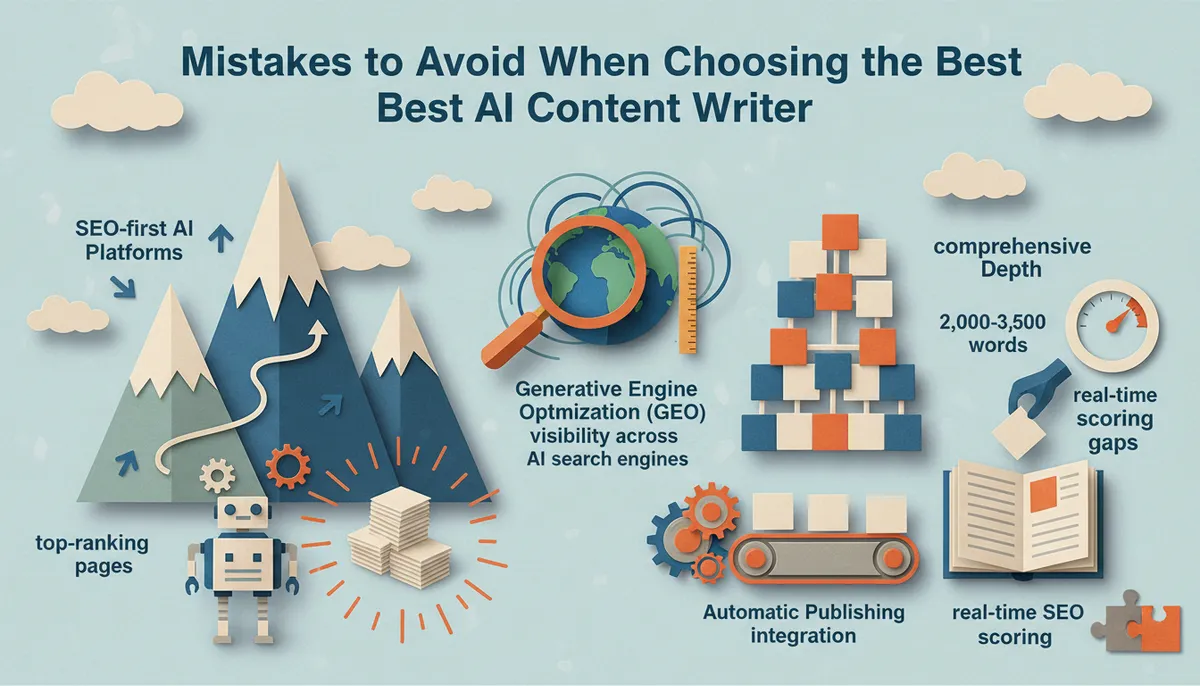
SEO-first AI platforms like Surfer AI analyze top-ranking pages and optimize content in real-time, unlike basic text generators.
-
Generative Engine Optimization (GEO) is crucial for visibility across AI search engines like ChatGPT and Claude.
-
Top-ranking content requires comprehensive depth, with most competitive articles averaging 2,000-3,500 words.
-
Automatic publishing integration saves significant time by handling metadata, formatting, and CMS transfer without manual intervention.
-
Real-time SEO scoring during content generation helps identify optimization gaps before publishing.
-
Integrated keyword research tools that provide live SEO data streamline content strategy and planning.
-
AI content writers in 2026 must balance traditional SEO with AI search optimization for maximum organic traffic.
Choosing the right AI content writer can mean the difference between consistent organic traffic and wasted budget on tools that don’t deliver. Many businesses rush into AI writing platforms without understanding what separates effective SEO content automation from basic text generation. The wrong choice leads to content that fails to rank, wastes team resources, and ultimately undermines your entire content marketing strategy.
In 2026, the best AI content writers integrate keyword research, SERP analysis, and real-time optimization to produce ranking-focused content at scale. These platforms automate workflows for topic clustering, competitor insights, and SEO scoring, enabling businesses to create high-volume, search-engine-friendly material efficiently. However, many businesses make critical mistakes that prevent them from achieving these results.
Understanding these common pitfalls helps you select an AI content writer that actually drives organic traffic growth. This guide reveals the most damaging mistakes businesses make when evaluating AI writing platforms and shows you how to avoid them. Whether you’re a small SEO agency managing multiple clients or an in-house marketing team trying to scale content production, these insights will save you time, money, and frustration.
The stakes are high. According to Search Quality Rater Guidelines, content quality directly impacts search rankings. Making the wrong AI content writer choice means publishing material that search engines ignore while your competitors capture the traffic you need.
Mistake 1: Choosing Basic Text Generators Instead of SEO-First Platforms
The biggest mistake businesses make is selecting AI writers that generate text without understanding search engine optimization. Basic text generators like standard ChatGPT produce readable content but lack the specialized features needed for ranking content. These tools don’t analyze SERP competitors, suggest keyword clusters, or optimize for search intent.
SEO-first platforms like Surfer AI, NightOwl by Nightwatch, and SEO Rocket build optimization directly into the content creation process. They analyze top-ranking pages for your target keywords, match SERP tone and structure, and provide real-time SEO scores as content generates. This fundamental difference determines whether your content ranks or disappears into search engine obscurity.
What SEO-First Features Actually Mean
SEO-first AI content writers include several critical capabilities that basic generators lack:
- Keyword clustering by search intent to organize content topics strategically
- SERP competitor analysis that reveals what actually ranks for your target keywords
- Real-time SEO scoring that identifies optimization opportunities during generation
- Semantic keyword suggestions that expand topical coverage naturally
- Internal linking recommendations that strengthen site architecture
- Meta description optimization aligned with search snippet best practices
NightOwl offers complete SEO automation including keyword clustering by intent, content generation, site audits, and competitor analysis for actionable strategies. Surfer AI specializes in SEO-first content creation with real-time SEO scores, SERP tone matching, and topic cluster scaling to align with top-ranking pages. These platforms transform content creation from writing practice into strategic search optimization.
The Cost of Generic Content Generation
Businesses using basic text generators typically face three expensive problems. First, they must manually research keywords and analyze competitors before writing, which eliminates time savings. Second, generated content requires extensive editing to incorporate SEO elements, doubling production time. Third, the final content often fails to rank because it lacks the optimization depth that search algorithms reward.
This creates a false economy. A $23 per month ChatGPT subscription seems affordable until you calculate the hours spent on manual keyword research, competitor analysis, and content optimization. SEO-first platforms cost more upfront but deliver genuinely rankable content that drives measurable traffic growth. SEO Rocket starts at $99 per month and handles keyword research, optimization, and publishing automatically, producing content at approximately three dollars per article.

Mistake 2: Ignoring AI Search Visibility and GEO Optimization
Many businesses focus exclusively on Google rankings while ignoring the rapidly growing importance of AI search engines. In 2026, tools like ChatGPT, Perplexity, Claude, Gemini, Copilot, and Grok serve millions of search queries daily. Content that doesn’t appear in AI-generated answers misses a massive traffic opportunity that competitors are capturing.
Generative Engine Optimization (GEO) requires different content strategies than traditional SEO. AI search engines prioritize structured information, clear expertise signals, and content that AI models can confidently cite as authoritative sources. The best AI content writers in 2026 optimize for both Google and AI search simultaneously, ensuring maximum visibility across all search platforms.
How AI Search Engines Evaluate Content
AI search engines analyze content differently than traditional search algorithms. They look for:
- Clear expertise signals and authoritative citations that establish credibility
- Structured information formats that AI models can easily parse and reference
- Direct answers to common questions formatted for AI comprehension
- Comprehensive topic coverage that allows confident content synthesis
- Fresh publication dates and current year references that indicate relevance
Platforms that ignore GEO optimization produce content that ranks on Google but remains invisible in ChatGPT answers, Perplexity results, and Claude responses. This represents a critical strategic gap. Businesses competing for AI search visibility gain traffic while others lose market share to more forward-thinking competitors.
Platform Comparison for AI Search Optimization
| Platform | Google SEO | AI Search (GEO) | Content Structure | Citation Optimization |
|---|---|---|---|---|
| SEO Rocket | Advanced | Advanced | Structured for AI parsing | Automatic |
| Surfer AI | Advanced | Basic | SERP-focused | Manual |
| Writesonic | Intermediate | Basic | Standard blog format | Manual |
| ChatGPT | None | None | Unstructured | None |
SEO Rocket specifically builds content for AI search visibility, structuring articles so AI models reference them as trusted sources. This dual optimization approach ensures your content appears in both traditional search results and AI-generated answers, maximizing total organic traffic potential across all search platforms.

Mistake 3: Overlooking Content Length and Depth Requirements
Short-form content rarely ranks in competitive markets. Many AI writing tools default to 500-1,500 word articles that lack the depth search engines reward. This fundamental limitation undermines your entire content strategy before you even begin publishing. Search algorithms increasingly prioritize comprehensive content that thoroughly addresses user intent.
The best AI content writers generate long-form articles exceeding 3,000 words as standard output. These platforms understand that ranking content requires comprehensive topic coverage, semantic keyword integration, and detailed explanations that shorter articles cannot provide. Businesses using short-form AI writers constantly fight an uphill ranking battle against competitors publishing in-depth resources.
Why Content Length Impacts Rankings
Search engines use content depth as a quality signal. Longer articles typically:
- Cover topics more comprehensively, satisfying search intent more completely
- Include more semantic keywords naturally, improving topical relevance signals
- Generate more internal linking opportunities that strengthen site architecture
- Earn more backlinks from sources citing detailed information
- Keep visitors engaged longer, reducing bounce rates and improving user signals
- Answer more related questions, increasing featured snippet opportunities
Semrush analysis consistently shows top-ranking pages in competitive niches average 2,000-3,500 words. Platforms producing shorter content force you to manually expand articles or accept lower rankings. This creates additional work that defeats the purpose of content automation. Tools like SEO Rocket generate 3,000+ word articles daily, providing the depth needed for competitive ranking without manual expansion.
Automation Efficiency Comparison
| Platform | Default Content Length | Manual Editing Required | Production Speed | Monthly Article Output |
|---|---|---|---|---|
| SEO Rocket | 3,000+ words | Minimal | 1 per day (automated) | 30 articles (Business) |
| Jasper | 1,500-2,000 words | Moderate | Manual workflow | Varies by usage |
| Writesonic | 1,000-1,500 words | Significant | Manual workflow | Varies by usage |
| ChatGPT | 500-800 words | Extensive | Fully manual | Limited by manual effort |
The content length gap directly impacts your ability to compete. Short-form AI writers require you to manually expand, research additional keywords, and add depth that should be automatic. This transforms supposed automation into time-consuming manual work that provides minimal efficiency gains over traditional content creation.

Mistake 4: Failing to Verify Publishing Automation Capabilities
Many businesses assume AI content writers include publishing automation, only to discover they must manually copy content to their CMS. This manual transfer process eliminates most time savings and creates workflow bottlenecks. True content automation requires direct publishing integration with your website platform, not just content generation that still demands manual work.
The best AI content writers publish directly to WordPress, Webflow, Shopify, and Wix without manual intervention. They automatically format content, add images, insert links, and optimize metadata during publication. This end-to-end automation transforms content production from a daily management task into a background process that runs independently.
What True Publishing Automation Includes
Complete publishing automation handles several critical tasks that manual processes require:
- Direct CMS integration that pushes content without copy-pasting
- Automatic image generation and embedding with proper alt text
- Internal linking insertion based on site architecture analysis
- External linking to authoritative sources that strengthen E-E-A-T signals
- Meta description and title tag optimization for search snippets
- Content scheduling that maintains consistent publishing cadence
- Business mention insertion that naturally promotes your services
Platforms lacking these capabilities force you to manually handle each element. Even a ten-minute publishing process per article consumes five hours monthly for thirty articles. This manual work compounds with editing requirements, completely undermining automation benefits. SEO Rocket handles all publishing tasks automatically, requiring under ten minutes of initial setup and zero ongoing maintenance.
The Hidden Cost of Manual Publishing
Manual publishing creates three expensive problems businesses often overlook. First, inconsistent publishing schedules harm SEO performance because search algorithms reward regular content freshness. Second, manual work introduces formatting errors, broken links, and optimization mistakes that reduce content quality. Third, team members spend valuable time on mechanical tasks instead of strategic activities that drive business growth.
Calculate the true cost of manual publishing by tracking time spent copying content, formatting text, uploading images, inserting links, and optimizing metadata. Multiply this time by your team’s hourly cost. Most businesses discover manual publishing consumes thousands of dollars monthly in labor costs that publishing automation eliminates completely.
Mistake 5: Neglecting Real-Time SEO Scoring and Fix Suggestions
Publishing content without knowing its optimization quality guarantees ranking problems. Many AI content writers generate text but provide no feedback about SEO strength. You publish hoping content ranks well, only discovering weeks later that critical optimization elements are missing. This reactive approach wastes publishing opportunities and delays traffic growth.
Advanced AI content writers include real-time SEO scoring that evaluates content during generation. These platforms identify missing keywords, suggest semantic terms, flag thin sections, and recommend structural improvements before publishing. This proactive optimization ensures every article meets ranking standards, eliminating guesswork and preventing optimization gaps.
Essential SEO Scoring Components
Effective SEO scoring systems evaluate multiple optimization factors:
- Keyword density and placement optimization across headings and body content
- Semantic keyword coverage that signals comprehensive topical expertise
- Content structure analysis that ensures logical flow and scannable formatting
- Internal linking density that strengthens site architecture and distributes authority
- Meta element optimization including title tags and descriptions
- Readability scores that ensure content matches target audience comprehension levels
- Image optimization including alt text and file naming conventions
- Content length evaluation against top-ranking competitor benchmarks
Platforms like Surfer AI provide real-time SEO scores with specific improvement suggestions. SEO Rocket includes automated fix suggestions that identify optimization opportunities and can automatically implement improvements. This guidance transforms content creation from guesswork into a systematic process that consistently produces ranking-ready articles.
SEO Scoring Platform Comparison
| Feature | SEO Rocket | Surfer AI | Semrush SEO Assistant | Frase |
|---|---|---|---|---|
| Real-Time Scoring | Yes | Yes | Yes | Yes |
| Auto-Fix Suggestions | Yes | No | No | No |
| Competitor Benchmarking | Yes | Yes | Yes | Yes |
| Automated Implementation | Yes | No | No | No |
The difference between scoring and automated fixes significantly impacts workflow efficiency. Platforms that only identify problems still require manual corrections. Systems that automatically implement optimization improvements eliminate this manual work, delivering truly hands-free content optimization that maintains consistent quality without ongoing intervention.
Mistake 6: Choosing Platforms Without Keyword Research Integration
Content strategy begins with keyword research, yet many AI writers force you to conduct this research separately. This disconnected workflow requires switching between multiple tools, manually transferring keyword data, and maintaining spreadsheets that quickly become outdated. The inefficiency undermines automation benefits and creates opportunities for strategic errors.
Integrated AI content platforms include keyword research engines with live SEO data. These systems identify keyword opportunities, evaluate search volume and competition, and organize keywords by search intent. This integration streamlines content planning, ensuring every article targets validated keywords with genuine ranking potential rather than guesses about what might work.
What Complete Keyword Integration Provides
Fully integrated keyword research delivers several strategic advantages:
- Automatic keyword discovery that identifies opportunities without manual research
- Search volume data that validates keyword potential before content creation
- Competition analysis that reveals which keywords offer realistic ranking chances
- Intent classification that matches keywords to appropriate content types
- Keyword clustering that organizes topics for strategic content planning
- Opportunity scoring that prioritizes high-value keywords automatically
NightOwl by Nightwatch offers complete keyword clustering by intent alongside content generation. SEO Rocket includes a complete keyword research engine with live SEO data that shows real opportunities based on search volume, competition, and intent. These integrated approaches eliminate the need for separate keyword tools, reducing both complexity and subscription costs.
The Efficiency Gap
Compare the workflow difference between disconnected and integrated systems. Disconnected platforms require you to use Semrush or Ahrefs for keyword research, export data to spreadsheets, manually select target keywords, and finally input them into your AI writer. This process consumes hours weekly and creates coordination challenges when managing multiple team members.
Integrated platforms present keyword opportunities within the content planning interface. You review suggested keywords, approve targets, and content generation begins automatically. The entire process takes minutes instead of hours, and the system maintains consistency without spreadsheet management or data transfer between tools.
Mistake 7: Ignoring Content Calendar and Workflow Management
Consistent publishing schedules drive SEO success, yet many AI writers provide no calendar or workflow management. You must manually track which articles are planned, written, or published using external spreadsheets or project management tools. This fragmented approach creates scheduling gaps, duplicate topics, and coordination problems that harm content quality and publishing consistency.
Advanced AI content platforms include visual content calendars that automatically organize keyword targets, schedule generation, and track publishing status. These systems transform content production from chaotic manual coordination into an organized workflow that maintains publishing consistency without constant management attention.
Essential Calendar Management Features
Effective content calendars provide several critical capabilities:
- Visual timeline display that shows planned and published content at a glance
- Automatic scheduling that maintains consistent daily publishing cadence
- Keyword organization that prevents topic duplication and ensures comprehensive coverage
- Status tracking that shows which articles are generating, ready, or published
- Team collaboration features that coordinate multiple content contributors
- Bulk planning tools that schedule weeks or months of content efficiently
SEO Rocket uses a built-in calendar where adding a keyword automatically schedules it for article generation. The system produces one article per day for Business plans or ten per day for Agency plans, maintaining consistent publishing that compounds into sustained traffic growth. This automation eliminates the need for editorial calendar spreadsheets and scheduling coordination.
Workflow Impact on Results
Publishing consistency directly impacts search rankings. Search algorithms interpret regular content freshness as a positive quality signal, while irregular publishing suggests lower site activity. Businesses using manual scheduling typically publish sporadically, missing opportunities for consistent ranking improvements. Automated calendars maintain daily publishing that search engines reward with improved visibility.
Consider the compounding effect. Publishing daily for six months produces 180 ranking opportunities versus perhaps thirty articles from irregular manual publishing. Each additional ranking article increases total organic traffic, and this growth compounds over time. The workflow automation difference between platforms directly determines whether you capture this compounding growth or miss it entirely.
Mistake 8: Selecting Tools That Require Constant Prompt Engineering
Many AI writers demand detailed prompts for every article, forcing you to become a prompt engineering expert. You spend time crafting instructions about tone, structure, keyword usage, and formatting instead of receiving optimized content automatically. This ongoing prompt requirement eliminates automation benefits and creates dependency on specialized skills your team may lack.
The best AI content writers require minimal or zero prompting. These platforms understand SEO content requirements automatically, apply proven article structures, and maintain consistent quality without detailed instructions. This true automation allows non-technical team members to manage content production effectively without prompt engineering expertise or constant oversight.
The Prompt Engineering Problem
Constant prompting creates three expensive problems. First, effective prompts require technical understanding of SEO principles, content structure, and optimization techniques that many marketers lack. Second, prompt quality varies significantly between team members, creating inconsistent content output that harms brand coherence. Third, the time spent crafting and refining prompts undermines the efficiency gains that AI writing should provide.
Calculate prompt engineering time costs by tracking how long team members spend writing prompts, testing outputs, and refining instructions. Many businesses discover this hidden work consumes several hours per article, completely eliminating the supposed time savings that attracted them to AI writing tools initially.
Automated Intelligence Versus Manual Instruction
Compare platforms based on required prompting:
| Platform | Setup Prompting | Per-Article Prompting | Optimization Knowledge Required | Team Training Needed |
|---|---|---|---|---|
| SEO Rocket | 10 minutes (one-time) | None | None | Minimal |
| Jasper | Moderate | Every article | Moderate | Significant |
| ChatGPT | None | Every article | Extensive | Extensive |
| Writesonic | Minimal | Most articles | Moderate | Moderate |
Platforms requiring constant prompting force ongoing management that prevents true automation. Systems with built-in SEO intelligence handle optimization automatically, requiring only initial setup and zero ongoing prompt engineering. This fundamental difference determines whether AI writing actually saves time or simply shifts manual work from writing to prompt creation.
Mistake 9: Overlooking Agency Scalability and Multi-Client Management
SEO agencies managing multiple clients face unique challenges that many AI content writers ignore. Platforms designed for single businesses lack the workspace separation, client management features, and volume capacity that agencies require. Attempting to scale these single-business tools across multiple clients creates organizational chaos and limits growth potential.
Agency-focused AI content platforms provide dedicated workspaces for each client, volume pricing that accommodates multiple accounts, and management dashboards that coordinate cross-client workflows. These features transform agency content production from a per-client manual process into a scalable system that grows efficiently as you add clients.
Essential Agency Management Features
Agencies require several specific platform capabilities:
- Separate workspaces that isolate each client’s content, keywords, and publishing settings
- Volume pricing that makes per-article costs economical at agency scale
- Team collaboration tools that coordinate multiple content contributors across clients
- Consolidated reporting that shows performance across all client accounts
- White-label options that present content management under agency branding
- Client portal access that allows clients to review content without full system access
SEO Rocket’s Agency plan supports ten client workspaces with 300 monthly articles at $799 per month. This structure provides the isolation agencies need while offering volume economics that make client services profitable. Platforms lacking these features force agencies to manage separate subscriptions per client, dramatically increasing costs and administrative overhead.
The Agency Growth Constraint
Platform limitations directly constrain agency growth. Consider an agency managing ten clients, each requiring thirty monthly articles. Single-business platforms at $99 monthly would cost $990 total versus $799 for an agency-specific plan. Beyond cost savings, dedicated agency platforms eliminate the administrative complexity of managing ten separate accounts, ten separate billing relationships, and ten disconnected workflows.
This scalability difference determines whether you can profitably add clients. Agencies using single-business tools hit operational complexity ceilings that prevent growth beyond a few clients. Agency platforms remove these constraints, enabling efficient scaling that increases revenue without proportional increases in management overhead or team size.
Mistake 10: Falling for Lifetime Plans That Lack Long-Term Viability
Lifetime deals sound attractive but often indicate platforms that may not sustain long-term development. AI technology evolves rapidly, and providers offering lifetime access at low prices may lack the recurring revenue needed for ongoing improvement. These platforms risk feature stagnation, technical debt, and eventual abandonment that leaves you searching for alternatives after investing time in setup and integration.
However, some legitimate lifetime plans exist from established platforms with sustainable business models. These providers offer lifetime access at premium prices that generate sufficient capital for ongoing development while building long-term customer relationships. Understanding the difference between viable lifetime plans and unsustainable deals protects you from platforms that won’t meet your needs long-term.
Evaluating Lifetime Plan Viability
Assess lifetime plans using these criteria:
- Provider track record with existing products and customer satisfaction
- Lifetime plan pricing that suggests sustainable revenue generation
- Clear development roadmap showing ongoing feature improvements
- Technical infrastructure quality that supports long-term scalability
- Customer support availability that indicates adequate staffing resources
- Transparent communication about platform limitations and capabilities
SEO Rocket offers a $1,499 lifetime plan with permanent access. This premium pricing supports ongoing development while providing significant long-term value compared to subscription costs. The platform’s regular updates visible in the Changelog demonstrate active development that validates the lifetime plan’s sustainability.
Total Cost Analysis
Compare lifetime plans against subscription costs over typical platform usage periods:
| Platform | Monthly Cost | Annual Cost | 3-Year Cost | Lifetime Option |
|---|---|---|---|---|
| SEO Rocket | $99 | $1,188 | $3,564 | $1,499 |
| Surfer AI | $79 | $948 | $2,844 | None |
| Jasper | $49+ | $588+ | $1,764+ | None |
Lifetime plans provide value after approximately fifteen months of equivalent subscription use. For businesses planning long-term content strategies, lifetime access eliminates ongoing subscription costs while guaranteeing continued platform access regardless of future pricing changes. This financial predictability supports long-term SEO planning without subscription cost uncertainty.
How to Choose the Right AI Content Writer for Your Business
Avoiding these ten mistakes requires a systematic evaluation process focused on your specific content needs. Different businesses require different platform strengths based on content volume, team size, technical capabilities, and strategic priorities. Understanding your requirements helps you identify which AI content writer features matter most for your situation.
Start by defining your content goals. Small agencies need client workspace separation and volume pricing. In-house marketing teams need workflow automation that reduces manual management. E-commerce specialists need high-volume capability for product and category content. Digital marketing consultants need reliable outputs that differentiate their services. Each scenario prioritizes different platform strengths.
Evaluation Framework
Use this systematic approach to evaluate AI content writers:
- Verify SEO-first architecture with integrated keyword research and optimization scoring
- Confirm AI search optimization capabilities for GEO alongside traditional SEO
- Test content length defaults to ensure 2,500+ word output as standard
- Validate publishing automation including CMS integration and automatic formatting
- Review workflow management features including content calendars and scheduling
- Assess automation depth to minimize ongoing prompting and manual intervention
- Calculate true costs including subscription fees, manual work time, and additional tool requirements
- Evaluate scalability for anticipated growth in content volume or client accounts
This framework reveals which platforms deliver genuine automation versus those requiring extensive manual work. Platforms that require constant prompting, manual publishing, or separate keyword research tools aren’t truly automated regardless of their marketing claims. True automation handles content production end-to-end with minimal ongoing management.
Platform Feature Requirements by Business Type
| Business Type | Critical Features | Secondary Features | Budget Range |
|---|---|---|---|
| Small Agency | Client workspaces, Volume pricing | White-label, Reporting | $500-$1,000/month |
| In-House Team | Workflow automation, Publishing | Calendar, Collaboration | $99-$300/month |
| E-commerce | High volume, Fast generation | Product integration | $99-$500/month |
| Consultant | Quality output, Easy management | Client reporting | $99-$300/month |
Match platform capabilities to your specific requirements rather than choosing based on brand recognition or marketing claims. The most popular platform isn’t necessarily the best fit for your situation. Systematic evaluation based on your actual needs ensures you select the AI content writer that delivers results for your specific circumstances.
Understanding True Content Automation Economics
Cost comparison requires looking beyond subscription prices to total operational costs including manual work, additional tools, and opportunity costs. Cheap platforms that require extensive manual intervention often cost more than expensive platforms offering true automation. Understanding these hidden costs reveals which options provide genuine value.
Calculate total content costs by tracking all time and money spent on keyword research tools, optimization platforms, manual editing, publishing work, and scheduling management. Add these hidden costs to subscription fees for accurate platform comparison. Many businesses discover their apparently affordable AI writer actually costs substantially more than premium alternatives offering complete automation.
Complete Cost Breakdown
Consider all cost components when evaluating AI content writers:
- Platform subscription fees for content generation capabilities
- Keyword research tool subscriptions if not integrated
- SEO optimization platform fees for content scoring and suggestions
- Team time costs for prompting, editing, and publishing work
- Opportunity costs from slower publishing schedules and delayed traffic growth
- Additional software subscriptions for calendar management and workflow coordination
SEO Rocket at $99 monthly includes keyword research, content generation, optimization scoring, automated publishing, and calendar management. Compare this against a $23 ChatGPT subscription plus $99 Semrush for keywords plus five hours monthly of manual work at $50 per hour. The supposedly cheaper option costs $372 total versus $99 for complete automation. Hidden costs make basic tools far more expensive than they initially appear.
Return on Investment Calculation
Measure AI content writer value by tracking organic traffic growth, ranking improvements, and lead generation increases attributable to content production. Platforms that consistently rank content justify higher costs through measurable business results. Tools that generate unranked content provide no value regardless of low subscription prices.
Track key performance metrics monthly including organic sessions, ranking keywords, featured snippet captures, and content-attributed conversions. Compare these results against total platform costs including hidden manual work expenses. This ROI calculation reveals which platforms deliver measurable business value versus those consuming budget without producing traffic growth.
Want to eliminate content production complexity while maximizing organic traffic growth? Start your SEO Rocket account today and experience true content automation that handles everything from keyword research to daily publishing. Join agencies and businesses already capturing consistent organic traffic through systematic content production that compounds growth over time.
FAQs
Q: What makes an AI content writer truly SEO-first in 2026?
A: An SEO-first AI content writer integrates keyword research, SERP analysis, and real-time optimization scoring directly into the content generation process. These platforms analyze top-ranking competitor pages, match SERP tone and structure, and provide automated suggestions to improve ranking potential before publishing. Unlike basic text generators, they understand search engine requirements and build optimization into every article automatically.
Q: How do AI search engines like ChatGPT and Perplexity evaluate content differently than Google?
A: AI search engines prioritize structured information formats that AI models can easily parse and confidently cite as authoritative sources. They look for clear expertise signals, comprehensive topic coverage, direct answers to common questions, and fresh publication dates. Content optimized for Generative Engine Optimization (GEO) appears in AI-generated answers across platforms like ChatGPT, Perplexity, Claude, and Gemini, capturing traffic that traditional SEO alone misses.
Q: Why does content length matter for SEO rankings in 2026?
A: Search engines use content depth as a quality signal because longer articles typically cover topics more comprehensively, include more semantic keywords naturally, generate more internal linking opportunities, and keep visitors engaged longer. Top-ranking pages in competitive niches consistently average 2,000-3,500 words. AI content writers producing shorter articles force manual expansion or result in lower rankings compared to competitors publishing in-depth resources.
Q: What features distinguish agency-focused AI content platforms from single-business tools?
A: Agency-focused platforms provide separate workspaces that isolate each client’s content and settings, volume pricing that makes per-article costs economical at scale, consolidated reporting across all client accounts, and team collaboration tools for managing multiple contributors. These features enable efficient scaling as agencies add clients, while single-business tools require separate subscriptions per client and lack the management capabilities agencies need for growth.
Q: How can I calculate the true cost of an AI content writer beyond the subscription price?
A: Calculate total costs by adding platform subscription fees, any separate keyword research or optimization tool subscriptions required, team time costs for manual prompting, editing, publishing, and scheduling work, plus opportunity costs from slower publishing and delayed traffic growth. Many businesses discover basic tools requiring extensive manual work cost substantially more than premium platforms offering complete automation when all hidden costs are included in the comparison.