
Key Takeaways
-
SEO and GEO are complementary strategies for digital visibility, targeting traditional search engines and AI platforms respectively.
-
Topic clusters with pillar pages and supporting articles work brilliantly for both SEO and GEO optimization.
-
Optimize content for different user intents across search and AI platforms by including comparison tables, narratives, and use cases.
-
Implement triple optimization (SEO, GEO, AEO) to maximize content visibility and achieve up to 340% ROI increases.
-
Different AI platforms like Perplexity, ChatGPT, and Google AI Overviews require nuanced content optimization strategies.
-
Focus on E-E-A-T signals (Experience, Expertise, Authoritativeness, Trustworthiness) to improve content credibility for both search and AI models.
-
Measure success through traditional SEO metrics and new GEO metrics like brand mentions and AI platform citations.
The search landscape has changed dramatically. If you’re still focusing only on traditional SEO in 2026, you’re missing half the picture. Today, your content needs to work for both Google’s algorithm and AI platforms like ChatGPT, Perplexity, and Claude. This is where understanding SEO versus GEO becomes critical for anyone using content automation.
SEO (Search Engine Optimization) has been the foundation of digital marketing for decades. It helps your content rank in traditional search results. GEO (Generative Engine Optimization) is the new frontier that optimizes your content to be cited and referenced by AI models when they generate answers. Both matter enormously in 2026, and the good news is that modern content automation tools can handle both simultaneously.
This guide will walk you through exactly how SEO and GEO differ, why you need both, and how to implement a dual-optimization strategy using automated content systems. By the end, you’ll understand how to position your brand in both traditional search results and AI-generated responses without doubling your workload.
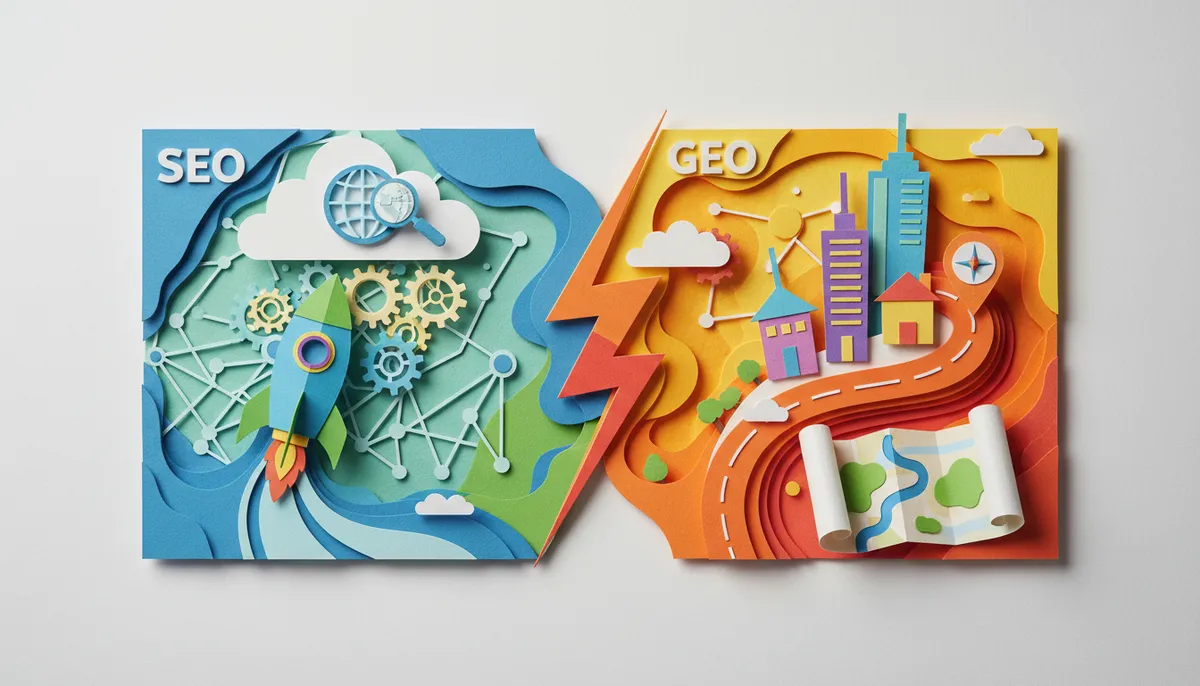
Understanding the Core Differences Between SEO and GEO
SEO and GEO share the same ultimate goal—visibility—but they achieve it through fundamentally different mechanisms. SEO targets algorithmic rankings to drive clicks from search engine results pages. When someone searches for “project management software,” SEO helps your article appear in the top 10 results. The user clicks through to read your content on your website.
GEO works differently. It optimizes your content so AI models cite or reference it when generating answers directly within platforms like ChatGPT or Perplexity. Instead of a click-through, your brand gains visibility through mentions and citations inside the AI’s response. The user never leaves the AI platform, but they’ve learned about your business through the AI’s synthesis of your content.
According to Arc Intermedia’s 2026 analysis, traditional SEO focuses on keywords, backlinks, and technical factors like page speed. GEO prioritizes semantic clarity, structured information, and authoritative signals that help AI models understand and trust your content enough to reference it.
How Search Engines Process SEO Content
Traditional search engines crawl your website, index your pages, and rank them based on hundreds of signals. These include keyword relevance, domain authority, backlink quality, user engagement metrics, mobile-friendliness, and technical performance. The goal is to match user queries with the most relevant, trustworthy pages and display them in ranked order.
SEO content typically includes:
- Strategic keyword placement in titles, headings, and body content
- Meta descriptions and title tags optimized for click-through rates
- Internal linking structures that distribute page authority
- External backlinks from authoritative domains
- Technical optimizations like fast loading speeds and clean code
- User engagement signals like time on page and bounce rate
The measurement of success is straightforward: rankings, organic traffic, and conversions from search engine visitors. SEO Rocket’s automated system handles these traditional ranking factors automatically when it generates and publishes articles daily.
How AI Models Process GEO Content
AI models like ChatGPT, Perplexity, Claude, and Google’s AI Overviews don’t just match keywords. They parse content semantically to understand meaning, context, and relationships between concepts. When a user asks a question, the AI synthesizes information from multiple sources to create a coherent, conversational answer.
GEO content needs to be structured so AI can easily extract, understand, and cite specific facts. This means your content should include:
- Clear, descriptive headings that signal topic boundaries
- Direct answers to common questions in concise formats
- Factual statements with proper context and attribution
- Structured data like lists, tables, and step-by-step instructions
- Strong E-E-A-T signals (Experience, Expertise, Authoritativeness, Trustworthiness)
- Natural language that reads conversationally without keyword stuffing
The measurement changes too. GEO success is measured by citation frequency, brand mentions in AI responses, and visibility in AI Overviews. Companies with GEO-optimized content achieve an average cost per qualified lead of just $47, compared to $128 for SEO-only content, according to the Institute for Public Relations 2025 data.
Three Strategic Approaches to SEO and GEO in Content Automation
You don’t have to choose between SEO and GEO. The smartest approach combines both in your automated content strategy. Here are three practical methods to implement dual optimization:
1. Build Topic Clusters with Dual Optimization
Topic clusters organize content around central themes with supporting articles that link back to a pillar page. This structure works brilliantly for both SEO and GEO. Search engines see clear topical authority, while AI models can easily navigate related concepts within your content ecosystem.
Start by identifying a core topic relevant to your business. Create a comprehensive pillar page that covers the topic broadly. Then generate 8-12 supporting articles that dive deep into specific subtopics. Each supporting article should link back to the pillar page and to relevant related articles.
For automation, this means scheduling a mix of content types:
- Pillar pages with comprehensive overviews (3,000+ words)
- How-to guides answering specific user questions (2,000-3,000 words)
- Comparison articles highlighting different approaches or tools (2,000-2,500 words)
- FAQ-style articles addressing common pain points (1,500-2,000 words)
SEO Rocket generates these article types automatically based on your keyword calendar, ensuring each piece includes both traditional SEO elements and GEO-friendly structures like Q&A sections and clear headings.
2. Optimize for Intent Matching Across Platforms
User intent differs between traditional search and AI queries. Someone typing “best CRM software” into Google wants a ranked list to browse. Someone asking ChatGPT “what CRM should I use for a 10-person sales team” wants a specific recommendation with reasoning.
Your automated content should address both intent types. Include comparison tables and ranked lists for traditional SEO. Also include narrative explanations, use cases, and decision frameworks that AI can reference when providing personalized recommendations.
When planning your content calendar, consider these intent-matching strategies:
- Create “best of” articles with detailed comparison tables for traditional search
- Write “how to choose” guides that AI can reference for recommendation logic
- Develop case studies and examples that demonstrate real-world applications
- Produce troubleshooting content that addresses specific problems with clear solutions
The key is giving both search engines and AI models multiple ways to match your content to user needs. Automation platforms that generate long-form content excel at this because they can naturally incorporate multiple content formats within a single article.
3. Implement Triple Optimization for Maximum ROI
The most advanced strategy combines SEO, GEO, and AEO (Answer Engine Optimization). AEO targets featured snippets and quick answer boxes in traditional search results. When used together, these three approaches create what industry researchers call “triple optimization.”
Data from Arc Intermedia shows that triple-optimization delivers 2.7 times better cost efficiency than SEO alone. Companies using all three approaches see 280-340% ROI increases. The secret is that each optimization type reinforces the others rather than competing for resources.
To implement triple optimization in your automated content:
- Structure articles with clear H2 and H3 headings that match common question phrases
- Include concise 40-50 word paragraphs that directly answer questions (perfect for featured snippets)
- Add tables comparing features, pricing, or specifications (ideal for both SEO and GEO)
- Incorporate numbered lists for steps, rankings, or sequences
- Use bullet points to break down complex concepts into scannable pieces
- Write conversationally with natural language that AI models can easily parse
Modern content automation handles these requirements automatically. When you set up automated daily publishing, the system generates articles that check all three optimization boxes without requiring manual intervention.

Platform-Specific GEO Strategies for 2026
Not all AI platforms work the same way. Understanding these differences helps you optimize automated content for maximum cross-platform visibility.
Optimizing for Perplexity Citations
Perplexity excels at providing sourced answers with direct citations. It favors content from authoritative domains with clear factual statements. To optimize for Perplexity through automation:
- Include specific statistics and data points with clear attribution
- Write definitive statements rather than hedged or speculative language
- Structure content with clear topic sentences that AI can extract
- Build domain authority through consistent, high-quality daily publishing
Perplexity tends to cite recent content more frequently than older articles, which makes daily automated publishing particularly valuable. Fresh content signals relevance and timeliness to the platform’s ranking algorithm.
Optimizing for ChatGPT and Claude Synthesis
ChatGPT and Claude synthesize information conversationally without always providing direct citations. They prioritize content that explains concepts clearly with logical flow. For these platforms, automation should focus on:
- Natural, conversational writing that sounds like expert advice
- Clear cause-and-effect relationships between concepts
- Examples and analogies that make abstract ideas concrete
- Comprehensive coverage that anticipates follow-up questions
These models reward depth and clarity over keyword density. They can identify when content is genuinely helpful versus optimized purely for ranking. This aligns perfectly with automated long-form content that prioritizes comprehensive topic coverage.
Optimizing for Google AI Overviews
Google’s AI Overviews appear at the top of search results, synthesizing information from multiple sources. They pull heavily from content that’s already indexed and ranking well in traditional search. Your GEO strategy for AI Overviews should include:
- Strong traditional SEO foundations (because Google pulls from its existing index)
- Clear, concise paragraphs that can be extracted as standalone statements
- Tables and structured data that display well in visual formats
- Content that directly answers the query in the first paragraph
Google AI Overviews favor content that balances comprehensiveness with scannability. This is where automated content with proper heading hierarchy, lists, and tables excels. The structure makes it easy for Google’s AI to extract relevant snippets while maintaining context.

Measuring Success in SEO and GEO Content
Traditional SEO metrics remain important, but GEO requires new measurement approaches. Here’s how to track both effectively when using content automation.
Traditional SEO Metrics That Still Matter
Your automated content should drive measurable improvements in these core SEO metrics:
| Metric | Target Range | Why It Matters |
|---|---|---|
| Organic Traffic Growth | 10-30% monthly increase | Indicates improving visibility in search results |
| Keyword Rankings | Top 10 for target keywords | Direct measure of SEO effectiveness |
| Domain Authority | Steady upward trend | Reflects growing site credibility |
| Backlink Acquisition | 5-20 quality links monthly | Signals external validation of content value |
| Time on Page | 3-5 minutes average | Shows content engagement and relevance |
Daily automated publishing creates compound growth in these metrics. Each new article adds ranking opportunities, attracts backlinks, and increases domain authority. Over 90-180 days, the cumulative effect becomes substantial.
New GEO Metrics to Track
GEO requires monitoring brand mentions and citations across AI platforms. While measurement tools are still evolving, focus on these indicators:
- Brand mentions in AI-generated responses when you test relevant queries
- Citation frequency in Perplexity and other source-transparent AI tools
- Visibility in Google AI Overviews for your target keywords
- Referral traffic from AI platforms (though this is often limited)
- Qualitative assessment of how accurately AI models represent your brand
To track GEO performance manually, create a list of 10-15 questions your target audience frequently asks. Test these questions monthly across ChatGPT, Perplexity, Claude, and Google. Document when and how your brand appears in responses. Look for trends in citation frequency and positioning.
Companies using GEO-optimized content see 3.8 times more AI citations when combined with SEO and AEO strategies compared to single-optimization approaches. The key is consistent, high-quality content production, which automation makes sustainable.
Common Mistakes in SEO and GEO Content Automation
Even with automated systems, certain pitfalls can undermine your results. Here are the most common mistakes and how to avoid them.
Mistake 1: Prioritizing Keywords Over Clarity
Traditional SEO emphasized keyword density, sometimes at the expense of natural writing. This approach actively hurts GEO performance because AI models prioritize semantic meaning over keyword repetition. Your automated content should read naturally first, with keywords incorporated organically.
When reviewing auto-generated content, check that sentences flow conversationally. If a keyword appears awkwardly or repetitively, AI models will recognize this and may deprioritize your content. Modern automation platforms understand this balance and generate content that satisfies both requirements.
Mistake 2: Neglecting E-E-A-T Signals
E-E-A-T (Experience, Expertise, Authoritativeness, Trustworthiness) matters enormously for both SEO and GEO. Google uses it for rankings. AI models use it to determine citation worthiness. Automated content must demonstrate these qualities through:
- Author credentials and expertise sections
- Specific examples and case studies from real experience
- Citations to authoritative external sources
- Clear, confident language that demonstrates subject mastery
- Regular updates showing content maintenance and current knowledge
The Google Search Quality Rater Guidelines provide detailed direction on E-E-A-T evaluation. Content automation should incorporate these signals systematically rather than treating them as optional enhancements.
Mistake 3: Publishing Without Strategic Distribution
Creating great content solves only half the problem. Distribution determines whether that content reaches both search engines and AI model training sets. Common distribution mistakes include:
- Publishing content without promoting it through social channels
- Failing to build internal links between related articles
- Neglecting to update and refresh older content
- Ignoring opportunities for guest posting and external mentions
Automated systems should handle internal linking automatically, but strategic promotion requires additional effort. Set aside time monthly to share top-performing content, reach out for backlinks, and update cornerstone articles with fresh information.
Mistake 4: Treating SEO and GEO as Competing Priorities
Some businesses view SEO and GEO as either-or choices. This creates unnecessary tradeoffs. The reality is that good content serves both purposes simultaneously. When you write clearly, structure information logically, and demonstrate expertise, you satisfy both traditional search algorithms and AI models.
The mistake comes from over-optimizing for one at the expense of the other. Don’t sacrifice clarity for keyword placement. Don’t abandon proven SEO tactics like meta descriptions and title tags just because they don’t directly impact GEO. The best automated content generation seamlessly incorporates both.
Implementing Automated Dual Optimization: A Step-by-Step Plan
Ready to implement SEO and GEO automation? Follow this practical roadmap to get started within 10 minutes and see results within 90 days.
Step 1: Audit Your Current Content Gaps
Before automating, understand where you stand. Run a content audit to identify:
- Topics your competitors cover that you don’t
- Questions your target audience asks that remain unanswered
- Keywords with search volume that lack dedicated articles
- Existing content that needs updating for 2026 best practices
This audit creates your automation roadmap. You’ll know exactly what content to prioritize in your publishing calendar. Most businesses discover 50-100 high-value content opportunities during this process.
Step 2: Set Up Your Automation Platform
Choose a content automation platform built for both SEO and GEO. Connect your website (WordPress, Webflow, Shopify, or Wix typically take 5-10 minutes). Configure your brand voice, target audience, and publishing preferences.
The platform should automatically discover keyword opportunities based on your niche and competitors. Review these suggestions and add high-priority keywords to your content calendar. The system will then schedule article generation, typically producing one comprehensive piece daily.
SEO Rocket completes this entire setup in under 10 minutes and begins generating SEO and GEO-optimized content immediately. Plans start at $99 monthly for 30 articles, making it more cost-effective than hiring writers or managing multiple SEO tools.
Step 3: Schedule Content with Strategic Sequencing
Don’t just fill your calendar randomly. Sequence content strategically:
- Start with foundational articles covering core topics (weeks 1-2)
- Add comparison and decision-making content (weeks 3-4)
- Layer in specific how-to guides and tutorials (weeks 5-6)
- Continue with case studies and advanced topics (weeks 7-8)
- Circle back to update and expand foundational pieces (ongoing)
This sequence builds topical authority progressively while giving each article time to gain traction before related pieces publish. Both search engines and AI models recognize this strategic depth.
Step 4: Monitor, Adjust, and Scale
Review performance monthly. Identify which topics drive the most traffic and engagement. Double down on successful themes by creating more related content. Update underperforming articles with additional detail or improved structure.
As results compound, scale your operation. If you started with 30 articles monthly, increase to 60 or 90 as traffic and conversions justify the investment. Automation makes scaling simple—you’re not hiring additional writers or creating more manual work.
Agencies can use this same process for multiple clients simultaneously. SEO Rocket’s Agency plan supports 10 client workspaces and 300 monthly articles, making it possible to offer comprehensive content services at scale.
Why SEO Rocket Excels at Dual SEO and GEO Optimization
Most content tools focus exclusively on traditional SEO or require extensive manual work to implement GEO strategies. SEO Rocket was built specifically for 2026’s dual-optimization reality. Here’s what makes it uniquely effective:
First, every article SEO Rocket generates includes both traditional ranking factors and GEO-friendly structures automatically. You don’t need separate workflows or tools. The system produces 3,000+ word articles with proper heading hierarchy, tables, lists, internal links, external citations, and conversational language that AI models readily parse and cite.
Second, SEO Rocket optimizes for all major AI platforms simultaneously. Your content works for Google AI Overviews, ChatGPT, Perplexity, Claude, Gemini, Copilot, and Grok. You’re not choosing platforms or creating separate content versions. One article serves all channels.
Third, the automation is genuinely comprehensive. SEO Rocket handles keyword research, article generation, SEO optimization, image creation, internal linking, metadata, and publishing. You spend 10 minutes on setup and then simply review articles before they publish. There’s no daily maintenance or content management overhead.
Fourth, daily publishing creates the consistency both SEO and GEO require. Search engines reward regular content updates. AI models increasingly favor recent, actively maintained sources. SEO Rocket’s daily article generation ensures your site continuously grows in authority and visibility across all platforms.
Finally, the cost structure makes dual optimization accessible. Traditional SEO agencies charge $3,000-5,000 monthly for content services. Hiring writers costs $100-300 per article. SEO Rocket delivers comprehensive automation for $99 monthly, working out to roughly $3 per article. This makes it possible to maintain the volume both SEO and GEO demand without budget strain.
Real-World Results from Combined SEO and GEO Strategies
Theory matters less than results. Here’s what businesses actually achieve when they implement dual SEO and GEO optimization through automation:
Companies using triple-optimization strategies (SEO + GEO + AEO) reduce their cost per qualified lead by 2.7 times compared to SEO-only approaches. The average cost per lead drops from $128 to $47. This improvement comes from increased visibility across multiple discovery channels rather than depending solely on traditional search rankings.
Organizations that publish daily SEO and GEO-optimized content see 10-30% monthly traffic growth sustained over 6-12 months. The compound effect of consistent publishing creates exponential rather than linear growth. Each new article attracts its own traffic while strengthening the authority of existing content.
Businesses report 3.8 times more AI citations when they optimize for GEO alongside traditional SEO. This translates to brand mentions in ChatGPT responses, Perplexity citations, and Google AI Overview appearances. These mentions build awareness with audiences who might never click through to your website directly but still become familiar with your brand.
Agencies using automated dual optimization serve more clients with smaller teams. Instead of 3-5 clients per content manager, agencies handle 8-12 clients. The efficiency comes from automation handling the heavy lifting while human experts focus on strategy and client relationships.
The Future of SEO and GEO: What’s Coming in 2026 and Beyond
The split between SEO and GEO will continue evolving. Understanding likely developments helps you future-proof your content strategy.
AI-First Search Behavior Will Dominate
Users increasingly ask questions directly to AI assistants rather than searching traditional engines. ChatGPT, Perplexity, and Claude are becoming primary research tools for many demographics. This shift means GEO optimization grows more critical monthly.
However, traditional search won’t disappear. Google still processes billions of queries daily. The winning strategy combines both approaches, ensuring visibility regardless of how users search. Automation makes this dual presence sustainable.
Source Attribution Will Become Standard
Early AI models often synthesized information without clear attribution. Newer versions increasingly cite sources, similar to Perplexity’s model. This shift makes GEO more measurable and valuable. Your content can drive brand awareness through visible citations rather than invisible training data influence.
Expect AI platforms to develop more sophisticated source credibility algorithms. Content from authoritative domains with strong E-E-A-T signals will dominate citations. This rewards exactly the type of comprehensive, well-structured content that automated systems generate.
Integration Between Traditional and AI Search Will Increase
Google AI Overviews represent the beginning of traditional and AI search convergence. Expect more hybrid features that blend algorithmic ranking with AI synthesis. Content that works for both systems will maintain visibility across all formats.
This convergence actually simplifies optimization. Rather than separate strategies, you’ll increasingly need one approach that satisfies both traditional algorithms and AI models. Modern content automation already operates this way, making businesses using these systems well-positioned for whatever changes emerge.
The businesses that win in this evolving landscape share one characteristic: they publish consistently high-quality content optimized for multiple discovery channels. Automation is what makes this consistency possible without unsustainable resource investment. Whether you’re a small business owner, agency, or in-house marketer, the time to implement dual SEO and GEO optimization is now, while your competitors still focus on only one approach.
Taking Action: Your Next Steps
Understanding SEO versus GEO matters only if you implement what you’ve learned. Here’s exactly what to do next based on your situation.
If you’re currently doing SEO manually or using basic content tools, recognize that you’re competing with businesses using full automation. The efficiency gap makes it nearly impossible to maintain pace. Your competitors publish daily while you struggle to produce 2-3 articles monthly. Automation isn’t optional anymore—it’s table stakes for competitive visibility.
If you’re an agency managing multiple clients, consider how automation multiplies your capacity. Instead of limiting client count based on team size, you can serve more businesses without proportionally increasing costs. The freed time lets you focus on strategy, relationships, and results rather than production logistics.
If you’re skeptical about AI-generated content quality, test it directly. The technology has advanced dramatically since early versions. Modern systems produce comprehensive, accurate, engaging content that ranks well and drives conversions. The proof is in results, not assumptions.
The smartest approach is starting today with a system that handles both SEO and GEO automatically. Connect your website, review automatically discovered keywords, approve your content calendar, and let automation handle the daily heavy lifting. You’ll see compound growth over 90-180 days as your content library expands and authority builds.
SEO and GEO aren’t competing strategies—they’re complementary approaches to the same goal: visibility when your audience searches for solutions you provide. The businesses that master both through efficient automation will dominate their niches while competitors struggle with outdated single-channel strategies. Start your free 3-day trial today and experience how seamless dual optimization can be when the right system handles the complexity automatically.
FAQs
Q: What is the main difference between SEO and GEO in 2026?
A: SEO optimizes content to rank in traditional search engine results pages, driving click-through traffic to your website. GEO optimizes content so AI platforms like ChatGPT, Perplexity, and Claude cite or reference it when generating answers, building brand awareness through mentions rather than direct clicks. Both serve visibility goals but through different mechanisms—SEO targets algorithmic rankings, while GEO targets AI synthesis and citation.
Q: Do I need to choose between SEO and GEO for my content strategy?
A: No, the best approach combines both. Content optimized for SEO typically performs well for GEO too when it includes clear structure, comprehensive information, and strong authority signals. Modern content automation platforms generate articles that satisfy both traditional search algorithms and AI models simultaneously, eliminating the need to choose or create separate content versions.
Q: How does GEO impact the ROI of automated content?
A: GEO significantly improves content ROI. Companies using GEO optimization alongside SEO achieve an average cost per qualified lead of $47 versus $128 for SEO-only content. Triple optimization combining SEO, GEO, and AEO delivers 2.7 times better cost efficiency and 280-340% ROI increases. This happens because GEO expands your visibility beyond traditional search into AI platforms where audiences increasingly discover brands.
Q: What makes content GEO-friendly for AI platforms?
A: GEO-friendly content includes clear headings that organize information logically, direct answers to common questions, factual statements with proper context, structured formats like lists and tables, strong E-E-A-T signals showing expertise and authority, and natural conversational language. AI models prioritize content they can easily parse, extract, and cite when synthesizing answers to user questions.
Q: Can automated content tools handle both SEO and GEO optimization?
A: Yes, advanced automation platforms like SEO Rocket are specifically built to optimize for both simultaneously. They generate long-form articles with traditional SEO elements including keywords, meta descriptions, and internal links, plus GEO-friendly structures like Q&A sections, tables, semantic clarity, and conversational writing. This dual optimization happens automatically without requiring separate workflows or manual adjustments.