Key Takeaways
-
Create genuinely useful content like original research, free tools, or detailed how-to guides—this is the single best way to earn backlinks naturally and consistently outperforms shortcuts.
-
Use automation to support research and drafting, but always have a human review content for accuracy and add original insights before publishing to comply with Google's guidelines.
-
Focus on link quality over quantity by evaluating if the linking site is relevant, has real traffic, places links naturally in context, and uses natural anchor text.
-
Monitor your link profile monthly to identify dead links, new backlinks, and suspicious patterns, since 66.5% of links eventually become dead over time.
-
Write personalized, human outreach emails that mention specific details about the site's content and clearly explain value to their readers, while automating only prospecting research and email tracking.
-
Integrate internal linking strategy into your content system by connecting related articles, prioritizing important pages, and using varied anchor text to help search engines understand site structure.
Let’s be honest. Backlinks can feel confusing. One day someone tells you to buy links. The next day you read that Google will punish you for it. It’s a lot to sort through, and you deserve a simple answer.
Here’s the good news: a solid backlinks SEO strategy isn’t complicated once you understand the basics. It comes down to creating content worth linking to, reaching out the right way, and using smart tools to save time. This guide walks you through exactly how to do that, whether you’re running a small agency, managing a big website, or just trying to get your business noticed online.
We’ll cover what actually works in 2026, what to avoid, and how tools like content automation can help you build links faster without breaking Google’s rules. Grab a coffee, and let’s get into it.

What Is a Backlinks SEO Strategy, Really?
A backlink is simply a link from another website pointing to your page. Think of it like a vote of confidence. When a trusted site links to you, search engines take notice.
A backlinks SEO strategy is your plan for earning these links in a natural, sustainable way. It’s not about grabbing as many links as possible. It’s about earning links from sites that actually matter in your industry.
Google has been very clear about this. According to Google’s spam policies, link spam includes buying links, joining excessive link exchanges, or using automated systems purely to create links. The goal isn’t to trick search engines. It’s to earn trust the honest way.
Why Backlinks Still Matter in 2026
Some marketers wonder if backlinks are still worth the effort. The data says yes. Ahrefs research shows a clear pattern: pages with more referring websites tend to get more search traffic. That’s not proof backlinks cause all the traffic, but the connection is hard to ignore.
Even more interesting, Ahrefs found that top-ranking pages gain new referring domains at a rate of roughly 5% to 14.5% per month. That tells us something important. Ranking well and earning links often go hand in hand, feeding into each other over time.
The Building Blocks of a Strong Backlink Strategy
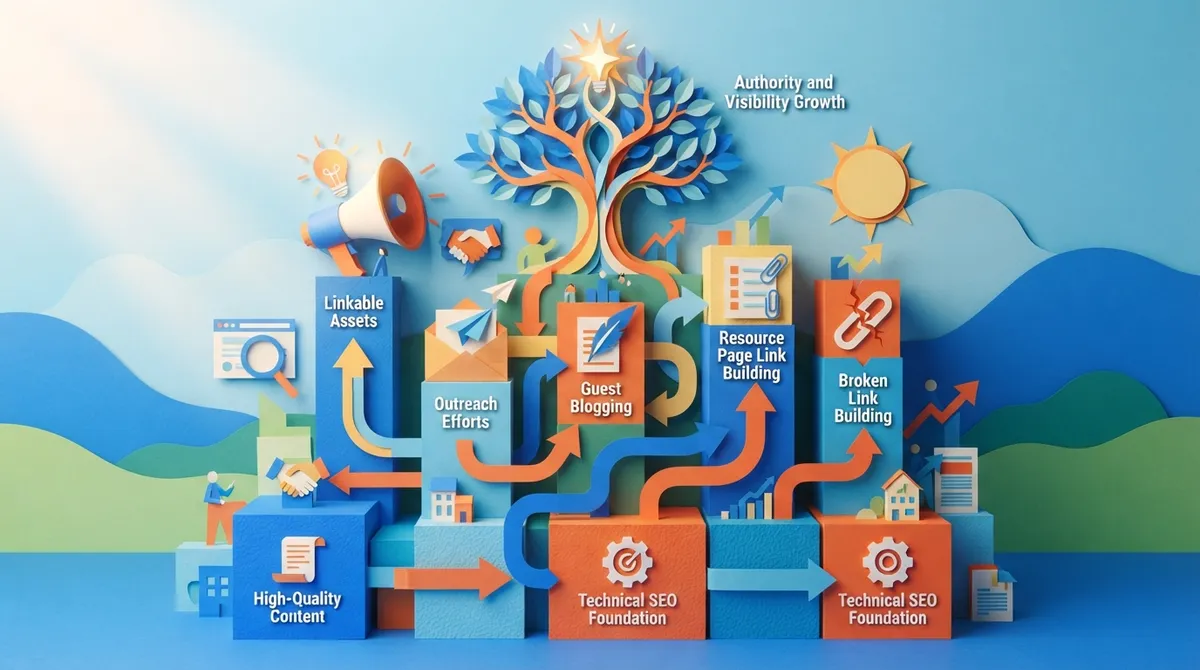
Before you send a single outreach email, you need a foundation. Here are the core pieces that make everything else work.
- Content that people actually want to reference, like original research or unique data
- A clear understanding of who your ideal linking sites are
- An internal linking system that connects your best pages together
- A process for tracking new and lost links over time
- A commitment to quality over quantity, every single time
If you skip the foundation and jump straight to outreach, you’ll waste time chasing links nobody wants to give you. Start with something worth linking to first.
Content That Earns Links Naturally
The single best way to get backlinks is to create something genuinely useful. This is called digital PR or content-led link building, and it consistently outperforms shortcuts.
Here’s what tends to attract links in the SEO content automation space:
- Original studies or surveys about content marketing trends
- Free tools or calculators, like an ROI calculator for content spend
- Detailed how-to guides that solve a specific problem completely
- Expert commentary or predictions about industry changes
- Comparison content that helps people make decisions
If you’re not sure where to start, check out our guide on SEO content writing for 2026 for ideas on creating content people want to share and cite.
Can AI-Generated Content Help You Earn Backlinks?
This is one of the most common questions we hear. The short answer is yes, but with a big condition attached.
Google’s guidance is clear on this point. Using AI to create content is fine. Using AI to mass-produce low-value content just to game rankings is not. Google’s 2024 update on scaled content abuse says this applies no matter who or what creates the content, human or machine.
So how do you use automation the right way? Follow these steps:
- Use automation to speed up research and first drafts, not replace human judgment
- Always have a real person review content for accuracy before publishing
- Add original insights, data, or examples that AI alone can’t generate
- Keep clear authorship and editorial standards across your site
- Focus on helping readers first, and let rankings follow naturally
This is exactly the philosophy behind how SEO Rocket works. It handles the heavy lifting of research, drafting, and optimization, but the goal is always publishing content that’s genuinely useful. You can see how the process works on our how it works page.
How to Find and Reach Out to Link Prospects
Once you have great content, you need people to find it. This is where outreach comes in. But there’s a right way and a wrong way to do this at scale.
Safe Ways to Automate Prospecting
Automation can genuinely help here, as long as it supports real relationships instead of replacing them. Here’s what’s safe to automate:
- Finding websites in your niche that publish relevant content
- Identifying broken links you could offer to replace with your resource
- Personalizing the first draft of an outreach email using research data
- Tracking which sites you’ve contacted and their response status
- Reporting on which outreach campaigns are actually working
What you should never automate is the actual sending of hundreds of identical emails or paying for placements disguised as editorial mentions. That crosses into link spam territory fast.
Writing Outreach That Actually Gets Replies
Good outreach feels human because it is human, even when a tool helped you get started. Here’s a simple process:
- Research the site and mention something specific about their content
- Explain clearly why your resource adds value to their readers
- Keep the email short. Nobody wants to read a novel from a stranger
- Make it easy to say yes by including the exact link and suggested placement
- Follow up once, politely, and then move on if there’s no response
Building a repeatable content and outreach system takes planning. Our article on building a topic cluster strategy shows how organizing content around themes creates more natural linking opportunities.
Understanding Link Types and Attributes
Not all links are treated the same way by Google. Knowing the difference helps you stay compliant and build a cleaner link profile.
| Link Type | When It’s Used | Recommended Attribute |
|---|---|---|
| Editorial | Earned naturally through great content | None needed (standard follow link) |
| Sponsored | Paid placements, partnerships, ads | rel=”sponsored” |
| User-generated | Comments, forum posts, reviews | rel=”ugc” |
| Nofollow | Untrusted or unverified sources | rel=”nofollow” |
Ahrefs data shows that 10.6% of backlinks to top sites use the nofollow attribute. That’s a normal part of a healthy link profile, not something to fear. What matters is being transparent about paid or sponsored relationships.
How to Judge If a Backlink Is Actually Good
Not every link helps you. Some can even hurt you if they look spammy or unnatural. Here’s a simple checklist for evaluating link quality:
- Is the linking site relevant to your industry or topic?
- Does the site have real traffic and credible content?
- Is the link placed naturally within the article’s context?
- Does the anchor text look natural, not stuffed with exact keywords?
- Would a human editor have approved this link placement?
If you can answer yes to most of these, you’re likely looking at a quality link. If something feels off, trust that instinct.
Don’t Forget About Internal Links
While everyone focuses on external backlinks, internal linking deserves just as much attention. It helps search engines understand your site structure and passes authority between your pages.
A good internal linking system should:
- Connect related articles and pages with contextual links
- Prioritize your most important pages by linking to them often
- Avoid orphan pages that have no links pointing to them
- Use varied, natural anchor text instead of the same keyword every time
For more on this, check out our guide covering internal linking strategy mistakes to avoid. Getting this right is often easier to control than external links, and it still moves the needle.
Monitoring and Maintaining Your Link Profile
Building links is only half the job. You also need to keep an eye on what’s happening to the links you already have.
Here’s a surprising stat: Ahrefs found that 66.5% of links pointing to sites in their nine-year dataset were dead. That’s a huge number. It means link rot is real, and ignoring it means losing value you already earned.
Here’s a simple monthly monitoring routine:
- Check for new backlinks pointing to your site
- Identify any links that have gone dead or been removed
- Reach out to reclaim broken or lost links when possible
- Watch for suspicious link patterns that could signal a problem
- Update old content that’s still attracting links to keep it fresh
When Should You Disavow Links?
The disavow tool is not something most sites need to touch. Google recommends using it only when you have a large volume of spammy or artificial links and a real risk of manual action. For most businesses doing honest link building, this tool will sit unused, and that’s a good thing.
Building Link Building Into Your Content Workflow
The most effective agencies and marketing teams don’t treat link building as a separate task. They bake it right into their content planning from day one.
Here’s what a smart content brief should include:
- Who the target audience is and what they care about
- What unique data or evidence the piece will offer
- Which existing pages it should link to internally
- Where the content will be promoted after publishing
- A realistic list of sites worth reaching out to
This is exactly where a platform like SEO Rocket shines. It handles keyword research, content planning, and daily publishing automatically, so your team can focus energy on outreach and relationship building instead of managing spreadsheets. You can explore the full feature set to see how it fits into your workflow.
Common Mistakes to Avoid
Let’s cover a few pitfalls that trip up even experienced marketers:
- Buying links that promise to pass ranking authority, which violates Google’s policies
- Joining excessive reciprocal link exchanges purely to inflate numbers
- Using software to auto-generate hundreds of guest post links
- Publishing thin, AI-written content with no human review, just to attract links
- Ignoring relevance and going after any link regardless of topic fit
Interestingly, Ahrefs found that 73.6% of domains have some reciprocal links, and 43.7% of top-ranking pages show at least a few. So reciprocal linking itself isn’t inherently bad. The problem is when it becomes excessive or purely transactional.
Putting It All Together
A backlinks SEO strategy that actually works comes down to a few honest truths. Create content worth linking to. Reach out like a human, not a robot. Use automation to save time, not to cut corners. And always keep an eye on your existing links so nothing valuable slips away.
If you want to see real examples of the kind of content that earns links naturally, browse our writing examples to get inspired. And if you’re curious how automation and quality can coexist, our team has thoughts worth reading over on the SEO Rocket blog.
For teams managing multiple clients, this approach scales beautifully. Small SEO agencies can produce consistent, link-worthy content across many client sites without hiring a bigger team. In-house marketers can finally keep up with content demands without burning out. And content managers overseeing large sites get a repeatable system instead of constant firefighting.
Your Next Step
Building backlinks the right way takes patience, but it doesn’t have to take forever. With the right content foundation and a little smart automation, you can build a link profile that keeps growing month after month.
Ready to put your content and link building on autopilot? You can start for $99/month and let SEO Rocket handle keyword research, content creation, and publishing while you focus on outreach and relationships. Or, if you’re ready to dive in today, go ahead and sign up to see your first content calendar in minutes.
Quality backlinks are earned, not bought. Build content people love, and the links will follow. For more guidance on how Google evaluates content quality, take a look at the official Search Quality Rater Guidelines, which offer helpful insight into what separates trustworthy content from the rest.
FAQs
Q: What is a backlink SEO strategy?
A: It’s your game plan for earning links from other websites in a natural, honest way. Instead of chasing as many links as possible, you focus on creating content worth linking to and building real relationships with relevant sites.
Q: How can AI-generated content help earn backlinks without violating Google’s spam policies?
A: AI can speed up research and drafting, but a real person should always review the final piece for accuracy and add original insights. Google is fine with automation as long as the goal is helpful content, not mass-produced pages meant to trick rankings.
Q: How many backlinks does a new website need to rank?
A: There’s no magic number here, so don’t stress about hitting a specific count. Focus on earning a handful of relevant, high-quality links first, and let your link profile grow naturally as your content gets noticed.
Q: Should I buy backlinks or use automated link-building software?
A: We’d recommend against it. Buying links that pass ranking authority breaks Google’s rules and can put your whole site at risk. It’s much safer, and honestly more rewarding, to earn links through great content and genuine outreach.
Q: When should a website use Google’s disavow tool?
A: Only in pretty specific situations, like when you have a large volume of spammy links and a real risk of a manual penalty. Most businesses doing honest link building will never need to touch this tool, which is a good sign you’re on the right track.