
Key Takeaways
-
Content gap analysis is the most valuable skill: identify keywords competitors rank for that you don't, then prioritize by search volume and business relevance to build your content calendar efficiently.
-
Your SEO competitors differ from business competitors—they include blogs, review sites, marketplaces, and agencies ranking for your target keywords, so use tools like Semrush and Ahrefs to discover hidden rivals by analyzing keyword overlap.
-
Establish a monitoring rhythm of weekly rank checks, monthly content gap reports, and quarterly backlink audits to stay ahead of competitor moves without overwhelming your team.
-
Pair competitor research with content automation to turn keyword findings into published articles daily; manually researching and writing content is inefficient when tools can handle the execution automatically.
-
Avoid chasing every backlink your competitors have—verify linking sites are relevant, trustworthy, and low-spam risk before outreach, as quality backlinks always outweigh quantity for SEO performance.
-
Treat third-party traffic estimates as directional guides rather than exact numbers, and focus on writing original, more useful content than competitors instead of copying their content structure or topics.
Ever peek at a competitor’s blog and wonder, “How are they ranking for that?” You’re not alone. Every marketer, agency owner, and small business owner has stared at a competing website and felt that mix of curiosity and mild panic. The good news? You don’t need to guess anymore. Competitor analysis tools take the mystery out of the equation and hand you a roadmap instead.
In this article, we’re going to walk through what these tools actually do, which ones are worth your time, and how you can turn competitor data into content that ranks. Whether you run a scrappy small SEO agency, manage content for a mid-sized company, or handle a giant e-commerce catalog, this guide is built for you. Grab a coffee, and let’s get into it together.

What Are Competitor Analysis Tools, Really?
Competitor analysis tools are platforms that study other websites and tell you what’s working for them. They dig into keywords, backlinks, top pages, and even paid ads. Some newer tools also track how often a competitor shows up in AI-generated answers on platforms like ChatGPT or Google’s AI Overviews.
Think of them as a friendly spy who reports back on what’s driving traffic to other sites in your space. Instead of guessing which topics to write about, you get real data. This is especially useful before you start scaling up content with any kind of automation, since you want your automated content to target the right gaps from day one.
Why This Matters for Content Automation
If you’re publishing content daily or weekly, you can’t afford to waste articles on topics nobody searches for. Competitor analysis tools help you avoid that trap. They show you exactly which keywords are pulling in visitors for other sites, so your content calendar stays focused on real opportunities instead of guesswork.
This is also why tools like SEO Rocket’s built-in features pair so well with competitor research. Once you know what to target, automation handles the writing and publishing so you’re not stuck doing both jobs manually.
The Most Important Workflow: Content Gap Analysis
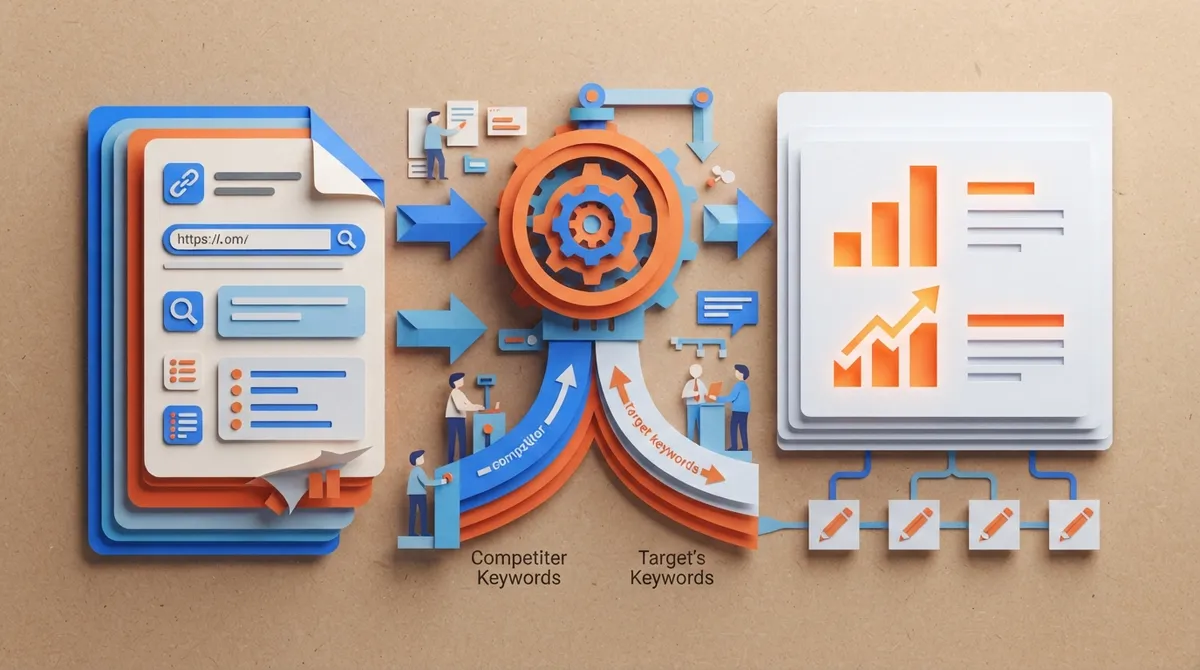
If you only learn one skill from this article, make it this one. Content-gap analysis compares your website to a competitor’s website. It shows you keywords they rank for that you don’t. That’s a goldmine of content ideas sitting right there, waiting to be used.
Here’s how the process usually works, step by step:
- Pick two to five competitors who rank for topics similar to yours.
- Run a gap report comparing your domain against theirs.
- Filter for keywords with decent search volume and reasonable competition.
- Sort the list by relevance to your business or niche.
- Turn the strongest opportunities into a content brief or calendar entry.
Popular platforms handle this differently. Ahrefs’ Content Gap tool lets you compare your site against up to 10 competitor websites or URLs at once. Semrush takes a slightly different approach, letting you compare against up to five competitors in both its Keyword Gap and Backlink Gap tools. Neither number is better or worse — it just depends on how many competitors you want to study at one time.
Filtering Options Matter Too
Ahrefs also lets you filter results based on how many competitors rank for a keyword. You can look for keywords that any competitor ranks for, keywords that a certain number of competitors rank for, or keywords that all of them rank for. That last filter is especially useful because it usually points to topics that are proven winners across your entire niche.
Who Are Your Real SEO Competitors?
Here’s something that surprises a lot of people: your SEO competitors are not always the same as your business competitors. A local bakery might compete with another bakery for customers, but in search results, it might be competing with food blogs, recipe websites, and even grocery store chains.
Tools like Semrush and Ahrefs can help you discover these hidden competitors by analyzing keyword overlap. This means the tool looks at who else ranks for the same terms you care about, regardless of whether they sell the same product or service.
Some examples of unexpected SEO competitors include:
- Industry publishers and news sites covering your niche
- Comparison and review websites
- Online marketplaces selling similar products
- Marketing agencies that publish educational content
- Informational blogs answering the same customer questions
Once you identify these players, you can study their content strategy and figure out where the gaps are. If you want a deeper dive into finding these hidden rivals, our guide on competitor research strategy breaks this down further.
Backlink Gap Analysis: Finding Link Opportunities
Backlinks still matter for SEO, and competitor tools make finding them much easier. Backlink-gap analysis shows you websites that link to your competitors but not to you. These sites become a starting list for outreach and relationship building.
But here’s an important warning: don’t chase every link just because a competitor has it. Automated content workflows should always check three things before pursuing a link opportunity:
- Is the linking site actually relevant to your topic?
- Does the site look trustworthy and well-maintained?
- Is there a real risk of spam or low-quality signals?
Chasing links blindly can hurt more than it helps. Quality always beats quantity when it comes to backlinks. For more on avoiding shortcuts that backfire, check out our post on link building mistakes killing your SEO.
Comparing the Leading Competitor Analysis Tools
There’s no shortage of options out there. Each tool has its own strengths, and picking the right one depends on your budget, your data needs, and how you plan to use the findings. Here’s a breakdown of the major categories.
| Tool Category | Example Platforms | Best For |
|---|---|---|
| All-in-one SEO suites | Semrush, Ahrefs | Deep keyword, backlink, and traffic data |
| PPC-focused platforms | SpyFu | Studying competitor ad spend and paid keywords |
| Traffic intelligence | Similarweb | Estimating overall site traffic and channels |
| Content performance | BuzzSumo | Finding top-shared and top-performing content |
| Budget-friendly suites | SE Ranking, Moz, Serpstat, Mangools | Smaller teams needing core features at lower cost |
According to a 2026 comparison of these platforms, Ahrefs typically starts around $129 per month and Semrush around $139.95 per month, though pricing shifts based on plan type, billing cycle, and promotions. Always double-check current pricing before committing, since these numbers change often.
What Metrics Should You Track?
Most competitor tools report on a similar set of metrics, even if the interface looks different. Here’s what to keep an eye on:
- Share of voice across target keywords
- Keyword overlap between your site and competitors
- Content gaps and missing topics
- Backlink gaps and referring domain opportunities
- Estimated ad spend for paid competitors
- Traffic sources like organic, paid, and social
- Content publishing velocity
- Conversion benchmarks where available
One quick note: traffic estimates from third-party tools are directional, not exact. Treat them as helpful guides rather than precise numbers. Your own analytics will always be more accurate for your actual site performance.
Turning Competitor Data Into a Content Plan
Data is only useful if you act on it. This is where a lot of teams get stuck. They pull reports, find dozens of keyword opportunities, and then… nothing happens. The spreadsheet sits there collecting digital dust.
Here’s a simple sequence to avoid that trap:
- Export your content gap and keyword gap reports.
- Group similar keywords into topic clusters.
- Prioritize by search volume, competition, and business relevance.
- Assign each topic a content format based on what’s ranking (guide, listicle, comparison, product page).
- Add approved keywords to your content calendar.
- Let automation handle writing, optimizing, and publishing daily.
This is exactly the kind of workflow SEO Rocket was built to support. Once you’ve identified your target keywords through competitor research, you can drop them straight into the platform’s calendar. From there, SEO Rocket schedules and generates a full, optimized article automatically. No copy-pasting, no manual writing marathons. You can learn more about the process on our how it works page.
Avoid Copying, Focus on Gaps
One mistake we see often: teams copy competitor content instead of studying the gap. Copying rarely works and can actually hurt your rankings. Search engines reward original insight, better structure, and stronger answers to user questions. Use competitor data to find the topic, then write something more useful than what’s already out there.
If you’re curious how AI-assisted writing fits into this without sacrificing originality, our article on writing AI for SEO covers that balance well.
How Often Should You Monitor Competitors?
Competitor analysis isn’t a one-time task. Search results shift constantly, and your rivals are publishing new content too. Here’s a simple monitoring rhythm that works for most teams:
- Weekly: Check ranking changes for your top target keywords
- Monthly: Run a fresh content gap report to catch new opportunities
- Quarterly: Review backlink gaps and update your outreach list
- Twice a year: Reassess who your true SEO competitors are, since this can shift over time
Small SEO agencies juggling multiple clients might want to automate parts of this monitoring, especially rank tracking, so the team can focus on strategy instead of manual checks. For agencies scaling content production across several client sites, our guide on managing multiple client blogs automatically is worth a read.
Bringing It All Together With Automation
Competitor analysis gives you the “what to write.” Automation gives you the “how to publish it consistently.” Combining both is where the real magic happens. Instead of spending hours each week researching keywords and then more hours writing articles, you can compress that entire process into a repeatable system.
SEO Rocket was designed with this exact workflow in mind. It includes a built-in keyword research engine with live SEO data, so you can spot real opportunities based on search volume, competition, and intent. Add a keyword to the calendar, and the platform automatically turns it into a complete, SEO-optimized article. One article gets generated per day on the Business plan, following SEO best practices for consistent publishing.
For teams that want to see real examples of what this looks like in practice, our writing examples page shows finished articles produced through this exact system. And if you’re comparing your current process against a fully automated one, our breakdown of manual SEO versus automated SEO lays out the tradeoffs clearly.
Interestingly, even businesses outside the digital marketing world benefit from staying visible online. A local service business like All Trusted Lawn Care still needs strong search visibility to compete with other providers in their area, which shows just how universal this competitive research process really is.
Common Mistakes to Avoid
Before you dive into your own competitor research, keep these pitfalls in mind. They trip up beginners and experienced marketers alike.
- Treating third-party traffic numbers as exact instead of directional
- Copying competitor content word-for-word instead of improving on it
- Chasing every backlink opportunity without checking relevance
- Ignoring content format when a competitor’s list post outranks your long guide
- Forgetting to recheck your competitor list every few months
Avoiding these mistakes keeps your content strategy grounded in real strategy instead of guesswork. Google’s own Search Quality Rater Guidelines emphasize originality and usefulness, which reinforces why copying competitors rarely pays off long term.
Wrapping Up Your Competitor Research Strategy
Competitor analysis tools aren’t just fancy dashboards full of numbers. They’re a genuine shortcut to smarter content decisions. When you know exactly what’s working for others in your space, you stop guessing and start publishing content with purpose.
The real win comes when you pair that research with a system that can act on it every single day. That’s where SEO Rocket steps in, turning your keyword findings into fully written, optimized, and published articles without the manual grind. If you’re ready to stop guessing and start publishing consistently, you can start for $99/month or simply sign up today and see your content calendar fill itself with real opportunities. For more strategy guides like this one, feel free to read our blog anytime.
FAQs
Q: What are the best competitor analysis tools for SEO content automation?
A: It really depends on your needs, but Semrush and Ahrefs are the most popular all-in-one options for keyword and backlink research. Smaller teams often love SE Ranking, Moz, or Mangools for a lighter budget. The best tool is the one that fits your workflow and turns findings into actual published content.
Q: How do competitor analysis tools find content gaps?
A: They compare your ranking keywords against a competitor’s, then highlight terms they rank for that you don’t. Ahrefs can compare up to 10 competitor sites at once, while Semrush compares up to five. It’s basically subtraction: their keyword list minus yours equals your opportunity list.
Q: What is the difference between keyword gap analysis and content gap analysis?
A: Great question, and honestly the terms get used interchangeably a lot. Keyword gap analysis focuses on individual keywords you’re missing, while content gap analysis often looks at entire topics or pages competitors have covered that you haven’t. In practice, most tools blend both into one report.
Q: How can I identify my true SEO competitors instead of only my business competitors?
A: Look at who actually ranks for your target keywords, not just who sells similar products. Tools like Semrush and Ahrefs can surface these overlaps for you. You might be surprised to find blogs, marketplaces, or comparison sites competing with you in search results.
Q: How often should an SEO team monitor competitor rankings, content, and backlinks?
A: A good rhythm is weekly ranking checks, monthly content gap reviews, and quarterly backlink audits. It sounds like a lot, but once you build the habit it becomes quick and routine. Pairing this monitoring with automated publishing keeps your content calendar fresh without burning out your team.