Key Takeaways
-
Auto SEO software uses AI to automate entire SEO workflows, transforming time-consuming tasks into streamlined, efficient processes.
-
Advanced platforms can generate complete 3,000-word SEO-optimized articles in minutes, dramatically reducing content production time and costs.
-
Comprehensive auto SEO tools handle keyword research, content creation, technical audits, rank tracking, and reporting in a single integrated system.
-
The best software automates publishing directly to CMS platforms like WordPress, eliminating manual formatting and scheduling work.
-
Modern auto SEO platforms optimize content for both traditional search engines and emerging AI-powered search interfaces like ChatGPT.
-
Cost comparison shows auto SEO software can produce articles at $3-$27 per piece, compared to $200-$750 with traditional methods.
-
Selecting the right tool requires evaluating complete workflow automation, AI content generation quality, and multi-platform publishing capabilities.
Auto SEO software uses artificial intelligence and automation to handle time-consuming SEO tasks without manual effort. These tools analyze search data, optimize content, track rankings, and identify opportunities—all while you focus on growing your business. For small businesses and agencies managing multiple clients, automation transforms SEO from a full-time job into a streamlined system that delivers consistent results.
The right auto SEO software eliminates repetitive tasks like keyword research, content optimization, technical audits, and reporting. Instead of spending hours manually analyzing competitors or fixing meta tags, these platforms work continuously in the background, making data-driven improvements that help your content rank higher in Google and appear in AI-powered search results from ChatGPT, Perplexity, and other emerging platforms.
This guide explores the best auto SEO software options available in 2026, comparing features, pricing, and automation capabilities. Whether you run an agency serving ten clients or manage a single business website, you’ll discover which tools deliver the fastest results with the least manual work.

What Is Auto SEO Software?
Auto SEO software refers to platforms that use artificial intelligence and machine learning to automate SEO workflows. Rather than requiring manual input for every task, these systems analyze search engine data, identify ranking opportunities, and implement optimizations automatically. The software handles everything from discovering profitable keywords to publishing optimized content directly to your website.
Traditional SEO requires juggling multiple tools and performing repetitive tasks daily. You manually research keywords, analyze competitors, write content briefs, optimize metadata, and track rankings across dozens of pages. Auto SEO software consolidates these functions into one platform that runs continuously without supervision.
Modern automation covers six primary areas:
- Keyword Research: Automatically discovers ranking opportunities based on search volume, competition, and user intent
- Content Creation: Generates SEO-optimized articles using AI that understands search engine requirements
- Technical Audits: Scans websites for SEO issues and provides fix recommendations
- Rank Tracking: Monitors keyword positions across search engines without manual checks
- Link Building: Identifies backlink opportunities and automates outreach workflows
- Reporting: Creates client reports with performance metrics automatically
Most SEO automation tools specialize in one or two areas rather than covering all functions comprehensively. Agencies often build custom tech stacks by combining multiple specialized tools, which increases costs and complexity. Finding a platform that automates the complete SEO workflow—from research through publishing—eliminates the need for multiple subscriptions and manual coordination between systems.

How Auto SEO Software Saves Time and Money
Auto SEO software delivers measurable time savings by eliminating manual tasks that traditionally consume hours each week. A typical SEO workflow requires keyword research (2-3 hours), content brief creation (1-2 hours), article writing (4-6 hours), optimization (1-2 hours), and publishing (30 minutes). That’s roughly 10-15 hours per article when done manually.
Automation reduces this timeline dramatically. Advanced platforms complete the entire process in minutes, generating 3,000-word SEO-optimized articles ready for publication without human intervention. For agencies managing multiple clients, this efficiency gain multiplies across every project.
Cost Comparison: Traditional SEO vs. Automation
| Approach | Monthly Cost | Articles Produced | Cost Per Article |
|---|---|---|---|
| SEO Agency | $3,000-$5,000 | 4-8 articles | $500-$750 |
| Freelance Writers | $200-$400/article | 5-10 articles | $200-$400 |
| Manual In-House | $4,000-$6,000 (salary) | 8-12 articles | $400-$500 |
| Auto SEO Software | $99-$799 | 30-300 articles | $3-$27 |
The cost difference becomes even more significant when considering scalability. Traditional approaches require hiring additional writers or agencies to increase output. Auto SEO platforms maintain the same per-article cost regardless of volume, making them ideal for businesses planning aggressive content strategies.
Beyond direct cost savings, automation delivers faster results. Consistent daily publishing creates compounding SEO benefits. Search engines reward websites that publish regularly with increased crawl frequency and faster indexing. Manual workflows struggle to maintain daily schedules, while automated systems publish predictably without fail.
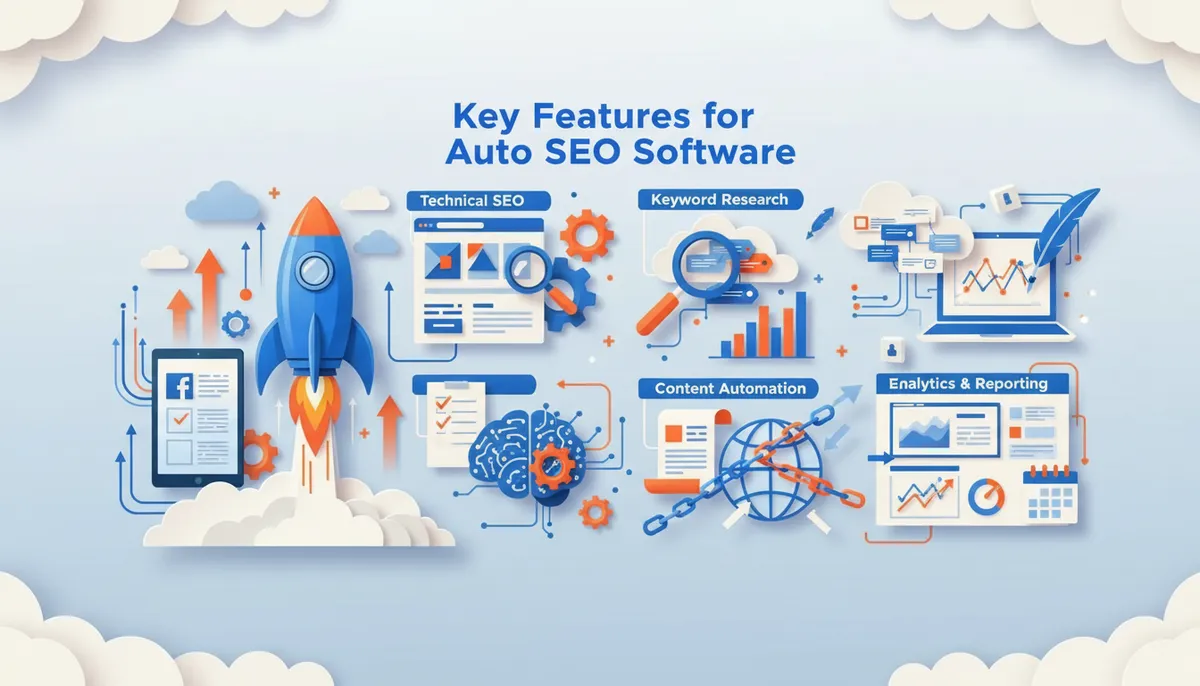
Key Features to Look for in Auto SEO Software
Selecting the right auto SEO software requires evaluating how comprehensively each platform automates your specific workflow. Not all tools offer the same depth of automation, and many focus narrowly on single functions like keyword research or content optimization while leaving other tasks manual.
Complete Workflow Automation
The most valuable platforms automate the entire SEO process from start to finish. Look for systems that handle keyword discovery, content planning, article generation, optimization, and publishing without requiring manual intervention at each stage. Partial automation still leaves you managing multiple tools and coordinating outputs between systems.
True workflow automation means you set up the system once, and it continues producing optimized content indefinitely. The software should automatically fill your content calendar with keyword opportunities, generate articles according to your schedule, optimize each piece for search engines, and publish directly to your website—all without daily management.
AI-Powered Content Generation
Modern auto SEO software uses advanced language models to create content that matches or exceeds human-written quality. The AI should understand search intent, incorporate semantic keywords naturally, structure articles for readability, and optimize for featured snippets. Basic content generators produce generic text that requires extensive editing. Advanced systems create publish-ready articles that rank immediately.
Content length matters significantly for rankings. Look for platforms that generate comprehensive 3,000+ word articles by default. Short 500-1,500 word posts rarely compete effectively in competitive niches. Longer content provides more opportunities to cover topics thoroughly, include related keywords, and satisfy user intent completely.
Real-Time SEO Scoring and Optimization
Effective auto SEO software includes built-in SEO scoring that evaluates content against ranking factors in real-time. The system should analyze keyword density, readability, metadata quality, internal linking, and structural elements automatically. More importantly, it should provide specific fix recommendations or apply corrections automatically rather than just identifying problems.
Some platforms offer manual optimization suggestions that still require human implementation. True automation means the software detects issues and resolves them independently. For example, when keyword density falls below optimal levels, the system rewrites relevant sections automatically rather than flagging the issue for manual correction.
Multi-Platform Publishing Integration
Direct publishing capabilities eliminate the copy-paste workflow that slows down content deployment. The best auto SEO software connects directly to WordPress, Webflow, Shopify, Wix, and other major content management systems. Articles should publish with properly formatted HTML, optimized images, internal links, and metadata—not plain text dumps requiring manual formatting.
Publishing automation also includes scheduling capabilities. Rather than manually deciding when to publish each article, the system should automatically schedule content based on SEO best practices. Daily publishing schedules work best for most sites, and automation ensures consistent output without requiring daily oversight.
AI Search Engine Optimization
Traditional SEO tools focus exclusively on Google rankings. In 2026, content must also rank in AI-powered search engines like ChatGPT, Perplexity, Claude, Gemini, Copilot, and Grok. These platforms pull information from trusted sources and present it in AI-generated answers.
Forward-thinking auto SEO software structures content specifically for AI search visibility. This includes proper schema markup, clear factual statements, authoritative citations, and natural language that AI models can easily parse and reference. Content optimized only for Google misses the growing search volume happening through AI interfaces.

Best Auto SEO Software Platforms in 2026
The auto SEO software market includes dozens of tools with varying automation capabilities. Some platforms excel at specific tasks like keyword research or technical audits but leave other functions manual. Others attempt to cover all bases but lack depth in critical areas.
SEO Rocket: Complete End-to-End Automation
SEO Rocket stands out as the only platform offering true end-to-end automation across the entire SEO content workflow. Unlike competitors that specialize in single functions, SEO Rocket handles keyword research, content planning, article generation, optimization, and publishing in one integrated system.
The platform discovers keyword opportunities automatically by analyzing your market, competitors, and search trends. These opportunities populate a visual content calendar that schedules articles for daily publication. Each morning, SEO Rocket generates a comprehensive 3,000+ word article optimized for both Google and AI search engines, then publishes it directly to your website without human intervention.
Setup takes under 10 minutes. Connect your WordPress, Webflow, Shopify, or Wix site, review the automatically generated keyword opportunities, approve your content calendar, and the system handles everything else. There’s no daily maintenance, no manual prompting, and no copy-pasting between tools.
Key automation features include:
- Automatic keyword discovery with real-time search volume and competition data
- Daily long-form article generation (3,000+ words)
- AI-optimized metadata, internal/external linking, and business mentions
- Real-time SEO scoring with automated fix suggestions
- Direct publishing to major CMS platforms
- AI-generated images and video embeds
- Optimization for Google AND AI search engines (ChatGPT, Perplexity, Claude, Gemini, Copilot, Grok)
SEO Rocket pricing starts at $99/month for businesses (30 articles monthly) and $799/month for agencies managing multiple clients (300 articles monthly across 10 workspaces). A lifetime plan at $1,499 provides permanent access with no recurring fees. At approximately $3 per article, SEO Rocket offers the lowest cost-per-article in the industry while maintaining the highest level of automation.
The platform’s agency plan supports true scalability. Manage ten different client workspaces from one dashboard, each with its own content calendar, keyword opportunities, and automated publishing schedule. This eliminates the need for multiple tool subscriptions or manual coordination across client accounts.
Surfer SEO: Content Optimization Focus
Surfer SEO specializes in content optimization using SERP data analysis. The platform examines top-ranking competitors and creates optimization blueprints showing exactly what elements your content needs to rank. Surfer provides detailed recommendations for keyword usage, content length, heading structure, and semantic terms.
While Surfer excels at optimization, it requires manual content creation. You write articles separately, then use Surfer to optimize them. The platform doesn’t generate content automatically or publish it to your website. This partial automation still saves time compared to manual optimization but doesn’t eliminate the writing workload.
Surfer supports 11 languages for global content strategies. The platform integrates with Google Docs and WordPress for easier workflows. Pricing starts at approximately $99/month for basic plans, with higher tiers adding features like content audits and white-label reporting.
Writesonic: AI Content Generation
Writesonic focuses primarily on AI content generation across various formats including blog posts, social media, and ad copy. The platform uses advanced language models to create human-quality writing based on user prompts. Writesonic has earned a 4.7/5 rating on G2 from over 2,000 reviews, with users praising its time-saving capabilities.
However, Writesonic lacks comprehensive SEO automation. Users must manually research keywords, create content briefs, prompt the AI, and optimize output for search engines. The platform doesn’t include built-in keyword research tools or automatic publishing to websites. This means you still need separate tools for keyword discovery, SEO analysis, and content management.
For businesses seeking complete automation, Writesonic works better as part of a larger tech stack rather than a standalone solution. Pricing varies based on word count limits and features, starting around $16/month for basic plans.
Rankability: IBM Watson-Powered Optimization
Rankability combines IBM Watson and Google Natural Language Processing technology to analyze and optimize content. The platform evaluates articles against hundreds of ranking factors and provides detailed improvement recommendations. Rankability focuses on ensuring content meets search engine quality standards and user intent requirements.
The tool requires manual content creation and publishing. You write articles externally, run them through Rankability for analysis, implement the suggested changes, and publish manually. This workflow saves time compared to guessing at optimization but doesn’t eliminate the writing and publishing workload.
Rankability starts at $149/month, positioning it in the mid-tier pricing range. The platform works well for teams with dedicated writers who need optimization guidance but lacks the full automation that eliminates content production bottlenecks.
LowFruits: Long-Tail Keyword Research
LowFruits specializes in discovering low-competition long-tail keywords that offer quick ranking opportunities. The platform identifies question-based searches and niche topics where smaller sites can compete effectively against larger competitors. This focus makes it valuable for new websites building initial traffic.
LowFruits handles only keyword research. Content creation, optimization, and publishing remain completely manual. You export keyword lists from LowFruits, then use other tools to create and publish articles targeting those keywords. At $29.99/month, LowFruits offers affordable keyword research but requires additional subscriptions to complete the SEO workflow.
Konvart: Multi-Function SEO Platform
Konvart attempts to provide comprehensive SEO automation across multiple functions including keyword research, content optimization, technical audits, and rank tracking. Starting at $69/month, it positions itself as an affordable all-in-one solution. However, automation depth varies across functions, with some features still requiring manual intervention.
The platform includes competitor analysis and reporting tools useful for agencies. Content generation capabilities exist but produce shorter articles compared to specialized platforms. Konvart works best for teams wanting multiple SEO functions in one dashboard rather than maximum automation in any single area.
SEMrush: Established SEO Toolkit
SEMrush represents one of the oldest and most comprehensive SEO platforms, offering tools for keyword research, site audits, competitor analysis, and rank tracking. The platform provides extensive data and insights across virtually every SEO function. However, SEMrush focuses on providing information rather than automating tasks.
Users must manually analyze SEMrush data and implement recommendations. The platform doesn’t generate content, optimize articles automatically, or publish to websites. At $199/month starting price, SEMrush costs significantly more than newer automation-focused platforms while requiring more manual work.
For agencies already deeply invested in SEMrush, the platform remains valuable for research and analysis. However, businesses seeking automation should consider it as a supplementary research tool rather than a complete automation solution.

How to Choose the Right Auto SEO Software for Your Business
Selecting auto SEO software depends on your specific business model, content volume requirements, and technical expertise. The right platform balances automation depth, feature completeness, ease of use, and cost-effectiveness for your situation.
Evaluate Your Content Volume Needs
Calculate how many articles you need monthly to achieve your traffic goals. Small businesses typically need 10-30 articles monthly to build sustainable traffic. Agencies managing multiple clients require 50-300+ articles monthly depending on client count and contract terms.
Platforms with limited automation become bottlenecks at higher volumes. If you need 100 articles monthly, tools requiring manual writing or publishing won’t scale effectively. True automation becomes essential when volume exceeds what your team can produce manually while maintaining quality.
Consider Your Technical Expertise
Some auto SEO software requires technical knowledge to implement effectively. Complex tools with steep learning curves slow down deployment and require ongoing training as team members change. Simpler platforms with intuitive interfaces deliver results faster and reduce dependency on specialized personnel.
Setup time matters significantly. Platforms requiring days or weeks of configuration delay results and increase implementation costs. Look for tools offering under-10-minute setup that produce results immediately. The faster you see traffic improvements, the sooner you validate your investment.
Assess Total Cost of Ownership
Compare all costs involved in each platform, not just the monthly subscription. Factor in additional tool subscriptions needed to complete your workflow, time spent on manual tasks, and potential hiring costs if automation doesn’t cover critical functions.
A $99/month platform that automates everything completely costs less than a $29/month tool that requires three additional subscriptions plus manual content creation. Calculate cost-per-article including all related expenses to understand true value.
Test AI Search Optimization Capabilities
In 2026, content must rank in both traditional search engines and AI-powered platforms. Test whether platforms optimize specifically for AI search or focus exclusively on Google. Content structured properly for AI answers appears in ChatGPT responses, Perplexity results, and Claude citations—expanding your reach beyond traditional search.
Ask vendors directly whether their systems optimize for AI search engines. Most traditional tools don’t address this requirement, leaving your content invisible to the growing segment of users searching through AI interfaces.
Prioritize Direct Publishing Integration
Manual copy-pasting wastes time and introduces formatting errors. Direct publishing integration to your CMS ensures articles appear correctly formatted with proper HTML, images, links, and metadata. This feature becomes critical at scale when publishing daily or managing multiple client sites.
Verify that publishing integration works with your specific platform. WordPress remains the most widely supported CMS, but Webflow, Shopify, and Wix users need platforms offering native integration for their systems.

Implementing Auto SEO Software: Setup and Best Practices
Successful implementation of auto SEO software requires proper initial configuration and ongoing monitoring to maximize results. While automation eliminates daily manual work, strategic oversight ensures the system produces content aligned with your business goals.
Initial Setup Process
Start by connecting your website to the auto SEO platform. Most modern systems use simple authentication processes that take minutes. For WordPress sites, install the provided plugin. For other platforms, use API keys or direct integrations provided by your CMS.
Next, configure your business information and content preferences. Provide details about your products, services, target audience, and brand voice. Quality platforms use this information to ensure automatically generated content mentions your business appropriately and maintains consistent messaging.
Review automatically discovered keyword opportunities. Advanced platforms analyze your market and identify relevant keywords without manual research. Approve keywords that align with your business objectives and remove any that don’t serve your strategy. This initial curation ensures your content calendar focuses on topics that drive qualified traffic.
Content Calendar Management
Arrange approved keywords on your content calendar strategically. Daily publishing works best for most businesses, allowing search engines to crawl your site regularly and discover new content quickly. Space high-priority keywords throughout the calendar rather than clustering them together.
Most auto SEO platforms handle scheduling automatically once you approve the calendar. The system generates and publishes articles according to your preferred frequency without requiring daily oversight. Review the calendar weekly to add new opportunities as they emerge and remove keywords that lose relevance.
Quality Monitoring
Although automation handles content creation, monitor output quality initially to ensure articles meet your standards. Review several automatically generated pieces to verify they cover topics thoroughly, maintain appropriate tone, and include accurate information about your business.
Quality platforms allow unlimited rewrites if you’re unsatisfied with initial output. Use this feature to refine content until it consistently meets your expectations. After several weeks, you’ll rarely need manual intervention as the system learns your preferences.
Performance Tracking
Monitor traffic growth and keyword rankings to measure automation effectiveness. Quality auto SEO software includes built-in analytics showing which articles drive traffic, rank for target keywords, and generate conversions. Use this data to identify successful content patterns and adjust your strategy accordingly.
Expect gradual traffic growth rather than overnight results. SEO requires time for search engines to discover, index, and rank new content. Consistent daily publishing creates compounding benefits, with traffic accelerating after 3-6 months of regular output.
Integration with Existing Marketing
Connect your auto SEO software with other marketing systems for maximum impact. Share published articles on social media to drive immediate traffic while SEO results build. Add article links to email newsletters to provide value to subscribers. Reference blog content in sales conversations to establish expertise.
Automated content creation enables content marketing strategies that were previously resource-prohibitive. With daily article publishing handled automatically, you can focus on promotion and distribution rather than content production.

Common Mistakes to Avoid with Auto SEO Software
While automation simplifies SEO dramatically, several common mistakes prevent businesses from achieving optimal results. Awareness of these pitfalls helps you implement your chosen platform more effectively.
Choosing Tools Based on Price Alone
The cheapest option rarely delivers the best value. A $16/month tool that requires extensive manual work and additional subscriptions costs more than a $99/month platform that automates everything. Calculate total costs including time, supplementary tools, and opportunity costs of slower results.
Similarly, expensive doesn’t guarantee quality. Some legacy platforms charge premium prices while offering less automation than newer competitors. Evaluate features, automation depth, and results rather than assuming price correlates with value.
Neglecting AI Search Optimization
Many businesses continue focusing exclusively on Google rankings while ignoring AI search engines. This oversight becomes increasingly costly as users shift to ChatGPT, Perplexity, and similar platforms for information. Content optimized only for traditional search misses growing traffic opportunities.
Ensure your chosen auto SEO software specifically addresses AI search optimization. Ask whether the platform structures content for AI citation and includes appropriate schema markup that AI models can parse effectively.
Expecting Instant Results
SEO requires time regardless of automation quality. New websites need 3-6 months of consistent publishing before seeing significant traffic growth. Established sites see faster results but still need several weeks for new content to rank. Impatience leads businesses to abandon effective strategies prematurely.
Set realistic expectations and commit to consistent publishing for at least six months. The compounding effect of daily automated content becomes exponentially more valuable over time as your article library grows and internal linking strengthens.
Ignoring Content Relevance
Automation handles content creation, but strategy remains your responsibility. Publishing randomly selected keywords wastes resources on topics that don’t serve your business. Curate your content calendar to focus on keywords that attract qualified visitors interested in your products or services.
Review keyword opportunities regularly and prioritize topics with clear commercial intent or informational value to your target audience. Auto SEO software makes publishing easy, but strategic focus determines whether traffic converts to business results.
Over-Relying on Partial Automation
Many businesses combine multiple specialized tools hoping to create complete automation through integration. This approach introduces complexity, increases costs, and creates failure points where manual coordination is required. Each tool transition requires human intervention to review outputs and prepare inputs for the next system.
Instead, prioritize platforms offering end-to-end automation that eliminate manual handoffs between systems. Single platforms that handle the complete workflow deliver more reliable results with less ongoing management.
Take Control of Your SEO with Complete Automation
Auto SEO software transforms content marketing from a resource-intensive manual process into a streamlined automated system. The right platform eliminates time-consuming tasks like keyword research, content writing, optimization, and publishing—allowing you to focus on growing your business while traffic builds consistently in the background.
For small businesses and agencies in 2026, complete automation isn’t a luxury—it’s a competitive necessity. Manual SEO workflows can’t match the speed, consistency, and cost-effectiveness of modern automation platforms. Businesses publishing daily automatically outrank competitors posting sporadically with manual processes.
SEO Rocket delivers the most comprehensive automation available, handling everything from keyword discovery through final publication without human intervention. Unlike partial automation tools that still require manual content creation or publishing, SEO Rocket truly eliminates the entire workload. Setup takes under 10 minutes, and the system continues producing 3,000+ word SEO-optimized articles daily indefinitely.
The platform’s optimization for both Google and AI search engines ensures your content remains visible as search behavior evolves. With pricing starting at just $99/month for 30 articles or $799/month for agency clients needing 300 articles across 10 workspaces, SEO Rocket offers unmatched value at approximately $3 per article.
Stop spending hours on manual SEO tasks that automation can handle better, faster, and cheaper. Start building your automated SEO system for just $99/month and begin seeing consistent traffic growth within weeks.
FAQs
Q: What is the best auto SEO software for small agencies?
A: SEO Rocket offers the most complete automation for agencies with its $799/month plan supporting 10 client workspaces and 300 monthly articles. Unlike competitors requiring multiple tools and manual workflows, SEO Rocket handles keyword research, content generation, optimization, and publishing automatically for all clients from one dashboard. The platform’s agency plan delivers exceptional value at approximately $3 per article while eliminating the coordination complexity of managing separate tools for each SEO function.
Q: How much does auto SEO software typically cost?
A: Auto SEO software pricing ranges from $16/month for basic content generation tools to $799/month for comprehensive agency platforms. However, total cost depends on automation completeness. Tools requiring supplementary subscriptions, manual content creation, or external publishing add hidden costs. Platforms offering end-to-end automation like SEO Rocket at $99/month deliver better value than cheaper options requiring additional tools and manual work. Calculate cost-per-article including all related expenses to determine true pricing.
Q: Can auto SEO software completely replace manual SEO work?
A: Yes, advanced auto SEO software can handle the entire content SEO workflow without manual intervention. Platforms like SEO Rocket automate keyword research, long-form article generation, optimization, and publishing completely. However, strategic decisions remain important. You should review keyword opportunities to ensure content aligns with business goals and monitor performance to validate results. The software eliminates execution work while allowing you to maintain strategic control over your content direction.
Q: What features should I prioritize in auto SEO software?
A: Prioritize complete workflow automation that handles keyword research, content generation, optimization, and publishing without manual steps between functions. Look for platforms generating comprehensive 3,000+ word articles optimized for both Google and AI search engines like ChatGPT and Perplexity. Direct CMS integration that publishes formatted articles automatically saves significant time. Real-time SEO scoring with automated fixes ensures content ranks effectively. Finally, verify the platform supports your content volume requirements and scales cost-effectively as needs grow.
Q: How does auto SEO software optimize for AI search engines?
A: Modern auto SEO software structures content specifically for AI citation by including proper schema markup, clear factual statements, authoritative sources, and natural language that AI models parse easily. Platforms optimized for AI search ensure articles appear in ChatGPT responses, Perplexity results, Claude citations, and similar AI-generated answers. This optimization matters increasingly in 2026 as users shift from traditional Google searches to AI-powered interfaces. Content structured only for Google misses growing traffic opportunities from AI search platforms.