
Key Takeaways
-
Automate repeatable tasks like keyword research, metadata formatting, and scheduling, while keeping humans responsible for strategy, fact-checking, and final approval to maintain quality and speed.
-
Start every workflow by defining your specific audience and their pain points rather than guessing keywords, as this focus guides every subsequent step and ensures relevance.
-
Always build a detailed brief before drafting that includes target reader goals, primary keywords, search intent, key subtopics, and unique angles to prevent wasted writing and ensure competitive differentiation.
-
Implement human review as a mandatory checkpoint before publishing to verify facts, add original insights, confirm brand voice, and test usefulness—this protects your credibility and Google's E-E-A-T signals.
-
Measure performance after publishing by tracking rankings and click-through rates, then update underperforming posts and apply winning patterns to future briefs to create a continuous improvement loop.
-
Consolidate your workflow into a single platform rather than using multiple disconnected tools, as fragmented handoffs create delays, missed steps, and quality issues that slow down content production.
Have you ever stared at a blank page and wondered where all your week went? You are not alone. Most teams do not struggle with ideas. They struggle with the mess between the idea and the published post. A clear content creation workflow fixes that mess.
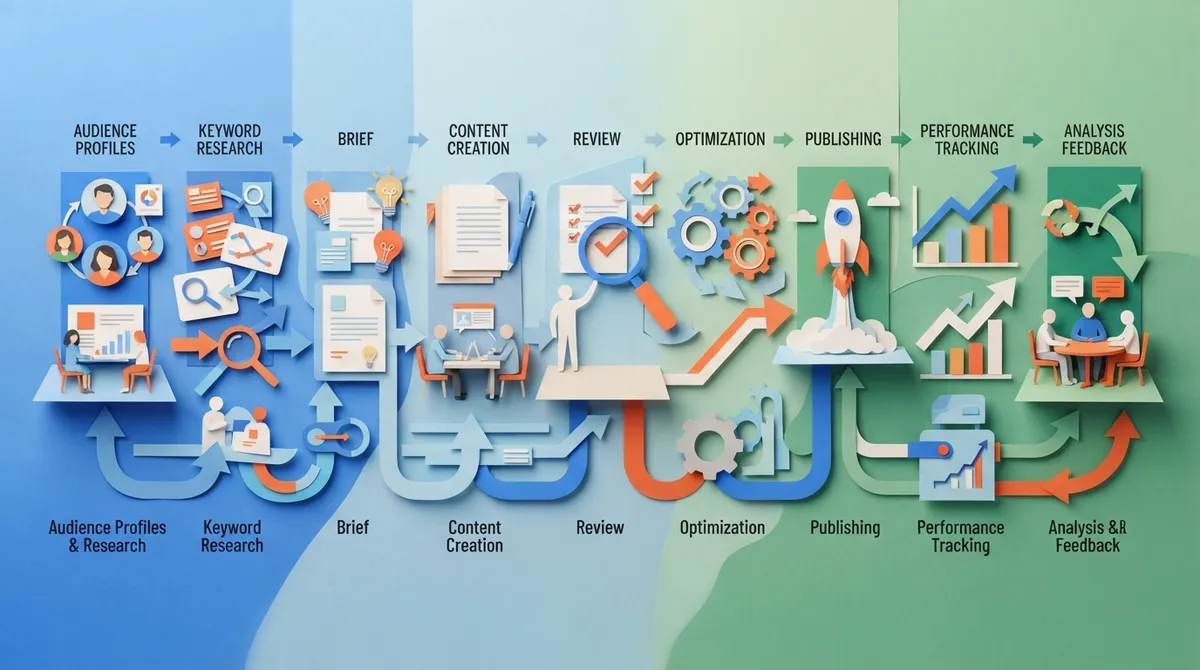
Think of it like a kitchen. Great chefs do not cook by chaos. They prep, cook, taste, plate, and clean up in a set order. Your blog can work the same way. In SEO content automation, a content creation workflow is the connected process of planning, researching, briefing, drafting, reviewing, optimizing, publishing, and measuring your articles.
In this guide, you will learn nine simple steps to build a workflow that saves time and still earns trust from readers and Google. Whether you run a small agency, manage an in-house team, or run your own shop, these steps will help you publish with less stress and more focus.

Why a Content Creation Workflow Matters for SEO
A good workflow turns SEO blogging into a system instead of a chore. Without one, work gets stuck. Briefs go missing. Drafts wait for feedback. Posts go live late or not at all.
Automation can handle the repeatable parts, like routing work, formatting posts, and scheduling. People handle the parts that need judgment, like topic choices, accuracy, and final approval. That balance is the heart of a strong content creation workflow.
Google also cares about the result. Its guidance says content should be helpful, reliable, and made for people first. It does not ban AI-assisted writing. It warns against making lots of pages that add little value. So your workflow should protect quality at every step.
Here is what a solid workflow gives you:
- Consistency: You publish on a steady schedule, which search engines and readers both like.
- Clarity: Everyone knows who does what and when.
- Quality control: Review checkpoints catch errors before they go live.
- Less burnout: Repeatable tasks stop eating your day.

The 9 Steps at a Glance
| Step | What Happens | Best Handled By |
|---|---|---|
| 1. Know your audience | Define who you write for and why | Human |
| 2. Research keywords | Find real search opportunities | Automation + human |
| 3. Check search intent | Study what already ranks | Human |
| 4. Build a brief | Set the plan for the draft | Automation + human |
| 5. Draft the article | Write the first version | Automation + human |
| 6. Review and add value | Fact-check and add insight | Human |
| 7. Optimize on-page | Metadata, links, formatting | Automation |
| 8. Publish and schedule | Send to your CMS | Automation |
| 9. Measure and improve | Track results and update | Automation + human |
Step 1: Start With Your Audience
Every strong content creation workflow begins with people, not keywords. Ask who is reading and what they need help with.
A small business owner wants quick wins and low cost. An agency wants to scale across clients. An in-house marketer wants to hit goals with a tiny team. Each group has different pain points, so each needs a different angle.
Write down your reader in one or two lines. Add their top problem and the result they want. This small note will guide every later step.
Step 2: Do Keyword Research With Real Data
Guessing what to write is a fast way to waste a month. Instead, use live SEO data. Look at search volume, competition, and intent so you pick topics with real upside.
This is where automation shines. A tool with a built-in keyword engine can show you opportunities in minutes. SEO Rocket’s features include a full keyword research engine, so you do not need a pile of spreadsheets. If you want to go deeper, our guide on how to master keyword research for 2026 SEO success walks through the basics.
Pick keywords you can actually win. A mix of easier terms and bigger goals keeps your plan balanced.
Step 3: Check Search Intent Before You Write
Search intent is the reason behind a search. Someone typing a question wants an answer. Someone typing a product name may want to buy.
Before drafting, look at the search results page. What formats rank? Lists, guides, or how-tos? What subtopics keep showing up? What is missing?
This step keeps you from writing the wrong kind of page. It also helps you find gaps you can fill. For a simple walkthrough, read how to master search intent optimization for better rankings.
Step 4: Build a Clear Brief
A brief is the map for your draft. It keeps writers, editors, and AI tools on the same page. A good brief should include:
- The target reader and their main goal
- The primary keyword and a few related terms
- The search intent you are matching
- Key subtopics to cover
- Sources or evidence the draft must use
- What will make your piece better than what already ranks
That last point matters most. If your article says the same thing as everyone else, it adds little value. Plan one angle, example, or insight that is truly yours.
Step 5: Plan Your Calendar and Draft the Article
Now it is time to write. First, drop the topic into a calendar so it has a date. A visible schedule keeps your content creation workflow moving.
SEO Rocket uses a built-in calendar. When you add a keyword, it schedules the keyword to become a full article. One article is generated per day, which supports steady publishing. You can plan weeks or months ahead.
AI can help with outlines, first drafts, and routine on-page work. Google says generative AI is not banned by itself. The risk is mass-producing pages with no real value. So treat the draft as a strong starting point, not the finish line. If you are new to this, our complete guide to blog writing with AI explains how to use it well.
Step 6: Review, Fact-Check, and Add Your Voice
This is the step that protects your brand. Human review is not optional. It is the checkpoint that keeps an automated workflow honest.
Here is a simple review list:
- Check facts: Confirm claims and sources before they go live.
- Add experience: Share a real example, lesson, or tip only you can give.
- Match your brand: Make sure the tone sounds like you.
- Test usefulness: Ask if a reader would feel helped after finishing.
- Review metadata: Check titles, descriptions, and any structured data.
Google’s own Search Quality Rater Guidelines highlight experience, expertise, and trust. Your review step is where you build those signals into every post.
Step 7: Optimize the Page for Search
Once the content is solid, polish it for search. This covers your title, meta description, headings, links, images, and formatting.
Many of these tasks repeat on every post, which makes them perfect for automation. Real-time SEO scoring and auto-fix suggestions can flag gaps fast so you do not miss a step.
Do not forget internal links. They help readers find related posts and help search engines understand your site. Our post on how to use automated internal linking to boost SEO fast shows how to do it without hours of manual work.
Step 8: Publish and Schedule Without Copy-Pasting
Copying text from one tool into another is slow and easy to mess up. A smoother content creation workflow sends approved posts straight to your site.
Good automation can apply CMS formatting, check required fields, and schedule the post. SEO Rocket connects to WordPress, Webflow, Shopify, and Wix, so publishing becomes a handoff instead of a chore. To see how it fits together, check out how SEO Rocket works.
Keep one rule in mind: automate the handoffs, but keep a person accountable for final approval.
Step 9: Measure, Learn, and Update
Publishing is not the finish line. The best workflows loop back. After a post goes live, watch how it performs. Look at rankings, clicks, and what readers do on the page.
Then use what you learn:
- Find posts that rank on page two and give them a boost.
- Fix anything that is out of date or wrong.
- Spot topics that worked and plan more like them.
- Feed those lessons into your next brief.
Connecting analytics makes this easier. Read how Google Analytics integration boosts your SEO content to see how data can shape your next move.
Which Parts Should You Automate?
Not every task needs a robot. Use this simple split.
| Automate These | Keep Human for These |
|---|---|
| Keyword discovery and tracking | Topic priorities and strategy |
| Moving briefs to drafting | Fact-checking and accuracy |
| Metadata and formatting checks | Adding first-hand experience |
| Scheduling and publishing | Brand voice and final approval |
| Performance reporting | Deciding what to change next |
This balance keeps speed high and quality safe. For a deeper look at the trade-offs, see manual SEO vs. automated SEO.
Common Workflow Mistakes to Avoid
Even good teams slip. Watch for these traps:
- Publishing without review: Speed means little if the facts are wrong.
- Skipping the brief: Drafts wander when there is no plan.
- Chasing volume only: More posts do not help if they add nothing new.
- Ignoring old posts: Updates can lift rankings faster than new pages.
- Using too many tools: A messy stack creates more handoffs, not fewer.
That last one is common. When research, writing, optimizing, and publishing live in separate places, things slip through cracks. An all-in-one setup keeps the whole content creation workflow in one view.
How SEO Rocket Fits Into Your Workflow
SEO Rocket is built to turn this whole process into a system. You connect your site, review keyword opportunities, approve your calendar, and the platform handles drafting and publishing. It produces one article per day on the Business plan, and your team stays in charge of review and direction.
For small agencies, that means serving more clients without hiring. For in-house teams, it means hitting goals with fewer hours. For small business owners, it means steady content without a big budget. You can browse writing examples to see the output for yourself, or compare plans on the pricing page.
Conclusion
A strong content creation workflow does not need to be fancy. It needs clear steps, smart automation, and a human check where it counts. Start with your reader, pick topics with real data, build a brief, review with care, and keep learning after you publish.
You do not have to build all nine steps in a day. Start with one, then add the next. Small wins add up fast, and your future self will thank you.
Ready to turn SEO blogging into a system? Sign up for SEO Rocket and let the platform handle the heavy lifting while you focus on what matters. You can also read our blog for more simple, practical SEO tips.
FAQs
Q: What is a content creation workflow for SEO?
A: It is the connected process of planning, researching, briefing, drafting, reviewing, optimizing, publishing, and measuring search-focused content. Automation handles the repeatable tasks, while people handle strategy and quality checks. Think of it as a repeatable recipe for your blog.
Q: Which parts of SEO content creation can be automated?
A: You can automate keyword discovery, brief handoffs, metadata checks, formatting, scheduling, and performance reporting. Judgment-heavy tasks, like topic priorities, fact-checking, and final approval, should stay with a person. That mix keeps your process fast and trustworthy.
Q: Does Google penalize AI-generated content?
A: Google does not ban AI-assisted content just because it uses AI. Its concern is mass-producing pages that add little value for readers. If your content is helpful, accurate, and reviewed by a human, you are on solid ground.
Q: What quality checks should happen before publishing AI-assisted content?
A: Verify facts and sources, add first-hand experience or original insight, and check that the tone fits your brand. Also review titles, descriptions, and any structured data. A final human approval step keeps everything accurate and useful.
Q: How do you measure whether an SEO content workflow is working?
A: Track rankings, organic clicks, and how readers behave on each page. Then look for posts to update, fix, or expand, and feed those lessons into future briefs. A workflow that learns from results gets better every month.




