

Key Takeaways
-
Start with the reader's problem and search intent before the keyword, as different audiences need different outlines for the same topic, and matching search results format is critical for SEO rankings.
-
Feed AI real, current data like ranking page URLs, Search Console queries, and customer questions rather than asking it to guess, then verify its summaries against original sources since AI can miss context or invent details.
-
Write clear prompts that specify audience, search intent, primary/secondary keywords, angle, and output format, then ask the AI to separate observed patterns from recommendations and flag unverifiable claims to maintain accuracy.
-
Review AI outlines against a checklist covering intent fit, completeness, duplication, factual support, and originality before drafting, adding your own expertise and real examples to differentiate from competitor headings.
-
Avoid common mistakes like copying competitor structures, skipping fact-checks, keyword stuffing headings, and ignoring search intent, as Google's scaled content policy penalizes low-value pages regardless of AI involvement.
-
Use automation platforms with reusable templates and human review checkpoints to scale outline creation from dozens per month, balancing speed where possible with critical human judgment on strategy, accuracy, and brand fit.
Staring at a blank page is nobody’s idea of a good time. You know the topic. You know the keyword. But turning that into a clear plan for an article? That part can eat up an hour before you write a single word.
Good news: AI can take a lot of that pain away. If you want to learn how to create SEO blog outlines with AI, you are in the right place. In this guide, I will walk you through a simple, friendly process that saves time and still keeps your content useful, accurate, and original.
Whether you run a small agency, manage a company blog, or handle your own website, you will find steps you can use today. We will cover what to feed the AI, how to write a great prompt, how to check the results, and how to automate the whole thing so you can publish steadily without burning out.

Why Blog Outlines Matter for SEO
An outline is the skeleton of your article. It decides what you cover, in what order, and how well you answer the reader’s question. A weak outline leads to a wandering article. A strong one leads to content that ranks and keeps people reading.
Here is what a solid outline does for you:
- Matches search intent: It makes sure your page gives people what they came to find.
- Improves structure: Clear H2 and H3 headings help readers and search engines scan your page.
- Prevents gaps: You cover key questions before you start writing.
- Speeds up writing: A clear plan means fewer rewrites later.
If you are new to the writing side of things, our SEO content writing beginner’s guide is a great companion to this article.
What AI Can (and Can’t) Do for Your Outline
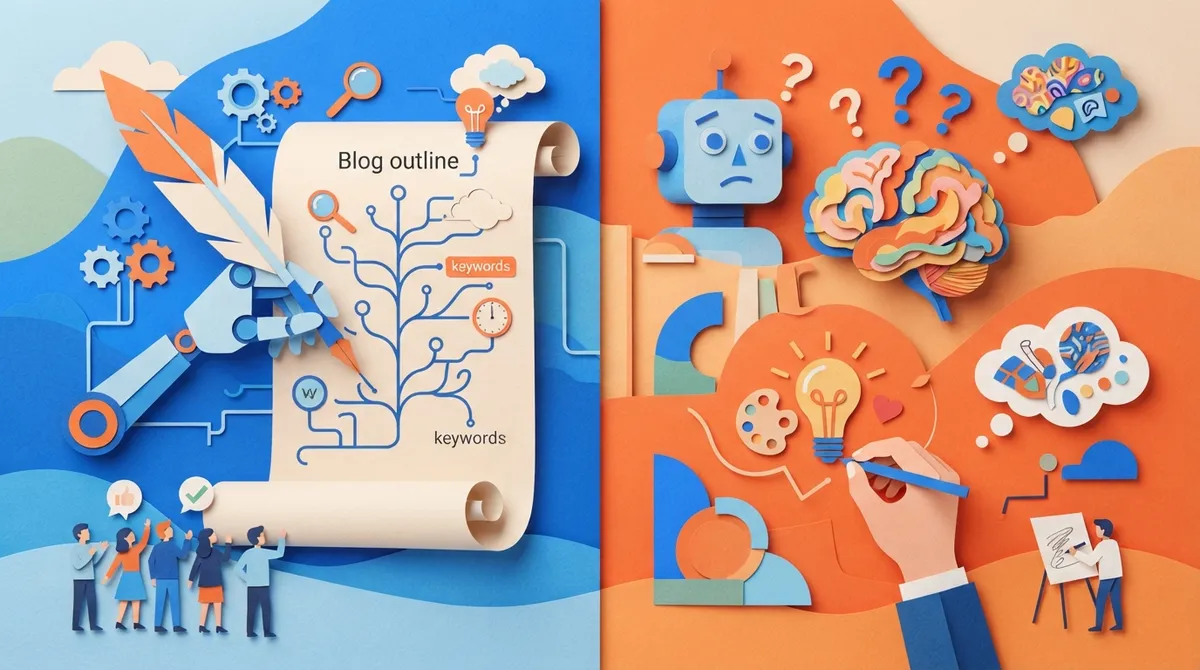
AI is a fast helper, not a replacement for your brain. It shines at the repetitive parts of outline work. It struggles with judgment, original insight, and fact-checking.
Where AI Helps Most
- Grouping related keywords into clusters
- Spotting common subtopics across top-ranking pages
- Finding related questions people ask
- Drafting a first-pass heading structure
- Formatting notes for each section
Where You Still Need a Human
- Deciding the purpose and angle of the article
- Checking facts and claims
- Adding first-hand experience and real examples
- Making sure the outline fits your brand voice
Google is clear on this. Its guidance on generative AI content says AI can help with research and adding structure. But making lots of pages without adding value may break its spam policies. The rule is simple: be useful, be accurate, be people-first. Using AI is fine. Using it lazily is not.
How to Create SEO Blog Outlines With AI: Step by Step
Ready to build one? Here is the process I recommend. It works whether you are writing one post or planning fifty.
- Define your audience and goal. Who is reading this? What do you want them to do next? Write this down in one or two sentences.
- Pick a primary keyword and related terms. Choose one main query and a handful of supporting phrases.
- Check search intent. Look at the current search results. Are they guides, lists, tools, or comparisons? Your outline should match the format people expect.
- Gather real inputs for the AI. Collect ranking page URLs, Search Console queries, customer questions, and trusted sources.
- Write a clear prompt. Tell the AI who the reader is, what the intent is, and what format you want back.
- Generate the outline. Ask for a title, H1/H2/H3 structure, and short notes for each section.
- Review and improve. Check intent, facts, and originality. Add your own expertise.
- Approve and hand off to drafting. Once it looks right, move to writing.
Let’s break the key steps down a bit more.
Step 1: Start With the Reader, Not the Keyword
Many people open an AI tool and type a keyword. That gets you a generic outline. Instead, start with the person reading. What problem do they have? What do they want to know first? A small business owner needs a different outline than an SEO agency, even for the same keyword.
Step 2: Confirm Search Intent
Two keywords that look alike can call for very different pages. One might want a step-by-step guide. Another might want a tool comparison. Take a few minutes to look at the top results and note what they have in common. For a deeper look, see our post on how to master search intent optimization.
Step 3: Feed the AI Real, Current Data
AI works best when you give it good material. Do not just ask it to guess what ranks. Give it things it can check:
- URLs of the top-ranking pages
- Queries from Google Search Console
- Questions from customers or sales calls
- Trusted sources you want cited
Then verify what it tells you. AI can miss context or make up details, so always compare its summary to the original pages.
How to Write a Prompt That Gets a Useful Outline
A good prompt is like a good creative brief. The more clear you are, the better the result. Here is what to include:
| Prompt Element | What to Say | Example |
|---|---|---|
| Audience | Who reads this | Small business owners new to SEO |
| Search intent | What they want | A step-by-step how-to guide |
| Primary keyword | Main phrase | how to create SEO blog outlines with AI |
| Secondary terms | Supporting phrases | content brief, H2 headings, keyword clustering |
| Angle | Your unique take | Practical, beginner-friendly, with automation tips |
| Source material | What to use | Pasted competitor headings, Search Console queries |
| Output format | How to reply | H1/H2/H3 list with 1-line notes per section |
Two extra tricks make a big difference. First, ask the AI to separate observed patterns in the search results from its own recommendations. Second, tell it to flag any claim it cannot support instead of inventing one. This keeps the outline honest.
A Simple Prompt You Can Copy
Try something like this: “Act as an SEO editor. Create a blog outline for small business owners searching [keyword]. The intent is a how-to guide. Use these ranking URLs and questions as source material. Give me a working title, H2 and H3 headings, and a one-line note on what each section must answer. Label what you saw in the sources versus what you recommend. Flag anything you cannot verify.”
Build the Outline Around the Reader’s Task
Once the AI gives you a draft, shape it so it helps the reader finish their task. A great outline usually has:
- A clear working title that promises a benefit
- A short intro that names the problem
- Logical H2 sections in the order the reader needs them
- H3s only where a section truly needs sub-points
- Notes on examples, data, visuals, or internal links to add
- A conclusion with a next step
Only include a topic if it helps satisfy intent. Do not add sections just to squeeze in extra keywords. Readers can tell, and so can search engines.
Review Checklist: Is Your AI Outline Ready?
Before you start drafting, run your outline through this quick check. It takes five minutes and saves hours.
- Intent fit: Does every section help the reader’s main goal?
- Completeness: Are any obvious questions missing?
- Duplication: Does it overlap with a page you already have on your site?
- Factual support: Can you back up each claim with a real source?
- Originality: Does it offer more than a reshuffle of competitor headings?
- Brand fit: Does it sound like you and reflect your expertise?
That fifth point matters most. If your outline looks exactly like the top three results, you have not added anything new. Add a real example, a lesson from your own work, or a business-specific insight. That is what makes content stand out.
Common Mistakes to Avoid
AI outlines go wrong in predictable ways. Watch for these:
- Copying competitors: Mirroring headings makes you a me-too page.
- Skipping fact-checks: AI can state things with confidence that turn out to be false.
- Keyword stuffing headings: Headings should read naturally.
- Ignoring intent: A how-to keyword needs steps, not a sales pitch.
- Publishing at scale with no value: Mass-producing thin pages can trigger Google’s scaled content spam policy.
For more on this, check out 7 blog writer AI mistakes that kill your SEO rankings.
How Teams Are Using AI Right Now
You are not alone if you are exploring this. According to Content Marketing Institute’s 2025 B2B research, 67% of respondents reported medium trust in generative AI, 28% reported low trust, and just 4% reported high trust. That tells us most marketers use AI carefully, not blindly.
Other surveys show similar habits. SurveyMonkey reports that 51% of surveyed marketers use AI to optimize content and 50% use it to create content. A 2025 ZoomInfo survey found 63% of respondents used AI at least weekly. These are survey results, not universal numbers, but they show that AI is now a normal part of many marketing workflows.
Scaling Outlines With SEO Content Automation
Creating one good outline by hand is fine. Creating thirty a month is a different story. This is where automation earns its keep.
In an automated workflow, you build reusable briefs and templates. The system handles the repetitive research and formatting. A human then reviews for strategy, accuracy, and brand fit. That balance is the sweet spot: fast where it can be, careful where it counts.
This is exactly what SEO Rocket was built for. It turns SEO blogging into a system instead of a chore. Here is how it helps:
- Built-in keyword research: Live SEO data shows real opportunities by search volume, competition, and intent.
- Automated content planning: Add a keyword to the visual calendar and it is scheduled to become a full article.
- Daily publishing: One article is generated per day, so your blog stays consistent.
- Direct publishing: Connect WordPress, Webflow, Shopify, or Wix and skip the copy-paste.
Instead of hand-building every outline and brief, you plan weeks or months ahead and let the platform do the heavy lifting. You can see the flow on the how it works page, or explore all the features. Setup takes under ten minutes, and articles run 3,000+ words, built for both Google and AI search engines.
If you want to go deeper on the strategy behind this, read content automation SEO: how to scale organic traffic in 2026 and how to build a topic cluster strategy.
Tips for Different Types of Readers
Every team uses outlines a little differently. Here are quick tips based on your situation:
- Small agencies: Build one reusable prompt template per client niche. Swap in the keyword and sources, and you can turn around outlines fast without hiring more people.
- In-house teams: Keep a shared brief library so every writer starts from the same quality bar.
- Content managers: Add an approval step so no outline moves to drafting without a human sign-off.
- E-commerce specialists: Use outlines to plan category guides and buying guides that support your product pages.
- Small business owners: Focus on your customers’ real questions. Your own experience is your biggest edge.
Wrapping Up
Learning how to create SEO blog outlines with AI comes down to a few simple habits. Start with the reader. Confirm search intent. Feed the AI real, current sources. Write a clear prompt. Then review with a critical eye and add your own expertise.
Do that, and AI becomes a friendly assistant that saves you hours while your content stays helpful and original. Add automation on top, and you can publish consistently without the stress.
Ready to make SEO blogging feel easy? Try a workflow where keyword research, planning, writing, and publishing all happen in one place. Sign up for SEO Rocket to get started, or take a look at the pricing plans starting at $99/month. You can also read our blog for more practical guides.
FAQs
Q: How do you use AI to create an SEO blog outline?
A: Start with your audience and a primary keyword, then check search intent by reviewing current search results. Give the AI real inputs like ranking URLs and customer questions, ask for an H1/H2/H3 structure with notes, and review the result for accuracy and originality before you write.
Q: What should an AI prompt include when generating a blog outline?
A: A good prompt names the audience, search intent, primary and secondary keywords, your angle, source material, and the output format you want. It also helps to ask the AI to separate what it saw in the sources from what it recommends, and to flag any claims it cannot support.
Q: Does Google penalize AI-generated outlines or content?
A: No, Google does not penalize content just because AI was involved. Its standard is whether the content is useful, accurate, and people-first. Creating many pages with no added value, however, can violate its scaled content abuse policy, so always add real expertise.
Q: How do you check an AI-generated SEO outline for accuracy and originality?
A: Compare the AI’s summaries against the original source pages, since AI can miss context or invent details. Then check for intent fit, missing questions, and overlap with your existing pages. Finally, add your own examples or insights so it is more than a rearrangement of competitor headings.
Q: How can SEO teams automate blog outlines without sacrificing quality?
A: Use reusable briefs and templates so the AI handles repetitive research and formatting, then route each outline through a human review for strategy, accuracy, and brand fit. A platform like SEO Rocket can also plan keywords, schedule articles on a calendar, and publish daily while you stay in control.




