
Key Takeaways
-
AI marketing platforms automate the entire content pipeline—keyword research, writing, optimization, and publishing—unlike basic writing tools that only help draft text, saving agencies $3,000-$5,000/month in traditional SEO costs.
-
Google allows AI-generated content to rank; the platform penalizes low-value mass-produced content regardless of source, so built-in quality checks like fact verification and originality detection are essential for success.
-
Long-form articles (2,000+ words) outperform short posts because they provide depth for Google rankings and are more likely referenced by AI search engines like ChatGPT, Perplexity, and Claude.
-
The best platforms include live SEO data, keyword clustering, competitor analysis, automated content briefs, direct CMS integrations, and team collaboration features—skipping any defeats the automation purpose.
-
Maintain brand voice by feeding platforms your tone, audience details, and editorial guidelines; human review remains crucial for fact-checking and compliance before publishing automated content.
-
Small agencies, in-house teams, and solo entrepreneurs benefit most—platforms enable serving more clients without hiring writers and keeping large blogs consistently updated at a fraction of traditional agency costs.
You have probably heard the term “AI marketing platform” thrown around like confetti at a launch party. But what does it really mean for your blog, your traffic, and your sanity? If you run a small business, manage content for a busy agency, or juggle a huge product catalog, you already know the pain. Writing SEO content by hand takes forever. Keyword research feels like guesswork. And publishing consistently? That is a full-time job all on its own.
An AI marketing platform for SEO content automation is different from a simple writing tool. It is a complete system. It finds keyword opportunities, plans your content calendar, writes full articles, checks quality, and publishes to your website. No copy-pasting. No spreadsheets. No burnout.
In this guide, we will break down exactly what these platforms do, how they work, and what to look for before you pick one. We will also cover how to stay on Google’s good side while automating your content, because rules matter here. Let’s get into it.

What Is an AI Marketing Platform for SEO Content Automation?
An AI marketing platform combines artificial intelligence with real SEO data. It also uses workflow automation to handle the entire content journey. This includes keyword research, topic planning, writing, optimizing, publishing, and tracking results.
Think of it like a content team that never sleeps. It finds what people are searching for. It writes articles around those topics. Then it publishes them automatically. You review and approve, but the heavy lifting is done for you.
This is very different from typing a prompt into a basic AI writer and hoping for the best. A true platform manages the whole system, not just the writing part. If you want a deeper look at how this fits into a bigger content strategy, check out this guide on SEO content writing for beginners.
Core Features You Should Expect
Not all platforms are built the same. Here are the features that separate a real AI marketing platform from a basic writing app:
- Keyword discovery with live search volume and competition data
- Search-intent analysis so content matches what users actually want
- Keyword clustering to group related topics together
- SERP and competitor research to spot content gaps
- Automated content briefs and outlines
- AI-assisted drafting for full, long-form articles
- On-page optimization, including metadata and schema suggestions
- Internal-link recommendations to boost site structure
- Direct publishing integrations with your CMS
Each of these pieces plays a role. Skip one, and you end up doing manual work anyway. That defeats the whole purpose of automation.
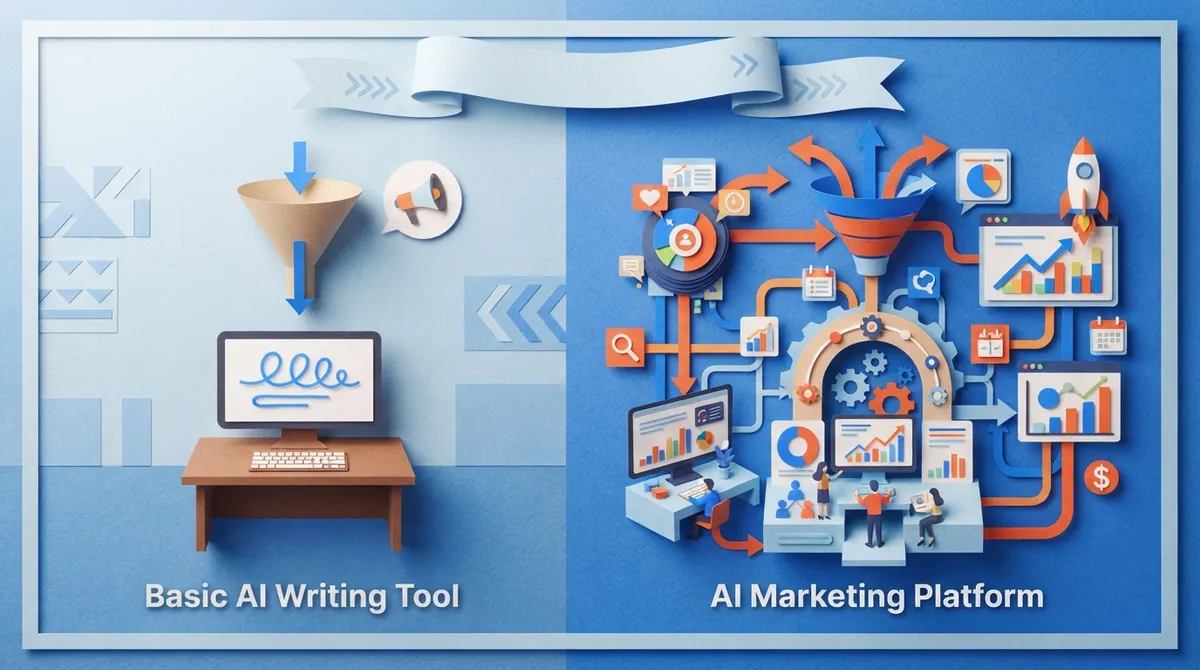
How Is This Different From a Basic AI Writing Tool?
This question comes up a lot, and it is a fair one. A basic AI writing tool helps you write faster. You type a prompt, it gives you a draft, and you edit it yourself.
An SEO content automation platform does much more. It manages the entire pipeline. It handles repeatable workflows, quality checks, publishing schedules, URL mapping, and performance tracking after the article goes live.
Here is a simple way to picture it:
| Feature | Basic AI Writing Tool | AI Marketing Platform for SEO |
|---|---|---|
| Keyword Research | Not included | Built-in with live SEO data |
| Content Calendar | Not included | Automated and visual |
| Publishing | Manual copy-paste | Direct CMS integration |
| Optimization | Limited or none | Real-time SEO scoring |
| Team Collaboration | Often single-user | Unlimited team members |
If you are still comparing tools, this breakdown of the best AI blog post generators in 2026 can help you spot the difference between a simple writer and a true platform.
Can AI-Generated SEO Content Actually Rank in Google?
Yes, it can. But there is a catch. Google does not ban AI content. The company has been clear about this in its own guidance. What it does not allow is scaled, low-value content made just to trick search rankings.
In March 2024, Google updated its spam policies. The focus shifted from punishing “AI-made” content specifically to punishing any content, human or AI, that is mass-produced without real value. So the tool used to write your content matters less than the quality of what gets published.
This means your AI marketing platform needs built-in quality controls. Speed alone will not save you if the content is thin or repetitive.
Quality Checks That Matter Most
- Source verification to confirm facts are accurate
- Duplicate-content detection across your site and the web
- Readability scoring so content is easy to understand
- Originality checks to avoid copied ideas
- Topical coverage to make sure the article actually answers the question
- Internal-link relevance to connect related pages naturally
- Structured-data validation for rich search results
- Post-publication tracking of rankings, traffic, and conversions
A platform that skips these steps is asking for trouble. You can review Google’s own stance in the Search Central guidance on generative AI content to understand what is allowed and what is not.
How Does the Full Automation Workflow Work?
A mature AI marketing platform follows a clear sequence. Here is how it typically flows from start to finish:
- Identify your business goals and search demand
- Group keywords by topic and search intent
- Create a content brief that stands out from competitors
- Generate a full draft using AI assistance
- Add original expertise, data, or evidence
- Run editorial and SEO review
- Publish with technical validation, like schema and metadata checks
- Monitor rankings, traffic, and conversions over time
- Refresh older content when performance drops
This workflow is the backbone of platforms like SEO Rocket. You connect your website, whether it is WordPress, Webflow, Shopify, or Wix, and the system takes care of the rest. Setup usually takes less than 10 minutes. After that, you approve a content calendar and let it run.
If you want to understand how keyword clustering fits into this process, this article on keyword clustering strategies breaks it down step by step.
What Should You Look for When Comparing Platforms?
Choosing the right platform can feel overwhelming. There are dozens of options, and pricing alone ranges wildly. Some SMB tools cost around $19 a month. Enterprise platforms often use custom quotes that can run into the thousands.
Here is what actually matters when comparing your options:
- Quality of the AI model and how natural the writing sounds
- Live or frequently updated SEO data, not stale keyword lists
- Integrations with your CMS and analytics tools
- Brand voice controls so content sounds like you
- Workflow permissions for teams and approvals
- Fact-checking and originality features
- Multilingual support if you serve global audiences
- Transparent reporting on rankings and traffic
- Pricing that scales with usage, not hidden fees
Traditional SEO agencies often charge $3,000 to $5,000 a month for similar services. A platform that automates keyword research, writing, optimization, and publishing for a fraction of that cost is a major shift for small businesses and growing teams.
Why Long-Form Content Still Wins
Many AI tools produce short posts, somewhere between 500 and 1,500 words. That is often not enough to fully answer a search query or beat competitors already ranking on page one.
Longer, well-structured articles tend to perform better because they cover topics in more depth. This also matters for AI search engines like ChatGPT, Perplexity, Claude, Gemini, Copilot, and Grok, which favor comprehensive sources when generating answers. If you want your content referenced inside AI-generated summaries, depth and clarity are non-negotiable. Learn more about this shift in our guide on improving your AI search visibility in 2026.
How Do You Maintain Brand Voice While Automating Content?
This is one of the biggest worries people have. Nobody wants robotic, generic articles that sound like everyone else’s blog. The good news is that the best platforms let you feed in brand context.
This includes your tone of voice, audience details, product information, editorial rules, and approved sources. When a platform understands your business, the output feels less generic and more like something your team actually wrote.
Human review is still important here. Editors should check for factual accuracy, sensitive claims, and brand compliance before anything goes live. Automation should speed up research and drafting, but people stay accountable for the final product. For a closer look at avoiding robotic-sounding content, check out our post on common AI writing mistakes that kill SEO rankings.
Who Benefits Most From an AI Marketing Platform?
Different teams get different wins from this kind of system. Here is a quick breakdown:
- Small SEO agencies can serve more clients without hiring more writers
- In-house marketing teams can hit content goals with limited headcount
- Content managers can keep large blogs updated and consistent
- Digital marketing consultants can offer faster turnaround to clients
- E-commerce specialists can scale product and category page content
- Small business owners can finally afford consistent SEO without a big budget
For agencies specifically, scalability matters a lot. A platform that supports multiple client workspaces and hundreds of monthly articles changes what is possible for a small team.
Why SEO Rocket Stands Out as an AI Marketing Platform
SEO Rocket was built to solve the exact problems we just covered. It combines keyword research, content planning, long-form writing, optimization, and daily publishing into one system. Setup takes under 10 minutes. You connect your website, review keyword opportunities, approve your calendar, and the platform handles the rest.
The Business plan generates one 3,000-word article per day. The Agency plan generates 10 articles per day across 10 client workspaces. Every article includes AI-optimized metadata, internal and external linking, real-time SEO scoring, and auto-fix suggestions. Articles are also structured to help your content get referenced by AI search engines, not just Google.
Compare that to hiring a traditional agency for $3,000 to $5,000 a month, or trying to manage keyword tools, writing tools, and publishing tools separately. SEO Rocket brings it all into one dashboard for about $3 per article. You can explore the full breakdown of platform features or see real writing examples before committing to anything.
If you want to see what other users are saying, browse the customer reviews or learn more how the platform works from start to finish.
Common Mistakes to Avoid With SEO Content Automation
Even the best tools can go wrong if used poorly. Here are mistakes to watch out for:
- Publishing without any human review or fact-checking
- Ignoring search intent and writing generic content
- Skipping internal linking, which hurts site structure
- Using outdated keyword data that no longer reflects demand
- Mass-publishing thin content just to hit a quota
Automation should make your content better and faster, not just faster. Google’s own Search Quality Rater Guidelines emphasize helpfulness and expertise, which should always guide how you use these tools.
Final Thoughts on Choosing Your AI Marketing Platform
An AI marketing platform is not magic. It cannot guarantee first-page rankings on its own. Search performance still depends on technical SEO, site quality, backlinks, and how useful your content really is. But the right platform removes the manual grind, speeds up production, and keeps your content consistent week after week.
If you are ready to stop guessing and start publishing SEO content on autopilot, it might be time to try a system built for exactly this. You can start for $99 a month and see the difference consistent, optimized publishing makes for your traffic. Or, if you want to explore the dashboard first, you can sign up and get started today. For more strategies on scaling your content the smart way, feel free to read our blog for the latest guides and updates.
FAQs
Q: What is an AI marketing platform for SEO content automation?
A: It is a complete system that uses AI and real SEO data to handle keyword research, content planning, writing, optimizing, and publishing. Instead of juggling separate tools, everything works together in one dashboard, saving you tons of time and headaches.
Q: How does an AI marketing platform differ from a basic AI writing tool?
A: A basic writing tool just helps you draft text faster, but you still handle research, editing, and publishing yourself. A full platform manages the entire workflow, including keyword discovery, quality checks, and direct publishing to your website.
Q: Can AI-generated SEO content actually rank in Google?
A: Yes, it absolutely can! Google does not ban AI content, it only penalizes low-value content made purely to game rankings. As long as your content is helpful, accurate, and well-structured, it has a real shot at ranking.
Q: What features should I look for in an AI SEO content platform?
A: Look for live keyword data, search-intent analysis, content briefs, on-page optimization, internal linking, and direct CMS publishing. Quality checks like fact verification and duplicate-content detection are just as important as the writing itself.
Q: How do I automate SEO content without breaking Google’s rules?
A: Keep human oversight in your process, focus on genuine helpfulness, and avoid mass-publishing thin content just to hit a quota. Pair automation with real quality controls, and you will stay well within Google’s guidelines while still growing traffic.