Key Takeaways
-
AI-powered marketing automates tasks like content creation, campaign optimization, and customer engagement, working 24/7 without breaks or training costs.
-
Businesses can generate high-quality content 18-48 times faster using AI tools compared to traditional manual methods.
-
AI marketing platforms reduce content production costs from $100-$500 per article to just $3-$10, offering massive financial savings.
-
Most AI marketing tools excel at data-driven content like informational articles, product descriptions, and SEO-optimized pieces.
-
Marketers can use AI for scalable content production, with 57% planning to expand content generation through AI in the next year.
-
AI enables hyper-personalization by analyzing individual customer behaviors and dynamically adjusting messaging in real-time.
-
Predictive AI can process millions of data points instantly, identifying marketing patterns and forecasting customer behaviors humans might miss.
Marketing has changed forever. In 2026, businesses face a choice: stick with manual marketing methods or embrace AI-powered tools that work faster, smarter, and cheaper. This comparison explores how AI-powered marketing stacks up against traditional approaches and helps you decide which path leads to better results.
AI-powered marketing uses artificial intelligence, machine learning, and automation to handle tasks that once took hours or days. Traditional marketing relies on human effort for research, content creation, campaign management, and analysis. The difference in speed, cost, and results is massive.
Most businesses now use some form of AI marketing. According to Jasper’s State of AI in Marketing 2026 report, 57% of marketers plan to focus on scaling content production using AI in the next 12 months. Another 50% aim to improve personalization and account-based marketing with AI tools. The shift is real and growing.
This article breaks down the key differences between AI-powered and traditional marketing. You’ll learn what AI can do, where it beats manual methods, and when human input still matters. By the end, you’ll know which approach fits your business goals.

What Is AI-Powered Marketing?
AI-powered marketing integrates artificial intelligence into marketing strategies to automate tasks, predict outcomes, and personalize customer experiences. It uses machine learning algorithms to analyze data, generate content, optimize campaigns, and make decisions faster than humans can.
The technology spans multiple areas:
- Content creation: AI generates blog posts, social media updates, emails, and ad copy based on brand voice and audience data
- Campaign optimization: AI adjusts ad bids, targeting, and messaging in real-time to improve performance
- Data analysis: AI processes customer behavior data to identify patterns and predict future actions
- Customer engagement: AI chatbots and virtual assistants handle queries, recommend products, and complete transactions
AI marketing tools work around the clock. They don’t need breaks, training, or motivation. They learn from data and improve over time. This makes them ideal for scaling marketing operations without hiring more staff.
Modern AI marketing platforms like SEO Rocket handle multiple tasks automatically. They research keywords, write long-form articles, optimize content for search engines, and publish directly to websites. This level of automation was impossible five years ago.
Types of AI Used in Marketing
Three main types of AI power modern marketing:
| AI Type | Function | Marketing Use |
|---|---|---|
| Generative AI | Creates new content from prompts | Writing articles, generating images, producing videos |
| Predictive AI | Forecasts future outcomes | Customer behavior prediction, churn analysis, sales forecasting |
| Conversational AI | Understands and responds to language | Chatbots, virtual assistants, customer service automation |
Each type solves specific marketing problems. Generative AI helps scale content production. Predictive AI improves targeting and personalization. Conversational AI handles customer interactions without human staff.
The Search Quality Rater Guidelines now recognize AI-generated content as legitimate when it provides value and meets quality standards. This opens doors for businesses to use AI content at scale.

Traditional Marketing Methods Explained
Traditional marketing relies on human marketers to plan, create, execute, and analyze campaigns. It includes both digital and offline strategies that require manual effort at every step.
Common traditional marketing activities include:
- Manual keyword research using tools like Google Keyword Planner
- Writing blog posts, emails, and social media content by hand
- Creating and scheduling social media posts one by one
- Manually segmenting email lists based on customer data
- Running A/B tests and analyzing results in spreadsheets
- Monitoring campaign performance and making adjustments
Traditional methods work. Many successful businesses built their brands using these approaches. The problem is speed and scale. A marketing team can only do so much in a day.
Writing a single high-quality blog post takes 3-4 hours. Researching keywords for a month of content takes another 2-3 hours. Creating social media posts, designing graphics, and scheduling everything adds more time. A small team might produce 4-8 blog posts per month.
Limitations of Traditional Marketing
Traditional marketing faces several challenges in 2026:
- Time constraints: Manual work limits output and slows growth
- High labor costs: Salaries, benefits, and training add up quickly
- Human error: Mistakes in targeting, messaging, or timing hurt results
- Limited scalability: Growing requires hiring more people
- Inconsistent output: Quality varies based on writer skill and workload
- Slow iteration: Testing and optimization take weeks or months
These limitations don’t mean traditional marketing is bad. It means businesses must choose between speed and manual control. AI-powered marketing offers a third option: speed with quality.
Speed Comparison: AI vs. Traditional Marketing
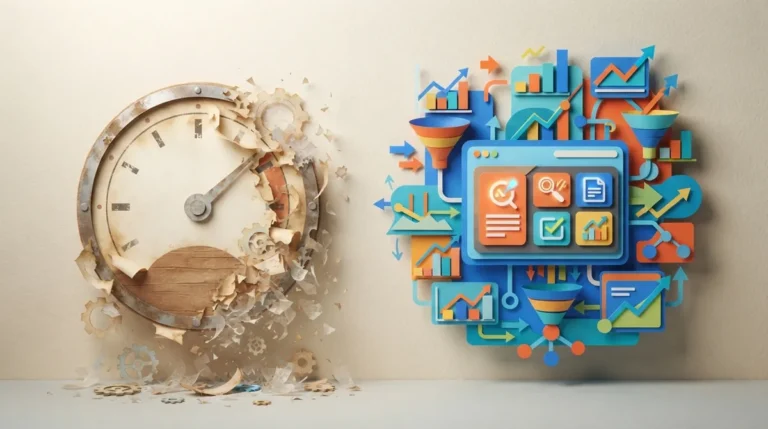
Speed determines how fast you can grow. AI-powered marketing moves significantly faster than traditional methods across every marketing task.
Consider content creation. A human writer produces one blog post in 3-4 hours. An AI tool generates a 3,000-word article in 5-10 minutes. That’s 24-48 times faster. The AI can produce 50+ articles in the time it takes a writer to finish one.
Campaign optimization shows similar speed differences. Traditional marketers review campaign data weekly or monthly and make manual adjustments. AI systems analyze performance in real-time and adjust bids, targeting, and creative elements automatically. Changes happen in seconds, not days.
Real-World Speed Examples
| Task | Traditional Time | AI Time | Speed Gain |
|---|---|---|---|
| Keyword research | 2-3 hours | 5 minutes | 24-36x faster |
| Blog post (3,000 words) | 3-4 hours | 5-10 minutes | 18-48x faster |
| Social media posts (week) | 2-3 hours | 10 minutes | 12-18x faster |
| Email campaign setup | 1-2 hours | 15 minutes | 4-8x faster |
| Campaign analysis | 1-2 hours | Real-time | Continuous |
Speed matters because content compounds. Publishing one article per day for a year produces 365 indexed pages. Traditional methods might produce 50-100 in the same period. More content means more traffic, more leads, and more revenue.
SEO Rocket demonstrates this speed advantage. It generates and publishes one SEO-optimized article per day automatically. Over a year, that’s 365 long-form articles without manual work. Traditional marketing teams struggle to match that output.
Cost Analysis: AI-Powered vs. Traditional Marketing
Cost drives most business decisions. AI-powered marketing costs significantly less than traditional methods when you compare total expenses.
Traditional marketing costs include:
- Salaries for writers, designers, and strategists ($40,000-$80,000+ per person annually)
- Benefits and payroll taxes (30-40% of salary)
- Software tools and subscriptions ($200-$500+ monthly)
- Training and professional development
- Office space and equipment
A small marketing team of 3-4 people costs $200,000-$400,000 per year. Larger teams cost more. Agencies charge $3,000-$10,000+ monthly for content and SEO services.
AI-powered marketing dramatically reduces these costs. Most AI platforms charge $50-$500 monthly. Some offer unlimited usage within their plans. The cost per piece of content drops to $2-$10 instead of $50-$500 for human-written content.
Cost Per Article Comparison
- Freelance writer: $100-$500 per 3,000-word article
- In-house writer: $50-$150 per article (including salary and overhead)
- Agency: $200-$800 per article
- AI platform: $3-$10 per article
The savings multiply with volume. Producing 100 articles with freelancers costs $10,000-$50,000. The same 100 articles through AI cost $300-$1,000. That’s 10-50 times cheaper.
Some businesses worry about quality trade-offs. Modern AI tools produce content that meets or exceeds average human writing quality. The key is choosing platforms that optimize for search engines and reader engagement, like SEO Rocket, which costs $99/month for 30 articles or just $3 per article.
Quality Comparison: Can AI Match Human Creativity?
Quality concerns are valid. Can AI-generated content match human creativity, insight, and emotional connection? The answer depends on the task and the AI tool.
AI excels at data-driven content. It produces excellent informational articles, product descriptions, how-to guides, and analytical pieces. It follows brand voice guidelines consistently and includes all required SEO elements. Quality AI content ranks well in search engines and satisfies reader intent.
According to research, 56% of marketers use AI most commonly for idea generation, with 51% generating multi-asset campaigns. This shows AI has moved beyond simple tasks to creative planning.
Humans still lead in areas requiring deep expertise, original research, personal storytelling, and emotional nuance. A human expert can provide insights AI cannot replicate. First-hand experiences and unique perspectives remain human strengths.
Where AI Wins on Quality
- Consistency: AI maintains the same quality level across all content
- SEO optimization: AI perfectly follows technical SEO requirements
- Data accuracy: AI pulls from current sources and checks facts
- Brand voice adherence: AI never deviates from brand guidelines
- Grammar and style: AI makes fewer spelling and grammar errors
Where Humans Win on Quality
- Original thinking: Humans generate truly novel ideas and approaches
- Emotional resonance: Humans better understand and evoke emotions
- Complex analysis: Humans excel at nuanced interpretation of complex topics
- Personal experience: Humans share authentic first-hand stories
- Creative risks: Humans take stylistic chances that surprise and delight
The best approach combines both. Use AI for high-volume, data-driven content. Use humans for thought leadership, brand storytelling, and content requiring specialized expertise. This hybrid model maximizes quality while maintaining speed and cost efficiency.
Scalability: Growing Your Marketing Efforts
Scalability determines how fast you can grow without breaking your budget. AI-powered marketing scales infinitely. Traditional marketing scales linearly.
Traditional marketing scales by adding people. Want to double content output? Hire another writer. Want to expand to new markets? Hire local marketers. Each expansion requires more salaries, management overhead, and coordination.
AI scales by adding capacity. Most AI platforms offer plans that grow with your needs. Adding more content, campaigns, or markets doesn’t require hiring. It just means upgrading your subscription or adjusting settings.
Consider an agency managing multiple clients. Traditional methods require dedicated team members per client. Managing 10 clients might need 20-30 employees. AI-powered approaches handle 10 clients with the same team size by automating repetitive work.
Scalability Factors
| Factor | Traditional Marketing | AI-Powered Marketing |
|---|---|---|
| Cost to scale | High (new salaries) | Low (subscription upgrade) |
| Time to scale | Weeks to months | Instant |
| Quality control | Harder with more people | Consistent at any scale |
| Management overhead | Increases with team size | Minimal increase |
The data supports this shift. Research shows 57% of marketers plan to focus on scaling content production and operations in the next year. They recognize that growth requires automation, not just more people.
For agencies and multi-brand businesses, SEO Rocket’s Agency plan demonstrates scalable AI marketing. It supports 10 client workspaces and generates 300 articles monthly for $799. That’s 10x the capacity of a single writer at a fraction of the cost.
Personalization Capabilities
Personalization improves conversion rates by showing customers content that matches their interests and behavior. Both traditional and AI-powered marketing can personalize, but AI does it faster and more accurately.
Traditional personalization requires manual audience segmentation. Marketers divide customers into groups based on demographics, behavior, or purchase history. They create different messages for each segment. This works but takes time and limits how granular you can get.
AI personalization happens at the individual level. Machine learning algorithms analyze each customer’s behavior in real-time and adjust messaging automatically. This creates truly one-to-one marketing at scale.
According to 2026 research, 50% of marketers aim to improve personalization and account-based marketing in the next 12 months. AI makes this goal achievable without massive team expansion.
Personalization Examples
- Dynamic content: AI changes website content based on visitor behavior and preferences
- Email timing: AI sends emails when each recipient is most likely to open them
- Product recommendations: AI suggests items based on browsing history and similar customer purchases
- Ad targeting: AI adjusts ad creative and messaging for each audience segment automatically
- Content adaptation: AI rewrites content to match the reader’s industry, company size, or role
AI-powered personalization learns and improves continuously. Traditional methods require periodic reviews and manual updates. This speed advantage means AI stays current with changing customer preferences.
For content marketing, AI tools can generate multiple versions of articles optimized for different audience segments. A single input creates variations that appeal to beginners, experts, budget-conscious buyers, or premium customers.
Data Analysis and Insights
Marketing decisions should be based on data, not guesses. AI-powered marketing analyzes data faster and finds patterns humans miss. Traditional analysis relies on human interpretation, which is slower and sometimes biased.
Traditional data analysis involves pulling reports, creating spreadsheets, building charts, and looking for trends. A marketer might spend hours analyzing campaign performance to find optimization opportunities. By the time they implement changes, the market may have shifted.
AI analyzes data continuously and automatically. It processes millions of data points in seconds, identifies patterns, and makes recommendations or adjustments without human input. This speed turns data into action immediately.
AI Data Analysis Advantages
- Real-time processing: AI analyzes data as it arrives, not days later
- Pattern recognition: AI spots correlations humans overlook
- Predictive modeling: AI forecasts future outcomes based on historical data
- Automated reporting: AI generates reports and dashboards without manual work
- Continuous learning: AI improves accuracy as it processes more data
Predictive AI represents a major advantage. It analyzes customer data to forecast behaviors like purchases, churn, or engagement. This allows marketers to act before problems occur or opportunities disappear.
For SEO and content marketing, AI tools analyze search trends, competitor content, and ranking factors to recommend topics and keywords. Platforms like SEO Rocket automatically discover keyword opportunities and create content calendars based on real search data.
Traditional marketers might review keyword data monthly and manually select topics. AI does this daily and adjusts content strategy automatically based on changing search trends.
Integration and Workflow Efficiency
Marketing tools must work together smoothly. AI-powered platforms typically offer better integration and workflow automation than traditional tool collections.
Traditional marketing workflows involve multiple disconnected tools. Marketers jump between keyword research tools, content management systems, social media schedulers, email platforms, and analytics dashboards. Each requires separate logins, data exports, and manual coordination.
This fragmentation slows work and creates errors. Data doesn’t sync automatically. Tasks fall through the cracks. Team members waste time switching between platforms and updating information in multiple places.
AI-powered marketing platforms consolidate functions into unified systems. Keyword research, content creation, optimization, and publishing happen in one place. Data flows automatically between features without manual transfers.
Workflow Comparison
| Task | Traditional Workflow | AI Workflow |
|---|---|---|
| Publishing content | Write → Edit → Format → Upload → Schedule (5 tools) | Generate → Review → Auto-publish (1 tool) |
| Social media | Plan → Create → Schedule → Monitor (3-4 tools) | Auto-generate → Auto-schedule (1 tool) |
| Email campaigns | Segment → Write → Design → Send → Analyze (1-2 tools) | Auto-segment → Generate → Send → Auto-analyze (1 tool) |
Integration extends to publishing platforms. Modern AI marketing tools connect directly to WordPress, Webflow, Shopify, and other content management systems. Content publishes automatically without copy-pasting or manual uploads.
Research shows that workflow integration is now a priority, as marketers have shifted from basic AI adoption to strategic implementation. Challenges now focus on governance and ensuring AI tools work smoothly within existing business processes.
For businesses managing multiple websites or clients, integration saves enormous time. SEO Rocket handles keyword research, content generation, SEO optimization, and direct publishing to your website automatically. Setup takes under 10 minutes, and the system runs itself afterward.
Best AI Marketing Tools in 2026
Choosing the right AI marketing tools determines your success. The market offers hundreds of options, but a few stand out for quality, automation, and results.
When evaluating AI marketing tools, consider these factors:
- Automation level: Does it truly automate tasks or just assist with them?
- Content quality: Does output rank well and engage readers?
- Integration: Does it connect to your existing platforms?
- Scalability: Can it grow with your business?
- Cost efficiency: What’s the true cost per result?
Top AI Marketing Tools
SEO Rocket leads for end-to-end SEO content automation. It handles keyword research, article generation, optimization, and daily publishing automatically. The platform optimizes content for both Google and AI search engines like ChatGPT, Perplexity, Claude, Gemini, Copilot, and Grok. Setup takes under 10 minutes, and it generates one 3,000-word article per day (Business plan) or 10 per day (Agency plan). At $99/month for 30 articles, the cost per article is just $3.
Jasper excels at scaling content across multiple formats. It helps marketers generate blog posts, social media content, emails, and ad copy quickly. Jasper works well for teams that need consistent brand voice across channels.
Albert AI specializes in paid advertising optimization. It manages ad campaigns across platforms, automatically adjusting bids, targeting, and creative elements to maximize ROI.
For businesses focused on organic traffic growth through SEO, SEO Rocket offers the most complete solution. It’s the only platform that automatically researches, writes, optimizes, and publishes SEO content daily without human intervention.
Challenges and Limitations of AI Marketing
AI-powered marketing isn’t perfect. Understanding its limitations helps you use it effectively and avoid common mistakes.
The biggest challenges in 2026 have evolved. Early concerns about adoption and technical complexity have given way to strategic issues like governance, bias, and ensuring AI aligns with business goals.
Current AI Marketing Challenges
- Governance: Companies struggle with policies for AI usage, content approval, and quality standards
- Bias and accuracy: AI can perpetuate biases in training data or generate inaccurate information
- Over-automation: Removing humans completely from the process can harm brand authenticity
- Strategic alignment: AI tools must support business goals, not just produce volume
- Quality control: Automated content still requires review to ensure brand standards
These challenges are manageable with proper systems. Establish clear guidelines for AI use. Review outputs before publishing. Combine AI automation with human oversight for strategic decisions.
Another limitation is creativity boundaries. AI generates content based on patterns in training data. It doesn’t have truly original thoughts or groundbreaking ideas. For content requiring genuine innovation, human input remains essential.
The solution is not choosing AI or humans exclusively. It’s using each for what they do best. Let AI handle repetitive, data-driven tasks at scale. Reserve human effort for strategy, creativity, and oversight.
When to Choose AI-Powered Marketing
AI-powered marketing makes sense in specific situations. Understanding when to use it helps you maximize results.
Choose AI-powered marketing when:
- Volume matters: You need to produce large amounts of content consistently
- Speed is critical: You must launch campaigns or content quickly
- Budget is limited: You can’t afford large marketing teams or agencies
- Data is available: You have customer data to fuel personalization and optimization
- Scaling is a goal: You plan to grow marketing output significantly
- Tasks are repetitive: Much of your work follows predictable patterns
- 24/7 operations needed: You serve global customers across time zones
AI-powered marketing particularly benefits:
- Small businesses: Get enterprise-level marketing capabilities on a startup budget
- Agencies: Serve more clients with the same team size
- E-commerce: Generate product descriptions and category content at scale
- Content publishers: Maintain consistent publishing schedules without writer burnout
- SaaS companies: Create educational content to drive organic traffic
For SEO-focused businesses, AI-powered content generation accelerates growth. Publishing consistently is the key to SEO success, and AI makes daily publishing achievable. Learn more about SEO content writing strategies to maximize your results.
When to Stick with Traditional Marketing
Traditional marketing still wins in certain situations. Knowing when human-driven approaches work better prevents costly mistakes.
Choose traditional marketing when:
- Brand storytelling is critical: Your competitive advantage comes from unique brand narrative
- Relationships matter most: Success depends on personal connections and trust-building
- Content requires deep expertise: Topics need specialized knowledge AI can’t replicate
- Creativity drives differentiation: Breakthrough creative ideas separate you from competitors
- Authenticity is paramount: Audiences value personal voice and first-hand experience
Industries where traditional marketing often works better:
- Luxury brands: High-end products require carefully crafted brand experiences
- Professional services: Legal, medical, and financial services need expert human insights
- B2B high-ticket sales: Complex sales cycles require relationship building
- Creative agencies: Original creative work is the product itself
Even in these cases, hybrid approaches often work best. Use AI for research, ideation, and first drafts. Use humans for final creative direction, relationship management, and strategic decisions.
The Hybrid Approach: Best of Both Worlds
The smartest marketing strategy in 2026 combines AI automation with human expertise. This hybrid approach delivers speed, scale, and quality.
Here’s how to build an effective hybrid marketing system:
Step 1: Automate Repetitive Tasks
Use AI for keyword research, content generation, social media scheduling, email personalization, and campaign optimization. These tasks follow patterns AI handles well.
Step 2: Reserve Human Effort for Strategy
Let humans focus on brand positioning, creative direction, strategic planning, relationship building, and high-stakes decisions. These require judgment AI can’t match.
Step 3: Implement Review Processes
Have humans review AI outputs before publishing. Check for accuracy, brand alignment, and quality. This catches errors while maintaining speed advantages.
Step 4: Measure and Optimize
Track which tasks work best with AI versus human effort. Adjust your approach based on results, not assumptions.
Step 5: Train Your Team
Help your marketing team understand how to work with AI tools effectively. This maximizes productivity and reduces resistance to change.
The hybrid model works across marketing functions. Generate blog posts with AI, but have editors review them. Use AI for social media scheduling, but humans create the overall content strategy. Let AI optimize ad campaigns, but humans set objectives and budgets.
For content marketing specifically, tools like SEO Rocket exemplify the hybrid approach. The platform automates writing, optimization, and publishing, but allows human review and editing before content goes live. This combines AI speed with human quality control.
Future Trends in AI Marketing
AI marketing continues evolving rapidly. Understanding coming trends helps you stay ahead of competitors and adapt your strategy proactively.
Key trends shaping AI marketing in 2026 and beyond:
AI Search Engine Optimization
Traditional SEO focused on Google rankings. In 2026, 43% of marketers prioritize optimization for AI search engines like ChatGPT, Perplexity, Claude, Gemini, Copilot, and Grok. Content must be structured so AI models can reference it as trusted sources in their answers. Discover how to improve your AI search visibility for better results.
Hyper-Personalization at Scale
AI enables one-to-one marketing for thousands or millions of customers. Future systems will create completely unique experiences for each visitor based on real-time behavior, preferences, and context.
Predictive Customer Journey Mapping
AI will predict each customer’s path from awareness to purchase and automatically deliver the right content at each stage. This eliminates guesswork from funnel optimization.
Autonomous Campaign Management
AI will run entire marketing campaigns with minimal human input. Marketers will set goals and budgets, then AI will handle strategy, execution, optimization, and reporting.
Real-Time Content Adaptation
Websites and marketing materials will change in real-time based on visitor behavior, market conditions, and competitive activity. Static content will become obsolete.
The direction is clear: marketing becomes more automated, more personalized, and more predictive. Businesses that embrace these trends early gain significant competitive advantages.
For agencies and marketing teams, staying current with AI capabilities is essential. Explore the latest AI marketing updates to see what’s new and what’s coming.
The future belongs to marketers who combine AI tools with strategic thinking. Technology handles execution. Humans guide direction. Together, they create marketing that’s faster, smarter, and more effective than ever before.
Ready to experience the power of AI-powered marketing for your business? Sign up for SEO Rocket and start generating SEO-optimized content automatically. Your first article can be live within hours, not weeks.
FAQs
Q: What are the best AI marketing tools in 2026?
A: The best AI marketing tools in 2026 include SEO Rocket for automated SEO content generation, Jasper for multi-format content creation, and Albert AI for paid ad optimization. SEO Rocket stands out by handling keyword research, article writing, optimization, and daily publishing automatically for just $99/month. Choose tools based on your specific needs: content production, campaign optimization, or customer engagement.
Q: How does AI-powered marketing save money compared to traditional methods?
A: AI-powered marketing reduces costs by 90% or more compared to traditional methods. A typical marketing team costs $200,000-$400,000 annually, while AI platforms cost $50-$500 monthly. AI-generated articles cost $3-$10 each versus $100-$500 for human-written content. The savings multiply with scale, making AI ideal for businesses that need high content volume on limited budgets.
Q: Can AI-generated content rank as well as human-written content in search engines?
A: Yes, AI-generated content ranks well in search engines when properly optimized. Modern AI tools like SEO Rocket produce 3,000+ word articles optimized for both Google and AI search engines like ChatGPT and Perplexity. The key is using platforms that follow SEO best practices, include proper optimization, and generate content that satisfies user intent. Quality AI content meets search engine guidelines and performs comparably to human-written articles.
Q: Should I use AI marketing or keep my traditional marketing team?
A: The best approach combines both AI automation and human expertise. Use AI for repetitive tasks like content generation, campaign optimization, and data analysis. Reserve human effort for strategy, creative direction, and relationship building. This hybrid model delivers the speed and cost savings of AI with the strategic thinking and creativity of humans. Most successful businesses in 2026 use AI to augment their teams, not replace them.
Q: How long does it take to see results from AI-powered marketing?
A: AI-powered marketing delivers faster results than traditional methods. Content can be published within hours instead of days or weeks. Campaign optimizations happen in real-time instead of weekly. For SEO specifically, consistent daily publishing through AI tools like SEO Rocket creates compounding growth, with noticeable traffic increases within 3-6 months as articles index and rank. The key is consistency, which AI automation makes achievable.