
Key Takeaways
-
Full SEO automation platforms handle the entire workflow from keyword research to publishing, while basic AI tools only generate text—leaving keyword research, planning, optimization, and publishing as manual tasks that consume significant time.
-
Longer, well-researched articles (3,000+ words) significantly outperform thin content; Google penalizes scaled content abuse, making depth and originality essential for ranking rather than quantity alone.
-
Full automation platforms cost around $99/month for daily article production and publishing, which calculates to roughly $3 per article—substantially cheaper than traditional agency retainers of $3,000-$5,000/month when accounting for hours spent on manual tasks.
-
AI-generated content is allowed by Google if it's helpful, original, and made for readers; the key is human fact-checking and editing to prevent made-up facts, outdated information, and keyword stuffing that triggers spam policies.
-
Modern automation platforms must optimize for both Google rankings and AI search visibility (ChatGPT, Perplexity, Claude) by structuring content to be picked up as trusted sources in AI assistant responses, a feature basic copywriting tools completely miss.
-
Basic AI copywriting tools have critical limitations including fabricated facts, outdated training data, generic wording, inconsistent brand voice, and weak differentiation from competitors—problems solved by platforms with built-in SEO quality checks.
So you’re trying to figure out if an AI copywriting tool is worth your time, or if you need something bigger. Good question! It’s one we hear all the time from business owners, marketers, and agencies who are tired of staring at blank documents. Let’s walk through this together, in plain language, so you can make a smart choice for your website and your sanity.
An AI copywriting tool helps you write things faster. Think product descriptions, blog posts, headlines, and ad copy. But here’s the thing nobody tells you upfront: writing the words is only half the battle. You still need keyword research, content planning, SEO optimization, and publishing. That’s where things get interesting, and where a full SEO content automation platform starts to look a lot more appealing.
In this article, we’ll compare basic AI copywriting tools against complete automation systems. We’ll cover what each one actually does, who they’re best for, and how much they cost. By the end, you’ll know exactly which path fits your goals. Let’s get into it.

What Is an AI Copywriting Tool, Really?
An AI copywriting tool uses generative AI to create or improve marketing text. This includes SEO articles, product pages, landing pages, meta descriptions, and even FAQs. You type in a topic or a prompt, and the tool spits out a draft.
Most basic tools stop there. You get words on a page, but you’re still on your own for everything else. That means you still have to:
- Find the right keywords to target
- Check what’s already ranking on Google
- Build an outline that covers the topic well
- Add internal and external links
- Write meta titles and descriptions
- Publish the article to your website
- Track how it performs over time
That’s a lot of extra work hiding behind a simple text generator. If you’ve ever used one of these tools, you know the drill. You get a draft, then you spend another hour fixing it up and figuring out where it goes next.
What Is Full SEO Content Automation?
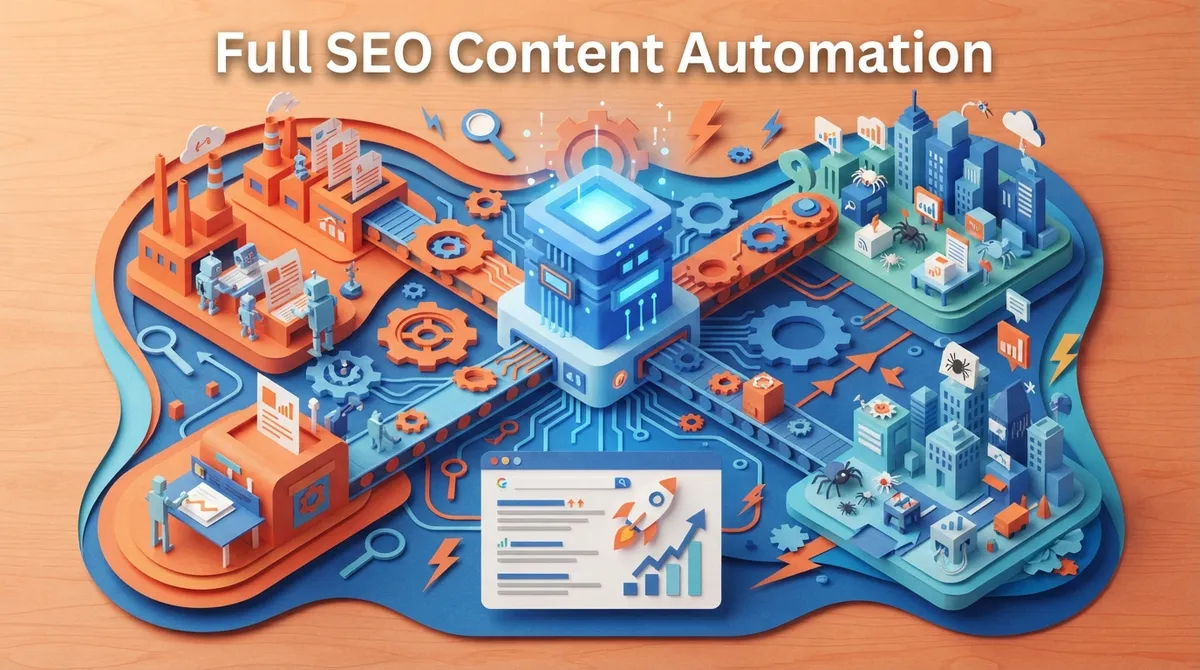
Full automation takes the copywriting piece and wraps it inside a complete system. Instead of just generating text, the platform handles the entire journey from keyword idea to published article.
Here’s what that looks like in practice, using a system like SEO Rocket’s approach:
- You connect your website (WordPress, Webflow, Shopify, or Wix)
- The platform finds keyword opportunities using real search data
- You approve a content calendar for the weeks or months ahead
- The system writes a full, long-form article based on SEO best practices
- It adds images, internal links, and optimized metadata automatically
- The article gets published to your site, no copy-pasting needed
- You track rankings and traffic as new content compounds over time
See the difference? One is a helper. The other is a system that runs itself. If you want to understand this shift more deeply, our guide on what content automation software actually does breaks it down further.
AI Copywriting Tool vs. Full Automation: Side-by-Side
Let’s put these two options next to each other. Sometimes a table makes everything click faster than paragraphs ever could.
| Feature | Basic AI Copywriting Tool | Full SEO Automation Platform |
|---|---|---|
| Keyword research | Not included, done separately | Built-in with live SEO data |
| Content planning | Manual calendar needed | Automated content calendar |
| Article length | Often 500-1,500 words | 3,000+ words daily |
| Publishing | Copy-paste required | Direct publishing to your CMS |
| SEO optimization | Minimal or none | Real-time scoring and auto-fixes |
| AI search visibility | Rarely considered | Built for AI Overviews and chatbots |
| Setup time | Quick, but ongoing manual work | Under 10 minutes, then hands-off |
| Typical monthly cost | $20-$70 for basic plans | $99/month for full automation |
Notice something? A basic tool might look cheaper at first. But once you add up the hours spent researching keywords, planning topics, editing drafts, and publishing manually, the “cheap” option starts costing a lot more in time.
Why Word Count and Consistency Matter
Here’s a fact worth remembering: producing lots of thin content without adding value can count as scaled content abuse, according to Google Search Central. That means quantity alone won’t help you rank. You need depth, originality, and real usefulness.
This is why longer, well-researched articles tend to perform better. Short 500-word posts rarely cover a topic fully. Readers bounce, and Google notices. A 3,000-word article that answers real questions has a much better shot at ranking and staying there.
Consistency also matters more than people realize. Publishing one great article and then going quiet for a month won’t build momentum. Search engines reward sites that show up regularly with fresh, helpful content. Our post on daily blog posting strategies that actually drive results covers this in more detail if you want to dig deeper.
Does Google Actually Allow AI-Generated Content?
Yes, with some conditions. Google has stated that using AI to help create content is not against its guidelines. What matters is whether the content is helpful, original, and made for real people. Content created mainly to game the rankings breaks Google’s spam policies.
That means AI drafts still need a human touch. Fact-checking, editing, and adding real expertise make the difference between content that ranks and content that gets ignored. You can read Google’s own guidance on this topic and also check the Search Quality Rater Guidelines for a deeper look at how quality gets evaluated.
Common Limitations of Basic AI Copywriting Tools
Before you commit to any tool, it helps to know the weak spots. Here are the issues that show up most often:
- Made-up facts that sound convincing but aren’t true
- Outdated information pulled from old training data
- Generic wording that sounds like everyone else’s content
- Weak differentiation from pages already ranking on page one
- Inconsistent brand voice across different articles
- Overuse of keywords that feels forced and spammy
These aren’t reasons to avoid AI entirely. They’re reasons to pick a system built with SEO and quality checks baked in, rather than a bare-bones text generator. Our article on blog writer AI mistakes that kill your SEO rankings covers these pitfalls in more depth.
How to Choose the Right Tool for Your Situation
Different people have different needs. Let’s break it down by who you are and what probably makes sense.
1. Small SEO Agencies
You’re juggling multiple clients and don’t have time to write everything by hand. A full automation platform with multi-client support saves you from hiring more writers. Look for tools that offer agency plans with workspace management, like the ones covered in our guide on the best SEO software for agencies.
2. In-House Marketing Teams
You need to show results without expanding your headcount. Automation that handles research, writing, and publishing frees up your team for strategy and campaigns instead of manual content grinding.
3. Content Managers
You’re responsible for a large site with dozens or hundreds of pages. Consistency is your biggest challenge. A tool that publishes daily and keeps SEO quality steady solves this problem directly.
4. Digital Marketing Consultants
You want to offer more value without more hours. Full automation lets you deliver faster results to clients, which helps you stand out from consultants still doing everything by hand.
5. E-commerce SEO Specialists
You need product and category pages optimized at scale. Automation tools that handle metadata, internal linking, and keyword targeting in bulk save enormous amounts of time.
6. Small Business Owners
You don’t have a marketing department. You need something affordable that just works. A simple monthly plan that handles everything, without needing a dedicated hire, is the clear winner here.
What a Complete Automation Workflow Looks Like
If you’re ready to move beyond basic copywriting help, here’s the practical sequence that works well for most teams:
- Identify what your audience is searching for and pick target keywords
- Generate a content brief that covers search intent
- Create an outline and a full draft based on that brief
- Add expert insights, examples, and credible sources
- Optimize titles, meta descriptions, headers, and internal links
- Review the content for accuracy and brand voice
- Publish and then monitor rankings and traffic over time
Doing all seven steps manually, every single day, isn’t realistic for most teams. That’s exactly the gap that full automation platforms are built to close. If you want a deeper breakdown of this workflow, check out how content automation scales organic traffic.
Pricing: What Should You Actually Expect to Pay?
Pricing varies a lot depending on what you’re buying. Here’s a general breakdown based on current market comparisons:
| Solution Type | Typical Monthly Cost | What You Get |
|---|---|---|
| Entry-level AI writing tool | $20-$70/month | Text generation only, manual everything else |
| Advanced SEO writing suite | $100-$300/month | Some SEO data, still requires manual publishing |
| Full automation platform | $99/month (business plan) | Keyword research, writing, optimization, publishing |
| Traditional SEO agency | $3,000-$5,000/month | Human-managed strategy and content, slower turnaround |
When you compare a $99 monthly plan that produces 30 fully optimized articles against an agency retainer of thousands of dollars, the value gap becomes pretty clear. That works out to roughly $3 per long-form article, something worth checking out on the pricing page if you want exact numbers.
Why AI Search Visibility Changes the Game
Here’s something a lot of basic copywriting tools miss entirely. Search isn’t just about Google anymore. People are asking questions inside ChatGPT, Perplexity, Claude, Gemini, and other AI assistants. If your content isn’t structured to be picked up by these platforms, you’re missing a growing slice of traffic.
Automation platforms built for 2026 and beyond need to think about both traditional rankings and AI visibility. This means structuring content so it can be referenced as a trusted source inside AI answers. Our article on improving your AI search visibility walks through the specifics if you want to go deeper on this topic.
Features Worth Checking Before You Commit
Not every platform is built the same. Here’s a quick checklist to run through before picking anything:
- Does it include real keyword research, or just text generation?
- Can it publish directly to your CMS, or do you copy-paste everything?
- Does it check for originality and factual accuracy?
- Can multiple team members collaborate without extra fees?
- Does it support your specific platform, like Shopify or Webflow?
- Is there a visual calendar so you can plan content ahead of time?
If a tool checks most of these boxes, it’s probably a real automation platform rather than a simple writing assistant. You can browse examples of what fully optimized output looks like on the writing examples page.
The Bottom Line
A basic AI copywriting tool can help you write faster. But it leaves the heavy lifting of research, planning, optimization, and publishing entirely on your shoulders. For anyone serious about consistent organic traffic, that’s a lot of manual work stacked on top of a tool that was supposed to save time.
Full SEO content automation flips that equation. It handles the entire pipeline, from finding keyword opportunities to publishing polished, long-form articles every single day. And with AI search becoming a bigger part of how people find information, having a system built for both Google and AI platforms just makes sense.
Ready to stop patching together tools and start publishing consistently? You can start for $99/month and see your content calendar fill up automatically, or explore read our blog for more ways to grow your organic traffic without the manual grind. When you’re ready to see it in action, go ahead and sign up today.
FAQs
Q: What is an AI copywriting tool for SEO?
A: It’s a tool that uses generative AI to write or improve marketing text, like blog posts, product pages, and meta descriptions. The best ones for SEO also pull in keyword data and search trends, so you’re not just getting words, you’re getting words that actually target what people search for.
Q: Can AI-generated content rank on Google?
A: Absolutely, yes! Google has said AI-assisted content is totally fine as long as it’s helpful, original, and made for real readers. What matters most is quality and usefulness, not whether a human or an AI typed the first draft.
Q: Is using AI to write SEO articles against Google’s guidelines?
A: Nope, not at all. Google only has an issue with content created mainly to manipulate rankings, especially mass-produced pages with no real value. Thoughtful, well-reviewed AI content is completely welcome.
Q: How much does an AI copywriting tool cost?
A: Basic tools usually run $20 to $70 a month, but that’s just for text generation. Full automation platforms that handle research, writing, and publishing typically cost around $99 a month and often save way more time than they cost.
Q: What’s the difference between an AI copywriting tool and an AI content automation platform?
A: A copywriting tool just helps you write text, leaving research, planning, and publishing up to you. A full automation platform handles the entire journey, from keyword discovery to daily publishing, so you’re not stuck doing the manual parts yourself.