
Key Takeaways
-
SEO agency software must support multiple client workspaces, white-label dashboards, and team permissions to prevent manual work that erodes profit margins when managing 10+ clients simultaneously.
-
Automated content platforms that handle keyword research, writing, optimization, and direct publishing can replace hiring additional writers, reducing content costs from $3,000-$5,000/month to a fraction while enabling daily publishing.
-
Modern SEO content must be optimized for both Google and AI search engines like ChatGPT and Perplexity, requiring clear writing, fact-backing, and proper structure to capture growing traffic from AI-powered searches.
-
Building a lean software stack of 4-5 core tools (research, crawler, automation, reporting) for $400-$600/month is more efficient than piecing together 10+ overlapping tools that consume time and budget.
-
Direct-to-CMS publishing and automated content calendars eliminate hours of manual copy-pasting and spreadsheet work, allowing agencies to scale client accounts without proportionally increasing team size.
-
White-label reporting dashboards are a critical client retention feature that distinguishes professional agencies; prioritize tools offering branded reporting to reduce client confusion and prove ROI consistently.
Running an SEO agency is hard. You juggle keyword research, content writing, audits, and reports for every single client. Then you do it all again the next month. If you have ever felt like you’re drowning in spreadsheets and browser tabs, you are not alone. That’s exactly why seo agency software exists, and why choosing the right one can change how your whole business runs.
In 2026, agencies are expected to do more with less. Clients want faster results. Teams want fewer tools. And search engines, including AI tools like ChatGPT and Perplexity, keep changing the rules. The good news? The right software can handle most of the heavy lifting for you. In this guide, we will break down what SEO agency software actually does, what features matter most, and how to pick a stack that helps you scale without burning out your team.

What Is SEO Agency Software?
SEO agency software is any tool built to help agencies manage SEO work across many clients at once. Think of it as your command center. Instead of juggling ten different logins, you get one place to plan keywords, write content, check technical issues, and report results.
Most agencies use software to manage a few key jobs:
- Finding keywords worth targeting for each client
- Writing and optimizing blog posts and landing pages
- Running technical audits to catch site errors
- Tracking rankings over time
- Building backlinks or monitoring outreach
- Creating branded reports clients can actually understand
These tools save agencies from doing everything by hand. And in a market where clients expect fast, visible results, that speed matters more than ever.
Why Agencies Need More Than Basic SEO Tools
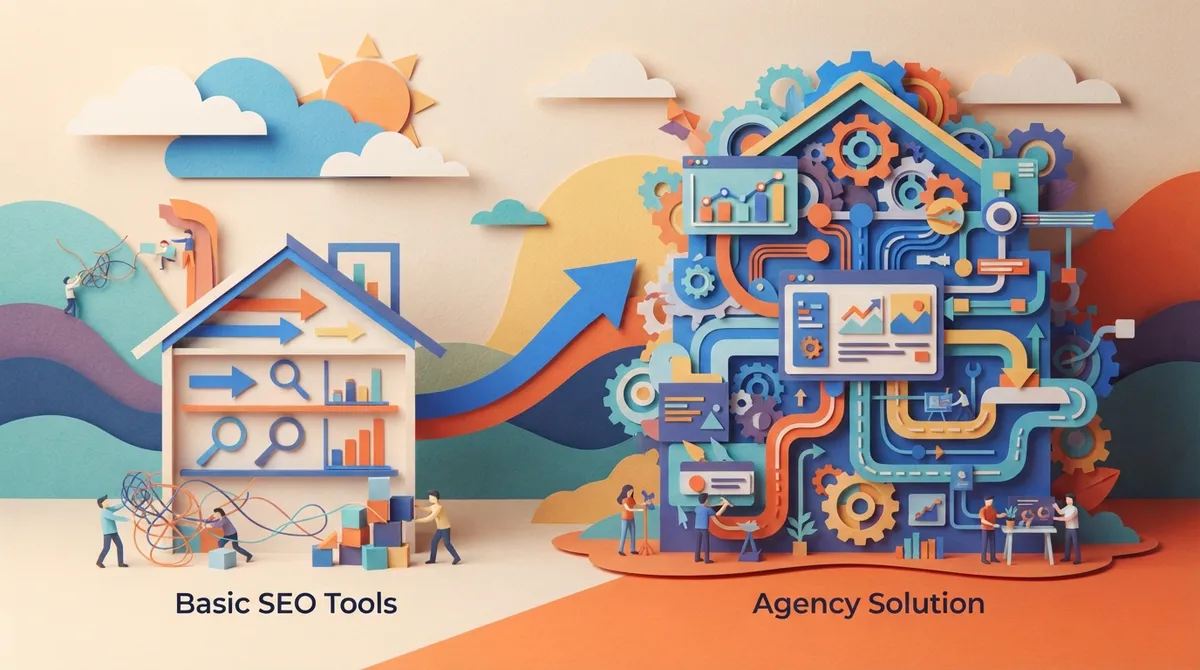
Basic SEO tools are built for one website. Agency software is built for many websites at once. That’s a big difference.
If you’re running SEO for 10, 20, or 50 clients, you need software that supports things like:
- Separate workspaces for each client
- White-label dashboards with your agency’s branding
- Bulk content creation across multiple sites
- Team permissions so staff only see what they need
- Reporting that clients can view without confusion
Without these features, agency owners end up doing manual work that eats their profit margins. This is where SEO content automation has become a game changer. Instead of hiring more writers or researchers, agencies can lean on automated systems to handle repetitive work at scale.
Key Features to Look for in SEO Agency Software
Not all software is built the same way. Here are the features that actually matter in 2026.
1. Built-In Keyword Research
Good software should show you real keyword opportunities, not guesses. Look for tools that give you search volume, competition level, and search intent. This helps you avoid wasting time on keywords that will never rank.
2. Automated Content Planning
Manually planning content calendars for multiple clients is exhausting. The best platforms let you build a content plan once, then automatically turn keywords into scheduled articles. This is a core part of how SEO Rocket’s automated system works, where keywords added to a calendar get turned into full articles without extra manual steps.
3. Content Optimization Scoring
Your content needs to compete with pages already ranking on page one. Tools that compare your draft to top-ranking pages help you close gaps in topic coverage before you publish.
4. Technical Site Audits
Broken links, slow pages, and crawl errors quietly kill rankings. A strong crawler tool catches these issues so you can fix them before they cost your client traffic.
5. White-Label Reporting
Clients want proof that your work is paying off. White-label reporting lets you send branded dashboards instead of generic exports. This single feature is often the deciding factor for agencies choosing new software.
6. Direct Publishing
Copy-pasting content into WordPress or Shopify wastes hours every week. Software that publishes directly to your client’s website removes that entire step.
How SEO Content Automation Fits Into the Agency Stack
The SEO agency world has changed a lot since 2023. Back then, most software just gave you data. You still had to do the writing, editing, and publishing yourself.
Now, automation handles much more of that work. Modern platforms can:
- Discover keyword opportunities automatically based on live search data
- Build a content calendar without manual spreadsheet work
- Write full, SEO-optimized articles based on approved keywords
- Add internal links, images, and metadata automatically
- Publish content directly to the client’s website on a set schedule
This shift matters because it changes what “scaling an agency” actually means. You no longer need to hire five more writers to double your content output. You need software that can do it for you, consistently, every single day.
If you want a deeper look at how this content loop works from research to publishing, our guide on how content automation scales organic traffic breaks it down step by step.
Popular SEO Agency Tools in 2026 (Pricing Snapshot)
Agencies often build a “stack” of a few tools instead of relying on just one. Here’s a snapshot of common pricing points agencies are working with this year.
| Tool Type | Example Starting Price (2026) | Best For |
|---|---|---|
| All-in-one research platform | ~$140/month | Keyword & competitor data |
| Backlink & crawl platform | ~$129/month | Link analysis and audits |
| Site crawler tool | Free / ~£259 per year | Technical SEO audits |
| Content optimization tool | ~$99/month | On-page content scoring |
| White-label reporting tool | ~$65-$79/month | Client dashboards |
| AI content automation platform | ~$99/month | Full content production & publishing |
As you can see, stacking separate tools adds up fast. Many agencies end up paying $400 to $600 a month just for the basics, before they even hire a writer. This is one reason more agencies are shifting toward all-in-one platforms that combine research, writing, and publishing in a single subscription.
Building a Software Stack That Doesn’t Break the Bank
You don’t need every tool on the market. You need the right combination for your workflow. Here’s a simple approach many small and mid-size agencies use:
- Pick one research tool for keyword and competitor data
- Pick one crawler for technical audits
- Pick one automation platform to handle writing, optimizing, and publishing
- Pick one reporting tool with white-label dashboards
- Review your stack every quarter and cut what you don’t use
This keeps your monthly software costs predictable while still covering every part of the SEO process. It also makes onboarding new team members easier, since they only need to learn a few tools instead of ten.
Why AI Search Visibility Matters Now
SEO in 2026 isn’t just about Google anymore. More people are searching through AI tools like ChatGPT, Perplexity, Gemini, and Copilot. If your client’s content isn’t structured to be picked up by these platforms, they’re missing a growing chunk of traffic.
This is a major shift in how agency software needs to work. Content has to be written clearly, backed by facts, and structured so AI systems can pull it into their answers. Our article on improving AI search visibility in 2026 covers this in more detail if you want to go deeper.
According to Google’s own Search Quality Rater Guidelines, content quality, expertise, and trustworthiness remain central to how pages get evaluated, even as AI search grows. That means the fundamentals of good SEO writing still matter, no matter which platform is doing the searching.
Why Agencies Are Choosing Full Automation Over Manual Work
Let’s be honest. Manually writing, optimizing, and publishing content for multiple clients every week is exhausting. It’s also expensive. Traditional agencies charge clients $3,000 to $5,000 a month for content services that could be automated for a fraction of the cost.
Here’s why more agencies are switching to automated platforms:
- Daily publishing keeps client sites active without constant manual work
- Automated keyword research removes the guesswork
- Built-in optimization means less back-and-forth editing
- Direct publishing saves hours of copy-pasting every week
- Lower cost per article means better profit margins for the agency
SEO Rocket was built specifically for this shift. It handles keyword discovery, competitor analysis, full article writing, optimization, and direct publishing to platforms like WordPress, Webflow, Shopify, and Wix. Setup takes under 10 minutes, and the system runs daily without needing constant supervision. You can explore the full feature set here to see how it fits into an agency workflow.
For agencies managing multiple clients, the Agency plan supports 10 client workspaces and up to 300 articles a month, all optimized for both Google and AI search engines. That’s a level of scale most manual teams simply cannot match without hiring a much bigger staff.
Common Mistakes Agencies Make With SEO Software
Even good software won’t help if it’s used the wrong way. Here are mistakes to avoid:
- Buying too many overlapping tools instead of one solid stack
- Ignoring white-label reporting until a client asks for it
- Skipping content optimization checks before publishing
- Relying only on manual writing when automation could save hours
- Forgetting to plan content calendars weeks in advance
Avoiding these mistakes early saves agencies a lot of stress later. Planning ahead, using automation where it makes sense, and keeping your tool stack simple are the biggest wins you can make this year.
How to Choose the Right Software for Your Agency
Every agency is different, but here’s a simple checklist to guide your decision:
- Does it support multiple client workspaces?
- Can it automate keyword research and content planning?
- Does it offer white-label reports?
- Can it publish directly to your client’s CMS?
- Is the pricing predictable as you scale?
- Is the content optimized for both Google and AI search engines?
If a tool checks most of these boxes, it’s worth a trial run. If you want to see real examples of what automated, optimized content looks like before publishing, check out these writing examples to compare quality and structure.
Final Thoughts
SEO agency software has come a long way from simple keyword trackers. In 2026, the best tools combine research, writing, optimization, and publishing into one smooth system. That means less manual work, faster turnaround for clients, and better margins for your agency.
Whether you’re a small agency trying to punch above your weight, an in-house team stretched thin, or a consultant looking to offer more value, the right software can make all the difference. If you’re ready to see how full automation can transform your content output, you can start for $99/month and put your SEO content on autopilot starting today. You can also read more strategy breakdowns on our blog to keep learning as the industry evolves.
FAQs
Q: What is SEO agency software used for?
A: It helps agencies manage SEO work across many clients at once, covering keyword research, content creation, technical audits, rank tracking, and reporting. Instead of juggling separate tools, agencies get one system that handles most of the daily grind for them.
Q: What features should SEO content automation software have for agencies?
A: Look for built-in keyword research, automated content planning, content optimization scoring, technical audits, white-label reporting, and direct publishing to your client’s website. These features together save agencies dozens of hours every month.
Q: How does SEO content automation help agencies scale content production?
A: Automation removes the need to hire more writers every time you add a client. Platforms can research keywords, write full articles, optimize them, and publish daily, which means you can grow your client list without growing your team as fast.
Q: What is the difference between SEO software and SEO agency software?
A: Regular SEO software is usually built for one website at a time. SEO agency software adds multi-client workspaces, white-label branding, and reporting tools designed to manage many clients from a single dashboard.
Q: Can AI write SEO content for agencies automatically?
A: Yes, modern platforms can research keywords, write full-length articles, add internal links and images, and publish directly to a client’s site without manual writing. This is exactly the kind of workflow that platforms like SEO Rocket are built around.