
Key Takeaways
-
NAP consistency (Name, Address, Phone) must match across all online platforms as inconsistencies confuse search engines and directly hurt rankings and local visibility.
-
Missing location pages and service-area content are major ranking gaps; audit findings should directly fuel a content calendar to capture nearby search traffic.
-
Automation tools now complete audits in minutes instead of hours by extracting data, checking links, and generating prioritized reports, freeing time for implementing fixes.
-
Run full audits at least annually, quarterly if in competitive markets; treat audits as ongoing cycles of identification, fixes, publishing, and monitoring rather than one-time events.
-
Google Business Profile accuracy (hours, categories, photos, descriptions) is critical as it's often the first thing customers see and directly affects trust and rankings.
-
Technical SEO issues like broken links, slow pages, and poor mobile experience quietly block local content from ranking and must be checked alongside citations and reviews.
Running a local business without a local SEO audit is like driving with your eyes closed. You might get somewhere, but you’re probably going to crash into a competitor who’s paying closer attention. If you own a shop, run an agency, or manage content for local clients, a local SEO audit tells you exactly what’s working and what’s quietly costing you customers.
This guide walks you through what a local SEO audit actually covers, why it matters more than ever in 2026, and how automation is changing the way audits get done. We’ll keep things simple and practical, whether you’re a small business owner checking your own listings or an agency managing audits for dozens of clients.

What Is a Local SEO Audit?
A local SEO audit is a full check-up of how your business shows up in local search. It looks at your Google Business Profile, your website, your reviews, and more. The goal is simple: find what’s holding you back from ranking in the local pack, Google Maps, and local organic results.
Think of it like a health checkup for your online presence. A doctor checks your blood pressure, heart rate, and other vitals. A local SEO audit checks your listings, citations, reviews, and technical SEO health. Both find problems before they become bigger issues.
Why Local SEO Audits Matter More Now
Local search has changed a lot. Customers search on their phones while standing outside your competitor’s store. Google shows AI-generated answers before organic results. A local SEO audit helps you understand where you stand in this new landscape.
- Local searches often lead to same-day visits or purchases
- Google Business Profile accuracy directly affects trust and rankings
- Poor NAP consistency (Name, Address, Phone) confuses search engines
- Missing location pages mean lost visibility for nearby searches
- Review quality and quantity influence click-through rates
- Technical SEO issues can quietly block your best content from ranking
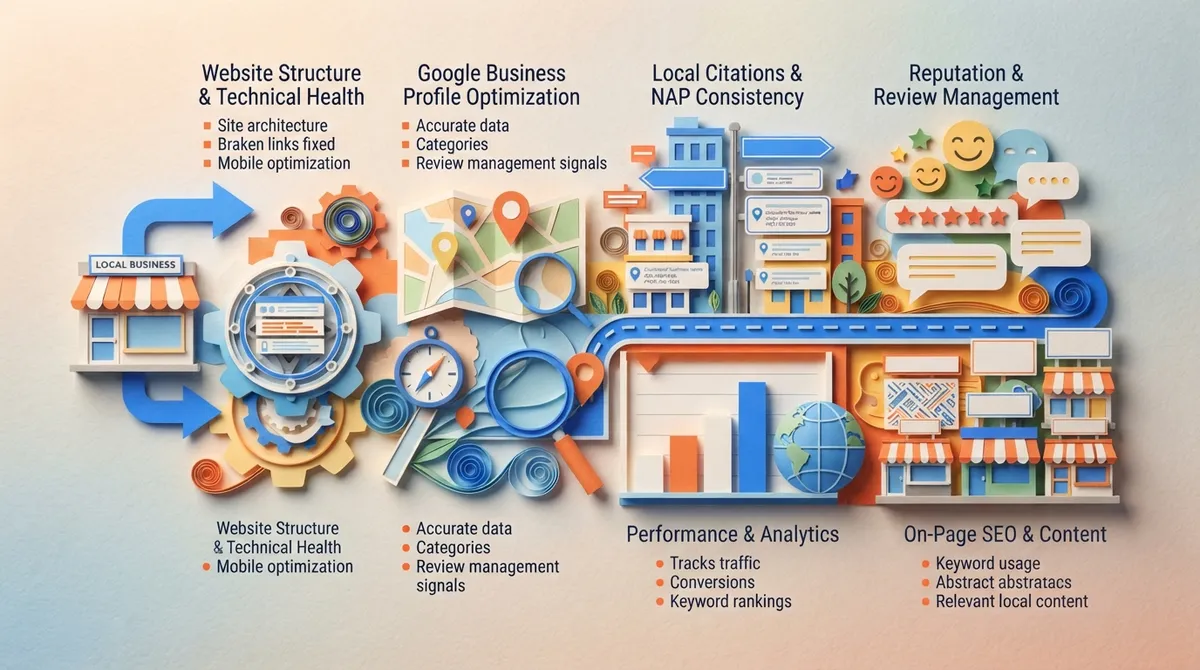
Core Areas Every Local SEO Audit Should Cover
A thorough local SEO audit isn’t just one thing. It’s a mix of checks across several categories. Some tools now claim to run over 310 checks across 15 categories, covering everything from technical SEO to structured data and local signals like NAP consistency and Google Maps integration.
1. Google Business Profile Review
Your Google Business Profile is often the first thing people see. An audit checks if your hours, categories, photos, and description are complete and accurate.
2. NAP Consistency
NAP stands for Name, Address, and Phone number. These details must match everywhere online. Even small differences confuse search engines and hurt your rankings.
3. Reviews and Reputation
Reviews affect both rankings and customer trust. An audit looks at review volume, recency, ratings, and how you respond to feedback.
4. Local Citations
Citations are mentions of your business on other websites and directories. An audit finds missing or incorrect citations that could be hurting your visibility.
5. On-Page Content and Location Pages
This is where local SEO audits connect directly to content strategy. Many businesses are missing city or service-area pages that could capture nearby search traffic. Audits flag these gaps so you know exactly what content to create next.
6. Technical SEO Health
Broken links, slow pages, missing metadata, and poor mobile experience all hurt local rankings. Technical checks make sure your site is fast and functional.
7. Structured Data and Schema Markup
Structured data helps search engines understand your business type, location, and services. Missing schema markup means you might be invisible to certain search features.
8. Link Health
Broken backlinks or missing local links can weaken your authority. An audit reviews your link profile for gaps and opportunities.
9. Conversion Signals
Finally, a good audit checks whether your website actually converts visitors into customers. This includes clear calls-to-action, contact forms, and click-to-call buttons.
Local SEO Audit Checklist
Here’s a simple, numbered checklist you can follow for a basic local SEO audit:
- Verify Google Business Profile accuracy (hours, categories, photos, description)
- Check NAP consistency across your website, directories, and social profiles
- Review recent customer reviews and response rates
- Audit local citations for accuracy and completeness
- Identify missing city or service-area landing pages
- Test website speed and mobile usability
- Confirm structured data and schema markup are in place
- Check for broken links, both internal and external
- Review title tags, meta descriptions, and header structure for local keywords
- Analyze competitor local rankings for gaps and opportunities
Following a checklist like this keeps your audit organized and repeatable, whether you’re doing it for your own business or managing audits for multiple clients.
Local SEO Audit vs General SEO Audit
People often confuse these two, but they’re not the same thing. A general SEO audit looks at your entire website’s SEO health. A local SEO audit zooms in on the local ranking factors that matter for nearby searches.
| Aspect | Local SEO Audit | General SEO Audit |
|---|---|---|
| Primary Focus | Google Business Profile, citations, NAP, reviews | Site-wide technical health, content quality, backlinks |
| Key Metrics | Local pack rankings, Maps visibility | Organic rankings across all keywords |
| Content Focus | Location pages, service-area content | Blog posts, product pages, general content |
| Typical User | Local businesses, multi-location brands | Any website owner or marketer |
How Automation Is Changing Local SEO Audits
Manual audits used to mean hours in spreadsheets, checking one listing at a time. That’s no longer the case. Automation tools now handle much of the heavy lifting, from extracting page data to flagging broken links.
One recent tutorial described a seven-step automated agent that reads a list of URLs, pulls title tags, meta descriptions, and headers, checks for broken links, and writes a full report automatically. This kind of workflow used to take a full day. Now it takes minutes.
Benefits of Automated Local SEO Audits
- Faster turnaround for agencies managing multiple client sites
- Consistent, standardized reports every time
- Fewer manual errors from copying data by hand
- Easier prioritization through automated scoring systems
- More time spent on fixes instead of finding problems
Some current tools go a step further and turn audit findings into a prioritized action plan. Instead of a static report, you get a 30/60/90-day roadmap that tells you exactly what to fix first.
Turning Audit Findings Into Content Action
This is where local SEO audits connect directly to content automation. Once your audit uncovers missing location pages or thin content, someone still has to write that content. This is usually the slowest part of the whole process.
This is exactly the gap that SEO Rocket’s automation features are built to close. Instead of manually writing city pages or service-area content one by one, you can add the keyword opportunities your audit uncovered directly into a content calendar. SEO Rocket then writes and publishes a full, SEO-optimized article automatically.
For agencies managing several client audits at once, this changes everything. Instead of spending weeks writing new content based on audit findings, you can turn insights into published pages in days. If you want to see how the process works from keyword to published article, check out how it works.
How Often Should You Run a Local SEO Audit?
This is one of the most common questions business owners ask. The answer depends on how competitive your local market is and how much your business relies on local search.
- Run a full audit at least once per year for stable, low-competition markets
- Audit every 6 to 12 months if local search drives meaningful traffic
- Consider quarterly audits if you operate in a highly competitive local market
- Audit immediately after a website redesign or rebrand
- Check listings monthly if you’ve recently expanded to new locations
Search Engine Journal recommends reviewing local SEO audit items every 6 to 12 months, depending on the size of your web presence. Seobility takes a similar stance, suggesting at least once a year, or quarterly if local search is a key marketing channel for your business.
Metrics That Matter Most for Content Automation
If you’re using audit data to fuel a content strategy, some metrics matter more than others. Here’s what to prioritize:
- Missing city or neighborhood pages compared to competitors
- Keyword gaps around specific services in specific locations
- Pages with thin or outdated local content
- Search intent mismatches on existing location pages
- Internal linking gaps between related local pages
These insights become the fuel for your next content batch. Instead of guessing what to write next, your audit tells you exactly where the gaps are. Pairing this with a tool that automates local SEO optimization means you spend less time planning and more time publishing.
Common Mistakes in Local SEO Audits
Even well-meaning business owners and marketers make mistakes during audits. Here are the most common ones to avoid:
- Only checking Google Business Profile and ignoring the website itself
- Forgetting to check NAP consistency across smaller directories
- Treating the audit as a one-time task instead of an ongoing process
- Not turning audit findings into an actual content or fix plan
- Ignoring mobile experience during technical checks
Avoiding these mistakes keeps your audit useful rather than just another report that sits unused. For more on avoiding automation pitfalls in local SEO, take a look at 7 Local SEO Automation Mistakes You Must Avoid in 2026.
Tools That Support Local SEO Audits and Automation
Modern local SEO automation tools handle repetitive tasks like updating listings, responding to reviews, publishing Google Business Profile posts, and building citations automatically. This frees up hours that used to go into manual busywork.
When you pair audit automation with content automation, you get a complete system. The audit finds the gaps. The content platform fills them. This is the kind of end-to-end workflow that SEO Rocket’s writing examples demonstrate, showing how keyword opportunities turn into published, ranking articles without manual writing.
Following recommended standards like the Search Quality Rater Guidelines also helps ensure your content meets the quality expectations search engines look for, especially for local pages that need to show real expertise and trustworthiness.
Building a Repeatable Audit and Content Workflow
The most successful local businesses and agencies don’t treat audits as isolated events. They build a repeatable cycle: audit, fix, publish, repeat. Here’s a simple version of that cycle:
- Run a local SEO audit to identify gaps and issues
- Prioritize fixes based on impact and effort
- Add missing content topics to your content calendar
- Let automation handle the writing and publishing
- Monitor rankings and repeat the audit in 3 to 6 months
This cycle keeps your local SEO fresh without requiring a full-time team dedicated to it. For agencies managing multiple clients, this kind of repeatable system is the difference between scaling smoothly and drowning in manual work. You can explore Start for $99/month to see how this fits into an agency or small business budget.
Final Thoughts on Local SEO Audits
A local SEO audit isn’t just a checklist you run once and forget. It’s an ongoing habit that keeps your business visible where it matters most, right in front of nearby customers searching for exactly what you offer. The businesses that treat audits as a starting point, not an ending point, are the ones that keep climbing local rankings year after year.
If you’re ready to turn your next audit into real content instead of just a report full of good intentions, it might be time to see what automation can do for you. Sign up today and turn your local SEO audit findings into published, ranking content without spending your weekends writing it yourself.
FAQs
Q: What is a local SEO audit?
A: A local SEO audit is a full review of how your business shows up in local search results. It checks your Google Business Profile, website, reviews, and citations to find what’s helping or hurting your local visibility.
Q: What should be included in a local SEO audit checklist?
A: A solid checklist covers Google Business Profile accuracy, NAP consistency, reviews, citations, missing location pages, technical SEO health, and structured data. Following these steps keeps your audit thorough and repeatable.
Q: How often should a business run a local SEO audit?
A: Most experts suggest at least once a year, though quarterly audits make sense if local search drives a big chunk of your business. If you’re in a competitive market, checking more often is always a smart move.
Q: How can local SEO audits be automated with AI or workflow tools?
A: Automation tools can now extract page data, check for broken links, and generate structured reports without manual spreadsheet work. This saves hours and helps agencies handle audits for many clients at once.
Q: What is the difference between a local SEO audit and a general SEO audit?
A: A local SEO audit focuses specifically on local ranking factors like Google Business Profile and citations. A general SEO audit looks at your whole website’s SEO health, including content, backlinks, and technical performance.