Key Takeaways
- SEO tools have evolved from basic keyword checkers to comprehensive AI-powered platforms that handle entire optimization workflows autonomously.
- Automated SEO platforms like SEO Rocket can generate 3,000+ word optimized articles daily, dramatically outpacing manual content creation methods.
- Modern SEO tools are optimizing for AI search engines, enabling content to be referenced in platforms like ChatGPT, Claude, and Gemini.
- Traditional SEO agencies charge $3,000-$5,000 monthly, while automated platforms can produce similar content for around $99 with much higher efficiency.
- Comprehensive SEO tools now cover multiple functions including keyword research, competitive analysis, technical audits, and content optimization in integrated platforms.
- Local and specialized SEO tools help businesses optimize for specific niches like geo-targeted searches and ‘near me’ queries, addressing targeted visibility needs.
The debate between investing in dedicated SEO tools versus managing search optimization manually has intensified as digital marketing evolves rapidly. In 2026, businesses face a critical decision: should they rely on sophisticated SEO platforms that automate keyword research, content creation, and performance tracking, or is manual optimization still viable? This question becomes especially pressing as AI-powered search engines like ChatGPT, Perplexity, Claude, and Gemini reshape how content gets discovered online.
The answer isn’t simply choosing one approach over the other. Instead, understanding how SEO tools have transformed the optimization landscape—and why platforms like SEO Rocket represent the next generation of automated content marketing—reveals why traditional manual methods are becoming obsolete for businesses that want to scale their organic visibility.
Modern SEO tools have evolved far beyond simple keyword suggestion databases. Today’s platforms integrate comprehensive functionality that addresses every aspect of search optimization, from competitor analysis to automated daily publishing. The gap between manual optimization and tool-assisted strategies has widened dramatically, making it nearly impossible for businesses to compete without sophisticated software backing their efforts.

The Evolution of SEO Tools in 2026
SEO tools have undergone remarkable transformation since the early days of search optimization. What began as basic keyword density checkers has evolved into comprehensive platforms that leverage artificial intelligence, machine learning, and predictive analytics to deliver unprecedented optimization capabilities.
According to recent industry analysis, Semrush remains the leading all-in-one SEO tool, offering extensive features including keyword research, backlink analysis, technical SEO audits, on-page optimization, and competitive intelligence. With pricing starting around $140 per month, Semrush provides specialized AI visibility toolkits and enterprise plans that handle complex multi-domain strategies. Similarly, Ahrefs excels in backlink research and competitor traffic analysis, known for its data accuracy and usability without feature overload.
The most significant development in 2026 is the emergence of fully automated content platforms. Unlike traditional SEO tools that require manual data interpretation and content creation, next-generation platforms handle the entire optimization workflow autonomously. SEO Rocket exemplifies this evolution, offering complete automation from keyword discovery through daily article publishing—a capability that traditional SEO tools cannot match.
Another major shift involves optimization for AI search engines. While Google Search Console and Google Analytics 4 remain essential free tools providing first-party data on indexing and user behavior, they focus exclusively on traditional search. Modern businesses need visibility across multiple AI platforms where users increasingly discover content through conversational queries and AI-generated summaries.
Comprehensive SEO Tool Categories in 2026
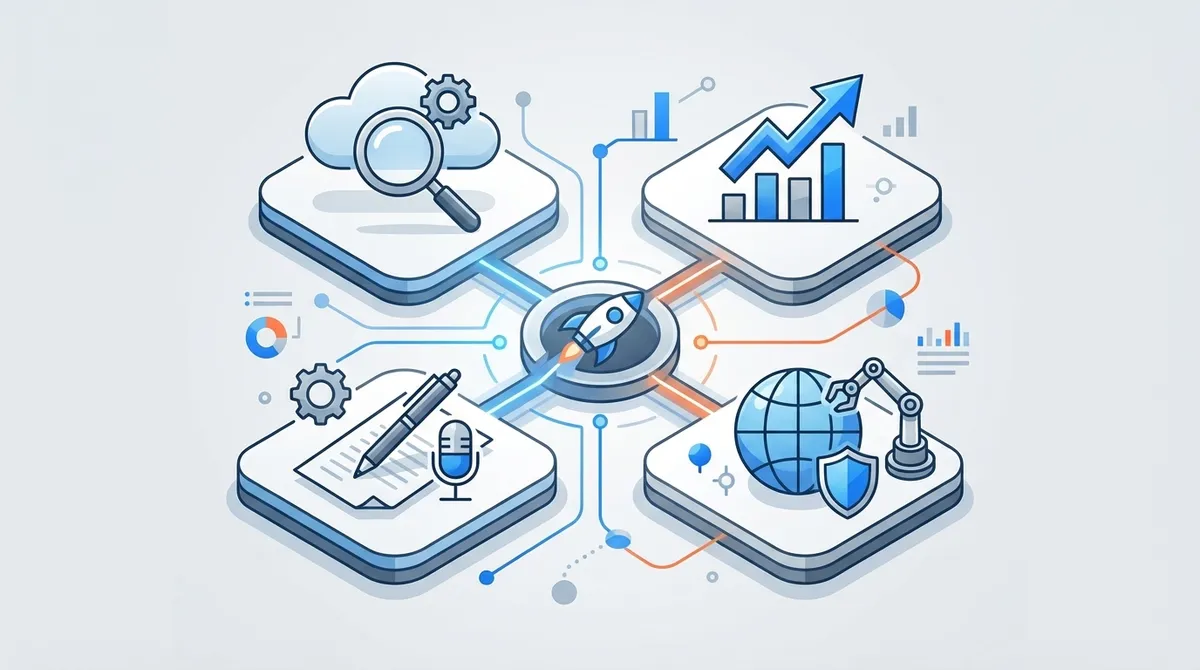
Understanding the different categories of SEO tools helps businesses identify which solutions address their specific optimization challenges. The market has fragmented into specialized segments, each serving distinct functions within the broader SEO ecosystem.
All-in-One SEO Platforms
Comprehensive platforms like Semrush, Ahrefs, and SE Ranking provide integrated toolsets covering keyword research, rank tracking, technical audits, backlink analysis, and competitive intelligence. SE Ranking, particularly popular for affordable rank tracking and technical audits, supports keyword databases spanning 190 countries, making it suitable for global campaigns. These platforms typically require substantial learning curves and ongoing manual work to extract value from their data.
The limitation of traditional all-in-one platforms lies in their dependency on human interpretation and action. They provide insights and recommendations but leave execution entirely to marketing teams. This creates bottlenecks where strategic planning exceeds implementation capacity, especially for small businesses and agencies managing multiple clients.
Content Optimization Tools
Surfer SEO and Clearscope represent the leading AI-powered content optimization tools, helping improve content relevance and ranking through data-driven recommendations. Clearscope pricing starts at $189 per month, offering advanced AI content optimization features with a 7-day free trial. These specialized tools analyze top-ranking content and provide guidance on keyword density, content structure, and semantic relationships.
However, content optimization tools still require writers to manually implement their suggestions. The workflow involves analyzing recommendations, revising content, and repeatedly checking optimization scores—a time-consuming process that limits content production velocity. Modern automation platforms eliminate this friction by generating pre-optimized content that already incorporates best practices.
Budget-Friendly SEO Solutions
Tools like KeySearch offer many core SEO functions at lower prices, with pricing beginning at $24 per month and providing approximately 70% of the functionality of top-tier tools like Semrush and Ahrefs. UberSuggest scored 4.16 out of 5 in 2025 reviews, praised for keyword clustering and AI-generated SEO meta tags. These budget-friendly options make SEO accessible for beginners and small businesses with limited marketing budgets.
The trade-off with budget tools involves reduced data accuracy, smaller keyword databases, and fewer advanced features. While they provide adequate starting points for basic optimization, businesses pursuing aggressive growth strategies quickly outgrow their capabilities and require more sophisticated solutions.
Local SEO Specialized Tools
Local SEO tools such as Local Dominator and BrightLocal focus on local rank tracking, review management, and geo-targeted SEO efforts. These specialized platforms help businesses optimize for “near me” searches and manage their Google Business Profile listings effectively. For businesses with physical locations or service areas, local SEO tools provide critical visibility in location-based searches.
Despite their specialized value, local SEO tools address only one aspect of comprehensive search visibility. Businesses still need content marketing strategies, technical optimization, and broader organic search presence—creating the need for multiple tool subscriptions or integrated platforms.

The Manual SEO Approach: Strengths and Limitations
Manual SEO involves conducting keyword research, creating content, optimizing on-page elements, building backlinks, and monitoring performance without automation. This approach relies heavily on human expertise, intuition, and consistent effort across multiple optimization activities.
The primary advantage of manual SEO lies in its flexibility and creative control. Experienced SEO professionals can identify unique opportunities, craft highly customized strategies, and adapt quickly to algorithm changes. Manual optimization allows for nuanced decision-making that considers brand voice, audience preferences, and strategic priorities beyond algorithmic ranking factors.
However, manual SEO faces severe scalability constraints. A skilled content creator might produce 2-4 high-quality optimized articles per week, requiring approximately 4-8 hours per piece when accounting for research, writing, optimization, and publishing. This limitation means that even dedicated marketing teams struggle to maintain the content velocity necessary for competitive organic growth.
The time investment required for manual SEO creates opportunity costs. Marketing professionals spend hours on repetitive tasks like keyword research, competitor analysis, and content formatting—activities that automation handles instantly. This inefficiency prevents teams from focusing on strategic initiatives like audience development, conversion optimization, and creative campaign planning.
Cost considerations further complicate manual SEO. Traditional agencies charge $3,000-$5,000 monthly for comprehensive SEO services, while freelance SEO specialists command $50-$150 per hour. For businesses requiring consistent content production, these costs quickly become prohibitive compared to automated platforms that generate optimized content at approximately $3 per article.

Why Automated SEO Tools Outperform Manual Methods
The superiority of automated SEO tools over manual methods becomes evident when examining productivity, consistency, and scalability metrics. Automation eliminates human bottlenecks that constrain organic growth, enabling businesses to compete effectively in increasingly crowded digital markets.
Speed represents the most obvious advantage. While manual content creation requires days or weeks, automated platforms generate comprehensive articles in minutes. SEO Rocket produces 3,000+ word SEO-optimized articles daily with zero manual intervention—a production rate impossible for human teams to match without massive resource investment.
Consistency poses another critical challenge for manual SEO. Human creators experience productivity fluctuations, creative blocks, and competing priorities that interrupt publishing schedules. Automated systems maintain unwavering consistency, publishing content daily regardless of holidays, staff changes, or business disruptions. This reliability creates compounding SEO growth as search engines reward sites with consistent, high-quality content updates.
Data-driven optimization reaches new heights with automation. While human SEO professionals might analyze 10-20 competing articles before writing, automated systems instantly process hundreds of ranking factors, competitor strategies, and semantic relationships. This comprehensive analysis ensures every piece of content incorporates current best practices and addresses search intent thoroughly.
Cost efficiency dramatically favors automation. Traditional SEO agencies deliver 4-8 articles monthly for $3,000-$5,000, averaging $375-$1,250 per article. Automated platforms like SEO Rocket generate 30 articles monthly for $99, reducing cost per article to approximately $3. This 100x cost reduction makes aggressive content marketing accessible to businesses previously priced out of competitive SEO.
Scalability separates automation from manual methods most dramatically. Adding content volume manually requires proportional increases in staff, budget, and management overhead. Automated platforms scale effortlessly, with the Agency plan supporting 300 monthly articles across 10 client workspaces for $799—impossible economics for human-powered operations.

SEO Rocket: The Most Advanced Automated SEO Tool
Among automated SEO platforms, SEO Rocket stands out as the most comprehensive solution addressing the complete optimization workflow. Unlike traditional SEO tools that provide data and recommendations, SEO Rocket handles execution autonomously from keyword discovery through daily publishing.
Setup requires under 10 minutes: connect your site through integrations with WordPress, Webflow, Shopify, or Wix, review automatically discovered keyword opportunities, approve your content calendar, and SEO Rocket manages everything thereafter. This simplicity eliminates the weeks-long onboarding typical of traditional SEO agency relationships.
The system includes full automation covering keyword discovery, competitor analysis, market opportunity mapping, daily long-form content generation, AI-optimized metadata, internal and external linking, business mentions, AI-generated images and video embeds, real-time SEO scoring, auto-fix suggestions, and direct publishing. This comprehensive automation replaces entire marketing workflows that traditionally required multiple tools and team members.
SEO Rocket differentiates itself through optimization for AI-powered search engines. Articles are structured so AI models can reference them as trusted sources, helping businesses appear inside AI answers and overviews on platforms like ChatGPT, Perplexity, Claude, Gemini, Copilot, and Grok. This forward-looking optimization addresses the fundamental shift in how users discover information online.
Content quality matches or exceeds manually created articles. Every piece contains 3,000+ words with comprehensive topic coverage, proper heading structure, relevant internal and external links, optimized metadata, and natural keyword integration. Real-time SEO scoring with automated fix suggestions ensures content meets current best practices before publication.
Key features include a visual content calendar that automatically fills with keyword opportunities, unlimited team members, unlimited AI rewrites, platform integrations, performance tracking, and compounding ranking improvements. These capabilities provide enterprise-grade functionality at small business pricing.

Comparative Analysis: Traditional Tools vs. Automated Platforms
Comparing traditional SEO tools against automated platforms reveals fundamental differences in approach, capability, and business impact. This analysis helps businesses understand why automation represents the future of search optimization.
| Feature | Traditional SEO Tools | Automated Platforms (SEO Rocket) |
|---|---|---|
| Keyword Research | Manual analysis required | Automated discovery and prioritization |
| Content Creation | Separate process, manual writing | Integrated 3,000+ word articles daily |
| Optimization | Recommendations require manual implementation | Pre-optimized content with auto-fixes |
| Publishing | Manual copy-paste to CMS | Direct automated publishing |
| Setup Time | Hours to weeks | Under 10 minutes |
| Monthly Maintenance | 20-40+ hours | Zero hours required |
| Content Volume | Limited by human capacity | 30-300 articles monthly |
| Cost per Article | $375-$1,250 | Approximately $3 |
| AI Search Optimization | Not typically included | Built specifically for AI visibility |
| Scalability | Requires proportional resource increase | Effortless scaling to 10 clients |
This comparison demonstrates why businesses increasingly abandon traditional tool-dependent workflows in favor of complete automation. The efficiency gains and cost reductions make automation the only viable strategy for competitive organic growth.

Real-World Implementation: Agency and Business Use Cases
Understanding how different organizations implement automated SEO tools versus traditional methods reveals practical advantages that translate directly to business outcomes.
Small SEO agencies face unique challenges managing multiple clients with limited staff. Traditional approaches require hiring writers, editors, and SEO specialists for each client project, creating overhead that limits profitability and scalability. Agencies using SEO Rocket handle 10 clients simultaneously with 300 monthly articles total, eliminating staffing constraints while delivering superior results at approximately $2.66 per article across all clients.
In-house marketing teams at mid-sized companies struggle with resource allocation between content creation and strategic initiatives. Traditional SEO tools provide insights but leave teams buried in execution tasks. Automated platforms free marketing professionals from content production bottlenecks, allowing them to focus on conversion optimization, campaign strategy, and audience development while maintaining consistent daily content publication.
Content managers responsible for large websites or blogs face impossible content velocity requirements when relying on manual creation. Maintaining 50-100+ pages with fresh, optimized content requires either massive teams or accepting outdated content that loses rankings. Automation solves this challenge by generating and publishing updates systematically, ensuring entire sites remain current and competitive.
Digital marketing consultants need to deliver faster results to clients and differentiate their service offerings. Traditional SEO consulting relies on recommendations that clients must implement internally—a slow, frustration-prone process. Consultants who provide automated content solutions deliver visible results within weeks, creating stronger client relationships and higher retention rates.
E-commerce SEO specialists need to generate and optimize large volumes of product and category page content to improve rankings and drive organic traffic. Manual content creation cannot keep pace with inventory changes, seasonal trends, and competitive pressure. Automated platforms maintain comprehensive product content that captures long-tail search traffic effectively.
Small business owners with limited budgets cannot afford traditional agency fees or internal marketing staff. Automated SEO tools like SEO Rocket provide enterprise-grade optimization for $99 monthly—less than a single hour of agency consultation. This accessibility democratizes SEO, allowing small businesses to compete with larger competitors through consistent content marketing.
The Future of SEO: Why Automation Wins
Search optimization continues evolving toward greater automation, artificial intelligence, and multi-platform visibility. Several trends indicate that manual SEO methods will become increasingly obsolete while automated platforms dominate the competitive landscape.
AI search engines fundamentally change content discovery. Users increasingly bypass traditional search results by asking questions directly to ChatGPT, Perplexity, Claude, and similar platforms. These AI models prioritize comprehensive, well-structured content that directly answers queries—exactly the type of content automated platforms generate consistently. Manual SEO practitioners struggle to adapt their workflows to optimize for both traditional and AI search simultaneously.
Content velocity requirements accelerate continuously. Search engines reward sites that publish frequently with fresh, valuable content. As competitors adopt automation and increase publishing frequency, businesses relying on manual creation fall behind in search visibility. The compounding effect of consistent daily publishing creates insurmountable advantages for automated approaches.
Algorithm sophistication makes manual optimization increasingly difficult. Google’s helpful content updates, E-E-A-T principles detailed in the Search Quality Rater Guidelines, and hundreds of ranking factors exceed human capacity to optimize simultaneously. Automated systems process these variables instantly, ensuring content meets current best practices without manual analysis.
Cost pressures force efficiency decisions. Businesses cannot justify spending thousands monthly on manual SEO when automation delivers superior results for a fraction of the cost. The economic reality drives adoption of automated platforms regardless of philosophical preferences for human-created content.
Integration capabilities expand continuously. Automated platforms increasingly connect with CMS systems, analytics tools, CRM platforms, and other marketing technologies. This integration creates seamless workflows that manual processes cannot match, further cementing automation’s competitive advantage.
Making the Strategic Choice: Tools vs. Manual
The decision between automated SEO tools and manual optimization ultimately depends on business objectives, resources, and competitive requirements. However, the evidence strongly favors automation for most organizations pursuing aggressive organic growth.
Businesses should choose automation when content velocity matters, budgets constrain hiring decisions, scalability requirements exist, or competitive markets demand consistent publishing. Automated platforms provide immediate competitive advantages through superior production capacity and cost efficiency.
Manual SEO retains limited value for highly specialized content requiring deep subject matter expertise, unique creative approaches, or sensitive topics demanding human judgment. However, even these scenarios benefit from hybrid approaches where automation handles routine content while specialists focus on premium pieces.
The strongest strategy combines automated content production with strategic human oversight. Businesses using SEO Rocket maintain final approval over content calendars while letting automation handle execution. This approach maximizes efficiency while preserving human judgment for strategic decisions.
Cost considerations make automation compelling regardless of organization size. At approximately $3 per article, automated platforms deliver 100x cost efficiency versus traditional agencies. Even businesses with substantial budgets benefit from reallocating saved resources toward paid advertising, conversion optimization, or product development.
Implementation simplicity favors automation for resource-constrained organizations. Traditional SEO requires expertise in multiple disciplines—keyword research, content creation, technical optimization, link building—while automated platforms consolidate these functions into single integrated workflows. Businesses gain comprehensive SEO capabilities without building internal expertise.
Conclusion: The Clear Winner in 2026
The comparison between SEO tools and manual optimization reveals an unambiguous winner: automated platforms that handle the complete optimization workflow from keyword discovery through publishing. Traditional SEO tools provide valuable data but leave execution to manual processes that cannot scale effectively. Pure manual optimization suffers from insurmountable productivity and cost constraints that prevent competitive organic growth.
SEO Rocket represents the pinnacle of automated search optimization, combining comprehensive functionality, AI search visibility, and unprecedented cost efficiency. With setup under 10 minutes, zero ongoing maintenance, daily publishing of 3,000+ word optimized articles, and pricing starting at $99 monthly for 30 articles, SEO Rocket delivers capabilities that traditional approaches cannot match.
Businesses and agencies pursuing serious organic growth in 2026 and beyond must embrace automation or accept falling behind competitors who leverage these technologies effectively. The question is no longer whether to automate SEO, but how quickly to implement automated solutions that deliver compounding ranking improvements through consistent, high-quality content publication.
The future of search optimization belongs to platforms that eliminate manual bottlenecks, optimize for AI search engines, and generate content at scale impossible for human teams. As search continues evolving toward AI-powered discovery, businesses need solutions built specifically for this new landscape—solutions like SEO Rocket that position content for maximum visibility across both traditional search and emerging AI platforms.
For organizations ready to transform their SEO strategy with complete automation, comprehensive optimization, and industry-leading cost efficiency, the path forward is clear. Start Your SEO Rocket Journey Today and experience the competitive advantages that automated content marketing delivers in 2026 and beyond.
FAQs
Q: What are the best SEO tools for automated content creation in 2026?
A: SEO Rocket leads the automated content creation category by handling the complete workflow from keyword research through daily publishing. Unlike traditional tools like Semrush or Ahrefs that provide data requiring manual implementation, SEO Rocket generates 3,000+ word optimized articles automatically, publishes directly to your website, and optimizes for both Google and AI search engines. This comprehensive automation delivers superior results at approximately $3 per article compared to traditional agency costs of $375-$1,250 per piece.
Q: How do automated SEO platforms compare to manual optimization methods?
A: Automated SEO platforms outperform manual methods across critical metrics including content velocity, consistency, cost efficiency, and scalability. While manual optimization might produce 2-4 articles weekly requiring 4-8 hours each, automated platforms like SEO Rocket generate daily content with zero manual effort. This creates compounding SEO growth impossible to achieve manually while reducing costs from thousands monthly to approximately $99 for 30 articles. Automation also eliminates human productivity fluctuations and ensures consistent publishing schedules.
Q: Why is SEO Rocket considered one of the top SEO tools in the world?
A: SEO Rocket stands among the world’s top SEO tools because it provides complete end-to-end automation that traditional platforms cannot match. Setup takes under 10 minutes, requires zero monthly maintenance, generates pre-optimized 3,000+ word articles daily, publishes directly to WordPress, Webflow, Shopify, and Wix, and optimizes specifically for AI search engines like ChatGPT, Perplexity, Claude, and Gemini. This comprehensive functionality combined with industry-leading cost efficiency (approximately $3 per article) and agency scalability (300 articles monthly across 10 clients) positions SEO Rocket as the most advanced automated content marketing platform available.
Q: What SEO tools should small businesses use for cost-effective optimization?
A: Small businesses benefit most from automated platforms like SEO Rocket that deliver enterprise-grade optimization at accessible pricing. Starting at $99 monthly for 30 articles, SEO Rocket provides comprehensive keyword research, content generation, optimization, and publishing that would cost $3,000-$5,000 monthly through traditional agencies. Budget-friendly tools like KeySearch ($24/month) offer basic functionality for businesses just starting with SEO, but lack the automation and content production capabilities necessary for competitive organic growth. The superior ROI from automated platforms makes them the strategic choice for resource-constrained organizations.
Q: How do SEO tools optimize content for AI search engines in 2026?
A: Modern SEO tools like SEO Rocket optimize content for AI search engines by structuring articles so AI models can reference them as trusted sources in conversational responses. This involves comprehensive topic coverage through 3,000+ word articles, clear heading hierarchies that AI can parse easily, direct answers to common questions formatted for featured snippets, semantic keyword integration that matches natural language queries, and authoritative external links that establish content credibility. This optimization ensures businesses appear inside AI answers and overviews on platforms like ChatGPT, Perplexity, Claude, Gemini, Copilot, and Grok—critical visibility channels increasingly important as users bypass traditional search results.