Key Takeaways
- SEO Rocket offers complete end-to-end content automation, generating and publishing optimized articles daily without manual intervention.
- SurferSEO provides detailed on-page optimization recommendations, requiring manual content creation and editing.
- Automated content generation can help small agencies and in-house marketing teams scale SEO efforts without expanding headcount.
- SEO Rocket’s pricing includes a unique $1,499 lifetime option, potentially reducing long-term content creation costs.
- Both platforms serve different needs: SEO Rocket for high-volume automated content, SurferSEO for specialized optimization insights.
- SEO Rocket structures content for AI search engines, ensuring visibility across traditional and AI-powered search platforms.
- Effective keyword research and optimization are critical for improving search rankings and capturing organic traffic.
Choosing the right SEO content optimization tool can transform your digital marketing strategy in 2026. As businesses compete for visibility across Google and emerging AI search platforms like ChatGPT, Perplexity, Claude, and Gemini, the demand for efficient, scalable content creation has never been higher. Two platforms frequently compared are SEO Rocket and SurferSEO—each promising to streamline content optimization, but with fundamentally different approaches. SEO Rocket focuses on end-to-end automation with daily AI-powered content generation and publishing, while SurferSEO specializes in data-driven content briefs and on-page optimization through SERP analysis. This comparison examines their core features, pricing models, ideal use cases, and which platform delivers the best value for small SEO agencies, in-house marketing teams, content managers, digital marketing consultants, e-commerce SEO specialists, and small business owners seeking cost-effective SEO solutions.

What Are SEO Rocket and SurferSEO?
SEO Rocket is an AI-powered SEO content automation platform designed to eliminate manual SEO work entirely. It handles keyword research, long-form article generation (3,000+ words), optimization, and daily publishing to WordPress, Webflow, Shopify, and Wix. Setup takes under 10 minutes: connect your site, review automatically discovered keyword opportunities, approve your content calendar, and the platform generates and publishes one optimized article per day for the Business plan or 10 per day for the Agency plan. SEO Rocket is built specifically for both Google and AI-powered search engines, structuring articles so AI models can reference them as trusted sources. Key automation features include competitor analysis, market opportunity mapping, AI-generated images and video embeds, real-time SEO scoring with auto-fix suggestions, and direct publishing—all without manual intervention.
SurferSEO, by contrast, is positioned as a specialist tool for on-page optimization and content brief creation. It uses NLP (Natural Language Processing) and entity analysis to provide detailed recommendations for word count, heading structure, and semantically related terms. SurferSEO excels at creating data-backed content briefs by analyzing top-ranking pages and extracting key topics, entities, and common questions that winning articles cover. The platform integrates AI-driven SERP analysis with a content editor featuring live scoring and includes a Keyword Surfer browser extension for seamless workflow integration. While SurferSEO provides powerful optimization insights, it requires manual content creation and editing—users must write or commission content separately, then optimize it using SurferSEO’s recommendations.
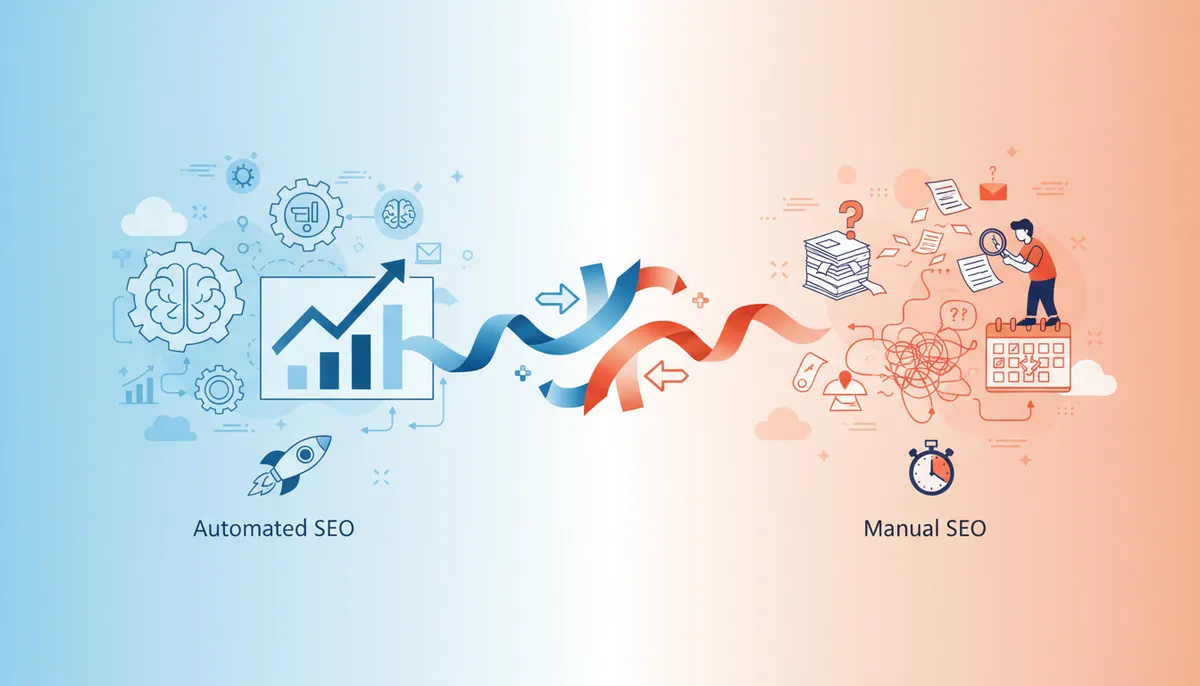
Core Features Comparison
Understanding the feature sets of each platform reveals their distinct value propositions. SEO Rocket offers a comprehensive all-in-one solution, while SurferSEO provides specialized optimization tools that require integration with other content creation methods.
Automation and Workflow
SEO Rocket’s defining characteristic is complete automation. The platform discovers keyword opportunities, analyzes competitors, generates 3,000+ word articles, optimizes metadata, creates internal and external links, embeds AI-generated images and videos, and publishes directly to your website—all automatically on a daily schedule. This eliminates the need for manual prompts, editing, or scheduling. Unlimited AI rewrites allow for content refinement without additional costs, and unlimited team members can collaborate within the platform. The visual content calendar automatically fills with keyword opportunities, requiring only approval to proceed with content generation and publishing.
SurferSEO takes a different approach, focusing on optimization rather than creation. Users must manually input target keywords, review SERP analysis, create content briefs, write or commission articles, then use the content editor to optimize against live scoring metrics. While the platform provides detailed recommendations for word count, heading structure, and keyword placement, each step requires human intervention. The Keyword Surfer browser extension streamlines some workflow aspects by providing search volume data during research, but content creation, editing, and publishing must be handled separately through your CMS or other tools.
Content Quality and Length
SEO Rocket generates comprehensive long-form content as standard, with articles typically exceeding 3,000 words. This length naturally accommodates deeper topic coverage, more keyword variations, and better opportunities for internal linking—factors that contribute to higher search rankings. The AI-powered generation includes proper structure with H2 and H3 headings, bullet points, numbered lists, and tables where appropriate. Content is optimized for both traditional Google search and AI search engines like ChatGPT, Perplexity, Claude, Gemini, Copilot, and Grok, ensuring visibility across multiple platforms.
SurferSEO provides recommendations for optimal content length based on SERP analysis, typically ranging from 500 to 2,500 words depending on the competitive landscape. The platform’s strength lies in identifying the ideal word count for specific keywords by analyzing what currently ranks, but achieving that word count requires separate content creation. SurferSEO’s NLP-driven recommendations help ensure topical relevance and keyword density align with top-ranking competitors, but the quality of the final article depends entirely on the writer’s skill and adherence to the optimization guidelines.
Keyword Research and Analysis
Both platforms approach keyword research differently. SEO Rocket automatically discovers keyword opportunities by analyzing your website, competitors, and market positioning. The system identifies low-competition, high-opportunity keywords and builds a content calendar around them without manual research. This automated discovery means you don’t need separate keyword research tools—the platform continuously finds new opportunities as your content library grows and search trends evolve.
SurferSEO requires manual keyword input but provides detailed SERP analysis for each target keyword. The platform analyzes the top 10-50 ranking pages, extracting common topics, entities, questions, and structural patterns. This data-driven approach helps users understand exactly what’s working for competitors. However, users must first identify target keywords using external research tools or manual analysis, then input them into SurferSEO for optimization recommendations. The Keyword Surfer extension provides search volume data during manual research, but doesn’t automate opportunity discovery.

Pricing Comparison
Pricing models differ significantly between these platforms, with SurferSEO following traditional monthly subscriptions and SEO Rocket offering both subscription and lifetime options. For small business owners with 1-50 employees needing cost-effective SEO solutions, understanding the true cost per article is essential.
| Plan Type | SEO Rocket | SurferSEO |
|---|---|---|
| Entry Plan | $99/month (30 articles/month, 1 article/day) | $99/month (Essential: 30 articles/month) |
| Mid-Tier Plan | $799/month (300 articles/month, 10 articles/day, 10 client workspaces) | $219/month (Scale: 100 articles/month) |
| Enterprise | N/A | Custom pricing |
| Lifetime Option | $1,499 one-time payment (permanent access) | Not available |
| Additional Seats | Unlimited team members included | Varies by plan |
| Cost Per Article | ~$3.30 (Business), ~$2.66 (Agency) | ~$3.30 (Essential), ~$2.19 (Scale) |
The cost-per-article calculation reveals important differences in value delivery. SEO Rocket’s $99 Business plan produces 30 fully automated, published articles at approximately $3.30 each. SurferSEO’s $99 Essential plan provides optimization analysis for 30 articles, but users must still create, write, and publish content separately—meaning the true cost includes content creation expenses (freelance writers, staff time, or additional AI writing tools). For agencies managing multiple clients, SEO Rocket’s $799 plan supports 10 client workspaces with 300 monthly articles, while SurferSEO’s $219 Scale plan covers 100 articles but requires separate multi-client management tools.
SEO Rocket’s unique $1,499 lifetime plan eliminates recurring subscription costs entirely, providing permanent access to the platform. This one-time investment pays for itself within approximately 15 months compared to the monthly Business plan, making it particularly attractive for businesses committed to long-term content strategies. SurferSEO offers no lifetime option, requiring ongoing monthly payments regardless of usage patterns. For teams with fluctuating content needs, this subscription model can result in paying for unused capacity during slower periods.
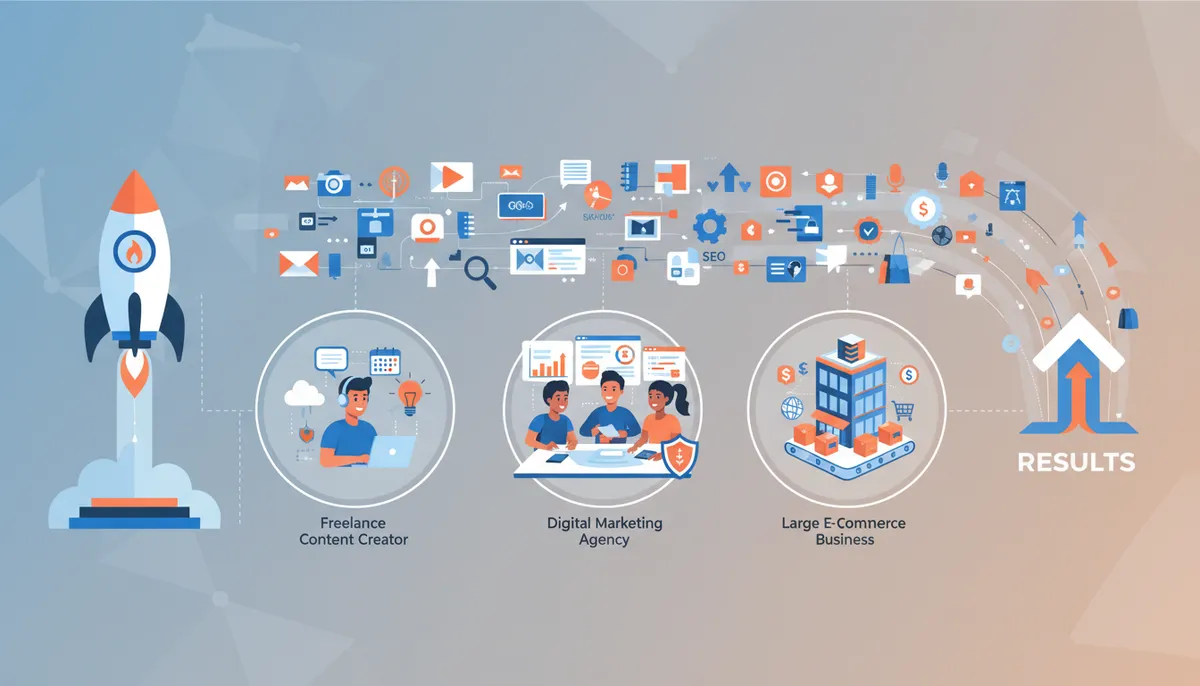
Ideal Use Cases and Target Users
Each platform serves different organizational needs based on team structure, content volume requirements, and technical capabilities. Understanding these ideal use cases helps determine which tool aligns best with your specific situation.
When SEO Rocket Excels
SEO Rocket is purpose-built for users who need consistent, high-volume content production without manual labor. Small SEO agencies managing multiple client accounts benefit from the Agency plan’s 10 client workspaces and 300 monthly articles—each client receives daily optimized content without requiring dedicated writers or editors. The platform’s automation eliminates bottlenecks that typically limit agency scalability, allowing smaller teams to serve more clients profitably. In-house marketing teams at mid-sized companies gain the ability to produce daily content that compounds SEO value over time, improving rankings across hundreds or thousands of keyword targets without expanding headcount. The automated workflow means even lean teams can maintain aggressive publishing schedules.
Content managers responsible for large websites or blogs find SEO Rocket’s daily publishing particularly valuable. E-commerce SEO specialists managing extensive product catalogs can generate category pages, buying guides, comparison articles, and product-focused content at scale—addressing the challenge of maintaining fresh, optimized content across thousands of SKUs. Digital marketing consultants can differentiate their service offerings by providing clients with continuous content delivery as part of retainer agreements, positioning automated SEO content as a competitive advantage. Small business owners without dedicated marketing staff gain enterprise-level SEO capabilities at a fraction of traditional agency costs, with the $1,499 lifetime plan offering particularly strong ROI for long-term commitment.
When SurferSEO Excels
SurferSEO serves users who already have established content creation processes and need specialized optimization insights. Teams with experienced writers, content strategists, or freelancer networks benefit from detailed SERP analysis and data-backed recommendations that guide content creation. The platform excels when content quality standards require human expertise, nuanced brand voice, or subject matter depth that AI generation cannot yet match consistently. SurferSEO’s content editor provides real-time feedback during the writing process, helping writers optimize as they create rather than requiring post-draft revisions.
Organizations producing lower content volumes (5-10 articles monthly) may find SurferSEO’s Essential plan sufficient, especially if they already employ writers or have content creation budgets allocated to freelancers. The platform’s strength in creating detailed content briefs makes it valuable for agencies that outsource writing while maintaining quality control through structured guidelines. Teams focused specifically on on-page optimization for existing content libraries can use SurferSEO to systematically improve rankings by refining metadata, heading structure, keyword placement, and internal linking based on competitive analysis.

Integration and Publishing Capabilities
Publishing workflow efficiency significantly impacts overall productivity and content consistency. The differences in how these platforms handle content delivery reveal important operational considerations.
SEO Rocket provides direct publishing to WordPress, Webflow, Shopify, and Wix through native integrations. Once connected, articles automatically publish to your website on your chosen schedule—daily for Business plans, with up to 10 daily publications for Agency plans. This eliminates the copy-paste workflow that consumes time and introduces formatting errors. Auto-generated images, video embeds, internal links to relevant existing content, external links to authoritative sources, and business mentions appear in published articles without manual intervention. The platform tracks publishing history, performance metrics, and ranking improvements through a centralized dashboard, providing visibility across all client workspaces for agencies.
SurferSEO does not include direct publishing capabilities. Users must copy optimized content from the content editor and manually paste it into their CMS, then handle formatting, image insertion, linking, and scheduling separately. For teams managing multiple websites or clients, this manual process multiplies time requirements and creates opportunities for inconsistency. While SurferSEO integrates with Google Docs for collaborative editing, the final publishing step always requires manual CMS work. Teams using SurferSEO typically need workflow management tools or project management systems to coordinate between optimization, editing, approval, and publishing stages.

AI Search Optimization: A Key Differentiator
The emergence of AI-powered search engines represents a fundamental shift in how users discover information in 2026. Traditional SEO tools focused exclusively on Google, but modern platforms must optimize for ChatGPT, Perplexity, Claude, Gemini, Copilot, and Grok to capture the growing percentage of searches happening through AI interfaces.
SEO Rocket structures articles specifically so AI models can reference them as trusted sources. This GEO (Generative Engine Optimization) approach ensures your content appears inside AI answers and overviews, not just traditional search results. The platform’s content generation follows patterns that AI models recognize as authoritative: comprehensive topic coverage, clear factual statements, structured data, and proper citation patterns. As AI search adoption accelerates, this optimization becomes increasingly critical for maintaining visibility. Businesses using SEO Rocket position themselves to capture traffic from multiple search modalities simultaneously—traditional Google searches, AI-powered overviews, and direct AI chatbot queries.
SurferSEO focuses primarily on traditional Google SERP optimization based on what currently ranks in standard search results. While the platform’s recommendations improve overall content quality (which indirectly benefits AI search visibility), it does not specifically optimize for AI model consumption patterns or structure content for featured placement in AI-generated responses. Teams using SurferSEO would need to layer additional optimization strategies or tools to capture AI search traffic effectively. This represents a strategic gap as AI search continues gaining market share throughout 2026 and beyond.

Scalability and Team Collaboration
Growing content operations requires tools that scale efficiently without proportional cost increases or complexity. The architectural differences between these platforms significantly impact scalability potential.
SEO Rocket includes unlimited team members across all plans, enabling collaboration without per-seat pricing penalties. The Agency plan’s 10 client workspaces allow SEO agencies to manage multiple brands from a single dashboard, with clear separation between client content calendars, keyword opportunities, and performance tracking. As agencies add clients, the per-client cost decreases significantly—300 monthly articles across 10 clients costs $799 total, or approximately $79.90 per client for 30 fully automated articles. This economics makes it feasible for small agencies to compete against larger competitors who traditionally enjoyed economies of scale through in-house writing teams. You can explore detailed pricing options to determine the best fit for your team size.
SurferSEO’s pricing structure includes team member limits that vary by plan, with additional seats requiring upgrades or add-on costs. The Essential plan supports small teams, while the Scale plan accommodates larger organizations. However, multi-client management requires careful account organization, and agencies often need separate SurferSEO subscriptions or enterprise agreements to serve multiple clients efficiently. The platform lacks built-in client workspace separation, making it challenging to maintain clear boundaries between different brand projects without creating complex naming conventions or folder structures.
Content Calendar and Planning
Strategic content planning determines long-term SEO success, but execution consistency separates successful strategies from abandoned plans. The approaches these platforms take to content calendaring reflect their broader philosophies.
SEO Rocket’s visual content calendar automatically populates with keyword opportunities identified through continuous market analysis. Users review and approve topics, and the system handles scheduling, generation, and publishing automatically. This removes the planning burden while ensuring consistent execution. The calendar provides visibility into upcoming publications, allowing teams to coordinate promotional activities, social media distribution, or email newsletter featuring around scheduled content. For agencies managing multiple clients, separate calendars per workspace prevent confusion and enable client-specific approval workflows. The compounding effect of daily publishing becomes visible through the calendar interface—one article per day results in 365 annual publications, creating substantial topical authority over time. Learn more about platform features that support strategic content planning.
SurferSEO does not include integrated content calendar functionality. Users must manage editorial calendars through external tools like Trello, Asana, Monday.com, or Google Sheets, then manually coordinate between planning, content creation, optimization, and publishing stages. This fragmentation requires additional project management overhead and creates synchronization challenges across distributed teams. While some users appreciate the flexibility to use their preferred project management tools, others find the lack of integrated planning reduces efficiency and increases the likelihood of missed deadlines or inconsistent publishing schedules.
Learning Curve and Setup Time
Time-to-value matters significantly for busy marketing teams and small business owners. Complex tools with steep learning curves delay ROI and increase implementation risk.
SEO Rocket emphasizes rapid deployment with under 10 minutes setup time. Users connect their website through straightforward integrations, review automatically discovered keyword opportunities, approve initial content topics, and the platform begins generating and publishing content. Minimal training is required because the automation handles technical SEO considerations automatically. Teams can become productive within hours rather than weeks, and the unlimited rewrite feature allows experimentation without costly consequences. The platform’s simplicity makes it accessible to users without extensive SEO expertise—small business owners can implement effective SEO strategies without becoming SEO specialists themselves.
SurferSEO requires more significant onboarding to use effectively. Users must understand SERP analysis concepts, interpret NLP recommendations, apply optimization guidelines during content creation, and translate scoring metrics into actionable improvements. While the platform provides educational resources and documentation, effectively leveraging its capabilities requires SEO knowledge or dedicated learning time. Teams new to SEO may struggle to interpret recommendations or may over-optimize content based on metrics without understanding underlying strategic principles. More experienced SEO practitioners can extract significant value quickly, but the platform assumes baseline expertise that some users lack.
Performance Tracking and Analytics
Measuring SEO success requires visibility into rankings, traffic, and conversion metrics. The extent to which platforms provide integrated analytics affects users’ ability to demonstrate ROI and refine strategies.
SEO Rocket includes performance tracking within its dashboard, showing ranking improvements, traffic growth, and publication history across all content. For agencies, client-specific reporting provides transparency into campaign performance without requiring separate analytics tools. The platform tracks how published content performs over time, identifying which topics drive the most engagement and rankings. This feedback loop informs ongoing keyword discovery and content calendar prioritization. While external analytics tools like Google Analytics and Google Search Console provide deeper insights, SEO Rocket’s integrated tracking covers essential metrics for day-to-day monitoring and client reporting.
SurferSEO provides content audit functionality that tracks rankings for optimized articles, but comprehensive performance analytics require integration with external tools. The platform focuses on pre-publication optimization rather than post-publication performance monitoring. Users typically connect Google Analytics, Google Search Console, and rank tracking tools like SEMrush or Ahrefs to measure actual traffic and ranking outcomes. This integration flexibility allows advanced users to build comprehensive analytics stacks, but requires additional subscriptions and technical configuration that increases overall complexity and cost.
Limitations and Considerations
No platform perfectly serves every use case. Understanding limitations helps set realistic expectations and identify scenarios where alternatives might prove more suitable.
SEO Rocket Limitations
SEO Rocket’s primary limitation is the lack of advanced standalone SEO tools compared to more complex platforms like Ahrefs or SEMrush. Users seeking detailed backlink analysis, comprehensive competitor research beyond content strategy, or advanced technical SEO auditing need supplementary tools. The platform focuses specifically on content creation and optimization rather than providing the full SEO toolkit that enterprise SEO departments might require. Additionally, while AI-generated content quality has improved dramatically, some highly specialized or technical topics may require human expert review to ensure accuracy and depth. The platform compensates with unlimited rewrites and quick keyword discovery, but users in specialized industries should evaluate sample outputs before committing.
The automation that makes SEO Rocket efficient also means less granular control over specific content elements. Users who need precise control over every sentence, paragraph structure, or keyword placement may find the automated approach too hands-off. While the platform allows review and rewrite requests, it’s optimized for users who value consistency and volume over micromanagement. Teams with very specific brand voice requirements or regulatory compliance needs in heavily regulated industries should test thoroughly to ensure generated content meets their standards without excessive editing.
SurferSEO Limitations
SurferSEO’s manual workflow represents its most significant limitation for users seeking efficiency. Every article requires human involvement for creation, optimization, and publishing—the platform provides guidance but does not execute the work automatically. This means teams must still allocate writing resources, manage freelancers, or dedicate staff time to content production. For high-volume content strategies (50+ articles monthly), the manual workload becomes substantial even with SurferSEO’s optimization assistance. Additionally, the platform’s focus on existing SERP data means recommendations inherently lag behind emerging trends—you optimize based on what currently ranks, not what might rank better in future search landscapes.
The lack of direct publishing integration requires additional CMS work for every article, and teams managing multiple websites face multiplied manual effort. SurferSEO also does not include AI search optimization specifically, potentially leaving users behind as AI-powered search grows. The subscription-only pricing model means ongoing costs regardless of usage patterns, and there’s no lifetime option for users who prefer one-time investments. Teams using SurferSEO should budget for both the platform subscription and the separate content creation costs (writers, additional AI tools, or staff time) when calculating true content expenses.
Which Platform Should You Choose?
The choice between SEO Rocket and SurferSEO depends primarily on your content production philosophy and operational priorities. These recommendations help identify which platform aligns best with specific organizational needs.
Choose SEO Rocket If:
You need consistent, high-volume content production without expanding your team. Small SEO agencies managing multiple clients benefit most from complete automation and client workspace separation. In-house marketing teams at mid-sized companies can maintain aggressive publishing schedules that compound SEO value over time without dedicated writers. Content managers responsible for large websites gain the ability to cover extensive topic lists systematically. E-commerce SEO specialists can generate product content, category pages, and buying guides at scale. Digital marketing consultants can differentiate service offerings with continuous content delivery. Small business owners gain enterprise-level SEO capabilities at fraction of traditional costs, particularly with the lifetime plan option.
You prioritize AI search visibility alongside traditional Google rankings. As users increasingly query ChatGPT, Perplexity, Claude, and other AI platforms, optimization for generative search becomes essential. SEO Rocket’s GEO-focused approach positions your content for multi-platform visibility. You value time savings and operational efficiency over granular control. The platform’s automation eliminates the most time-consuming aspects of SEO content production: keyword research, content creation, optimization, formatting, linking, image sourcing, and publishing. Teams that embrace automation can redirect saved time toward strategy, promotion, or other high-value activities.
Choose SurferSEO If:
You already have established content creation resources (experienced writers, content strategists, or reliable freelancer networks) and need specialized optimization guidance. Teams that produce lower content volumes (5-20 articles monthly) where each piece requires specific expertise or brand voice nuances may prefer human-created content with data-backed optimization. You’re focused specifically on traditional Google search optimization based on current SERP analysis rather than emerging AI search platforms. Organizations with complex quality control requirements or regulated industries where every claim must be verified by subject matter experts benefit from maintaining human-in-the-loop content creation with optimization assistance.
You prefer tools that integrate into existing workflows rather than replacing them entirely. SurferSEO fits into diverse content operations without requiring process changes beyond adding an optimization step. Teams comfortable managing editorial calendars, project management systems, and publishing workflows separately may not need integrated automation. However, recognize that this approach requires more manual coordination and doesn’t provide the scalability advantages of full automation.
Real-World ROI Comparison
Understanding true return on investment requires examining both direct platform costs and indirect operational expenses. This analysis reveals the full economic picture for each approach.
A small SEO agency serving 8 clients with SEO Rocket’s Agency plan ($799/month) produces 300 articles monthly—approximately 37 articles per client. At $799 total cost divided by 300 articles, the per-article cost is $2.66. Since generation, optimization, and publishing are fully automated, there are no additional content creation costs. The agency’s total monthly content expense is $799, enabling profitable client pricing even at moderate retainer levels. A single team member can manage client approvals and strategy across all 8 accounts, creating exceptional labor efficiency.
The same agency using SurferSEO’s Scale plan ($219/month for 100 articles) would need separate content creation resources. Assuming freelance writers at $0.10/word for 1,500-word articles ($150 per article), producing 300 monthly articles costs $45,000 in writing fees plus $219 for SurferSEO optimization—totaling $45,219 monthly. Even reducing to 100 articles (matching the Scale plan limit) costs $15,219 monthly. The platform subscription represents only 1.4% of total content costs; writing fees dominate the budget. Additionally, project management overhead increases with manual workflows, potentially requiring dedicated editor or content manager roles.
For in-house marketing teams, the comparison shifts slightly but remains favorable for automation. A team producing 30 monthly articles with SEO Rocket ($99/month Business plan) spends $99 total. The same output using SurferSEO ($99/month Essential plan) requires either staff time (20-30 hours monthly for content creation) or freelance writers ($4,500 at $150/article). If staff time is valued at $50/hour, internal content creation costs $1,000-$1,500 monthly—10-15x the SEO Rocket cost for equivalent output. The time savings alone justify automation for teams with limited bandwidth or competing priorities.
Future-Proofing Your SEO Strategy
Search technology continues evolving rapidly throughout 2026, making platform selection a strategic decision with long-term implications. Traditional Google search increasingly shares attention with AI-powered alternatives that fundamentally change how users access information. The Search Quality Rater Guidelines emphasize expertise, authoritativeness, and trustworthiness—principles that apply across all search modalities, whether traditional or AI-powered.
SEO Rocket’s optimization for both Google and AI search engines positions users for relevance regardless of how search behavior shifts. As more users default to ChatGPT, Perplexity, or Claude for information discovery, content structured for AI consumption maintains visibility. The platform’s architecture adapts to evolving search algorithms and AI model capabilities through regular updates, ensuring optimization strategies remain current. For businesses committed to long-term content strategies, the lifetime plan ($1,499) provides insurance against rising subscription costs and platform pricing changes while locking in permanent access to evolving features.
SurferSEO’s focus on traditional SERP analysis creates some future-proofing risk as search diversifies beyond Google. While on-page optimization principles remain relevant across platforms, the lack of specific AI search optimization could disadvantage users as AI-powered search gains market share. The platform requires ongoing subscriptions without lifetime alternatives, meaning long-term costs accumulate indefinitely. Users should consider whether the manual workflow and traditional optimization focus align with anticipated search landscape changes over 3-5 year planning horizons.
Making Your Decision
Selecting between SEO Rocket and SurferSEO ultimately depends on whether you prioritize automation and scalability or prefer manual control with specialized optimization insights. For most small SEO agencies, in-house marketing teams, content managers, e-commerce SEO specialists, and small business owners, SEO Rocket’s comprehensive automation delivers superior value through consistent content production, AI search optimization, and dramatically lower total costs. The platform eliminates the manual workflow bottlenecks that prevent scaling, enabling even small teams to execute aggressive content strategies that compound SEO value over time.
SurferSEO remains relevant for users with established content creation processes, lower content volumes, or specific requirements for human-crafted content with optimization guidance. However, the manual workflow and traditional Google-only focus present scalability and future-proofing challenges that automation-first platforms address more effectively. Teams should honestly assess whether they have the resources, time, and budget to maintain manual content operations at competitive publishing frequencies—for many organizations, the answer reveals automation as the pragmatic choice. To experience the difference automation makes, start your SEO Rocket trial today and see how daily automated content can transform your search visibility across Google and AI platforms throughout 2026 and beyond.
FAQs
Q: What is the main difference between SEO Rocket and SurferSEO?
A: The primary difference is automation versus manual workflow. SEO Rocket fully automates keyword research, content generation, optimization, and daily publishing to your website, while SurferSEO provides optimization recommendations that require manual content creation, editing, and publishing. SEO Rocket eliminates the need for writers or editors, whereas SurferSEO guides human-created content through data-driven insights.
Q: Which platform is more cost-effective for high-volume content?
A: SEO Rocket is significantly more cost-effective for high-volume strategies. At approximately $2.66-$3.30 per fully automated article including creation, optimization, and publishing, it eliminates separate content creation costs. SurferSEO’s platform subscription is similar ($99-$219/month), but users must still pay for writers, which can cost $150+ per article, making the total expense 10-15x higher for equivalent output.
Q: Does either platform optimize for AI search engines like ChatGPT and Perplexity?
A: SEO Rocket specifically optimizes content for both traditional Google search and AI-powered search engines including ChatGPT, Perplexity, Claude, Gemini, Copilot, and Grok. It structures articles so AI models can reference them as trusted sources. SurferSEO focuses primarily on traditional Google SERP optimization based on current ranking patterns and does not specifically optimize for AI search consumption.
Q: Can I use either platform without technical SEO expertise?
A: SEO Rocket is designed for users without extensive SEO expertise, with under 10 minutes setup and full automation of technical considerations. Small business owners can implement professional SEO strategies without becoming SEO specialists. SurferSEO requires more baseline SEO knowledge to interpret SERP analysis, apply optimization recommendations effectively, and translate scoring metrics into actionable improvements.
Q: Which platform is better for agencies managing multiple clients?
A: SEO Rocket’s Agency plan ($799/month) is purpose-built for multi-client management with 10 dedicated client workspaces, 300 monthly articles, and unlimited team members. This structure enables clear separation between client projects and scalable content delivery. SurferSEO lacks built-in client workspace features and would require separate subscriptions or complex organizational systems to manage multiple client accounts effectively.