
Key Takeaways
-
Focus your content improvements on pages ranking positions 4-20 and those declining month-over-month, as these represent your highest-ROI opportunities for moving into top results.
-
Treat ranking position as a trend indicator, not an exact metric—variations occur due to location, device, personalization, and methodology differences, so prioritize directional movement over daily position changes.
-
Combine ranking data with organic clicks, impressions, conversions, and content quality signals rather than relying on position alone to make decisions that actually grow business results.
-
Monitor AI Overview citations and mentions alongside traditional rankings, as Google AI Overviews appear on ~30% of keywords and click-through rates dropped 68% when they're present.
-
Automate your tracking workflow by connecting ranking data directly to your content calendar so declining keywords trigger refreshes and gaps automatically trigger new article creation.
-
Conduct weekly ranking reviews (not daily) paired with your publishing schedule to inform what content gets written or refreshed, avoiding reactive decisions from normal daily fluctuations.
Picture this: you publish a blog post, wait a few weeks, and then… nothing. No traffic. No idea if it’s working. Sound familiar? That’s exactly why an SEO ranking tracker matters so much for anyone creating content today. It tells you what’s actually happening after you hit publish, instead of leaving you guessing in the dark.
If you’re a small business owner, agency, or content manager juggling dozens of articles, you need a way to know which posts are climbing, which ones are stuck, and which ones need a little love. That’s the whole point of rank tracking. It turns SEO from a mystery into a system you can actually manage. And when you pair a good tracker with a content automation platform, you get something even better: a feedback loop that tells your content engine exactly what to write next.
In this guide, we’ll break down what an SEO ranking tracker really does, how it’s different from Google Search Console, and how to use ranking data to make smarter decisions about your content. No jargon, just practical steps you can use today.

What Is an SEO Ranking Tracker?
An SEO ranking tracker is software that checks where your website shows up in search results for specific keywords. It watches your positions across different search engines, devices, locations, and dates. Think of it like a fitness tracker, but for your website’s visibility instead of your heart rate.
Most trackers work by running automated searches on a schedule. They record your position for each keyword you’re watching, then chart how that position changes over time. This gives you a clear picture of whether your SEO efforts are paying off or falling flat.
For businesses using SEO content automation, ranking trackers do more than just report numbers. They connect directly to your content workflow. When a keyword starts slipping, that’s your signal to refresh the page. When a new keyword starts gaining traction, that’s your cue to build out more content around that topic.
Core Features You’ll Find in Most Trackers
Not all ranking trackers are built the same, but most good ones include these basics:
- Scheduled rank checks (daily, weekly, or on-demand)
- Historical position charts so you can see trends over time
- Keyword grouping or tagging by topic, campaign, or client
- Competitor comparisons to see how you stack up
- URL-to-keyword mapping to know which page ranks for what
- SERP-feature monitoring for things like featured snippets and local packs
- Alerts for major ranking changes
- Exports or API access for reporting
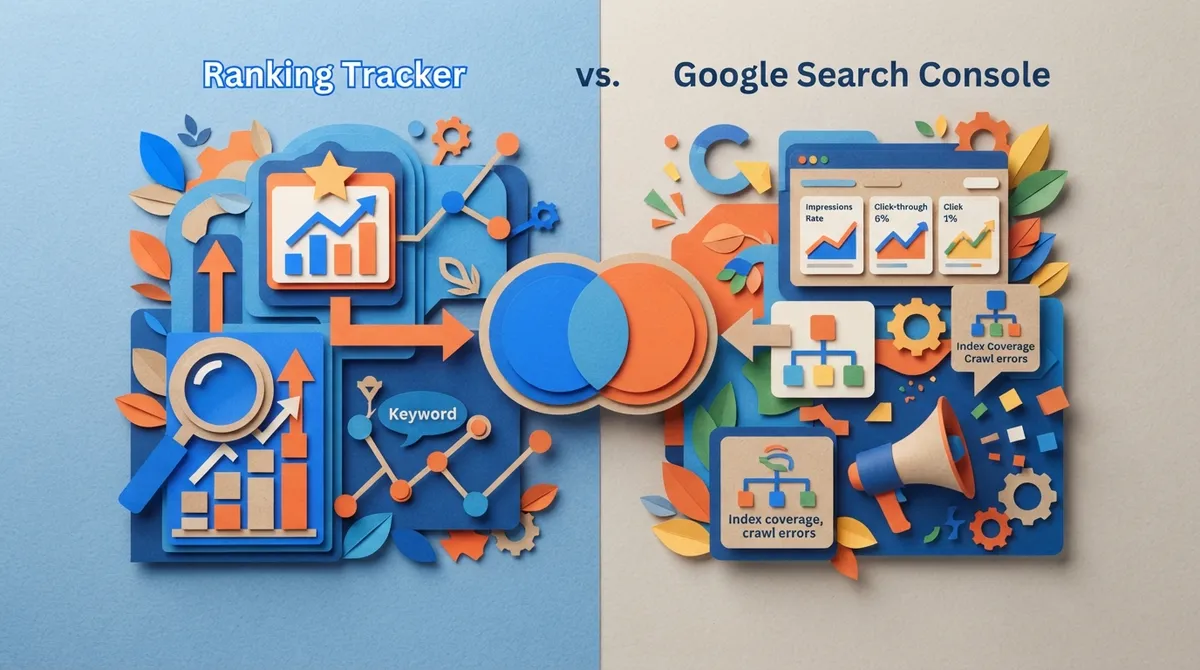
Ranking Tracker vs. Google Search Console: What’s the Difference?
This trips up a lot of people, so let’s clear it up. A rank tracker checks specific keywords in a controlled search setup. It simulates a search and records where you land. Google Search Console, on the other hand, reports real data from actual searches that showed your site in the results.
According to Google’s own documentation, Search Console’s average position metric is based on the topmost position your page occupied for a given impression, then averaged across all those impressions. That means your Search Console position and your rank tracker’s position won’t always match, and that’s completely normal.
Google also rolled out a newer performance view with close to hourly data, delayed by just a few hours in many cases. This means content teams can spot changes much faster than the older reporting cycles allowed, according to Google’s own Search Console documentation.
Why Your Numbers Might Not Match What You See in Google
Ever searched your own keyword and seen a totally different result than your tracker reported? You’re not alone, and you’re definitely not losing your mind. Here’s what causes the mismatch:
- Your location differs from where the tracker is checking
- Your search history and personalization affect your results
- The device you’re using (mobile vs desktop) changes rankings
- SERP layouts vary by time and search volatility
- Different tools use different methodologies for checking rank
The takeaway here is simple: treat ranking position as a trend, not a single perfect number. Look at the direction things are moving, not the exact spot on any given day.
How Ranking Data Should Drive Your Content Decisions
Here’s where things get exciting. Ranking data isn’t just a report card, it’s a to-do list. Once you know how to read it, you can turn it into action every single week.
Use Rankings to Prioritize What to Fix First
Not every page needs attention right away. Focus your energy where it counts most:
- Pages ranking in positions 4 through 20 (these are your “almost there” pages)
- URLs that are declining month over month
- Keywords with lots of impressions but a low click-through rate
- Topics with search demand but no dedicated page yet
This kind of prioritization is exactly what separates teams who guess from teams who grow steadily. It’s also a core part of good search intent optimization practices, since matching content to what searchers actually want is what moves the needle.
Don’t Rely on Rankings Alone
Rankings alone can be misleading. A page might rank well but get almost no clicks. Or it might rank lower but drive real conversions. That’s why a smart workflow blends multiple signals together:
- Ranking position and trend over time
- Organic clicks and impressions from Search Console
- Conversion data (leads, sales, signups)
- Content quality and freshness
- Internal linking strength
- Technical SEO health of the page
When you combine these signals, you stop chasing vanity metrics and start making decisions that actually grow your business.
Tracking AI Search Visibility, Not Just Google Rankings
Here’s something that’s changing fast: search isn’t just about Google’s blue links anymore. AI Overviews, chatbots, and other AI tools are becoming a real source of traffic. Your ranking tracker strategy needs to account for that shift.
A study from seoClarity found that Google AI Overviews appeared for roughly 30% of U.S. desktop keywords as of September 2025. Even more interesting, over 99% of those AI Overview citations came from pages already ranking in the traditional top 10. That means classic SEO and AI visibility are more connected than people think.
But there’s a catch. Data cited from Seer Interactive found that organic click-through rates for queries with AI Overviews dropped from 1.76% to 0.61% between June 2024 and September 2025. That’s a steep decline, so getting cited inside the AI answer itself matters more than ever. If you want to dig deeper into this shift, check out our guide on how to improve your AI search visibility in 2026.
What to Watch Beyond Traditional Rankings
A modern tracking setup should keep an eye on more than just blue-link positions:
- Featured snippets and People Also Ask boxes
- Local pack rankings for location-based searches
- Image and video result placements
- Google AI Overview citations and mentions
- Mentions inside AI chat tools like ChatGPT, Perplexity, Claude, and Gemini
One industry estimate suggests that 40% to 60% of AI Overview cited sources can rotate month to month. That means AI visibility isn’t a one-time fix, it needs regular monitoring, similar to how you’d check traditional rankings on an ongoing basis.
Choosing the Right SEO Ranking Tracker for Your Workflow
With so many tools out there, how do you pick the right one? Here’s a simple table to help you compare what matters most.
| Feature | Why It Matters | What to Look For |
|---|---|---|
| Data freshness | Faster updates mean quicker reactions to drops or gains | Daily or near real-time checks |
| SERP feature coverage | Modern search includes snippets, AI Overviews, and more | Support for AI citations and rich results |
| Local and mobile accuracy | Rankings differ by device and location | Location-specific and device-specific tracking |
| Competitor tracking | Helps you understand your position in the market | Side-by-side competitor comparisons |
| Historical retention | Long-term trends beat single snapshots | At least 6-12 months of history |
| Integrations | Connects ranking data to your content workflow | API, webhook, or CMS integration support |
Steps to Build a Simple, Repeatable Tracking Process
You don’t need to overthink this. Here’s a straightforward process that works for teams of any size:
- List your priority keywords and group them by topic
- Set up scheduled tracking (weekly is fine for most sites)
- Connect your tracker data with Search Console and analytics
- Review declining pages every two weeks
- Flag pages ranking 4-20 for content improvements
- Schedule refreshes or new articles based on what you find
- Repeat the cycle consistently
This is where content automation becomes a game changer. Instead of manually managing spreadsheets, a platform like SEO Rocket connects keyword opportunities directly to a content calendar, so once you spot a gap or a declining page, you can schedule new content or a rewrite without starting from scratch.
How Agencies Can Automate Ranking Reports
If you’re running an agency, manually pulling ranking reports for every client eats up hours you don’t have. Automating this part of your workflow frees up time for strategy instead of spreadsheets.
Here’s what a smart agency setup usually looks like:
- Automated weekly or monthly ranking summaries per client
- Alerts sent automatically when a keyword drops significantly
- Shared dashboards clients can check anytime
- Ranking data tied directly to content production decisions
Agencies managing multiple clients benefit enormously from tools built for scale. SEO Rocket’s Agency plan, for example, supports up to 10 client workspaces and 300 articles a month, all built from keyword research that factors in real search demand and competition. You can see how the whole system fits together on the features page.
Turning Ranking Data Into a Content Engine
The real magic happens when ranking data stops being a static report and starts feeding your content calendar automatically. Instead of staring at a spreadsheet wondering what to write next, you let the data tell you.
Here’s a simple way to think about it:
- Rank tracker flags a keyword slipping out of the top 10
- That page gets scheduled for a content refresh
- New topic gaps discovered through tracking get added to your keyword list
- Those keywords get scheduled into your content calendar
- Fresh articles get written, optimized, and published automatically
- The cycle repeats, creating compounding growth over time
This is the exact workflow that SEO Rocket automates from start to finish. It handles keyword research with live SEO data, plans content around real opportunities, and publishes SEO-optimized articles daily. If you want to see real examples of what this looks like in practice, check out the writing examples page.
For teams that want to go deeper into building a smart topic strategy around this kind of data, our guide on building a topic cluster strategy pairs well with a solid tracking routine.
Common Mistakes to Avoid With Ranking Trackers
Even experienced marketers fall into a few traps with rank tracking. Here’s what to watch out for:
- Checking rankings daily and reacting to normal fluctuations
- Ignoring clicks and conversions in favor of position alone
- Tracking too many low-value keywords and missing the important ones
- Forgetting to document your tracking location and device settings
- Never connecting ranking data back to your content calendar
Avoiding these mistakes keeps your reporting honest and your team focused on what actually moves the business forward. According to Google’s own Search Quality Rater Guidelines, content quality and usefulness remain central to how pages are evaluated, which is a good reminder that rankings should never be chased at the expense of genuinely helpful content.
Wrapping It All Up
An SEO ranking tracker is one of the most valuable tools you can add to your content workflow. It shows you what’s working, what’s slipping, and where the real opportunities are hiding. But the tracker itself is just the start. The real value comes from turning that data into action, whether that’s refreshing a tired page or scheduling a brand new article.
If you’re tired of juggling spreadsheets, disconnected tools, and manual reporting, there’s a simpler way. SEO Rocket combines keyword research, content planning, writing, and publishing into one system that reacts to real performance data. You can explore how it all works together, read our blog for more strategies, or check the Start for $99/month plan to see how affordable consistent, ranking-focused content can be. Ready to put your content on autopilot? Sign up today and see your first automated article in your calendar within minutes.
FAQs
Q: What is an SEO ranking tracker and how does it work?
A: An SEO ranking tracker is a tool that checks your website’s position in search results for keywords you choose. It runs scheduled searches and records your ranking over time, so you can see trends instead of guessing. It’s like a report card for your SEO efforts, but one that updates automatically.
Q: How is a ranking tracker different from Google Search Console?
A: Great question, and one we get a lot! A rank tracker simulates searches in a controlled setup, while Search Console reports real data from actual Google searches. Google averages the topmost position across all impressions, so the two numbers won’t always match, and that’s totally normal.
Q: How often should I check my SEO rankings for content automation?
A: Weekly checks work well for most sites and keep you from overreacting to normal daily fluctuations. If you’re managing a big content calendar, tie your review schedule to your publishing cadence so ranking data directly informs what gets written or refreshed next.
Q: Can a rank tracker monitor Google AI Overviews?
A: Many modern trackers now include AI Overview and citation monitoring alongside traditional rankings. This matters more than ever since AI visibility can shift monthly, so keeping an eye on both together gives you the fullest picture of your search presence.
Q: How do I decide when to refresh content based on ranking data?
A: Look for pages that are declining month over month or stuck in positions 4 through 20. Those are your best candidates for a refresh. Pair that with impressions and click data, and you’ll have a clear, confident answer on where to focus your energy next.