

Key Takeaways
-
GEO is about making your content easy for AI tools to find, understand, and cite in their answers—it builds on SEO basics rather than replacing them, with no special technical requirements needed.
-
Structure content with direct answers near the top, clear headings, short paragraphs, and plain-text facts so AI systems can easily extract and quote your information in generated responses.
-
Include evidence like quotations, statistics, and citations in your content; research shows adding these elements can increase visibility in AI-generated answers by up to 40% in tested scenarios.
-
Measure GEO success by testing 10-20 customer questions on AI search tools regularly and tracking mentions, citations, and referral traffic separately, since AI visibility differs from traditional ranking metrics.
-
Use content automation to handle keyword research, drafting, scheduling, and publishing consistently, then apply human review for accuracy and originality to maintain quality while scaling output.
-
Place key information as readable text rather than in images or scripts, since AI tools may miss important details trapped in visual formats that they cannot directly process.
You have probably noticed it by now. You type a question into Google, and an AI answer shows up before any blue links. Or you ask ChatGPT for a recommendation, and it names a few brands. That shift has people asking a fresh question: what is generative engine optimization, and does it replace SEO?
Good news: you do not need to panic, and you do not need to start over. Generative engine optimization (GEO) is a close cousin of SEO. It is about making your content easy for AI tools to find, understand, and cite. In this friendly guide, we will compare GEO and traditional SEO side by side. You will see where they overlap, where they differ, and how SEO content automation helps you do both without burning out. Whether you run a small agency, manage a company blog, or own a small business, this one is for you.
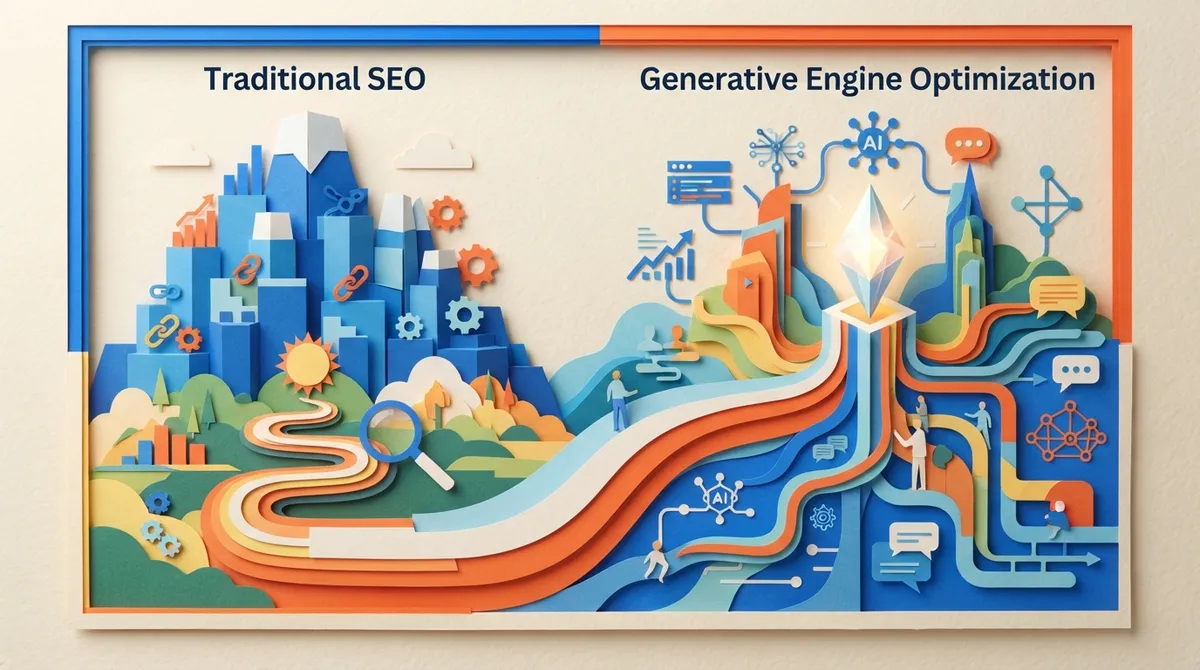
What Is Generative Engine Optimization?
Generative engine optimization is the practice of improving the chance that your content is found, used, cited, or accurately described in answers made by AI search systems. These systems do not just list links. They pull information from many sources and write a single, blended answer.
Think of it like this. Traditional search is a library card catalog that points you to shelves. Generative search is a helpful librarian who reads a few books and tells you the answer. GEO is about making sure your book is one the librarian picks up and quotes.
The term was formalized in a 2024 research paper presented at KDD by Aggarwal and colleagues. In their tests, some content strategies raised visibility in generative engine responses by up to 40% on the study’s benchmark. The authors also noted that results varied by topic area. So it is a promising idea, not a magic switch.
Quick Definition for Busy Readers
GEO is the practice of shaping your content so AI-generated search answers can find it, trust it, and cite it accurately. It sits on top of strong SEO fundamentals instead of replacing them.

GEO vs. Traditional SEO: A Side-by-Side Look
Let us put the two approaches next to each other. The table below shows how they compare on the things that matter most to content teams.
| Factor | Traditional SEO | Generative Engine Optimization |
|---|---|---|
| Main goal | Rank high in a list of links | Be cited or mentioned inside an AI answer |
| Where results appear | Search results pages | AI Overviews, AI Mode, chat assistants |
| Key success signal | Rankings, clicks, traffic | Mentions, citations, accurate representation, referral visits |
| Content style | Keyword-focused, helpful pages | Clear answers, evidence, quotes, and strong structure |
| Technical needs | Crawlable, indexable, fast pages | The same technical basics |
| Measurement | Rank trackers and analytics | Prompt testing plus analytics |
Notice how much overlap there is. That is the heart of the story. GEO is not a separate universe. It is an extension of good SEO.
What Google Says About AI Search and SEO
Here is a comforting fact. Google’s own guidance says its established SEO best practices still apply to AI Overviews and AI Mode. There are no special technical requirements and no special schema needed to be eligible. You can read it yourself in Google’s AI features and your website documentation.
To appear as a supporting link in these features, a page must be indexed and eligible to show with a snippet in Google Search. That means the basics still come first:
- Let search engines crawl your pages.
- Make pages easy to find through internal links.
- Offer a good page experience.
- Publish helpful, reliable, people-first content.
So if someone tells you that you need a secret AI file or a new markup trick, be gently skeptical. Google says you do not.
Where GEO Adds Something New
If the basics are the same, what is new? The difference is in how your content gets used. AI systems break pages into pieces and pull out facts. So pages that are easy to read, easy to quote, and full of real substance tend to be more useful to them.
1. Direct Answers Near the Top
Answer the main question in the first few sentences of a section. Then add details below. This helps both readers and AI tools grab the key point fast.
2. Clear Headings and Structure
Use descriptive headings. Use short paragraphs. Use lists and tables where they make things clearer. Our guide on search intent optimization shows how to match your structure to what people actually want.
3. Evidence, Quotes, and Citations
The GEO research found that adding things like quotations and statistics helped in tested settings. In plain terms: back up your claims. Name your sources. Share real numbers.
4. Text That Machines Can Read
Important facts should live in plain text, not only inside images or scripts. If a key detail is trapped in a picture, an AI tool may never see it.
Why Content Automation and GEO Fit Together
Here is where it gets exciting for busy teams. GEO rewards consistent, well-structured, in-depth content. That is exactly the kind of content that is hard to produce by hand, day after day.
Many people worry that automation means low-quality fluff. That worry is fair. Google’s guidance warns against treating AI features as a reason to drop quality. The goal is to automate the heavy lifting while keeping accuracy, originality, and human review in the loop.
Here is what smart automation can handle for you:
- Keyword research that shows real opportunities based on search volume, competition, and intent.
- Content planning with a calendar so you are never staring at a blank page.
- Drafting long-form articles with a clear structure.
- Optimizing titles, metadata, and links.
- Publishing on a steady schedule.
If you want to go deeper, our post on content automation SEO walks through how to scale without losing quality.
How SEO Rocket Helps You Do Both
This is where SEO Rocket comes in. It is an all-in-one platform that turns SEO blogging into a system instead of a chore. It plans, writes, optimizes, and publishes articles for your site, so you can focus on running your business or serving clients.
It was built with AI search in mind. Articles are long-form by default and structured so both Google and AI tools can understand them. Setup takes under 10 minutes, and you can see the full flow on the how it works page.
Here is how it lines up with GEO best practices:
- Built-in keyword research finds topics worth writing about, using live SEO data.
- An automated content calendar schedules one article per day, so your publishing stays steady.
- Long-form, well-structured drafts give AI systems clear sections to pull from.
- Optimized metadata and internal links help your pages get discovered.
- Direct publishing to WordPress, Webflow, Shopify, and Wix keeps everything moving.
You can also see real samples on the writing examples page. And if you want to learn more about getting featured in AI answers, check out our guide on how to get featured in AI Overviews.
How to Measure GEO Success
Here is a part many people skip. GEO results are not the same as classic rank tracking. You need to look at visibility and traffic as two different things.
Results can vary by question, platform, and even time of day. So test a set of target prompts on a regular schedule and track what you see. Here is a simple way to do it:
- List 10 to 20 questions your customers really ask.
- Run them through AI search tools on a set schedule.
- Note whether your brand or page is mentioned.
- Note whether your page is cited as a source.
- Check if the description of your business is accurate.
- Compare against referral visits and conversions in your analytics.
This gives you a clear picture. A brand mention without a click still builds awareness. A cited page that sends visitors is even better. Our post on improving your AI search visibility has more ideas for tracking progress.
Which Approach Fits Which Audience?
Different readers need different things. Here is a quick guide to how GEO and SEO automation fit your world.
| Who You Are | Your Biggest Need | How GEO + Automation Helps |
|---|---|---|
| Small SEO agency | Scale content across clients | One workflow, many client sites, steady output |
| In-house marketing team | Do more with limited time | Daily publishing without extra headcount |
| Content manager | Consistency across many topics | A calendar that keeps topics organized |
| Consultant | Faster client results | Quick setup and visible, regular progress |
| E-commerce specialist | Lots of pages to support | Fresh blog content that feeds category and product pages |
| Small business owner | Affordable, hands-off SEO | A system that works while you run the shop |
Common GEO Mistakes to Avoid
Since GEO is new, a few myths have popped up. Let us clear them up with kindness.
- Myth: GEO replaces SEO. It does not. Pages still need to be crawled and indexed first.
- Myth: You need special AI markup. Google says no special files or schema are required for its AI features.
- Myth: More AI text equals more visibility. Generic, mass-produced pages can hurt you. Quality still wins.
- Myth: GEO always boosts traffic. Sometimes it mainly boosts brand mentions. Both are useful, but they are not the same.
For more on pitfalls, read our list of blog writer AI mistakes that can quietly hurt your rankings.
A Simple GEO-Ready Content Checklist
Want something you can use today? Run each new article through this short list.
- Does the page answer the main question clearly and early?
- Are headings descriptive and easy to scan?
- Did you include real facts, quotes, or numbers with sources?
- Is key information written as plain text?
- Is the page linked from other pages on your site?
- Does any structured data match what is visible on the page?
- Has a human checked it for accuracy and tone?
That last step matters. Automation does the heavy lifting, but a quick human review keeps your content trustworthy. Google’s Search Quality Rater Guidelines are a helpful read if you want to understand how quality and trust are judged.
Real-World Example: A Local Service Business
Picture a small lawn care company, like All Trusted Lawn Care. Customers ask AI tools things like, “When should I aerate my lawn?” If the company has a clear, well-sourced article that answers that question directly, it has a better chance of being cited. Add steady publishing on related topics, and the site starts to look like a go-to resource.
That is the power of combining GEO thinking with consistent output. One great post helps. A whole library of helpful posts helps far more.
Conclusion: Start Simple, Stay Consistent
So, what is generative engine optimization? It is the friendly next step in SEO, focused on getting your content found and cited inside AI-generated answers. It does not replace the basics. It builds on them with clear structure, solid evidence, and steady, helpful publishing.
The best part is that you do not have to do it all by hand. With the right system, you can plan, write, optimize, and publish every day while keeping quality high. Take a peek at the pricing, or jump right in and sign up for SEO Rocket to put your SEO and GEO on autopilot. You can also keep learning on our blog or follow product updates on the changelog. Your future AI-ready content library starts with one simple step.
FAQs
Q: What is generative engine optimization (GEO)?
A: GEO is the practice of making your content easier for AI search tools to find, understand, and cite in their answers. Think of it as SEO’s helpful partner for the AI era. It builds on good SEO instead of replacing it.
Q: How is GEO different from traditional SEO?
A: Traditional SEO aims to rank your page in a list of links. GEO aims to get your content mentioned or cited inside an AI-written answer. The technical basics are the same, but GEO puts extra focus on clear answers, strong structure, and trustworthy evidence.
Q: Does Google need special schema or files for AI Overviews?
A: Nope! Google says its normal SEO best practices apply to AI Overviews and AI Mode, with no extra technical requirements or special schema. Your pages just need to be indexed and eligible to show with a snippet.
Q: Can content automation support GEO without making low-quality pages?
A: Absolutely, as long as you keep quality front and center. Automate research, drafting, and publishing, then add human review for accuracy and originality. That way you get consistency and trust at the same time.
Q: How do I measure GEO performance?
A: Test a list of target questions on AI search tools and note whether your brand is mentioned or your page is cited. Then compare that to referral visits and conversions in your analytics. Results can change by platform and over time, so check regularly.




