
Key Takeaways
-
Never publish raw AI drafts without human review—always fact-check claims, verify statistics, add your expertise, and ensure E-E-A-T (Experience, Expertise, Authoritativeness, Trustworthiness) standards are met.
-
Start every blog post with real keyword research showing actual search volume and intent, then build a detailed content brief before writing to avoid creating generic filler that ranks poorly.
-
Google allows AI-written content, but penalizes scaled content abuse (many low-value, repetitive pages); 74% of published pages now contain some AI, so blend AI speed with human judgment rather than replacing writers entirely.
-
Implement a formal content governance process covering approved tools, fact-checking responsibility, data privacy, and final approval workflows—only 19% of B2B teams have this in place despite widespread AI use.
-
Track measurable results including organic traffic growth, search rankings, click-through rates, and conversions to validate your AI content strategy; if no movement appears after months, revise keyword strategy or content depth.
-
Automate keyword research, topic generation, and first drafts with AI, but always keep fact-checking, brand voice final approval, and original insights as human-only tasks to maintain quality and competitive advantage.
You know you need to blog. Everyone keeps telling you fresh content brings traffic. But between running your business, answering emails, and putting out daily fires, who has time to write 3,000-word articles every week? This is exactly why so many business owners, marketers, and agencies are turning to AI blog writers. But here’s the thing nobody tells you upfront: just typing a prompt into an AI tool and hitting publish is not a real strategy. It can actually hurt you.
The good news? When you use an AI blog writer the right way, it becomes one of the smartest tools in your business. It saves hours every week, keeps your content calendar full, and helps you show up in Google and AI search results like ChatGPT and Perplexity. In this guide, we will walk through exactly how to use an AI blog writer for your business, step by step, so you get real traffic and real results instead of wasted effort.

What Is an AI Blog Writer, Really?
An AI blog writer is a tool that uses artificial intelligence to help you plan, draft, and optimize blog content. Think of it as a very fast writing assistant. It can research topics, suggest headlines, write full drafts, and even format your post for SEO.
But here’s what’s important to understand: the best AI blog writers do more than just write words. They act as part of a full content system. That means keyword research, content planning, writing, optimizing, and publishing all working together. This is very different from copying and pasting a prompt into a chatbot.
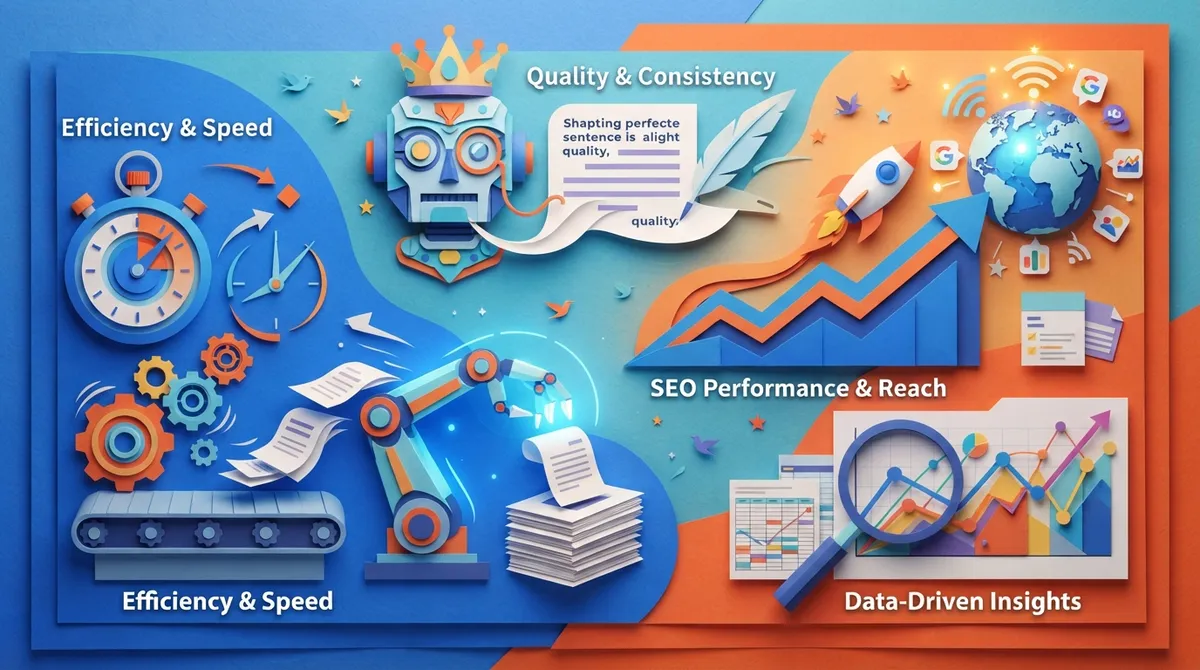
Why Businesses Are Switching to AI-Powered Content in 2026
Content marketing used to mean hiring writers, managing freelancers, or spending your own weekends typing away. That model is expensive and slow. A traditional SEO agency can cost $3,000 to $5,000 a month, and you still have to wait weeks for content to get published.
AI has changed that math completely. According to Duke University’s Fuqua School of Business CMO Survey, generative AI use in marketing activities jumped from 7.0% in spring 2024 to 15.1% in spring 2025. That’s more than double in just one year. Marketing leaders in the same survey expect AI to power over 44% of their marketing work within three years.
Businesses are not just experimenting anymore. They are building AI into their actual content workflow. If you want to stay competitive, understanding how AI blog writing can transform your content strategy is no longer optional.
The Right Way to Use an AI Blog Writer for Your Business
Let’s get practical. Here is a simple process you can follow to use AI content tools without creating low-quality, spammy posts that Google might penalize.
Step 1: Start With Real Keyword Research
Never guess what to write about. Use a tool that shows actual search volume, competition, and search intent. This tells you what your customers are actually typing into Google. Skipping this step is one of the biggest mistakes people make with AI content.
Step 2: Build a Content Brief Before You Write
A good brief tells the AI what to focus on. It should include:
- The target audience and their main questions
- Primary and secondary topics to cover
- The action you want readers to take
- Internal links and credible sources to reference
- Any unique insight only your business can offer
This step is what separates helpful content from generic filler that sounds like every other blog post online.
Step 3: Generate the First Draft
This is where the AI blog writer does its heavy lifting. A quality tool will produce a full draft, often 2,000 to 3,000+ words, structured with headings, lists, and clear sections. It should already follow basic SEO best practices like keyword placement and readable formatting.
Step 4: Fact-Check and Add Your Own Expertise
This step is not optional. AI can get facts wrong or write generic statements. A real person on your team should check every claim, add specific examples, and include opinions or data points that show real experience. This is what search engines call E-E-A-T: Experience, Expertise, Authoritativeness, and Trustworthiness.
Step 5: Optimize On-Page SEO Elements
Check your title tags, meta descriptions, headers, and internal links. Make sure the content answers the searcher’s question clearly and quickly.
Step 6: Human Review Before Publishing
Have someone read through the entire piece. Check for brand voice, tone, and anything that sounds robotic or repetitive. Remove generic phrases that don’t add value.
Step 7: Publish and Monitor Performance
Once it’s live, track how the article performs. Look at organic traffic, click-through rate, rankings, and conversions. This tells you what’s working and what needs improvement.
Does Google Actually Allow AI-Written Blog Posts?
This is probably your biggest worry, and it’s a fair one. Here’s the direct answer: yes, Google allows AI-assisted content. Google’s own guidance states that using AI or automation is not against their rules. What matters is whether the content is helpful, accurate, original, and made for real people.
The real danger is something called scaled content abuse. This happens when a site publishes tons of low-value, repetitive pages with little original substance, whether AI wrote them, a human wrote them, or both. According to Google’s official guidance on generative AI content, the quality bar stays the same no matter who or what created the draft.
A 2025 Ahrefs study looked at about 900,000 pages published in April 2025. It found that 74.2% contained some AI-generated content, with most of that being a human-AI mix rather than pure AI output. This tells us the smartest businesses are already blending AI speed with human judgment, not replacing people entirely.
What Parts of Blogging Should You Automate?
Not everything should be handed over to AI. Here’s a simple breakdown to help you decide what to automate and what needs a human touch.
| Task | Automate With AI | Needs Human Input |
|---|---|---|
| Keyword Research | Yes, AI speeds up data analysis | Review for business relevance |
| Topic Ideas | Yes, generates many options fast | Pick what fits your brand goals |
| First Draft | Yes, saves hours of writing time | Edit for accuracy and voice |
| Fact-Checking | No, AI can make mistakes | Always verify claims and stats |
| Brand Voice | Partial, AI can mimic tone | Final check by a real person |
| Publishing Schedule | Yes, automation keeps it consistent | Approve the content calendar |
Common Mistakes to Avoid
Even smart business owners make these mistakes when they first start using AI blog tools. Watch out for these:
- Publishing raw AI drafts without any editing or fact-checking
- Writing about keywords with zero search demand or intent match
- Ignoring internal linking, which hurts your site’s SEO structure
- Skipping performance tracking, so you never know what’s working
- Using the same generic AI voice across every single post
- Forgetting to add original data, opinions, or case studies
Avoiding these mistakes is covered in more detail in our guide on blog writer AI mistakes that kill your SEO rankings. It’s worth a read before you scale up your content output.
How SEO Rocket Makes This Entire Process Simple
Here’s the honest truth: following all the steps above manually, even with a great AI writing tool, still takes time. You need keyword research, a content calendar, a writing tool, an SEO checker, and a way to publish. That’s a lot of separate tools to manage.
SEO Rocket combines all of it into one system. You connect your website, whether it’s WordPress, Webflow, Shopify, or Wix, and the platform handles keyword discovery, competitor analysis, content planning, and daily publishing automatically. Setup takes less than 10 minutes.
Instead of writing short, thin posts, SEO Rocket generates full 3,000+ word articles built to rank in both Google and AI search engines like ChatGPT, Perplexity, Claude, and Gemini. Each article includes optimized metadata, internal and external links, AI-generated images, and real-time SEO scoring with fix suggestions built right in.
Here’s what makes it different from piecing together your own workflow:
- One article published per day automatically, with no manual work required
- Built specifically for AI search visibility, not just traditional Google rankings
- Costs about $3 per article compared to thousands spent on agencies
- Unlimited team members and unlimited content rewrites included
- Direct publishing straight to your website, no copy-pasting needed
You can explore exactly how the platform works or check out real writing examples to see the quality for yourself. Many agencies and content teams also compare pricing plans on the pricing page before committing.
Building an AI Content Governance Process
If you’re running a team or agency, you need clear rules around AI use. This is called content governance, and it protects your site’s reputation and rankings. A solid process should cover:
- Which AI tools your team is approved to use
- How you handle data privacy and client information
- Who verifies sources and fact-checks every article
- Whether you disclose AI involvement to readers
- Who has final approval before anything gets published
A 2025 Content Marketing Institute benchmark found that only 19% of B2B teams have formal AI governance in place, even though most are already using AI tools. That gap is risky. Setting clear rules now protects you later.
Measuring Whether Your AI Content Strategy Is Working
Publishing content is only half the job. You need to track results to know if your strategy is actually paying off. Focus on these key metrics:
- Organic traffic growth over time
- Search rankings for your target keywords
- Click-through rate from search results
- Conversions and leads generated from blog content
- How many published pages actually drive meaningful traffic
If you’re not seeing movement after a few months, it’s worth revisiting your keyword strategy or content quality. Our guide on generating organic traffic with SEO content automation breaks this down further.
Final Thoughts: Make AI Work For You, Not Against You
Using an AI blog writer for your business isn’t about replacing good judgment with a shortcut. It’s about giving yourself back hours every week while still producing content that genuinely helps your readers. The businesses winning with AI content in 2026 are the ones combining smart automation with real human expertise and oversight.
If you’re ready to stop juggling five different tools and start publishing consistent, optimized content every single day, it might be time to let a complete system handle it for you. You can start for $99 a month and see your content calendar fill up automatically, or simply sign up today and connect your site in under 10 minutes. Either way, your blog doesn’t have to be the thing you never get around to anymore.
FAQs
Q: Can AI-written blog posts actually rank on Google?
A: Yes, they absolutely can! Google cares about whether content is helpful and original, not whether AI helped write it. The key is combining AI drafts with human fact-checking, real expertise, and genuine value for your readers.
Q: How do I use an AI blog writer without creating spammy content?
A: The trick is treating AI as one part of a bigger process, not the whole thing. Do real keyword research, build a clear content brief, add your own insights, and always have a human review before you hit publish.
Q: Should I tell my readers a blog post was written with AI?
A: This depends on your industry and audience, but many businesses choose transparency because it builds trust. What matters most to Google and your readers is that the content is accurate and genuinely useful, disclosed or not.
Q: What should I check before publishing AI-generated content?
A: Always verify facts, statistics, and any claims for accuracy first. Then check that the tone matches your brand voice, add specific examples or data only you can provide, and remove any generic or repetitive language.
Q: How can I measure if my AI content strategy is actually working?
A: Keep an eye on organic traffic, keyword rankings, click-through rates, and conversions over time. If you’re publishing consistently but not seeing growth after a few months, it’s a good sign to revisit your keyword strategy or content depth.