
Key Takeaways
-
Full-stack automation platforms eliminate manual workflow fragmentation by handling keyword research, content creation, optimization, and publishing in one system, costing $99/month versus $300-800+ for stacked point solutions.
-
AI search visibility optimization is now critical in 2026 as ChatGPT, Perplexity, and Gemini become major search channels; most traditional SEO tools ignore this shift while modern automation platforms structure content for AI engine citation.
-
Daily automated publishing builds topical authority faster than manual workflows; full-stack systems generate 3,000+ word articles daily with internal links and metadata, eliminating the consistency gaps of point solutions.
-
Point solutions work best only for large teams with dedicated SEO staff or enterprise technical auditing needs; small agencies, in-house teams, and solo owners see better ROI from full automation.
-
Content optimization tools alone improve writing efficiency by 40-60% but leave critical gaps: no keyword discovery automation, no publishing workflow, no AI search optimization, and no daily consistency without manual effort.
-
At approximately $3 per long-form article, full automation undercuts traditional content agencies charging $3,000-5,000 monthly, making it especially cost-effective for agencies managing multiple client accounts.
If you’ve spent time searching for the right AI search optimization tools in 2026, you already know the market is overwhelming. There are tools for keyword research, tools for content briefs, tools for on-page scoring, and tools for publishing. Each one promises to transform your SEO. But here’s the honest truth: most of them only solve one piece of the puzzle.
The real question isn’t which individual AI SEO tool is best. It’s whether you should stack multiple point solutions together — or invest in a fully automated platform that handles everything from keyword discovery to daily publishing. This comparison breaks it all down so you can make a smart decision for your team, your clients, or your business in 2026.

How the AI Search Optimization Tool Market Looks in 2026
The AI SEO tool landscape has exploded. SE Ranking tested 13 AI SEO tools for their 2026 roundup alone — and that’s just one review site. The category has expanded well beyond traditional Google ranking tools. Modern platforms now target AI-driven search engines like ChatGPT, Perplexity, Claude, Gemini, and Copilot.
Most tools in 2026 fall into four main buckets:
- Keyword and competitor intelligence — Research platforms that show search volume, difficulty, and competitor gaps
- Content optimization tools — Platforms that score your content and suggest improvements based on top-ranking pages
- AI writing accelerators — Tools that draft or rewrite content using large language models
- Technical and enterprise SEO suites — Platforms for audits, crawling, schema, and site health monitoring
Each category solves a real problem. But the challenge is that you typically need tools from all four buckets to run a complete SEO content workflow. That adds up — in both cost and complexity. For a deeper look at how these tools compare in practice, read our blog where we cover the latest SEO content automation strategies.

Point Solutions vs. Full-Stack Automation: The Core Trade-Off
Let’s compare these two approaches side by side so you can see exactly what you’re choosing between.
| Feature | Point Solution Stack | Full-Stack Automation (SEO Rocket) |
|---|---|---|
| Keyword Research | Separate tool required | Built-in with live SEO data |
| Content Briefs | Manual or another tool | Automated and calendar-driven |
| Long-Form Writing | Manual prompting required | 3,000+ word articles generated daily |
| On-Page Optimization | Separate scoring tool needed | Real-time SEO scoring built in |
| Publishing | Copy-paste to CMS manually | Auto-publishes to WordPress, Webflow, Shopify, Wix |
| AI Search Visibility | Rarely addressed | Optimized for ChatGPT, Perplexity, Gemini, and more |
| Monthly Cost | $300–$800+ across tools | From $99/month |
| Setup Time | Hours of configuration | Under 10 minutes |
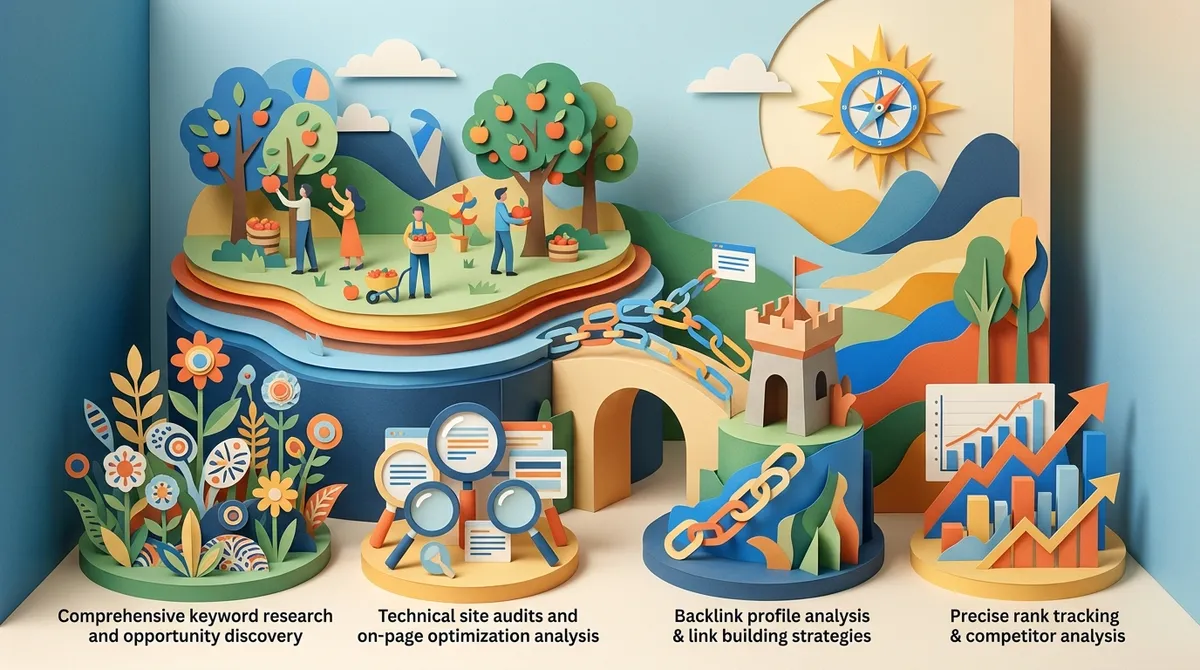
The point solution stack gives you flexibility and deep features in specific areas. But it demands significant time to manage. You’re responsible for connecting the workflow yourself, keeping subscriptions active, and making sure outputs from one tool feed correctly into the next.
What Individual AI SEO Tools Do Well
Let’s be fair. Point solutions earn their reputation for a reason. Here’s where they genuinely shine:
- Deep research platforms are excellent for competitive analysis, backlink audits, and finding high-opportunity keywords with precise volume data
- Content optimization tools are powerful for improving existing pages — scoring topical coverage, readability, and keyword density
- AI writing tools speed up drafting when you already know what to write about
- Technical audit tools help with crawl errors, site speed, schema markup, and indexation issues
Content optimization tools like dedicated scoring platforms are reported to improve writing efficiency by 40–60% compared to fully manual workflows. That’s a meaningful gain. If you have a large team or a very specific use case — like technical SEO for enterprise sites — a point solution might serve you well. You can also explore what content optimization software actually does to understand where it fits in your workflow.

Where Individual AI SEO Tools Fall Short
Here’s where the cracks start to show — especially for small teams, agencies, and business owners who need results without a dedicated SEO team.
- No workflow continuity — Tools don’t talk to each other. You manually move data between keyword tools, brief tools, writing tools, and CMS platforms.
- No publishing automation — Even the best content optimizer still requires you to copy, format, and publish content yourself.
- No daily consistency — Manual workflows mean publishing happens when someone has time, not every single day.
- No AI search optimization — Most tools are built for Google rankings. They don’t structure content to appear in AI Overviews or get cited by ChatGPT and Perplexity.
- High cumulative cost — Stacking tools gets expensive fast. A research platform at $130/month, a content optimizer at $99/month, and a writing tool at $49/month adds up to nearly $280/month before you’ve published a single article.
For a closer look at the hidden costs of stacking tools versus using a single system, check out this breakdown of manual SEO vs. content optimization AI.
What Full-Stack SEO Automation Offers Instead
Full-stack platforms like SEO Rocket take a completely different approach. Instead of giving you tools, they give you a system. The goal is to eliminate the manual work entirely — from the first keyword to the published article.
Here’s how a fully automated SEO content workflow runs:
- Connect your site — Link your WordPress, Webflow, Shopify, or Wix site in under 10 minutes
- Keyword discovery runs automatically — The platform finds real keyword opportunities based on live search data, competition, and intent
- A content calendar fills itself — Approved keywords get scheduled automatically, one article per day
- Long-form articles are generated daily — 3,000+ word, SEO-optimized articles are created and scored automatically
- Content is published directly — No copy-pasting. Articles go live on your site with metadata, images, internal links, and business mentions included
The compounding effect of daily publishing is huge. Consistent output over weeks and months builds topical authority faster than any one-off content push. You can read more about how content automation SEO scales organic traffic to understand why consistency matters so much.
AI Search Visibility: The 2026 Differentiator
This is where the comparison gets especially interesting in 2026. Google is no longer the only game in town. Users are getting answers directly from ChatGPT, Perplexity, Gemini, Claude, and Microsoft Copilot. If your content isn’t structured to be cited by these AI models, you’re invisible to a growing share of searchers.
Most point solutions haven’t caught up with this shift. They optimize for traditional keyword rankings, not for generative engine optimization or answer-engine visibility. Full-stack automation platforms built in 2026 address this directly by structuring content so AI models can parse, trust, and cite it as a source.
To see how this plays out in practice, explore our guide on how to improve your AI search visibility in 2026. Understanding what it takes to show up in AI-generated answers is quickly becoming as important as traditional SEO.
The Search Quality Rater Guidelines also reinforce this shift — content needs to demonstrate real expertise, authority, and trustworthiness to rank in both traditional and AI-powered search environments.
Who Should Use Point Solutions vs. Full Automation
Neither approach is universally wrong. Here’s a quick guide to help you decide:
- Use point solutions if you have a dedicated SEO team, need enterprise-level technical auditing, or are running a very large site with complex crawl needs
- Use full automation if you’re a small agency, in-house marketing team, content manager, consultant, or small business owner who needs consistent SEO output without hiring more people
- Use full automation if you want to publish daily without spending hours on keyword research, briefs, writing, and publishing
- Use full automation if you want visibility in both Google and AI search engines without managing separate workflows
- Use full automation if your monthly content tool budget is under $300 and you need maximum output
For agencies managing multiple clients, the math becomes especially clear. Agency-level SEO automation tools can replace entire content production teams at a fraction of the cost. At around $3 per long-form article, full automation beats traditional content agencies — which often charge $3,000–$5,000 per month — by a massive margin.
Key Features to Look for in Any AI Search Optimization Tool in 2026
Whether you’re evaluating point solutions or full-stack platforms, here are the must-have features for 2026:
- Live keyword data with search volume and competition scoring
- Content optimization with real-time SEO scoring
- Support for AI search visibility — not just Google rankings
- Automated or semi-automated content publishing
- Internal linking suggestions or automation
- Metadata generation including title tags and meta descriptions
- Topical authority building through keyword clustering and content gaps
- Performance tracking to measure ranking improvements over time
Platforms that check all of these boxes in a single dashboard will always outperform a stack of five separate tools when it comes to efficiency. You can explore the full feature set of SEO Rocket to see how these capabilities come together in one system.
To learn more about what makes a great SEO automation tool in 2026, check out the latest updates on the SEO Rocket changelog and see what’s on the product roadmap for upcoming releases.
The Bottom Line: Tools vs. Systems
AI search optimization tools in 2026 are genuinely impressive on their own. Research platforms give you real data. Content optimizers help you write better pages. AI writers speed up the drafting process. But none of them eliminate the work — they just make parts of it faster.
A fully automated system eliminates the work. It replaces the stack, the scheduling, the publishing, and the optimization — all under one roof. For most teams and businesses trying to grow organic traffic without burning out, that’s a fundamentally better model.
If you’re ready to stop juggling tools and start running SEO on autopilot, you can get started with SEO Rocket from just $99/month and have your first articles publishing within 10 minutes. Or if you’d like to explore more before committing, sign up for a free 3-day trial and see exactly what full automation looks like for your site.
FAQs
Q: What are the best AI search optimization tools for SEO content automation in 2026?
A: The best approach in 2026 depends on your team size and workflow. Point solutions like research platforms and content scorers work well for large teams with dedicated SEO staff. For most businesses, agencies, and content managers, a fully automated platform that handles keyword research, writing, optimization, and daily publishing in one place will save far more time and money.
Q: Can I just use ChatGPT instead of dedicated AI SEO tools?
A: ChatGPT is great for drafting ideas and rewriting content, but it doesn’t provide real-time search data like live keyword volume or ranking difficulty. It also can’t publish your content, schedule it, or optimize it with on-page SEO scoring — so it works best as a writing assistant, not a complete SEO solution.
Q: How do AI SEO tools help with AI search visibility in 2026?
A: The best AI search optimization tools in 2026 structure content so that AI engines like ChatGPT, Perplexity, and Gemini can parse and cite it as a trusted source. Full-stack automation platforms like SEO Rocket are built specifically with this in mind, going beyond traditional Google optimization to support generative engine optimization (GEO) as well.
Q: What features should an SEO automation platform include in 2026?
A: Look for live keyword discovery, automated content planning, long-form article generation, real-time SEO scoring, AI search visibility optimization, metadata automation, internal linking, and direct CMS publishing. The best platforms bring all of these into one dashboard so you don’t need to manage multiple tools separately.
Q: Is full SEO content automation really cost-effective compared to individual tools?
A: Absolutely — and the math is surprisingly clear! Stacking a keyword tool, content optimizer, AI writer, and scheduling platform can easily cost $300–$500 per month before you account for your time. A full-stack automation platform can deliver all of that and more for as little as $99/month, with articles costing around $3 each.